

What you'll learn
- Why firms may pursue different objectives, not just profit maximisation.
- How to distinguish profit, revenue, market share, survival, and social/community objectives.
- How stakeholder interests can conflict.
- What satisficing means and why it matters in real-world businesses.
Starting point: what is a business objective?
A firm is a business organisation that produces goods or services. A business objective is a goal the firm is trying to achieve.
Objectives matter because they influence decisions such as:
- what price to charge
- how much output to produce
- whether to expand or cut costs
- how workers, customers and communities are treated
The big idea
Firms do not all behave in the same way. Some aim to maximise profit, but others prioritise sales growth, market share, survival, or social goals — especially when different stakeholders have different priorities.
Profit maximisation
Profit is the difference between total revenue and total cost. Total revenue is the money a firm receives from selling output. Total cost is the full cost of producing that output.
π=TR−TC\pi = TR - TCπ=TR−TCwhere π\piπ means profit, TRTRTR means total revenue, and TCTCTC means total cost.
A firm is said to maximise profit when it chooses the output level where profit is as high as possible.
In A-Level economics, the standard condition for profit maximisation is:
MR=MCMR = MCMR=MCMarginal revenue is the extra revenue gained from selling one more unit. Marginal cost is the extra cost of producing one more unit.
If marginal revenue is greater than marginal cost, producing one more unit adds more to revenue than to cost, so profit rises. If marginal cost is greater than marginal revenue, producing one more unit reduces profit.
A profit-maximising firm expands output until the extra revenue from the last unit equals the extra cost of producing it.
Revenue maximisation
Revenue maximisation means choosing the output level where total revenue is as high as possible, even if profit is not maximised.
Total revenue is:
TR=P×QTR = P \times QTR=P×Qwhere PPP is price and QQQ is quantity sold.
Revenue is maximised where:
MR=0MR = 0MR=0This is because marginal revenue measures the change in total revenue. When MR=0MR = 0MR=0, selling one more unit adds nothing to total revenue.
On a cost-revenue diagram, profit maximisation usually occurs at a lower output and higher price than revenue maximisation.
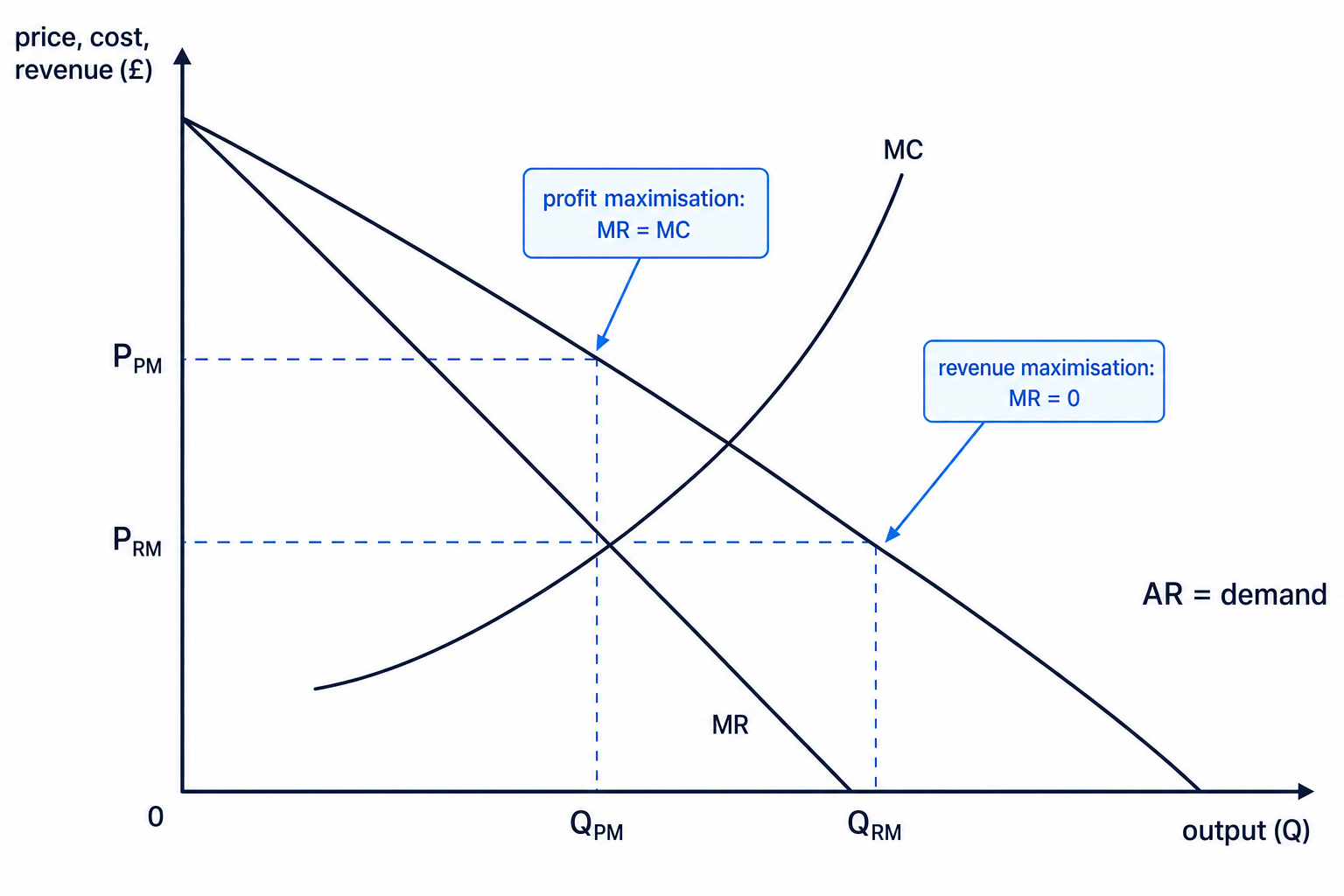
Revenue maximisation may be attractive if managers are rewarded for sales growth, if the firm wants to deter new competitors, or if it wants to build brand recognition quickly.
Comparing profit and revenue
A firm is choosing between two pricing strategies.
-
Under Strategy A, it sells 1,000 units at £8 each, so total revenue is TR=8×1000=£8,000TR = 8 \times 1000 = £8{,}000TR=8×1000=£8,000. Total cost is £5,900, so profit is π=8000−5900=£2,100\pi = 8000 - 5900 = £2{,}100π=8000−5900=£2,100.
-
Under Strategy B, it cuts the price to £6 and sells 1,500 units, so total revenue is TR=6×1500=£9,000TR = 6 \times 1500 = £9{,}000TR=6×1500=£9,000. Total cost rises to £7,400, so profit is π=9000−7400=£1,600\pi = 9000 - 7400 = £1{,}600π=9000−7400=£1,600.
-
Strategy B gives higher revenue, £9,000 compared with £8,000, but lower profit, £1,600 compared with £2,100. So a revenue-maximising decision may conflict with profit maximisation.
Revenue is not profit
Higher sales revenue does not automatically mean higher profit. If extra sales require large discounts, higher wages, more advertising or higher delivery costs, profit may fall.
Market share maximisation
Market share is the percentage of total market sales controlled by one firm.
Market share=firm’s salestotal market sales×100\text{Market share} = \frac{\text{firm's sales}}{\text{total market sales}} \times 100Market share=total market salesfirm’s sales×100A firm pursuing market share maximisation wants to increase its share of the market relative to competitors.
This can be done through:
- lower prices
- heavy advertising
- loyalty schemes
- product innovation
- mergers and takeovers
- expanding into new regions or online platforms
This objective is common in competitive or fast-growing markets. For example, supermarkets, streaming platforms and food delivery firms may accept lower short-run profit to gain customers and make it harder for rivals to compete.
Calculating market share
A firm has annual sales of £42 million in a market worth £300 million.
-
Use the market share formula: Market share=42300×100\text{Market share} = \frac{42}{300} \times 100Market share=30042×100.
-
Calculate the fraction of the market controlled by the firm: 42300=0.14\frac{42}{300} = 0.1430042=0.14.
-
Convert to a percentage: 0.14×100=14%0.14 \times 100 = 14\%0.14×100=14%. The firm has a market share of 14%.
Percentage points
If market share rises from 14% to 18%, say it has increased by 4 percentage points, not “4%”. A rise from 14% to 18% is a larger percentage increase than that.
Survival
Survival means the firm’s main objective is to stay in business.
This is especially likely for:
- start-ups facing high initial costs
- firms in recession-hit industries
- businesses facing rising costs, such as energy or rent
- firms under pressure from new competitors
- shops and restaurants during a cost-of-living squeeze
A survival objective may involve accepting low profit or even temporary losses. The key aim is to maintain cash flow, keep customers, and avoid closure.
Deciding whether to keep trading
A café earns monthly revenue of £18,000. Its variable costs, such as food ingredients and hourly wages, are £14,000. Its fixed costs, such as rent and insurance, are £6,000 and must be paid even if it closes temporarily.
-
If the café stays open, total cost is £20,000, so profit is π=18000−20000=−£2,000\pi = 18000 - 20000 = -£2{,}000π=18000−20000=−£2,000. It makes a £2,000 loss.
-
If the café closes for the month, revenue is £0 and variable costs fall to £0, but fixed costs of £6,000 remain. The loss would be £6,000.
-
Staying open is better in the short run because revenue covers all variable costs and contributes £4,000 towards fixed costs. A survival-focused firm may keep trading while trying to renegotiate rent, raise prices or boost demand.
Social and community objectives
Some firms pursue social and community objectives, meaning they aim to create benefits beyond profit for owners.
These objectives may include:
- reducing pollution or carbon emissions
- paying workers fairly
- supporting local suppliers
- donating to community projects
- improving customer wellbeing
- avoiding harmful or exploitative products
This is linked to corporate social responsibility, often shortened to CSR, where firms consider the impact of their actions on society and the environment.
Social enterprises, co-operatives and some family businesses may place these aims near the centre of their decision-making. However, large profit-seeking firms may also use social objectives to strengthen brand reputation and customer loyalty.
Evaluating a social objective
A supermarket considers switching to local suppliers. This would raise unit costs but reduce food miles and support farms in the local area.
-
The private cost to the firm rises because local suppliers may charge more than large national wholesalers. If prices stay the same, profit margins fall.
-
The firm may gain benefits through stronger brand reputation, more loyal customers and lower supply-chain risk, especially if shoppers value local produce.
-
The final impact depends on the market. During a cost-of-living squeeze, consumers may be more price-sensitive, so the supermarket could lose market share if prices rise too much.
Stakeholders and their objectives
A stakeholder is any individual or group affected by the decisions of a firm.
Different stakeholders often want different things:
- Shareholders or owners usually want profit, dividends and a rising value of the business.
- Managers may want growth, higher sales, job security, bonuses or prestige.
- Workers want secure employment, good wages and safe working conditions.
- Customers want low prices, quality products and reliable service.
- Suppliers want regular orders and prompt payment.
- Lenders want the firm to repay loans on time.
- Government wants tax revenue, employment and legal compliance.
- Local communities may want jobs, low pollution and support for the area.
This creates potential conflict. A decision that benefits one stakeholder may harm another.
Analysing stakeholder conflict
A manufacturer wants to reduce costs by moving production from the UK to a lower-cost country.
-
Shareholders may benefit if lower labour costs increase profit and dividends.
-
UK workers may lose jobs or face weaker bargaining power, so their interests conflict with the owners’ objective.
-
Customers may benefit if lower costs lead to lower prices, but the local community may lose income and employment. A strong answer weighs these effects rather than assuming the decision is simply “good” or “bad”.
Satisficing
Satisficing means aiming for a satisfactory outcome rather than the maximum possible outcome.
Satisficing
Satisficing occurs when a firm accepts a target that is “good enough”, such as a minimum profit level, rather than trying to maximise profit, revenue or growth.
This idea is associated with Herbert Simon, who argued that decision-makers often face bounded rationality. This means they have limited information, limited time and limited ability to process every possible option.
Satisficing is especially likely when:
- managers do not own the firm
- shareholders cannot monitor every decision
- different stakeholders must be kept reasonably happy
- the business environment is uncertain
- the firm has several objectives at once
This links to the principal-agent problem. The principal is the owner or shareholder. The agent is the manager acting on their behalf. The problem is that managers may pursue their own objectives, such as growth or job security, rather than maximum shareholder profit.
Identifying satisficing
A retail chain sets a target profit margin of 8%. Once this is achieved, managers focus on opening new stores to increase brand presence.
-
The firm is not necessarily maximising profit because 8% is a target threshold, not proof that profit is as high as possible.
-
Managers may prefer expansion because it increases their status, pay and control over resources, even if shareholders might prefer higher short-run dividends.
-
This is satisficing because the firm accepts a satisfactory profit level while pursuing another objective, such as market share or growth.
Why objectives change over time
Business objectives are not fixed forever. They can change depending on context.
A new business may focus on survival. A growing firm may prioritise market share. A mature firm with strong brand loyalty may focus more on profit. A firm facing public criticism may increase its social and community objectives.
Market structure also matters. In highly competitive markets, firms may have to focus on survival and cost control. In oligopoly markets, where a few large firms dominate, market share and revenue growth may be especially important. A monopoly may have more ability to focus on profit, although regulation and public pressure can limit this.
Evaluation point
The best objective for a firm depends on ownership, stakeholder power, market conditions, time period and the wider economy. Strong answers avoid claiming that all firms simply maximise profit all the time.
In the exam
-
Define the objective clearly, then explain how it affects decisions on price, output, costs or investment.
-
Apply your answer to the type of firm: start-up, large PLC, social enterprise, monopoly, oligopoly, or firm under cost pressure.
-
Evaluate by considering stakeholder conflict, short run versus long run, and whether the firm may be satisficing rather than maximising one objective.
Check yourself
- Why might a firm choose revenue maximisation even if it reduces profit?
- How can the objectives of shareholders and workers conflict?
- What does satisficing mean, and why might it happen in a large firm?
