What you'll learn
- How economists classify markets using the number of firms and contestability.
- Why entry and exit barriers affect prices, profits, innovation and consumer choice.
- How to distinguish structural barriers from behavioural barriers such as limit pricing.
- How regulators such as the CMA, Ofcom and Ofgem can affect market contestability.
Why market structure matters
Before you study perfect competition, monopoly, monopolistic competition and oligopoly in detail, you need the “background” question: what makes one market behave differently from another?
A coffee cart market, the UK supermarket sector, and the rail network all involve buyers and sellers. But firms in these markets face very different levels of competition, freedom to enter, and ability to influence price.
Market structure
A market structure is the set of characteristics that describes how competitive a market is, especially the number of firms, the size of firms, the degree of product differentiation, and how easily firms can enter or exit the market.
A market is any arrangement where buyers and sellers exchange a good or service. A firm is a business that produces goods or services. An incumbent is a firm already in the market, while an entrant is a firm trying to enter.
The two key dimensions
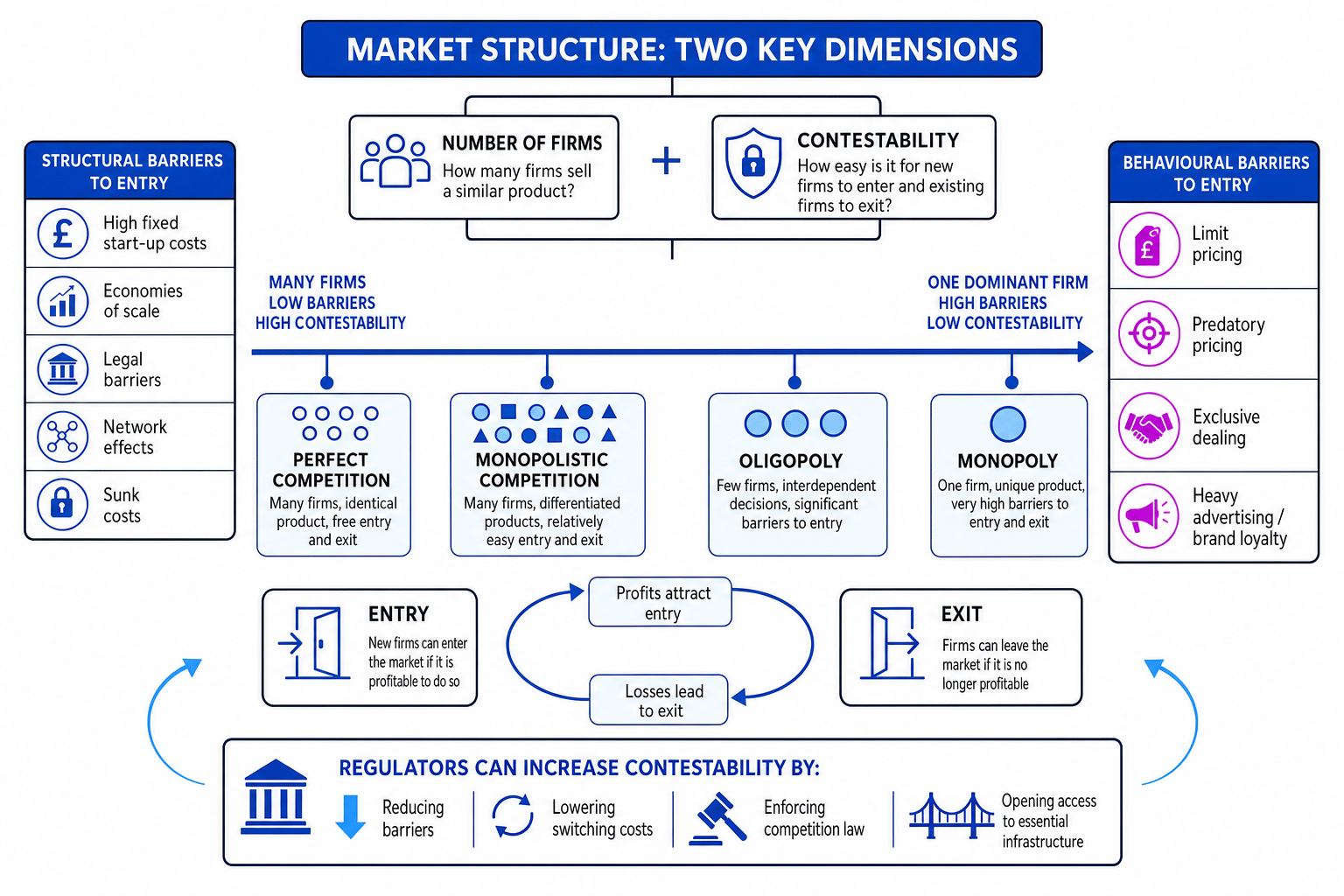
For this specification point, focus on two core questions:
- How many firms are in the market?
- How freely can firms enter and exit the market?
The second question is about contestability, which is often just as important as the first.
Number of firms
The number of firms gives you an initial clue about how competitive a market might be.
- Many small firms usually means each firm has little control over price.
- A few large firms suggests interdependence: firms must consider how rivals will react.
- One dominant firm may have substantial market power.
Market power
Market power is the ability of a firm to influence the price, output, or quality of a good or service, rather than simply accepting the market price.
A useful measure is the concentration ratio, which shows the percentage of total market sales controlled by the largest firms. For example, a four-firm concentration ratio measures the combined market share of the four largest firms.
Interpreting market concentration
Suppose the five largest firms in a market have these market shares: Firm A 32%, Firm B 25%, Firm C 18%, Firm D 10%, and all other firms together 15%.
-
Identify the four largest firms: A, B, C and D.
-
Add their market shares: CR4=32%+25%+18%+10%=85%CR_4 = 32\% + 25\% + 18\% + 10\% = 85\%CR4=32%+25%+18%+10%=85%.
-
Interpret the result: a four-firm concentration ratio of 85% suggests the market is highly concentrated, so it may be an oligopoly.
-
Qualify the conclusion: high concentration alone does not prove firms have strong market power. You also need to consider barriers to entry and how contestable the market is.
Counting firms only
Do not judge market structure only by the number of firms. A market with one dominant firm can still face competitive pressure if new firms can enter easily.
Contestability
A market can be competitive even when there are only a few actual firms if there is a strong threat of potential competition.
Contestability
Contestability is the ease with which new firms can enter a market and existing firms can exit. A highly contestable market has low barriers to entry, low barriers to exit, and credible potential competition.
The theory of contestable markets, associated with Baumol, Panzar and Willig, argues that the threat of entry can discipline incumbent firms. If incumbents raise prices too far above costs, new firms may enter, undercut them, and take profit.
A perfectly contestable market is a theoretical benchmark where entry and exit are completely free, firms have access to the same technology, and there are no sunk costs. Real markets are rarely perfectly contestable, but the idea is useful for analysis.
Potential competition matters
A firm does not need many current rivals to feel competitive pressure. If entry is easy, the threat of new entrants can limit prices and profits.
Judging contestability in broadband
Imagine a local broadband market where two providers currently dominate.
-
Start with the number of firms: two large providers suggest limited actual competition, so there may be market power.
-
Assess entry costs: if a new firm must build its own cables and street infrastructure, entry is expensive and slow, reducing contestability.
-
Assess exit conditions: if much of the spending on cables cannot be recovered, those are sunk costs, making potential entrants more cautious.
-
Consider regulation: if Ofcom requires access to existing infrastructure on fair terms, entrants may not need to build a full network, increasing contestability.
-
Reach a balanced judgement: the market may still be concentrated, but regulation can make it more contestable than the number of firms alone suggests.
Entry, exit and profits
Entry means a firm begins supplying a market. Exit means a firm stops supplying a market.
When entry is easy, high profits attract new firms. This tends to increase supply, increase consumer choice, and reduce profit margins. When exit is easy, firms are more willing to risk entering because they know they can leave if the market becomes unprofitable.
Normal and supernormal profit
Normal profit is the minimum return needed to keep a firm’s resources in their current use. Supernormal profit is profit above normal profit.
In a highly contestable market, persistent supernormal profit is difficult to maintain because it attracts entrants. In a less contestable market, incumbents may protect supernormal profit for longer.
Barriers to entry and exit
Barriers to entry and exit
A barrier to entry is anything that makes it difficult or costly for new firms to enter a market. A barrier to exit is anything that makes it difficult or costly for firms to leave a market.
Barriers matter because they affect the freedom of movement in and out of markets. If barriers are high, incumbents face less threat from entrants and may have more market power.
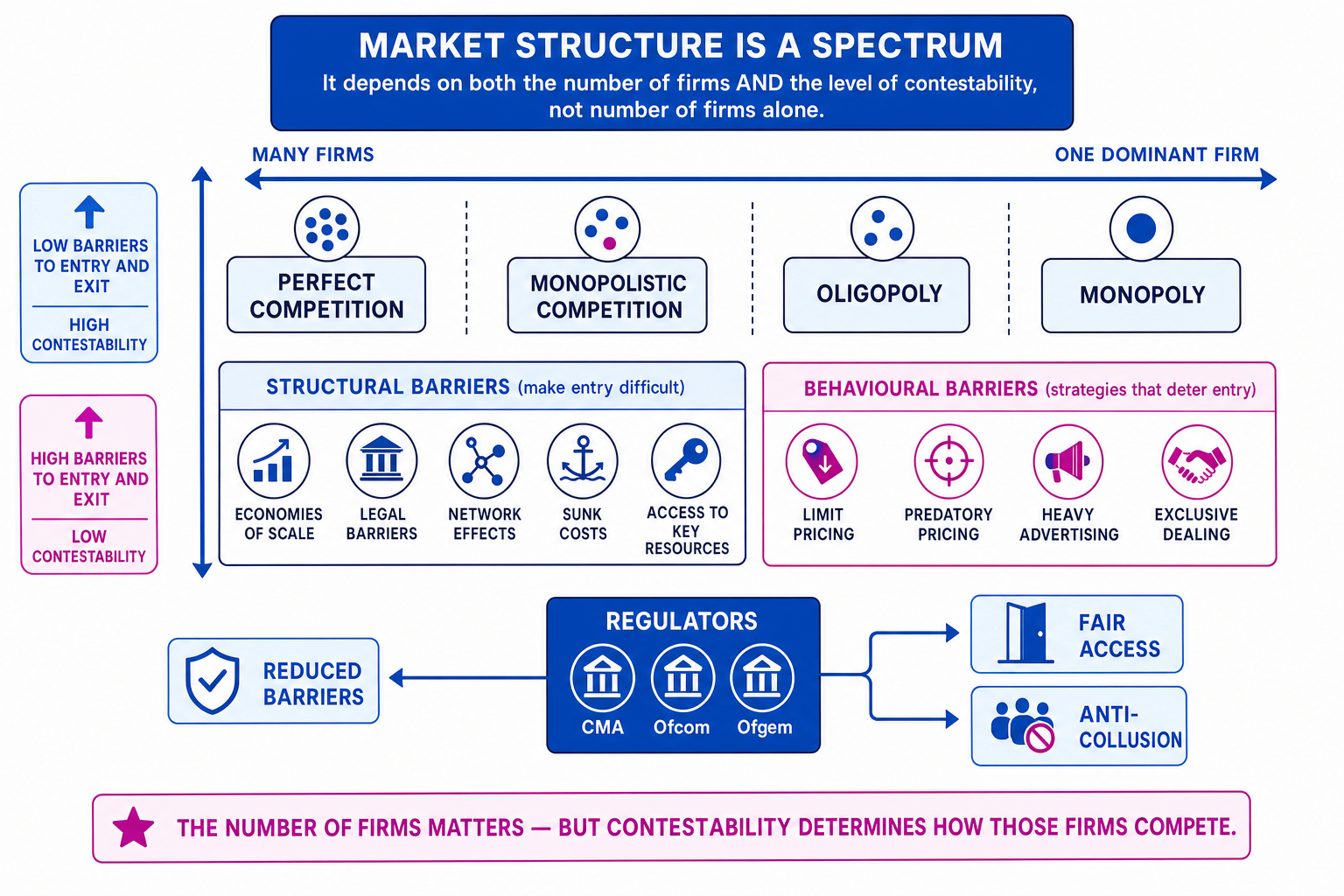
Structural barriers to entry
A structural barrier to entry comes from the nature of the market itself, rather than from deliberate actions by existing firms.
Common structural barriers include:
- High start-up costs: for example, building rail infrastructure, power stations, or a national telecoms network.
- Economies of scale: large firms may have lower average costs because they produce on a much bigger scale.
- Legal barriers: patents, licences, planning rules, safety approvals or exclusive legal rights.
- Network effects: a product becomes more valuable as more people use it, making it hard for new platforms to attract users.
- Access to key resources: an incumbent may control essential inputs, locations, data or distribution channels.
- Sunk costs: costs that cannot be recovered if the firm exits.
Sunk cost
A sunk cost is a cost that has already been paid and cannot be recovered, such as specialised advertising spending or custom-built equipment with little resale value.
Fixed cost is not always sunk
A fixed cost becomes a barrier to exit mainly when it is unrecoverable. A delivery van may be a fixed cost, but if it can be resold, it is less of a sunk cost than a highly specialised machine.
Behavioural barriers to entry
A behavioural barrier to entry is created by the deliberate actions of incumbent firms. These are also called strategic barriers.
Common behavioural barriers include:
- Limit pricing: setting price low enough to discourage entry.
- Predatory pricing: temporarily pricing below cost to drive out or deter rivals.
- Heavy advertising: building brand loyalty so entrants struggle to attract customers.
- Exclusive dealing: agreements that restrict suppliers or retailers from working with entrants.
- Product proliferation: launching many similar product varieties to occupy market niches.
Structural versus behavioural barriers
High start-up costs are usually a structural barrier because they come from the nature of production. Limit pricing is a behavioural barrier because it is a deliberate strategy by an incumbent firm.
Testing for limit pricing
An incumbent firm has average costs of £6 per unit. A potential entrant would have average costs of £9 per unit because it cannot yet produce at large scale. The incumbent sets the market price at £8.
-
Compare the entrant’s cost with the price: at £8, the entrant would make a loss of £1 per unit because its average cost is £9.
-
Compare the incumbent’s cost with the price: at £8, the incumbent still makes £2 profit per unit because its average cost is £6.
-
Identify the strategy: the incumbent may be sacrificing a higher short-run price to make entry unattractive, so this is likely to be limit pricing.
-
Classify the barrier: because the low price is a deliberate action by the incumbent, it is a behavioural barrier to entry.
Regulators and contestability
A regulator is a public body that oversees firms in a market. In the UK, examples include:
- Competition and Markets Authority (CMA): competition law, mergers, cartels and abuse of market power.
- Ofcom: communications, broadband and broadcasting.
- Ofgem: gas and electricity markets.
- FCA: financial services.
Regulators can increase contestability by reducing entry barriers or limiting anti-competitive behaviour. For example, they may:
- block mergers that would create excessive concentration;
- fine firms for collusion or abuse of dominance;
- force access to essential infrastructure on fair terms;
- reduce switching costs for consumers;
- require clearer price information;
- remove unnecessary licensing restrictions.
However, regulation can also reduce contestability if it creates high compliance costs, complex licensing rules, or price controls that make entry less profitable.
Regulators increasing contestability
Consider a broadband market where the main barrier is the cost of building a national network.
-
Identify the structural barrier: duplicating cables, exchanges and street infrastructure would require very high start-up costs.
-
Apply the regulatory action: Ofcom can require the owner of key infrastructure to provide wholesale access to rival firms on fair terms.
-
Trace the effect on entrants: new providers can compete using existing infrastructure, so they face lower entry costs and can enter more quickly.
-
Evaluate the limit: contestability may still be restricted by brand loyalty, marketing costs, customer switching difficulties and the quality of wholesale access.
Linking this to the main market structures
The four main market structures are best seen as a spectrum, not as isolated boxes.
| Market structure | Typical number of firms | Entry and exit | Contestability clue |
|---|---|---|---|
| Perfect competition | Very many | Free entry and exit | Very high contestability |
| Monopolistic competition | Many | Relatively easy entry and exit | Product differentiation limits direct competition |
| Oligopoly | Few large firms | Significant barriers likely | Contestability varies by sector |
| Monopoly | One dominant firm | High barriers likely | May still face threat if entry is possible |
Perfect competition and monopoly are often used as theoretical benchmarks. Real-world markets usually sit somewhere between them.
Structure affects conduct
In essays, connect market structure to firm behaviour: if barriers are high, firms may have more pricing power; if contestability is high, even dominant firms may keep prices lower to deter entry.
Evaluation points to remember
A strong answer avoids treating market structure as fixed or obvious.
First, market definition matters. A firm may look powerful in a local market but much less powerful in a national market. For example, a local supermarket may dominate a village, but not the whole UK grocery market.
Second, contestability can change over time. Digital platforms, comparison websites and app-based entry can lower some barriers, while network effects and data advantages can raise others.
Third, regulation involves trade-offs. Patents reduce contestability in the short run, but they may encourage innovation by protecting returns to research and development. Safety licensing may restrict entry, but it can protect consumers.
Finally, behavioural barriers are sometimes hard to prove. Predatory pricing, for instance, may look similar to normal competitive price-cutting unless there is evidence that the firm is deliberately trying to exclude rivals.
In the exam
-
Start by identifying both dimensions: the number of firms and the ease of entry and exit.
-
Use precise barrier language: say whether a barrier is structural or behavioural, and explain why.
-
Evaluate with context: ask whether regulation, technology, sunk costs or market definition changes the degree of contestability.
Check yourself
- Why might a monopoly still behave competitively if a market is highly contestable?
- What is the difference between high start-up costs and limit pricing?
- How can a regulator increase contestability without directly setting prices?