With reference to Figure 2 and Extract A, explain two likely reasons why the growth of Sweden's real GDP per capita at PPPs was slower than that of Finland after 2016.
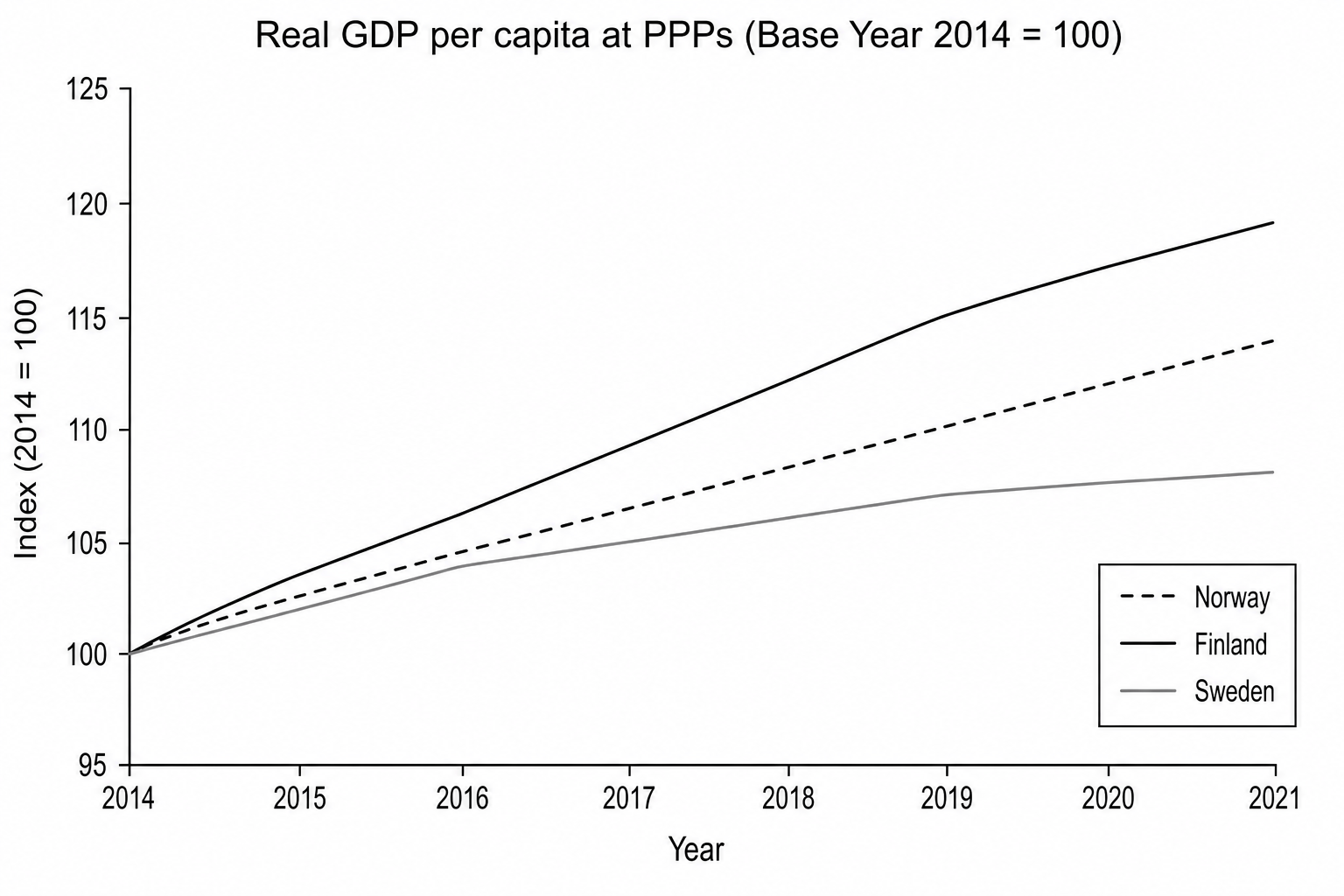
| Year | Norway (Dashed) | Finland (Solid Black) | Sweden (Solid Grey) |
|---|---|---|---|
| 2014 | 100 | 100 | 100 |
| 2015 | 102 | 103 | 102 |
| 2016 | 104 | 106 | 104 |
| 2017 | 107 | 110 | 105 |
| 2018 | 109 | 113 | 106 |
| 2019 | 111 | 116 | 107 |
| 2020 | 112 | 117 | 107.5 |
| 2021 | 114 | 119 | 108 |
In late 2020, the Ministry of Finance reported that while Sweden's aggregate GDP growth had shown a moderate post-recession recovery, deep structural bottlenecks continued to limit long-term expansion.
While overall GDP has expanded on paper, performance measured per capita has been remarkably sluggish. Although the domestic unemployment rate reached historic lows, business productivity improvements and private capital investment have stagnated.
Several macroeconomic imbalances persist. The trade balance surplus has steadily diminished, driven by a structural decline in national resource competitiveness and exceptionally weak growth in non-traditional high-tech exports. In 2016, the government set an ambitious national strategy to increase green technology and specialized service exports by 7% per annum. However, actual growth in these sectors has averaged only 2.4% annually. Furthermore, the specialized manufacturing sector in southern Sweden has struggled, with total factory output remaining 4.8% below its pre-2015 peak.
Additionally, high levels of domestic household debt remain a core risk. Driven by skyrocketing housing costs in major metropolitan regions, the household debt-to-income ratio is projected to rise by another 22 percentage points over the medium term. This high debt burden threatens to drag down future private consumption.
Crucial to Sweden’s slower growth trajectory is its persistent productivity gap. In 2020, Sweden’s average labour productivity was nearly 12 percentage points below that of other advanced Nordic economies such as Finland. Overcoming this stagnation will require concerted policy action: lowering inter-regional regulatory barriers, restructuring capital depreciation tax credits to incentivize business R&D, and establishing advanced vocational retraining schemes in software engineering and modern manufacturing.

