

In A-Level Chemistry, practical skills are not just assessed in the lab for your Practical Endorsement (PAGs); they are heavily tested in your written exam papers. Understanding the "how" and the "why" behind every apparatus setup, measurement, and purification method is key to scoring top marks in these questions.
What you'll learn
- How to accurately measure physical quantities and prepare standard solutions.
- The fundamental setups for organic synthesis, including heating under reflux and distillation.
- Essential purification methods for both solid and liquid products.
- How to measure pH, chromatographic separation, and reaction rates using different experimental techniques.
1. Fundamental Measurements and Safety
Accurate quantitative data is the backbone of experimental chemistry. You must know which tool is appropriate for recording specific physical quantities and how to use them safely.
Measuring Mass, Volume, Temperature, and Time
- Mass: Measured using a 2-decimal or 3-decimal place digital analytical balance. Always tared (zeroed) with the weighing boat on the pan before adding chemical reagents.
- Volume:
- For approximate volumes: Use a graduated measuring cylinder.
- For highly accurate fixed volumes: Use a volumetric pipette (e.g., 25.0 cm325.0\text{ cm}^325.0 cm3, which has a typical uncertainty of ±0.06 cm3\pm 0.06\text{ cm}^3±0.06 cm3).
- For variable added volumes: Use a burette (readings must always be recorded to two decimal places, with the second decimal place being a 000 or a 555).
- Temperature: Measured using a thermometer or a digital temperature probe. Always read the scale at eye level to avoid parallax error.
- Time: Measured using a digital stopwatch, usually to the nearest second or tenth of a second depending on the rate of reaction.
Percentage Uncertainty
The percentage uncertainty quantifies the potential error in a measurement relative to the size of the measurement itself. It is calculated using the formula:
% uncertainty=Uncertainty of apparatus×Number of readingsValue measured×100 \% \text{ uncertainty} = \frac{\text{Uncertainty of apparatus} \times \text{Number of readings}}{\text{Value measured}} \times 100 % uncertainty=Value measuredUncertainty of apparatus×Number of readings×100Number of Readings
Remember that when using a balance or a burette, you make two readings (initial and final mass, or initial and final volume). Therefore, the absolute uncertainty of the apparatus must be multiplied by 2 when calculating the percentage uncertainty of a single delivered mass or volume.
Safe Heating Methods
Direct heating with a Bunsen burner is not always safe. The choice of heating source depends on the physical properties of the chemicals involved:
- Water baths: Ideal for heating flammable substances or reaction mixtures below 100∘C100^\circ\text{C}100∘C without an open flame.
- Electric heating mantles: Essential for heating flammable organic solvents above 100∘C100^\circ\text{C}100∘C safely, as they eliminate the risk of igniting vapours.
- Sand baths: Provide even, high-temperature heating up to several hundred degrees Celsius.
Safe Handling of Chemicals
You must be able to recognise hazards and suggest appropriate safety precautions:
- Corrosive / Irritant substances (e.g., concentrated acids or alkalis): Wear safety goggles and chemical-resistant gloves.
- Toxic substances (e.g., chlorine gas, volatile halogenoalkanes): Handle inside a fully functioning fume cupboard to avoid inhalation of toxic vapours.
- Flammable substances (e.g., ethanol, propanone): Ensure there are no naked flames in the laboratory; use water baths or electric heaters.
2. Quantitative Techniques: Standard Solutions and Titrations
A key quantitative skill is the preparation of a standard solution followed by its analysis via titration.
Standard Solution
A standard solution is a solution of precisely known concentration.
Making Up a Standard Solution
To prepare a 250.0 cm3250.0\text{ cm}^3250.0 cm3 standard solution from a solid acid or anhydrous salt:
- Weigh the solid sample in a weighing boat using a balance.
- Transfer the solid to a clean beaker. Re-weigh the weighing boat to determine the precise mass of solid transferred (this is called weighing by difference).
- Add deionised water to the beaker and stir with a glass rod until the solid has dissolved completely.
- Transfer the solution quantitatively into a 250.0 cm3250.0\text{ cm}^3250.0 cm3 volumetric flask using a clean funnel.
- Rinse the beaker, glass rod, and funnel with deionised water, adding all washings directly into the volumetric flask to ensure no solute is lost.
- Add deionised water dropwise using a teat pipette until the bottom of the meniscus is exactly aligned with the graduation mark on the neck of the flask at eye level.
- Stopper the flask and invert it at least 10 times to ensure thorough mixing and a uniform concentration.
Preparing a Standard Solution and Dilution
A student is asked to prepare a 250.0 cm3250.0\text{ cm}^3250.0 cm3 standard solution of sodium carbonate, Na2CO3\text{Na}_2\text{CO}_3Na2CO3, with a concentration of 0.100 mol dm−30.100\text{ mol dm}^{-3}0.100 mol dm−3. They then pipette 25.0 cm325.0\text{ cm}^325.0 cm3 of this solution into another 250.0 cm3250.0\text{ cm}^3250.0 cm3 volumetric flask and dilute it to the mark with deionised water.
Calculate the mass of solid Na2CO3\text{Na}_2\text{CO}_3Na2CO3 needed to prepare the original solution, and calculate the concentration of the final diluted solution. (Molar mass M(Na2CO3)=106.0 g mol−1M(\text{Na}_2\text{CO}_3) = 106.0\text{ g mol}^{-1}M(Na2CO3)=106.0 g mol−1).
- Calculate the amount of substance (in moles) of Na2CO3\text{Na}_2\text{CO}_3Na2CO3 needed for the initial 250.0 cm3250.0\text{ cm}^3250.0 cm3 solution by converting volume to dm3\text{dm}^3dm3 and using n=c×Vn = c \times Vn=c×V:
- Determine the mass of solid required by multiplying the calculated moles by the molar mass:
- Calculate the final concentration after dilution using the conservation of moles during dilution (c1V1=c2V2c_1 V_1 = c_2 V_2c1V1=c2V2), rearranged for the final concentration c2c_2c2:
Indicators and Titration Curves
When performing an acid–base titration, you must select an indicator that changes colour rapidly within the vertical section (the pH jump) of your titration curve:
- Strong Acid & Strong Base: The pH jump is large (approx. pH 3 to 11). Phenolphthalein (colourless to pink) or methyl orange (red to yellow) can be used.
- Strong Acid & Weak Base: The pH jump is in the acidic region (approx. pH 3 to 7). Methyl orange is suitable; phenolphthalein is not, as its transition range is too high.
- Weak Acid & Strong Base: The pH jump is in the basic region (approx. pH 7 to 11). Phenolphthalein is suitable; methyl orange is not, as its transition range is too low.
- Weak Acid & Weak Base: There is no sharp vertical pH jump. Indicators are unsuitable; instead, a pH meter must be used to find the equivalence point.
Burette Reading Errors
When recording titration values, you must read the volume from the bottom of the meniscus. Always record readings to exactly 222 decimal places. The second decimal place must end in a .00.00.00 or a .05.05.05. Do not round to 1 decimal place.
3. Organic Synthesis and Purification Techniques
Organic chemistry relies heavily on isolating and purifying intermediate and final products.
Heating Under Reflux vs. Simple Distillation
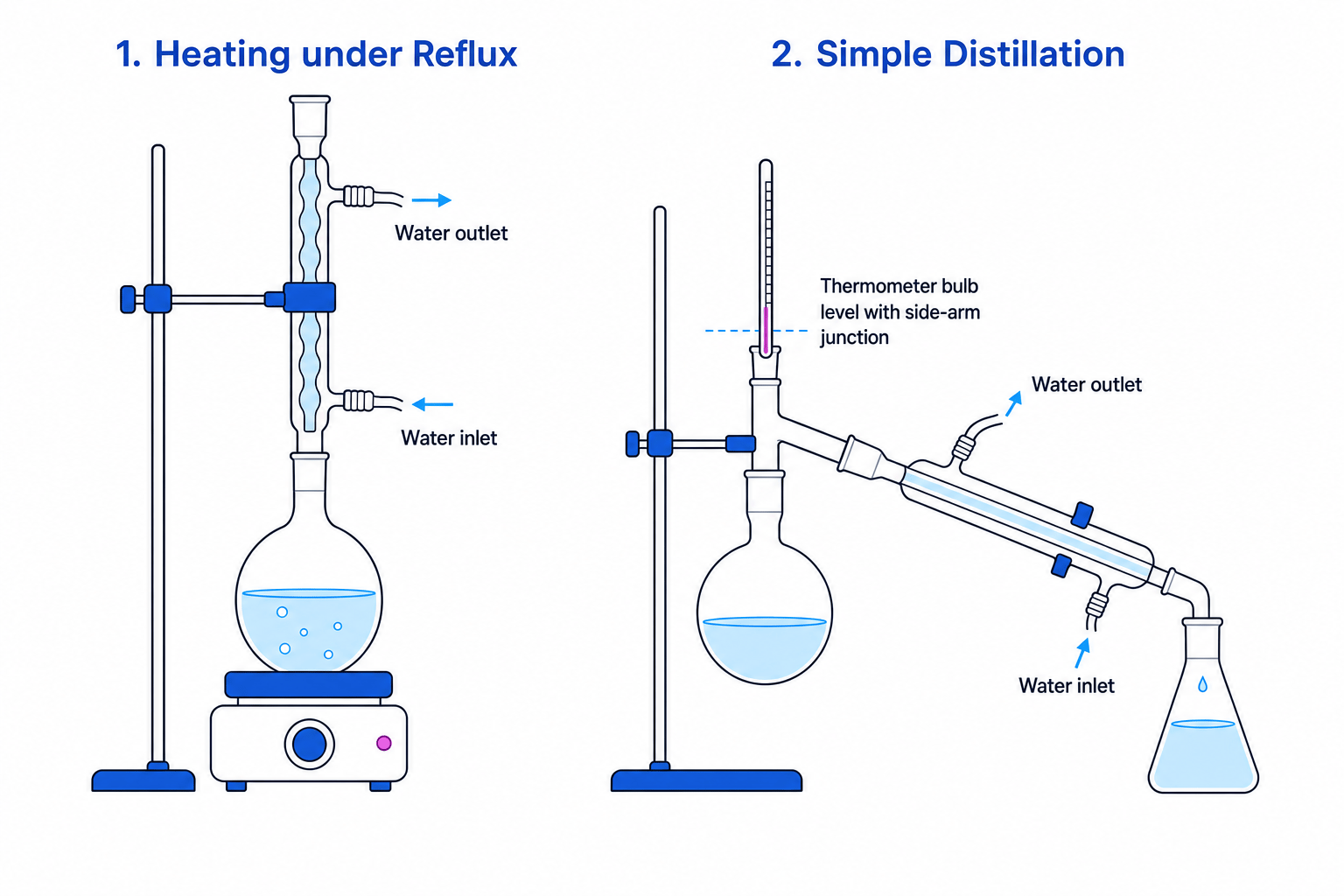
- Heating under Reflux: Continuous boiling and condensation of a reaction mixture. A vertical condenser is attached directly to the reaction flask. This allows reactions to be heated for long periods without losing volatile reactants or products through evaporation.
- Simple Distillation: Used to separate liquids with significantly different boiling points, or to separate a volatile liquid product from non-volatile impurities. The condenser is sloped downwards, allowing the condensed vapour to be collected in a separate receiving vessel.
Do Not Close the System
When setting up reflux or distillation apparatus, ensure the top of the condenser is never sealed with a stopper. Sealing the system creates a closed vessel under heat, leading to pressure build-up and a high risk of explosion.
Purification of a Solid: Recrystallisation
When preparing a solid product (e.g., aspirin or benzoic acid), the solid will contain impurities. Recrystallisation is used to remove these impurities based on their differing solubilities.
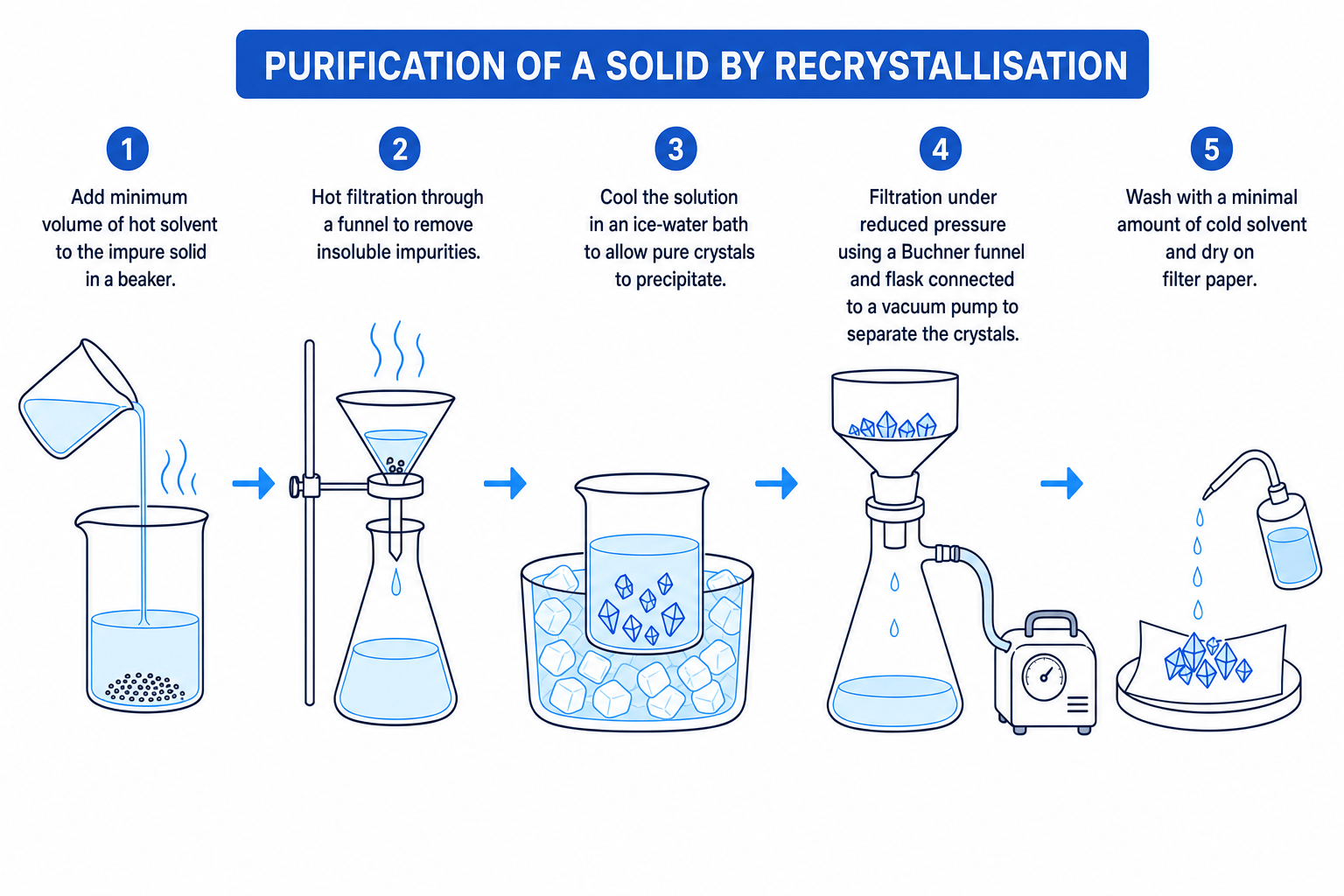
- Dissolve the impure solid in the minimum volume of hot solvent. The minimum volume ensures that the solution is saturated, which maximises the yield of crystals when cooled.
- Perform a hot gravity filtration using a pre-heated funnel and fluted filter paper. This step removes any insoluble impurities while keeping the desired product dissolved in the hot solvent.
- Cool the filtrate slowly to room temperature, then place it in an ice bath. As the temperature drops, the solubility of the product decreases rapidly, and pure crystals precipitate out. Soluble impurities remain dissolved in the cold solvent.
- Filter the mixture under reduced pressure using a Buchner funnel and a vacuum pump. This is much faster than gravity filtration and helps dry the crystals by drawing air through them.
- Wash the crystals with a small volume of ice-cold solvent to rinse away any remaining soluble impurities from the surface without dissolving the product.
- Dry the crystals in a low-temperature oven or desiccator.
Purification of a Liquid: Separating Funnel
When an organic liquid product is synthesised, it is often mixed with aqueous reagents and impurities.
- Pour the mixture into a separating funnel and add water or an aqueous washing solution (e.g., sodium hydrogencarbonate to neutralise acid impurities).
- Stopper the funnel, invert it gently several times, and open the tap periodically to release any built-up gas pressure.
- Allow the mixture to settle into two distinct layers (aqueous and organic) based on density.
- Remove the stopper and open the tap to run off the lower layer into a beaker, then collect the upper layer in a separate beaker.
- Add an anhydrous inorganic salt (e.g., anhydrous MgSO4\text{MgSO}_4MgSO4 or CaCl2\text{CaCl}_2CaCl2) to the organic liquid. These act as drying agents by binding to trace water.
- Filter or decant the dry organic liquid from the solid drying agent. The liquid should appear completely clear (no longer cloudy).
- Perform a final redistillation, collecting only the fraction that distills at the boiling point of your pure target compound.
Assessing Purity: Melting Point Analysis
Pure organic solids have sharp, well-defined melting points that match literature values. Impurities lower the melting point and cause the solid to melt over a wider temperature range.
- Place a tiny sample of dry solid inside a sealed glass capillary tube.
- Insert the capillary into a melting point apparatus and heat slowly.
- Record the temperature when melting starts and when it is fully complete.
4. Analytical and Physical Techniques
Thin-Layer Chromatography (TLC)
TLC is used to separate and identify components in a mixture based on their relative affinity for a stationary phase and a mobile phase.
TLC Retention Factor ()
The retention factor (RfR_fRf) is the ratio of the distance travelled by the substance to the distance travelled by the solvent front:
Rf=Distance travelled by componentDistance travelled by solvent front R_f = \frac{\text{Distance travelled by component}}{\text{Distance travelled by solvent front}} Rf=Distance travelled by solvent frontDistance travelled by component- Stationary phase: A thin layer of silica or alumina on a rigid plastic or glass sheet. Polar substances adsorb strongly to this phase.
- Mobile phase: A liquid solvent that moves up the plate by capillary action. Less polar substances dissolve better in the mobile phase and travel further.
- Visualisation: Non-coloured spots can be visualised using a UV lamp or by exposing the plate to iodine vapours or ninhydrin spray.
Electrochemical Cells
To measure standard electrode potentials (E∘E^\circE∘):
- Set up two half-cells containing the metal electrodes in contact with solutions of their ions at standard concentration (1.00 mol dm−31.00\text{ mol dm}^{-3}1.00 mol dm−3).
- Connect the two solutions using a salt bridge (usually filter paper soaked in saturated potassium nitrate, KNO3\text{KNO}_3KNO3). This completes the circuit by allowing ions to flow, without letting the two solutions mix.
- Connect the two electrodes using a high-resistance voltmeter to measure the cell potential (Ecell∘E^\circ_{\text{cell}}Ecell∘).
5. Measuring Rates of Reaction
You must be familiar with monitoring the progress of a chemical reaction over time.
1. Continuous Monitoring Method
This involves measuring how a physical property changes continuously as the reaction proceeds. Examples include:
- Gas syringe / Gas volume collection: Measuring the volume of gas produced over time.
- Mass loss: Measuring the mass of a flask containing a gas-evolving reaction on a digital balance over time.
- Colorimetry: Measuring the change in light absorption over time if a coloured reactant or product changes concentration.
2. Initial Rates Method (Clock Reactions)
In a clock reaction, you measure the time (ttt) taken for a small, fixed amount of a product to form, marked by a sudden, easily visible change (such as a colour change from clear to blue-black in the iodine-clock reaction).
- The average rate during this initial stage is assumed to be constant and proportional to:
- By repeating the experiment at varying concentrations, you can determine the order of reaction with respect to each reactant.
In the exam
- Look for closed systems: In questions testing your ability to draw or identify errors in reflux/distillation setups, check that the apparatus is not sealed (closed) at the top or end. This is a very common exam trap.
- Water flow direction: Always double-check that your water inlet is drawn at the bottom/lower end of the condenser jacket and the outlet is at the top/upper end.
- Justify indicator choices: When asked why an indicator is suitable for a specific titration, state the pH range of the indicator's colour change and explain that this range falls entirely within the vertical section of the titration curve.
- State experimental details: When describing standard solution preparation, don't forget minor details like "transferring washings" and "inverting the flask". Marks are frequently lost by omitting these small practical actions.
Check yourself
- Explain why a beaker or a measuring cylinder is not suitable for preparing a standard solution.
- Write down the steps you would take to purify an impure sample of aspirin by recrystallisation, highlighting how you would remove both insoluble and soluble impurities.
- A student measures a titre volume using a burette. The initial reading is 0.15 cm30.15\text{ cm}^30.15 cm3 and the final reading is 24.45 cm324.45\text{ cm}^324.45 cm3. If the absolute uncertainty of each burette reading is ±0.05 cm3\pm 0.05\text{ cm}^3±0.05 cm3, calculate the percentage uncertainty in the delivered titre.
