

What you'll learn
- How to work out numbers of protons, neutrons and electrons in atoms and ions.
- What isotopes are, and why atoms of the same element can have different masses.
- How relative isotopic mass and relative atomic mass are defined using carbon-12.
- How to use simple mass spectrum data to calculate ArA_rAr, MrM_rMr and relative formula mass.
The particles inside atoms
Atoms are built from three main subatomic particles:
- Protons: positively charged particles in the nucleus.
- Neutrons: neutral particles in the nucleus.
- Electrons: negatively charged particles found around the nucleus.
The nucleus is the tiny, dense centre of the atom. It contains almost all the atom’s mass because protons and neutrons are much heavier than electrons.
Atomic number and mass number
The atomic number, ZZZ, is the number of protons in the nucleus.
The mass number, AAA, is the total number of protons and neutrons in the nucleus.
The element is identified by its number of protons. For example, every atom with 6 protons is carbon. If the proton number changes, the element changes.
A useful way to show this is nuclide notation: ZAXq{}^{A}_{Z}\text{X}^{q}ZAXq, where X is the chemical symbol and qqq is the ionic charge if there is one.
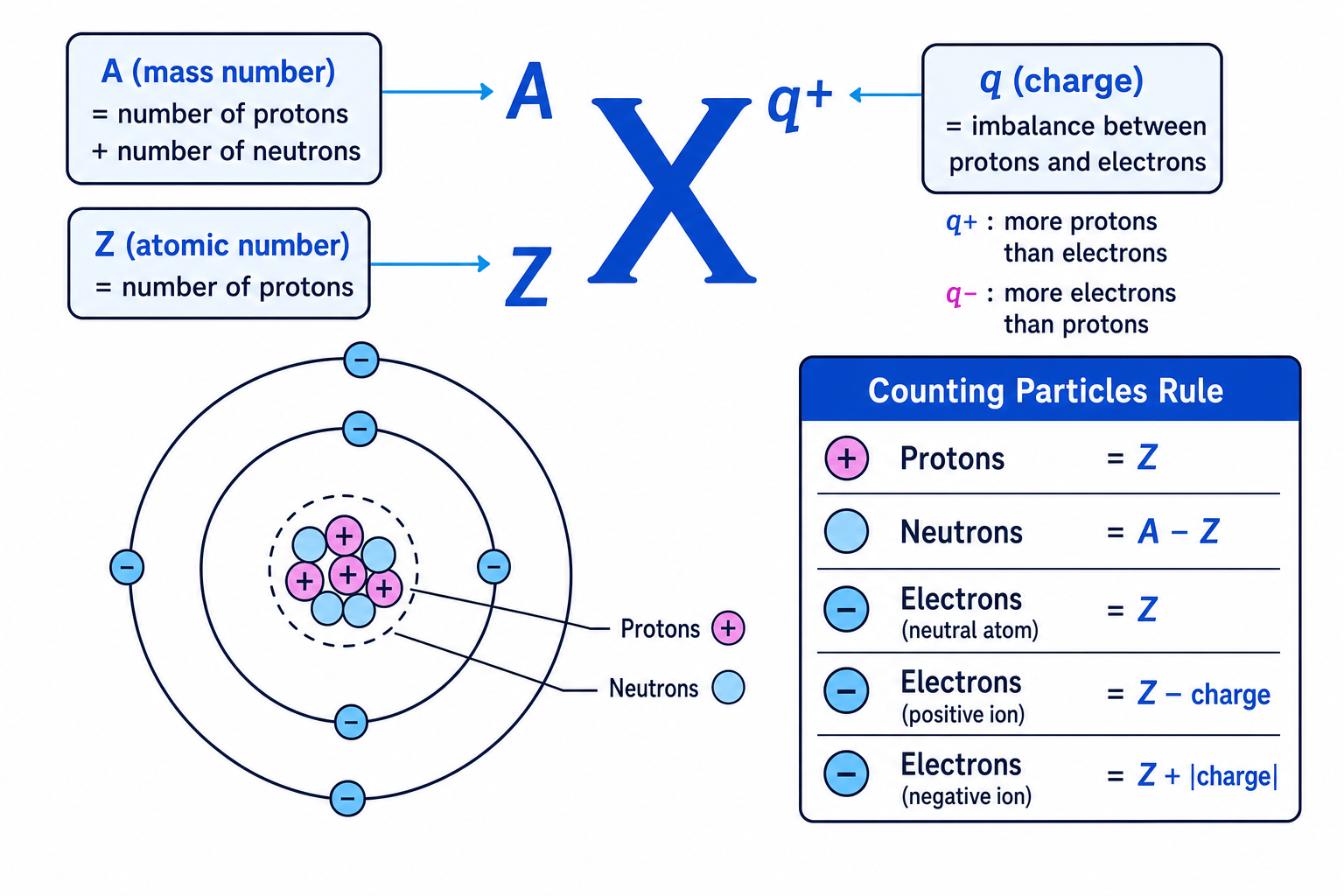
Counting protons, neutrons and electrons
For an atom or ion:
number of protons=Znumber of neutrons=A−Z\begin{aligned} \text{number of protons} &= Z \\ \text{number of neutrons} &= A - Z \end{aligned}number of protonsnumber of neutrons=Z=A−ZFor a neutral atom, the number of electrons equals the number of protons.
An ion is an atom or group of atoms with an overall charge because it has lost or gained electrons.
- A positive ion has lost electrons.
- A negative ion has gained electrons.
Only electrons change when ions form
Ions form by atoms losing or gaining electrons. The numbers of protons and neutrons in the nucleus do not change during ordinary chemical reactions.
Finding particles in an ion
Work out the numbers of protons, neutrons and electrons in 1327Al3+{}^{27}_{13}\text{Al}^{3+}1327Al3+.
- Use the atomic number to find protons: Z=13Z = 13Z=13, so there are 13 protons.
- Use the mass number to find neutrons: A−Z=27−13=14A - Z = 27 - 13 = 14A−Z=27−13=14, so there are 14 neutrons.
- Use the charge to find electrons: a 3+ ion has lost 3 electrons, so electrons =13−3=10= 13 - 3 = 10=13−3=10.
Adding electrons to positive ions
A 2+ ion has fewer electrons than the neutral atom, not more. Positive charge means electrons have been lost.
Isotopes
Atoms of the same element can have different numbers of neutrons. These are called isotopes.
Isotopes
Isotopes are atoms of the same element with the same number of protons but different numbers of neutrons and therefore different masses.
For example:
- 612C{}^{12}_{6}\text{C}612C has 6 protons and 6 neutrons.
- 613C{}^{13}_{6}\text{C}613C has 6 protons and 7 neutrons.
- 614C{}^{14}_{6}\text{C}614C has 6 protons and 8 neutrons.
They are all carbon because they all have 6 protons. They have different masses because they have different numbers of neutrons.
Spotting isotopes quickly
If two atoms have the same atomic number but different mass numbers, they are isotopes of the same element.
Atomic models: why we use simplified pictures
In this topic, you usually use a simple nuclear model: protons and neutrons in the nucleus, electrons arranged around it. This is enough to count particles and understand isotopes.
However, atomic models have changed over time as new evidence appeared. For example:
- Dalton described atoms as tiny indivisible spheres.
- Thomson’s model included electrons inside a positive sphere.
- Rutherford’s alpha-scattering evidence led to the nuclear model.
- Bohr’s model placed electrons in shells, which helps explain periodic properties.
Models depend on evidence
A scientific model is useful if it explains observations and makes successful predictions. When new evidence does not fit the model, chemists improve or replace it.
Relative mass: why carbon-12 is the standard
Atoms are incredibly small, so their actual masses in kilograms are inconvenient. Chemists compare atomic masses using a standard.
The standard is the mass of one atom of carbon-12, written 12C{}^{12}\text{C}12C.
Relative isotopic mass
The relative isotopic mass is the mass of an atom of an isotope compared with one-twelfth of the mass of an atom of carbon-12.
Relative atomic mass
The relative atomic mass, ArA_rAr, is the weighted mean mass of an atom of an element compared with one-twelfth of the mass of an atom of carbon-12.
“Weighted mean” matters because most elements exist as mixtures of isotopes. The more abundant an isotope is, the more it affects the average.
Relative masses have no units, because they are ratios comparing one mass with another mass.
Mass number is not always Ar
The mass number of one isotope is a whole number, but ArA_rAr is often a decimal because it is a weighted mean of all naturally occurring isotopes.
Mass spectrometry and isotope abundance
A mass spectrometer can be used to find:
- the relative isotopic masses of isotopes;
- the relative abundances of those isotopes.
You do not need to know how the mass spectrometer works for this part of OCR H432. You only need to interpret the data.
In this section, you are limited to ions with single charges. That means, for the simplified isotope calculations here, the m/zm/zm/z value can be treated as the relative isotopic mass.
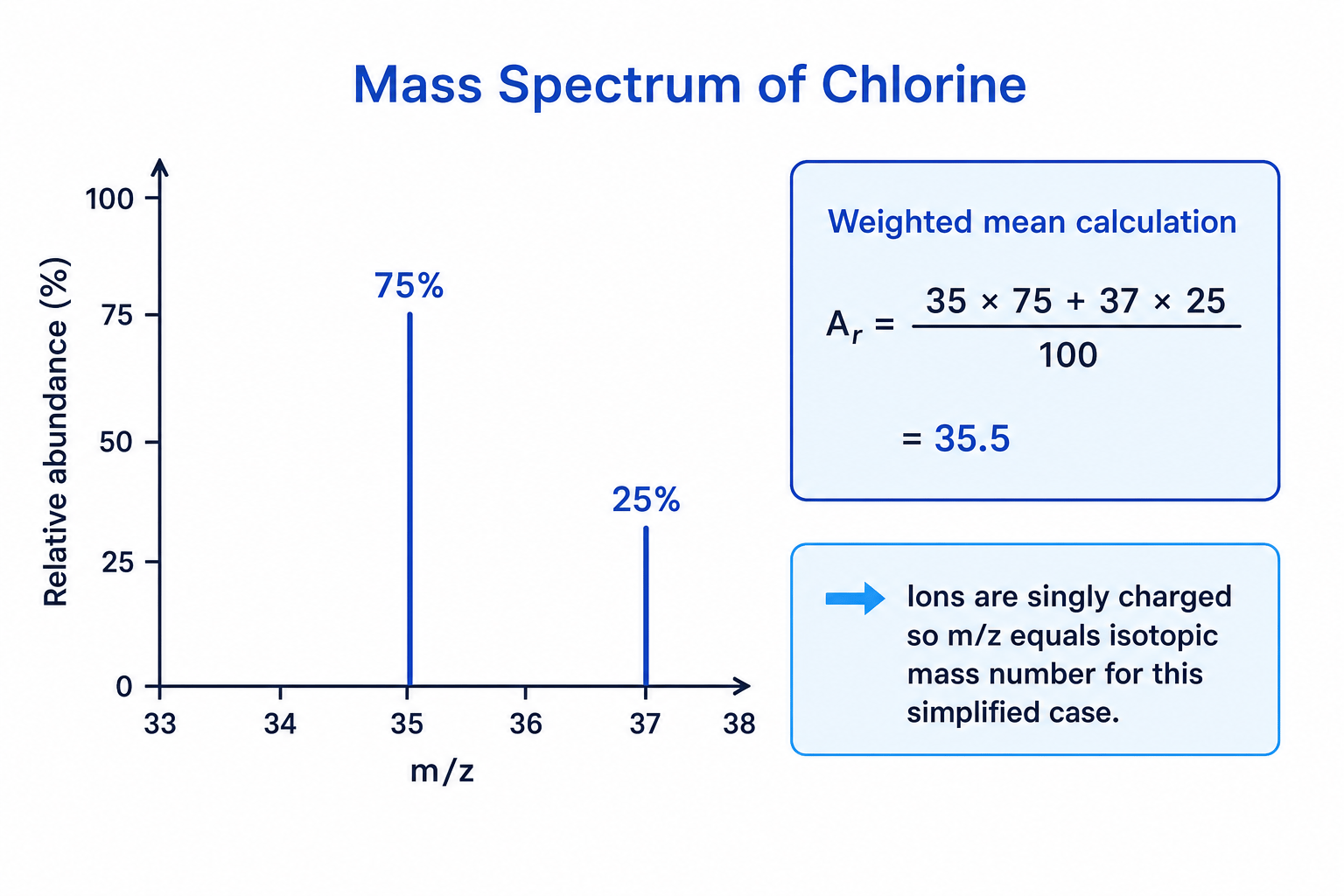
To calculate ArA_rAr from isotope data:
Ar=∑(isotopic mass×relative abundance)∑(relative abundances)A_r = \frac{\sum(\text{isotopic mass} \times \text{relative abundance})}{\sum(\text{relative abundances})}Ar=∑(relative abundances)∑(isotopic mass×relative abundance)If the abundances are percentages, the total is usually 100.
Calculating relative atomic mass from isotope data
Magnesium has three isotopes with the following relative abundances: magnesium-24 is 78.6%, magnesium-25 is 10.1%, and magnesium-26 is 11.3%. Calculate the relative atomic mass of magnesium.
- Multiply each isotope mass by its percentage abundance: 24×78.6=1886.424 \times 78.6 = 1886.424×78.6=1886.4, 25×10.1=252.525 \times 10.1 = 252.525×10.1=252.5, and 26×11.3=293.826 \times 11.3 = 293.826×11.3=293.8.
- Add the weighted contributions: 1886.4+252.5+293.8=2432.71886.4 + 252.5 + 293.8 = 2432.71886.4+252.5+293.8=2432.7.
- Divide by the total percentage abundance: Ar=2432.7100=24.327A_r = \frac{2432.7}{100} = 24.327Ar=1002432.7=24.327, so Ar≈24.3A_r \approx 24.3Ar≈24.3.
Sanity check for Ar
Your calculated ArA_rAr should lie between the lightest and heaviest isotope masses. If it does not, check your arithmetic.
Relative molecular mass and relative formula mass
The relative molecular mass, MrM_rMr, is found by adding the relative atomic masses of all atoms in a molecule.
For simple molecules, use the term relative molecular mass. Examples include H₂O, CO₂ and CH₄.
For compounds with giant structures, use the term relative formula mass instead. Examples include NaCl, MgO and SiO₂. These substances do not exist as simple separate molecules, so their formula gives the simplest ratio of ions or atoms.
You calculate both in the same way: add up the ArA_rAr values using the formula.
Calculating relative molecular mass
Calculate the relative molecular mass of ethanol, C₂H₅OH. Use ArA_rAr: C = 12.0, H = 1.0, O = 16.0.
- Count the atoms in the formula: C₂H₅OH contains 2 carbon atoms, 6 hydrogen atoms and 1 oxygen atom.
- Multiply each ArA_rAr by the number of atoms: carbon =2×12.0=24.0= 2 \times 12.0 = 24.0=2×12.0=24.0, hydrogen =6×1.0=6.0= 6 \times 1.0 = 6.0=6×1.0=6.0, oxygen =1×16.0=16.0= 1 \times 16.0 = 16.0=1×16.0=16.0.
- Add the contributions: Mr=24.0+6.0+16.0=46.0M_r = 24.0 + 6.0 + 16.0 = 46.0Mr=24.0+6.0+16.0=46.0.
Calculating relative formula mass
Calculate the relative formula mass of magnesium nitrate, Mg(NO₃)₂. Use ArA_rAr: Mg = 24.3, N = 14.0, O = 16.0.
- Interpret the brackets: Mg(NO₃)₂ contains 1 Mg atom, 2 N atoms and 6 O atoms.
- Multiply each ArA_rAr by the number of atoms: magnesium =1×24.3=24.3= 1 \times 24.3 = 24.3=1×24.3=24.3, nitrogen =2×14.0=28.0= 2 \times 14.0 = 28.0=2×14.0=28.0, oxygen =6×16.0=96.0= 6 \times 16.0 = 96.0=6×16.0=96.0.
- Add the contributions: relative formula mass =24.3+28.0+96.0=148.3= 24.3 + 28.0 + 96.0 = 148.3=24.3+28.0+96.0=148.3.
Forgetting brackets in formulae
In Mg(NO₃)₂, the 2 applies to everything inside the brackets. There are 2 nitrogen atoms and 6 oxygen atoms, not 1 nitrogen and 3 oxygen atoms.
Bringing the ideas together
The key skill in this topic is careful bookkeeping:
- Atomic number tells you protons.
- Mass number tells you protons plus neutrons.
- Ionic charge tells you how many electrons have been lost or gained.
- Isotope abundances let you calculate a weighted mean ArA_rAr.
- Formulae let you calculate MrM_rMr or relative formula mass by adding ArA_rAr values.
In the exam
- For particle-counting questions, write down protons, neutrons and electrons separately before giving the final answer.
- For isotope abundance calculations, multiply each isotope mass by its abundance, add the results, then divide by the total abundance.
- Use the correct term: MrM_rMr for simple molecules, and relative formula mass for giant structures such as ionic compounds.
Check yourself
- What is the difference between mass number and relative atomic mass?
- How many electrons are in 1735Cl−{}^{35}_{17}\text{Cl}^{-}1735Cl−?
- Why is the relative atomic mass of chlorine about 35.5 rather than a whole number?
