

Welcome to the chemistry of the d-block! Transition metals form some of the most vibrant, complex, and chemically diverse compounds in the universe. In these study notes, we will break down the essential concepts of OCR A section 5.3.1, moving systematically from electron configurations to coordination chemistry, 3D shapes, and chemical test-tube reactions.
What you'll learn
- How to write electron configurations for d-block atoms and ions, including key anomalies.
- What defines a true transition element and why certain d-block metals do not fit this definition.
- The formation, shapes, and stereoisomerism of complex ions.
- How to predict and write balanced equations for ligand substitution, precipitation, and redox reactions.
1. Electron Configurations of the d-block
Before diving into transition metal reactions, we must look closely at their atomic structure. The transition metals we study in Period 4 occupy the d-block of the periodic table, meaning their highest-energy electrons reside in d-sub-shells.
When writing these configurations, we must recall the ordering of sub-shells:
1s→2s→2p→3s→3p→4s→3d 1\text{s} \to 2\text{s} \to 2\text{p} \to 3\text{s} \to 3\text{p} \to 4\text{s} \to 3\text{d} 1s→2s→2p→3s→3p→4s→3dThe 4s Fill-First, Empty-First Rule
When building up Period 4 atoms, the 4s4\text{s}4s sub-shell fills before the 3d3\text{d}3d sub-shell because it is at a lower energy level. However, once the 3d3\text{d}3d sub-shell begins to fill, the 3d3\text{d}3d electrons repel the 4s4\text{s}4s electrons, pushing the 4s4\text{s}4s sub-shell to a higher energy level. Consequently, when d-block atoms form ions, electrons are always lost from the 4s4\text{s}4s sub-shell first.
Key Anomalies: Chromium and Copper
There are two exceptions to the standard filling rule in Period 4 that you must memorise:
- Chromium (Cr\text{Cr}Cr, Z=24Z = 24Z=24): Instead of the expected [Ar]3d44s2[\text{Ar}] 3\text{d}^4 4\text{s}^2[Ar]3d44s2, a 4s4\text{s}4s electron is promoted to give a half-filled d-sub-shell: [Ar]3d54s1[\text{Ar}] 3\text{d}^5 4\text{s}^1[Ar]3d54s1. This is because a half-filled d-sub-shell (d5\text{d}^5d5) and half-filled s-sub-shell (s1\text{s}^1s1) provide a more stable, symmetrical distribution of electron density.
- Copper (Cu\text{Cu}Cu, Z=29Z = 29Z=29): Instead of [Ar]3d94s2[\text{Ar}] 3\text{d}^9 4\text{s}^2[Ar]3d94s2, the configuration is [Ar]3d104s1[\text{Ar}] 3\text{d}^{10} 4\text{s}^1[Ar]3d104s1. Here, the completely filled d-sub-shell (d10\text{d}^{10}d10) is highly stable.
Transition Element
A d-block element that forms at least one stable ion with an incomplete d-sub-shell.
This definition is crucial. It explains why some d-block elements are not classified as transition elements:
- Scandium (Sc\text{Sc}Sc, Z=21Z = 21Z=21): Its electron configuration is [Ar]3d14s2[\text{Ar}] 3\text{d}^1 4\text{s}^2[Ar]3d14s2. Scandium only forms the Sc3+\text{Sc}^{3+}Sc3+ ion, which has the configuration [Ar]3d0[\text{Ar}] 3\text{d}^0[Ar]3d0. Since the d-sub-shell is empty, it does not possess an incomplete d-sub-shell, so scandium is not a transition element.
- Zinc (Zn\text{Zn}Zn, Z=30Z = 30Z=30): Its electron configuration is [Ar]3d104s2[\text{Ar}] 3\text{d}^{10} 4\text{s}^2[Ar]3d104s2. Zinc only forms the Zn2+\text{Zn}^{2+}Zn2+ ion, which has the configuration [Ar]3d10[\text{Ar}] 3\text{d}^{10}[Ar]3d10. Because the d-sub-shell is completely full, zinc is not a transition element.
The actual transition elements in Period 4 are therefore restricted to Titanium (Ti\text{Ti}Ti) through to Copper (Cu\text{Cu}Cu).
Writing the electron configuration of a transition metal ion
Determine the full electron configuration of the iron(III) ion (Fe3+\text{Fe}^{3+}Fe3+), given that iron has an atomic number of Z=26Z = 26Z=26.
- Write down the electron configuration of the neutral Fe\text{Fe}Fe atom first. The 4s4\text{s}4s sub-shell fills before 3d3\text{d}3d:
- Determine how many electrons must be removed to form the ion. Since the charge is +3+3+3, we must remove exactly three electrons.
- Remove electrons from the 4s4\text{s}4s orbital first. Removing the two 4s4\text{s}4s electrons leaves:
- Remove the remaining one electron from the 3d3\text{d}3d sub-shell to achieve the +3+3+3 state. This yields:
Forgetting the 4s orbital order
Do not write configurations like Fe2+\text{Fe}^{2+}Fe2+ as [Ar]3d44s2[\text{Ar}] 3\text{d}^4 4\text{s}^2[Ar]3d44s2. This is a classic error. Always remove the 4s4\text{s}4s electrons first!
2. Key Properties of Transition Elements
True transition elements exhibit several characteristic chemical properties:
Variable Oxidation States
Because the 4s4\text{s}4s and 3d3\text{d}3d sub-shells are close in energy, transition metals can lose different numbers of electrons without a massive jump in successive ionisation energies. For example, iron commonly exists as Fe2+\text{Fe}^{2+}Fe2+ and Fe3+\text{Fe}^{3+}Fe3+, while manganese can range from +2+2+2 in Mn2+\text{Mn}^{2+}Mn2+ up to +7+7+7 in MnO4−\text{MnO}_4^-MnO4−.
Coloured Ions
When transition metal ions dissolve in water, they form complexes with distinct, vivid colours. While the detailed mechanism of how colour arises (d-orbital splitting) is not required for OCR A at this point, you must know that the colour is directly associated with the presence of an incomplete d-sub-shell.
Catalytic Behaviour
Transition elements and their compounds make exceptional catalysts due to their ability to change oxidation states easily and provide surfaces for adsorption.
- Homogeneous catalysis example: Cu2+\text{Cu}^{2+}Cu2+ ions catalysing the reaction of zinc with acids.
- Heterogeneous catalysis example: Solid manganese(IV) oxide (MnO2\text{MnO}_2MnO2) catalysing the decomposition of hydrogen peroxide:
Toxicity vs Industrial Value
While transition metal catalysts are vital in industry for reducing energy consumption and lowering greenhouse gas emissions (by allowing reactions to proceed at lower temperatures and pressures), many of these metals (like chromium, nickel, and cobalt) are highly toxic and present environmental risks if not carefully controlled.
3. Ligands and Complex Ions
Transition metal chemistry is dominated by the formation of complex ions.
Ligand
A molecule or ion that donates a pair of electrons to a central metal ion to form a coordinate (dative covalent) bond.
Coordination Number
The total number of coordinate bonds formed between a central metal ion and its surrounding ligands.
Types of Ligands
- Monodentate ligands: Donate a single lone pair of electrons to the metal ion. Examples include:
- Water (H2O\text{H}_2\text{O}H2O): neutral
- Ammonia (NH3\text{NH}_3NH3): neutral
- Chloride ion (Cl−\text{Cl}^-Cl−): negative charge
- Bidentate ligands: Donate two lone pairs of electrons from two different atoms on the same molecule, forming two distinct coordinate bonds.
- A classic example is ethane-1,2-diamine (abbreviated as 'en', formula: NH2CH2CH2NH2\text{NH}_2\text{CH}_2\text{CH}_2\text{NH}_2NH2CH2CH2NH2). Each nitrogen atom possesses a lone pair capable of coordinate bonding.
Common Shapes and Geometries
The shape of a complex ion depends directly on its coordination number and the size of the ligands:
- Octahedral (Coordination Number = 6): Formed with small, uncharged ligands like H2O\text{H}_2\text{O}H2O or NH3\text{NH}_3NH3. The bond angles are 90∘90^\circ90∘. Examples include [Cu(H2O)6]2+[\text{Cu}(\text{H}_2\text{O})_6]^{2+}[Cu(H2O)6]2+ and [Fe(H2O)6]3+[\text{Fe}(\text{H}_2\text{O})_6]^{3+}[Fe(H2O)6]3+.
- Tetrahedral (Coordination Number = 4): Formed with larger, negatively charged ligands like Cl−\text{Cl}^-Cl−. Mutual repulsion between the bulky, charged ligands prevents a six-fold coordination. The bond angles are 109.5∘109.5^\circ109.5∘. Examples include [CuCl4]2−[\text{CuCl}_4]^{2-}[CuCl4]2− and [CoCl4]2−[\text{CoCl}_4]^{2-}[CoCl4]2−.
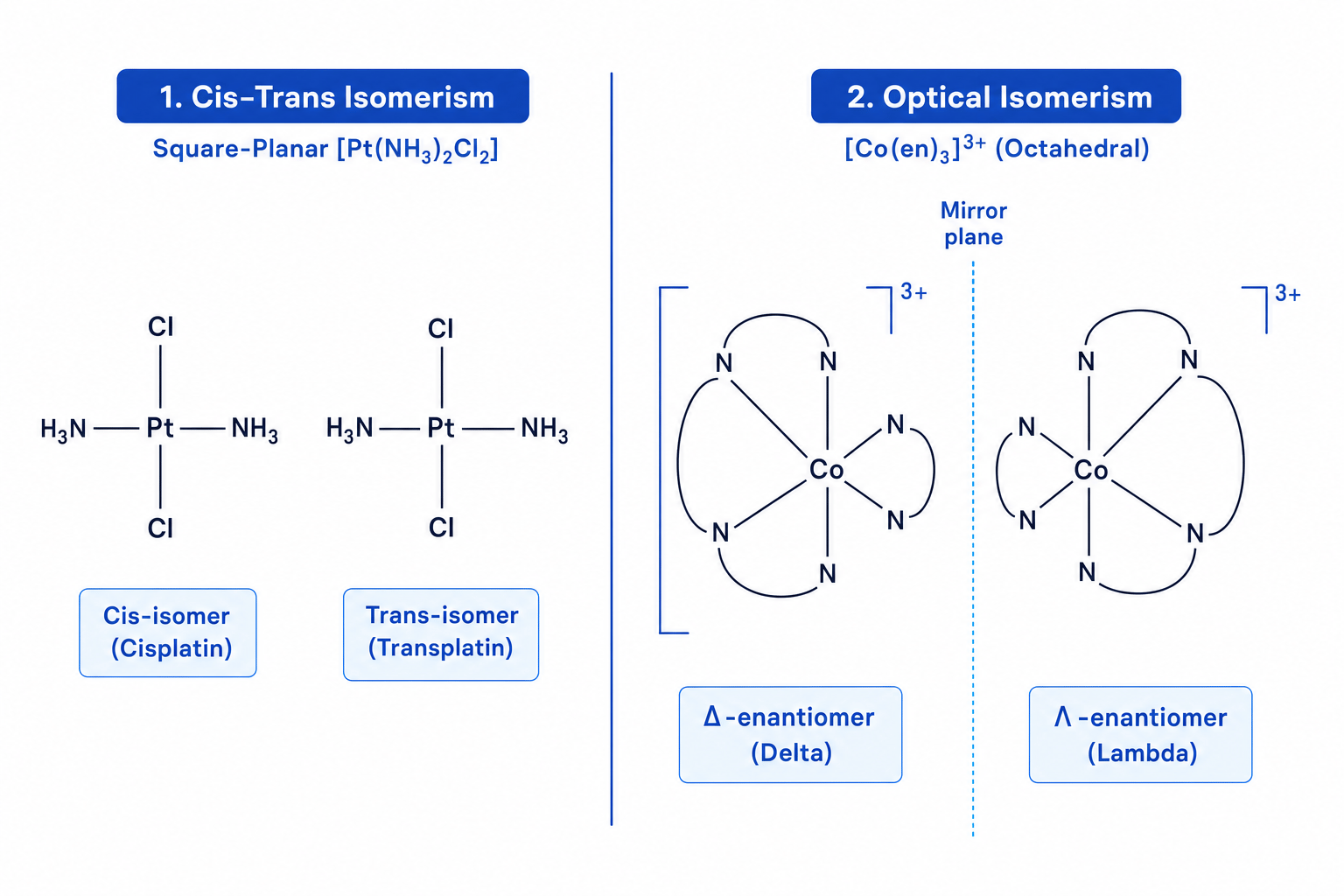
- Square Planar (Coordination Number = 4): This geometry is adopted by complexes of certain transition metals, particularly Platinum (Pt2+\text{Pt}^{2+}Pt2+) and Palladium (Pd2+\text{Pd}^{2+}Pd2+). The bond angles are 90∘90^\circ90∘. A major example is cisplatin, Pt(NH3)2Cl2\text{Pt}(\text{NH}_3)_2\text{Cl}_2Pt(NH3)2Cl2.
4. Stereoisomerism and Cisplatin
Transition metal complexes can exhibit stereoisomerism—where compounds have the same structural formula but a different 3D spatial arrangement of their atoms.
Cis-Trans Isomerism
This occurs in square-planar and octahedral complexes:
- Square-planar complexes: In cisplatin, Pt(NH3)2Cl2\text{Pt}(\text{NH}_3)_2\text{Cl}_2Pt(NH3)2Cl2, the two chloride ligands can be next to each other (90∘90^\circ90∘ bond angle) in the cis-isomer, or opposite each other (180∘180^\circ180∘ bond angle) in the trans-isomer.
- Octahedral complexes: Cis-trans isomerism can occur in complexes containing monodentate ligands (e.g., cis/trans-[Co(NH3)4Cl2]+[\text{Co}(\text{NH}_3)_4\text{Cl}_2]^+[Co(NH3)4Cl2]+) or those with bidentate ligands (e.g., cis/trans-[Co(en)2Cl2]+[\text{Co}(\text{en})_2\text{Cl}_2]^+[Co(en)2Cl2]+).
Optical Isomerism
This is found in octahedral complexes containing bidentate or multidentate ligands (such as [Ni(en)3]2+[\text{Ni}(\text{en})_3]^{2+}[Ni(en)3]2+). The two optical isomers (enantiomers) are non-superimposable mirror images of each other.
Cisplatin as an Anti-Cancer Drug
Cisplatin is a chemotherapy drug used to treat various cancers (e.g., testicular and ovarian).
- How it works: Cisplatin passes through cell membranes. Once inside the cell, where chloride concentrations are lower, water molecules replace the chloride ligands. The complex then binds to nitrogen atoms on DNA bases (specifically guanine) within cancer cells. This creates cross-links that kink the DNA structure, preventing replication and transcription. The cell is unable to divide and undergoes apoptosis (programmed cell death).
- Risks and Benefits: The benefit is a highly effective cancer treatment. The risk is that cisplatin is non-selective; it also targets healthy cells that divide rapidly (such as hair follicle cells and kidney lining), causing side effects like hair loss, severe nausea, and kidney toxicity.
5. Ligand Substitution Reactions
Ligand substitution is a reaction in which one ligand in a complex ion is replaced by another ligand. These reactions are usually equilibria and are accompanied by dramatic colour changes.
1. Copper(II) complexes
When excess aqueous ammonia is added to a solution of hexaaquacopper(II) ([Cu(H2O)6]2+[\text{Cu}(\text{H}_2\text{O})_6]^{2+}[Cu(H2O)6]2+), a partial substitution occurs:
[Cu(H2O)6]2+(aq)+4NH3(aq)→[Cu(NH3)4(H2O)2]2+(aq)+4H2O(l) [\text{Cu}(\text{H}_2\text{O})_6]^{2+}(\text{aq}) + 4\text{NH}_3(\text{aq}) \to [\text{Cu}(\text{NH}_3)_4(\text{H}_2\text{O})_2]^{2+}(\text{aq}) + 4\text{H}_2\text{O}(\text{l}) [Cu(H2O)6]2+(aq)+4NH3(aq)→[Cu(NH3)4(H2O)2]2+(aq)+4H2O(l)- Colour change: Pale blue solution to a deep, dark blue solution.
If concentrated hydrochloric acid (a source of Cl−\text{Cl}^-Cl− ligands) is added to [Cu(H2O)6]2+[\text{Cu}(\text{H}_2\text{O})_6]^{2+}[Cu(H2O)6]2+, a complete substitution with a change in coordination number occurs:
[Cu(H2O)6]2+(aq)+4Cl−(aq)⇌[CuCl4]2−(aq)+6H2O(l) [\text{Cu}(\text{H}_2\text{O})_6]^{2+}(\text{aq}) + 4\text{Cl}^-(\text{aq}) \rightleftharpoons [\text{CuCl}_4]^{2-}(\text{aq}) + 6\text{H}_2\text{O}(\text{l}) [Cu(H2O)6]2+(aq)+4Cl−(aq)⇌[CuCl4]2−(aq)+6H2O(l)- Colour change: Pale blue solution to a yellow-green solution (the yellow complex is in equilibrium with the blue complex, making it look green).
2. Chromium(III) complexes
When excess ammonia is added to hexaaquachromium(III) ([Cr(H2O)6]3+[\text{Cr}(\text{H}_2\text{O})_6]^{3+}[Cr(H2O)6]3+), all six water molecules are substituted:
[Cr(H2O)6]3+(aq)+6NH3(aq)→[Cr(NH3)6]3+(aq)+6H2O(l) [\text{Cr}(\text{H}_2\text{O})_6]^{3+}(\text{aq}) + 6\text{NH}_3(\text{aq}) \to [\text{Cr}(\text{NH}_3)_6]^{3+}(\text{aq}) + 6\text{H}_2\text{O}(\text{l}) [Cr(H2O)6]3+(aq)+6NH3(aq)→[Cr(NH3)6]3+(aq)+6H2O(l)- Colour change: Violet solution (often appearing green in laboratory bottles due to impurities/hydrolysis) to a purple solution.
3. Haemoglobin: A Biochemical Complex
Haemoglobin is an iron-containing protein responsible for oxygen transport in the blood:
- The central metal ion is Fe2+\text{Fe}^{2+}Fe2+, coordinated to four nitrogen atoms in a planar porphyrin ring (together forming the haem group).
- A fifth coordinate bond is formed with a nitrogen atom from the globin protein.
- The sixth coordination site is occupied by a weakly bound water molecule, which is easily and reversibly substituted by an oxygen molecule (O2\text{O}_2O2) to form oxyhaemoglobin.
- Carbon monoxide poisoning: Carbon monoxide (CO\text{CO}CO) binds to the same sixth site much more strongly than O2\text{O}_2O2. This ligand substitution is practically irreversible, preventing oxygen from binding and starving body tissues of oxygen.
6. Precipitation Reactions
When transition metal ions react with aqueous sodium hydroxide (NaOH\text{NaOH}NaOH) or dropwise aqueous ammonia (NH3\text{NH}_3NH3), they undergo precipitation reactions to form insoluble metal hydroxides.
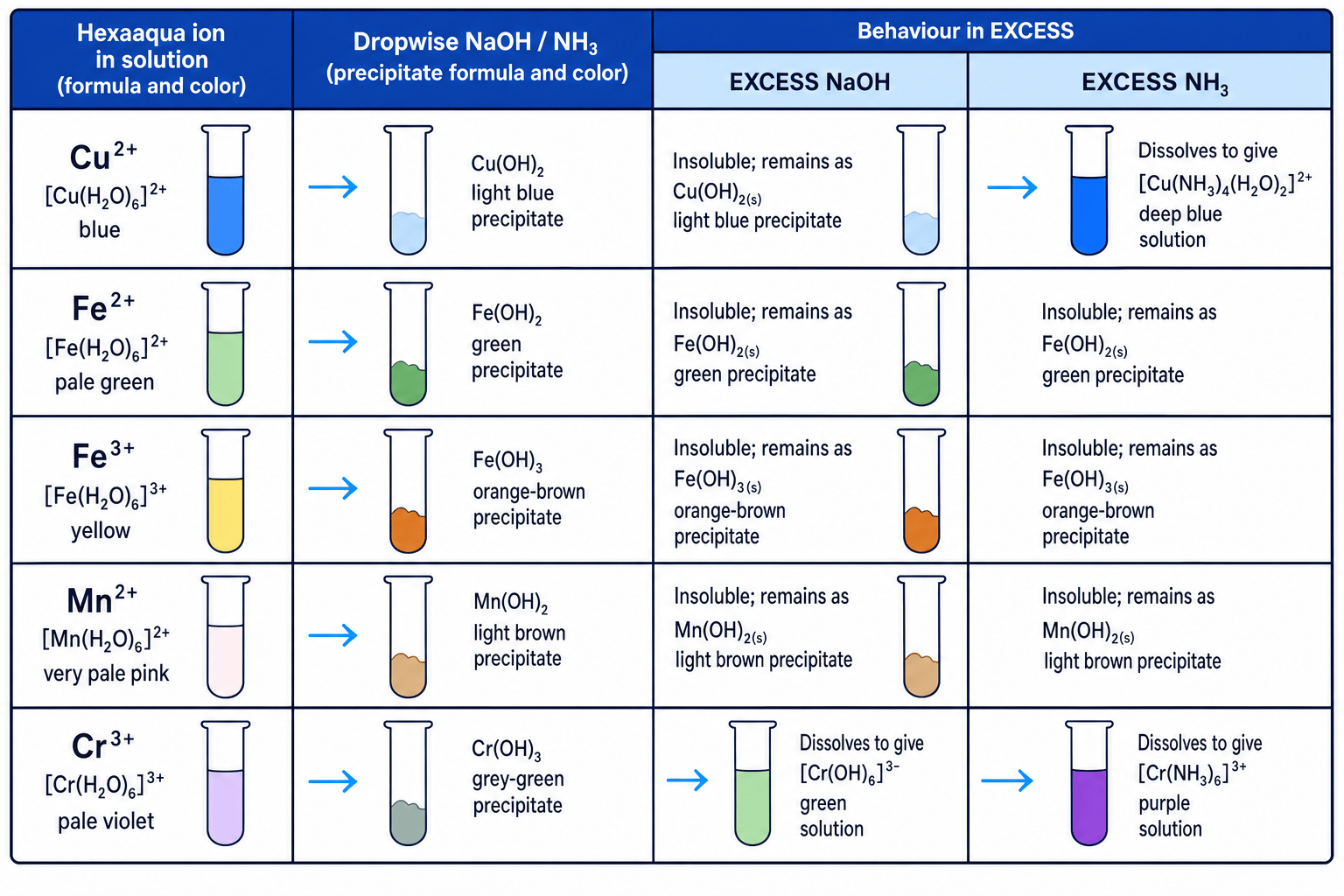
Let's review these reactions in detail:
1. Copper(II) — Cu2+\text{Cu}^{2+}Cu2+
- With dropwise NaOH\text{NaOH}NaOH or NH3\text{NH}_3NH3: Forms a light blue precipitate of copper(II) hydroxide.
- With excess NaOH\text{NaOH}NaOH: Insoluble; the precipitate remains.
- With excess NH3\text{NH}_3NH3: The precipitate dissolves to form a deep blue solution of [Cu(NH3)4(H2O)2]2+(aq)[\text{Cu}(\text{NH}_3)_4(\text{H}_2\text{O})_2]^{2+}(\text{aq})[Cu(NH3)4(H2O)2]2+(aq).
2. Iron(II) — Fe2+\text{Fe}^{2+}Fe2+
- With dropwise NaOH\text{NaOH}NaOH or NH3\text{NH}_3NH3: Forms a green precipitate of iron(II) hydroxide (which slowly oxidises to brown Fe(OH)3\text{Fe}(\text{OH})_3Fe(OH)3 at the surface in contact with air).
- With excess NaOH\text{NaOH}NaOH or NH3\text{NH}_3NH3: Insoluble in excess of both.
3. Iron(III) — Fe3+\text{Fe}^{3+}Fe3+
- With dropwise NaOH\text{NaOH}NaOH or NH3\text{NH}_3NH3: Forms an orange-brown precipitate of iron(III) hydroxide.
- With excess NaOH\text{NaOH}NaOH or NH3\text{NH}_3NH3: Insoluble in excess of both.
4. Manganese(II) — Mn2+\text{Mn}^{2+}Mn2+
- With dropwise NaOH\text{NaOH}NaOH or NH3\text{NH}_3NH3: Forms a light brown precipitate of manganese(II) hydroxide.
- With excess NaOH\text{NaOH}NaOH or NH3\text{NH}_3NH3: Insoluble in excess of both.
5. Chromium(III) — Cr3+\text{Cr}^{3+}Cr3+
- With dropwise NaOH\text{NaOH}NaOH or NH3\text{NH}_3NH3: Forms a grey-green precipitate of chromium(III) hydroxide.
- With excess NaOH\text{NaOH}NaOH: The precipitate dissolves to form a dark green solution of hexahydroxochromate(III):
- With excess NH3\text{NH}_3NH3: The precipitate dissolves to form a purple solution of hexaamminechromium(III):
7. Redox Reactions and Interconversions
Transition elements undergo key redox interconversions. You do not need to memorize these entire complex equations, but you must be able to assemble them using half-equations.
Fe2+⇌Fe3+\text{Fe}^{2+} \rightleftharpoons \text{Fe}^{3+}Fe2+⇌Fe3+ Interconversion
- Oxidation (Fe2+→Fe3+\text{Fe}^{2+} \to \text{Fe}^{3+}Fe2+→Fe3+): Done using acidified potassium manganate(VII), MnO4−/H+\text{MnO}_4^- / \text{H}^+MnO4−/H+. The purple solution decolourises to colourless:
- Reduction (Fe3+→Fe2+\text{Fe}^{3+} \to \text{Fe}^{2+}Fe3+→Fe2+): Done using iodide ions, I−\text{I}^-I−. The orange-brown solution of Fe3+\text{Fe}^{3+}Fe3+ turns brown due to the formation of iodine (I2\text{I}_2I2):
Cr3+⇌Cr2O72−\text{Cr}^{3+} \rightleftharpoons \text{Cr}_2\text{O}_7^{2-}Cr3+⇌Cr2O72− Interconversion
- Oxidation (Cr3+→Cr2O72−\text{Cr}^{3+} \to \text{Cr}_2\text{O}_7^{2-}Cr3+→Cr2O72−): Done by reacting Cr3+\text{Cr}^{3+}Cr3+ with hydrogen peroxide (H2O2\text{H}_2\text{O}_2H2O2) in alkaline conditions to form yellow chromate (CrO42−\text{CrO}_4^{2-}CrO42−), which is then acidified to form orange dichromate (Cr2O72−\text{Cr}_2\text{O}_7^{2-}Cr2O72−):
- Reduction (Cr2O72−→Cr3+\text{Cr}_2\text{O}_7^{2-} \to \text{Cr}^{3+}Cr2O72−→Cr3+): Done using zinc in acidic conditions. The orange solution turns green. Excess zinc reduces the green Cr3+\text{Cr}^{3+}Cr3+ further to unstable blue Cr2+\text{Cr}^{2+}Cr2+.
Cu2+⇌Cu+\text{Cu}^{2+} \rightleftharpoons \text{Cu}^+Cu2+⇌Cu+ and Disproportionation
- Reduction (Cu2+→Cu+\text{Cu}^{2+} \to \text{Cu}^+Cu2+→Cu+): Done by reacting Cu2+\text{Cu}^{2+}Cu2+ with iodide ions (I−\text{I}^-I−):
The pale blue solution forms a brown mixture containing a white precipitate of copper(I) iodide (CuI\text{CuI}CuI) and brown iodine (I2\text{I}_2I2) solution.
- Disproportionation of Cu+\text{Cu}^+Cu+: In aqueous conditions, copper(I) ions spontaneously react with themselves to form solid brown copper metal (Cu\text{Cu}Cu) and a blue solution of copper(II) (Cu2+\text{Cu}^{2+}Cu2+):
Constructing redox equations for transition metal reactions
Construct the balanced overall ionic equation for the reduction of dichromate(VI) ions (Cr2O72−\text{Cr}_2\text{O}_7^{2-}Cr2O72−) to chromium(III) ions (Cr3+\text{Cr}^{3+}Cr3+) using zinc metal (Zn\text{Zn}Zn) in acidic conditions.
- Write down the two relevant half-equations. The reduction half-equation of acidified dichromate is:
The oxidation half-equation of zinc is:
Zn(s)→Zn2+(aq)+2e− \text{Zn}(\text{s}) \to \text{Zn}^{2+}(\text{aq}) + 2\text{e}^- Zn(s)→Zn2+(aq)+2e−- Equalise the number of electrons in both half-equations by finding the lowest common multiple. The reduction equation uses 6 electrons, and the oxidation equation produces 2. Multiply the zinc equation by 3:
- Combine the two half-equations by adding reactants together and products together, and cancel the 6 electrons on both sides:
- Check that both mass and charge are balanced.
- Left-hand side charge: (−2)+(+14)+0=+12(-2) + (+14) + 0 = +12(−2)+(+14)+0=+12
- Right-hand side charge: 2(+3)+3(+2)=+122(+3) + 3(+2) = +122(+3)+3(+2)=+12
- Both atoms and charges balance perfectly.
In the exam
- Always double-check transition metal ion configurations. Write out the neutral atom configuration first, and then strip electrons from the 4s4\text{s}4s sub-shell before touching the 3d3\text{d}3d sub-shell.
- Memorise the exact wording of key definitions. Understand the exact difference between a d-block element and a transition element. Make sure you can explain why Scandium and Zinc are not transition elements.
- Be precise with complex formulas. Remember the square brackets, the correct oxidation states, and the overall charge of the complex. Show coordinate bonds clearly using arrows pointing from the donor atom (e.g. N\text{N}N in NH3\text{NH}_3NH3 or O\text{O}O in H2O\text{H}_2\text{O}H2O) to the central metal ion when drawing 3D stereoisomers.
- Learn the test-tube colors perfectly. Examiners love to ask you to identify an unknown compound based on its color changes with dropwise and excess NaOH\text{NaOH}NaOH or NH3\text{NH}_3NH3.
Check yourself
- Write the full electron configuration of a Cu2+\text{Cu}^{2+}Cu2+ ion. Why is copper classified as a transition element, but zinc is not?
- Draw 3D structures of the optical isomers of [Ni(en)3]2+[\text{Ni}(\text{en})_3]^{2+}[Ni(en)3]2+. Explain why they are classified as optical isomers.
- State the formula and colour of the transition metal complex formed when excess aqueous ammonia is added to a solution of hexaaquachromium(III) ions.
- Write a balanced ionic equation for the disproportionation of aqueous copper(I) ions.
