

Welcome to one of the most intellectually rewarding and highly examined areas of A-Level Chemistry. This topic bridges the gap between chemical reactions, thermodynamics, and electricity. By understanding how electrons move between species, you will be able to predict whether a reaction is thermodynamically possible, calculate the voltage of batteries, and explain how cutting-edge fuel cells operate.
What you'll learn
- How to construct complex redox equations using half-equations and oxidation numbers.
- How to perform quantitative calculations for redox titrations, including manganese and iodine systems.
- How standard electrode potentials (E⊖E^\ominusE⊖) are measured experimentally using reference electrodes.
- How to calculate standard cell potentials (Ecell⊖E^\ominus_{\text{cell}}Ecell⊖) and predict the feasibility of chemical reactions.
- The electrochemical principles, benefits, and environmental risks of modern storage and fuel cells.
1. Foundations of Redox
Before exploring electrode potentials, let us secure our understanding of redox fundamentals.
Oxidation and Reduction
- Oxidation is the loss of electrons, resulting in an increase in oxidation number.
- Reduction is the gain of electrons, resulting in a decrease in oxidation number.
Oxidising and Reducing Agents
- An oxidising agent is a species that oxidises another species by accepting electrons. Because it gains electrons, the oxidising agent itself is reduced.
- A reducing agent is a species that reduces another species by donating electrons. Because it loses electrons, the reducing agent itself is oxidised.
Constructing Redox Equations Using Half-Equations
To construct a full redox equation, you must combine an oxidation half-equation with a reduction half-equation. The key rule is that the number of electrons lost must equal the number of electrons gained.
When writing or balancing half-equations in acidic conditions, follow this systematic order:
- Balance all elements other than hydrogen (H\text{H}H) and oxygen (O\text{O}O).
- Balance oxygen atoms by adding water (H2O\text{H}_2\text{O}H2O) molecules to the opposite side.
- Balance hydrogen atoms by adding hydrogen ions (H+\text{H}^+H+) to the opposite side.
- Balance the overall charge by adding electrons (e−\text{e}^-e−) to the more positive side.
Constructing a overall redox equation
- Write down the two individual half-equations. Let us use the oxidation of iron(II) ions by dichromate(VI) ions in acidic solution:
- Multiply the half-equations so that the electron transfer is balanced. The reduction half-equation requires 6 electrons, whereas the oxidation half-equation releases only 1. Multiply the iron half-equation by 6:
- Add the two equations together and cancel the electrons on both sides to give the final balanced redox equation:
2. Redox Titrations
In practical work (PAG 8), you will use redox titrations to find the concentration of an unknown reducing or oxidising agent. The two primary systems you must master are the manganate(VII) titration and the iodine–thiosulfate titration.
The Manganate(VII) Titration (Fe2+/MnO4−\text{Fe}^{2+} / \text{MnO}_4^-Fe2+/MnO4−)
This titration is used to analyse reducing agents such as iron(II) ions or ethanedioic acid.
- Procedure: Acidified potassium manganate(VII), KMnO4\text{KMnO}_4KMnO4, is placed in the burette. A known volume of the reducing agent is pipetted into a conical flask and acidified with an excess of dilute sulfuric acid (H2SO4\text{H}_2\text{SO}_4H2SO4).
- Self-Indicating: Manganate(VII) ions (MnO4−\text{MnO}_4^-MnO4−) are an intense purple colour, while manganese(II) ions (Mn2+\text{Mn}^{2+}Mn2+) are virtually colourless.
- Endpoint: At the endpoint, the first drop of excess MnO4−\text{MnO}_4^-MnO4− remains unreacted, changing the solution in the conical flask from colourless to a permanent pale pink.
The overall equation for the titration is:
MnO4−(aq)+8H+(aq)+5Fe2+(aq)→Mn2+(aq)+4H2O(l)+5Fe3+(aq) \text{MnO}_4^-(aq) + 8\text{H}^+(aq) + 5\text{Fe}^{2+}(aq) \to \text{Mn}^{2+}(aq) + 4\text{H}_2\text{O}(l) + 5\text{Fe}^{3+}(aq) MnO4−(aq)+8H+(aq)+5Fe2+(aq)→Mn2+(aq)+4H2O(l)+5Fe3+(aq)Using the wrong acid for acidification
Always acidify MnO4−\text{MnO}_4^-MnO4− titrations with dilute sulfuric acid (H2SO4\text{H}_2\text{SO}_4H2SO4).
- Do not use hydrochloric acid (HCl\text{HCl}HCl), because the MnO4−\text{MnO}_4^-MnO4− is a strong enough oxidising agent to oxidise the Cl−\text{Cl}^-Cl− ions into toxic Cl2\text{Cl}_2Cl2 gas, leading to an artificially high titre.
- Do not use nitric acid (HNO3\text{HNO}_3HNO3), because the nitrate ions (NO3−\text{NO}_3^-NO3−) are strong oxidising agents themselves and will react with the analyte, leading to an artificially low titre.
The Iodine–Thiosulfate Titration (I2/S2O32−\text{I}_2 / \text{S}_2\text{O}_3^{2-}I2/S2O32−)
This is a indirect titration method used to determine the concentration of an oxidising agent (such as copper(II) ions or chlorate(I) ions in bleach).
- Step 1: React a known volume of the oxidising agent (e.g. Cu2+\text{Cu}^{2+}Cu2+) with an excess of iodide ions (I−\text{I}^-I−). This produces brown iodine gas/aqueous solution:
- Step 2: Titrate the liberated iodine (I2\text{I}_2I2) against a standard solution of sodium thiosulfate (Na2S2O3\text{Na}_2\text{S}_2\text{O}_3Na2S2O3) from the burette:
- Indicator: As the titration proceeds, the brown iodine colour fades to a pale straw yellow. At this point, add a few drops of starch indicator, which turns the mixture blue-black.
- Endpoint: Titrate dropwise until the blue-black colour disappears completely, leaving a colourless solution (or a white/cream suspension of copper(I) iodide if copper ions were analysed).
When to add the starch indicator
Do not add the starch indicator at the very start of the titration. High concentrations of iodine bind irreversibly to starch, preventing an accurate endpoint. Only add starch when the mixture has reached a pale straw-yellow colour.
Redox Titration Calculations
Let's work through an unstructured calculation step-by-step.
Determining the percentage by mass of iron in a wire
An iron wire of mass 1.40 g was dissolved in an excess of dilute sulfuric acid to convert all the iron atoms into Fe2+(aq)\text{Fe}^{2+}(aq)Fe2+(aq) ions. The resulting solution was made up to 250.0 cm3250.0\text{ cm}^3250.0 cm3 in a volumetric flask.
A 25.0 cm325.0\text{ cm}^325.0 cm3 sample of this solution was pipetted into a conical flask, acidified, and titrated against 0.0200 mol dm−30.0200\text{ mol dm}^{-3}0.0200 mol dm−3 KMnO4(aq)\text{KMnO}_4(aq)KMnO4(aq). The mean titre was 22.50 cm322.50\text{ cm}^322.50 cm3. Calculate the percentage by mass of iron in the wire.
- Calculate the amount, in moles, of manganate(VII) ions that reacted: Using the formula n=cVn = cVn=cV:
- Use the reaction stoichiometry to find the moles of iron(II) in the 25.0 cm325.0\text{ cm}^325.0 cm3 sample: The balanced titration equation is:
The ratio of MnO4−\text{MnO}_4^-MnO4− to Fe2+\text{Fe}^{2+}Fe2+ is 1:51:51:5.
n(Fe2+) in 25.0 cm3=5×4.50×10−4 mol=2.25×10⁻³ mol n(\text{Fe}^{2+}) \text{ in } 25.0\text{ cm}^3 = 5 \times 4.50 \times 10^{-4}\text{ mol} = 2.25 \times 10^{-3}\text{ mol} n(Fe2+) in 25.0 cm3=5×4.50×10−4 mol=2.25×10⁻³ mol- Scale up to find the total moles of iron(II) in the 250.0 cm3250.0\text{ cm}^3250.0 cm3 volumetric flask:
- Calculate the mass of iron present in the wire: The molar mass of iron is 55.8 g mol−155.8\text{ g mol}^{-1}55.8 g mol−1.
- Calculate the percentage by mass of iron in the wire:
3. Standard Electrode Potentials
When a metal is placed in a solution of its own ions, an equilibrium is established between the metal atoms and the metal ions:
Mn+(aq)+ne−⇌M(s) \text{M}^{n+}(aq) + n\text{e}^- \rightleftharpoons \text{M}(s) Mn+(aq)+ne−⇌M(s)This is a half-cell. The tendency of this half-reaction to gain or lose electrons is its electrode potential. Because we cannot measure the potential of an isolated half-cell directly, we must connect it to a reference electrode and measure the difference in potential (the electromotive force, or e.m.f.) using a high-resistance voltmeter.
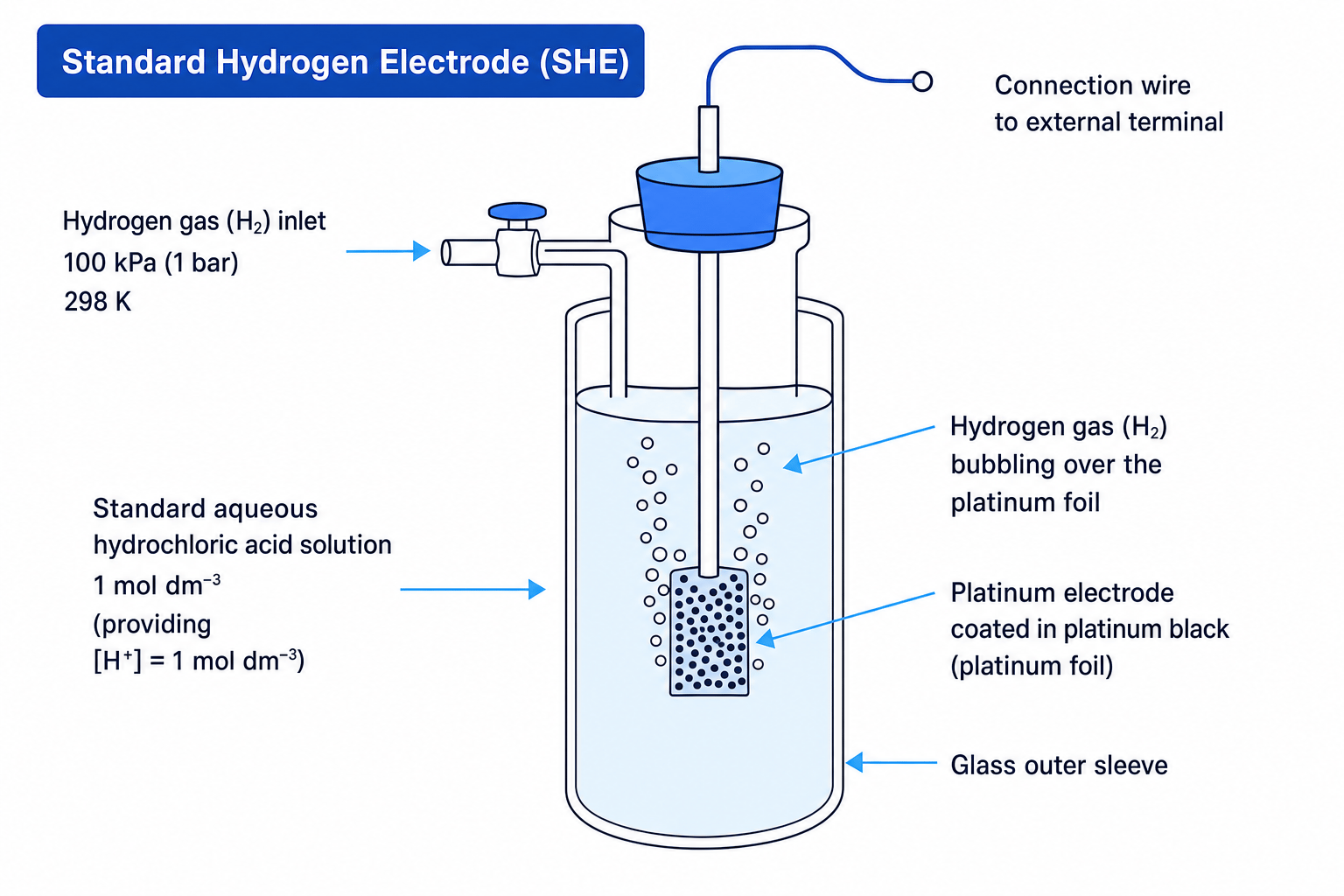
The Standard Hydrogen Electrode (SHE)
The universal reference electrode is the Standard Hydrogen Electrode (SHE). By international agreement, its standard electrode potential is defined as exactly 0.00 V0.00\text{ V}0.00 V at all temperatures.
Standard conditions
To obtain standard measurements, the following conditions must be strictly maintained:
- Temperature: 298 K298\text{ K}298 K (25∘C25^\circ\text{C}25∘C)
- Pressure of gas: 100 kPa100\text{ kPa}100 kPa (1 bar)
- Concentration of solutions: 1.0 mol dm−31.0\text{ mol dm}^{-3}1.0 mol dm−3 of the relevant ions (specifically [H+]=1.0 mol dm−3[\text{H}^+] = 1.0\text{ mol dm}^{-3}[H+]=1.0 mol dm−3 for the SHE)
The SHE uses an inert platinum electrode coated in platinum black (finely divided platinum). This acts as a catalyst for the standard hydrogen half-reaction:
2H+(aq)+2e−⇌H2(g) 2\text{H}^+(aq) + 2\text{e}^- \rightleftharpoons \text{H}_2(g) 2H+(aq)+2e−⇌H2(g)Standard Electrode Potential,
The standard electrode potential, E⊖E^\ominusE⊖, of a half-cell is the e.m.f. of that half-cell connected to a standard hydrogen electrode under standard conditions (298 K298\text{ K}298 K, 100 kPa100\text{ kPa}100 kPa, and ion concentrations of 1.0 mol dm−31.0\text{ mol dm}^{-3}1.0 mol dm−3).
4. Measuring and Calculating Cell Potentials
Experimental Setups for Measuring Cell Potentials
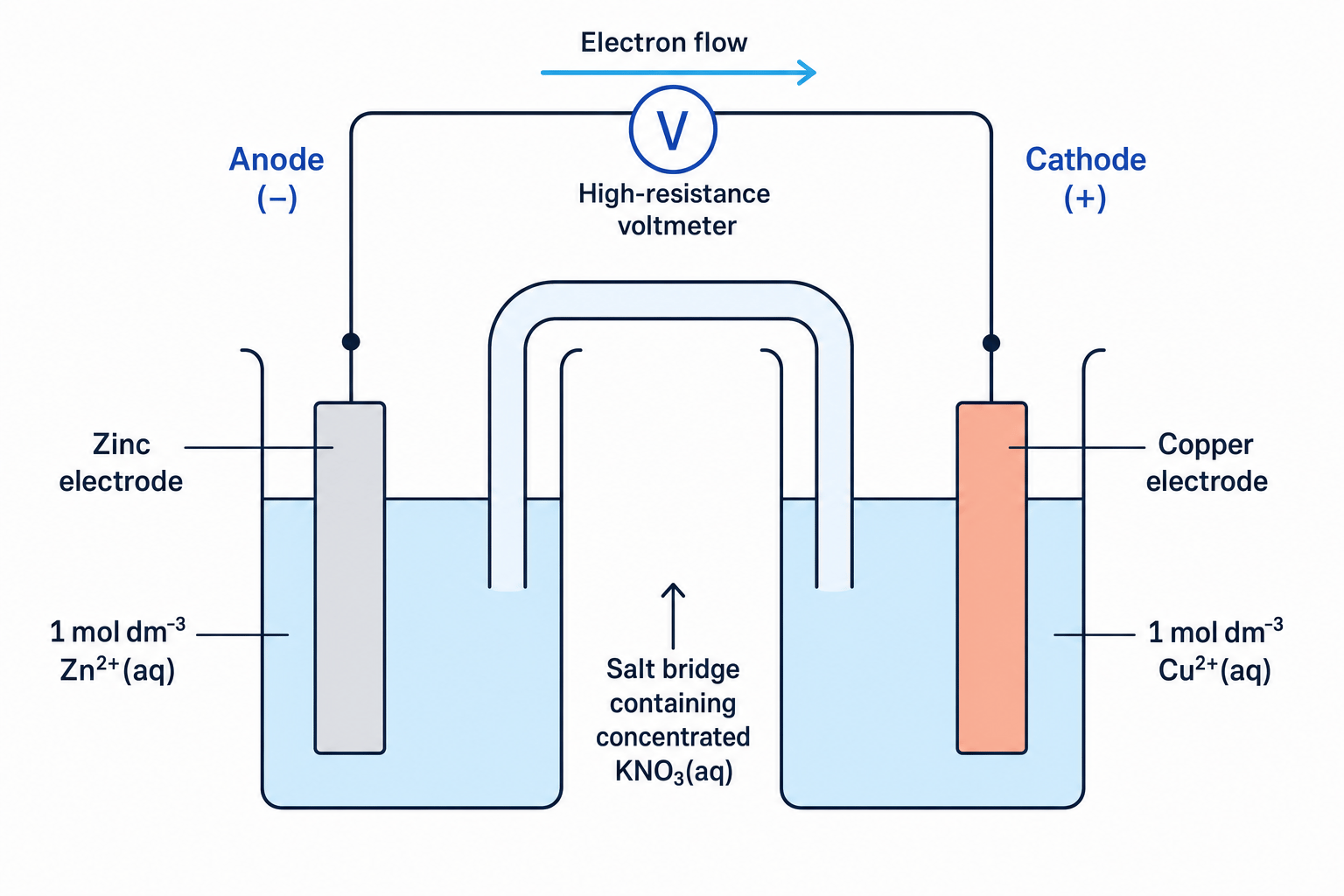
You need to know how to measure the potential of three types of half-cell systems connected to another half-cell (or the SHE) via a salt bridge and a high-resistance voltmeter.
- Metal / metal ion half-cells: A metal rod (electrode) is dipped into a solution of its metal ions (e.g., a zinc strip in 1 mol dm−3 Zn2+(aq)1\text{ mol dm}^{-3}\ \text{Zn}^{2+}(aq)1 mol dm−3 Zn2+(aq)).
- Non-metal / non-metal ion half-cells: For non-metals like chlorine, the gas is bubbled at 100 kPa100\text{ kPa}100 kPa over an inert platinum electrode immersed in a solution of the halide ions (e.g., 1 mol dm−3 Cl−(aq)1\text{ mol dm}^{-3}\ \text{Cl}^-(aq)1 mol dm−3 Cl−(aq)).
- Ions of the same element in different oxidation states: For half-cells such as Fe3+(aq)/Fe2+(aq)\text{Fe}^{3+}(aq) / \text{Fe}^{2+}(aq)Fe3+(aq)/Fe2+(aq), an inert platinum electrode is placed into a solution containing both ions, each at a concentration of 1 mol dm−31\text{ mol dm}^{-3}1 mol dm−3 (or in an equimolar ratio).
The role of the Salt Bridge
The salt bridge completes the electrical circuit by allowing the migration of ions between the two half-cells, preventing the build-up of charge. It is usually a strip of filter paper soaked in a concentrated, chemically inert electrolyte such as potassium nitrate (KNO3\text{KNO}_3KNO3). Do not use a wire, as a wire conducts electrons, not ions!
Calculating Standard Cell Potentials, Ecell⊖E^\ominus_{\text{cell}}Ecell⊖
Standard electrode potentials are always tabulated as reduction reactions (electrons on the left).
- A more positive E⊖E^\ominusE⊖ value indicates a greater tendency to gain electrons (undergo reduction). The species on the left of the half-equation is a strong oxidising agent.
- A more negative (or less positive) E⊖E^\ominusE⊖ value indicates a greater tendency to lose electrons (undergo oxidation). The species on the right of the half-equation is a strong reducing agent.
To calculate the standard potential of a complete electrochemical cell:
Ecell⊖=Ereduction⊖−Eoxidation⊖ E^\ominus_{\text{cell}} = E^\ominus_{\text{reduction}} - E^\ominus_{\text{oxidation}} Ecell⊖=Ereduction⊖−Eoxidation⊖Or simply:
Ecell⊖=Epositive terminal⊖−Enegative terminal⊖ E^\ominus_{\text{cell}} = E^\ominus_{\text{positive terminal}} - E^\ominus_{\text{negative terminal}} Ecell⊖=Epositive terminal⊖−Enegative terminal⊖5. Predicting Reaction Feasibility
You can use standard electrode potentials to predict whether a redox reaction will occur spontaneously under standard conditions. A reaction is thermodynamically feasible if the overall cell potential (Ecell⊖E^\ominus_{\text{cell}}Ecell⊖) is positive (Ecell⊖>0E^\ominus_{\text{cell}} > 0Ecell⊖>0).
Predicting the feasibility of a reaction
Using the standard electrode potentials below, predict whether iron(III) ions, Fe3+\text{Fe}^{3+}Fe3+, can oxidise iodide ions, I−\text{I}^-I−, under standard conditions.
(1)Fe3+(aq)+e−⇌Fe2+(aq)E⊖=+0.77 V(2)I2(aq)+2e−⇌2I−(aq)E⊖=+0.54 V \begin{aligned} (1) \quad \text{Fe}^{3+}(aq) + \text{e}^- &\rightleftharpoons \text{Fe}^{2+}(aq) \quad &E^\ominus = +0.77\text{ V} \\ (2) \quad \text{I}_2(aq) + 2\text{e}^- &\rightleftharpoons 2\text{I}^-(aq) \quad &E^\ominus = +0.54\text{ V} \end{aligned} (1)Fe3+(aq)+e−(2)I2(aq)+2e−⇌Fe2+(aq)⇌2I−(aq)E⊖=+0.77 VE⊖=+0.54 V- Compare the two electrode potentials to identify which species is reduced and which is oxidised: The half-cell with the more positive E⊖E^\ominusE⊖ value will undergo reduction (proceed in the forward direction). Since +0.77 V>+0.54 V+0.77\text{ V} > +0.54\text{ V}+0.77 V>+0.54 V, system (1) will undergo reduction:
The half-cell with the less positive E⊖E^\ominusE⊖ value will undergo oxidation (proceed in the reverse direction):
2I−(aq)→I2(aq)+2e− 2\text{I}^-(aq) \to \text{I}_2(aq) + 2\text{e}^- 2I−(aq)→I2(aq)+2e−- Combine the half-equations into a balanced redox equation: Multiply the iron reduction half-equation by 2 and combine with the iodide oxidation:
- Calculate the standard cell potential (Ecell⊖E^\ominus_{\text{cell}}Ecell⊖):
- Conclude the feasibility of the reaction: Because Ecell⊖E^\ominus_{\text{cell}}Ecell⊖ is positive (+0.23 V+0.23\text{ V}+0.23 V), the reaction is thermodynamically feasible under standard conditions. Iron(III) ions will spontaneously oxidise iodide ions to iodine.
Limitations of Feasibility Predictions
In the written papers, you will often be asked why a reaction predicted to be feasible does not actually appear to occur, or why it produces different results. There are two major limitations to predictions made using standard electrode potentials:
- Kinetics (Activation Energy): A positive Ecell⊖E^\ominus_{\text{cell}}Ecell⊖ only tells us that a reaction is thermodynamically feasible. It says nothing about the rate of reaction. If the reaction has a very high activation energy (EaE_aEa), it will be extremely slow at room temperature, making the system kinetically stable.
- Concentration (Non-standard conditions): Standard electrode potentials are measured at exactly 1.0 mol dm−31.0\text{ mol dm}^{-3}1.0 mol dm−3. If the concentration of ions is changed, the position of equilibrium for the half-cell shifts (Le Chatelier's principle), changing the electrode potential. This can cause a reaction that is unfeasible under standard conditions to become feasible (or vice versa).
6. Storage and Fuel Cells
Electrochemistry is central to modern green energy technology. You need to apply your understanding of cell potentials to storage (rechargeable) cells and fuel cells.
Storage Cells
Modern storage cells, such as Lithium-ion cells found in mobile phones and electric vehicles, are rechargeable.
- Rechargeability: When the battery is discharging, chemical reactions occur spontaneously, generating an electric current. By applying an external voltage greater than the cell potential, the redox reactions are reversed, regenerating the original reactants.
- Benefits: Lithium-ion cells have high energy densities, are lightweight, and maintain a constant voltage during discharge.
- Risks: Lithium is highly reactive. If damaged, overcharged, or exposed to high temperatures, lithium-based batteries are prone to thermal runaway, which can lead to fires and explosions. There are also toxic chemical hazards associated with the disposal of transition metal compounds in the electrodes.
Fuel Cells
Fuel Cell
A fuel cell uses the energy from the reaction of a continuous external supply of a fuel (such as hydrogen) with an oxidant (such as oxygen) to generate a voltage.
Unlike standard batteries, fuel cells do not store chemical energy; they operate continuously as long as fuel and oxygen are supplied.
The Hydrogen-Oxygen Fuel Cell
The cell can operate under either acidic or alkaline conditions. You do not need to memorise these equations (the exam will provide them), but you must understand how to interpret and combine them.
Under alkaline conditions:
- Anode (Oxidation):
- Cathode (Reduction):
- Overall Equation:
The only byproduct is water, making hydrogen fuel cells an exceptionally clean alternative to fossil fuels.
In the exam
- Balance electron transfer first: When combining half-equations or performing titration calculations, always double-check that the total electrons lost in the oxidation step equals the total electrons gained in the reduction step.
- Watch your state symbols: In cell descriptions and half-equations, include correct state symbols (especially gas phase for H2\text{H}_2H2 or Cl2\text{Cl}_2Cl2, and solid for Pt\text{Pt}Pt electrodes).
- Handle negative signs with care: When calculating Ecell⊖=Ered⊖−Eox⊖E^\ominus_{\text{cell}} = E^\ominus_{\text{red}} - E^\ominus_{\text{ox}}Ecell⊖=Ered⊖−Eox⊖, be extremely careful with subtracting negative values. Write out the calculation in full: e.g. (+0.34 V)−(−0.76 V)=+1.10 V(+0.34\text{ V}) - (-0.76\text{ V}) = +1.10\text{ V}(+0.34 V)−(−0.76 V)=+1.10 V.
- Distinguish kinetic vs thermodynamic arguments: If asked why a reaction with a positive cell potential does not happen, use the term "high activation energy" rather than just saying "it is too slow".
Check yourself
- Why is a platinum electrode used in the standard hydrogen electrode, and what are its two main physical features?
- A student performs a redox titration of Fe2+\text{Fe}^{2+}Fe2+ with MnO4−\text{MnO}_4^-MnO4−. They run out of dilute sulfuric acid and decide to use dilute hydrochloric acid instead. How will this affect their titre value, and why?
- If the concentration of Cu2+(aq)\text{Cu}^{2+}(aq)Cu2+(aq) ions in a Cu2+(aq)/Cu(s)\text{Cu}^{2+}(aq)/\text{Cu}(s)Cu2+(aq)/Cu(s) half-cell is decreased below 1.0 mol dm−31.0\text{ mol dm}^{-3}1.0 mol dm−3, how does the electrode potential change? Explain your answer using Le Chatelier's principle.
