

Welcome to your study notes on the Halogens (Group 17, formerly Group 7). This topic is a cornerstone of inorganic chemistry for OCR A-Level Chemistry. You will explore physical trends, investigate how atomic structure dictates chemical reactivity, and learn crucial diagnostic test methods.
What you'll learn:
- Why physical states change down Group 17, explained by intermolecular forces.
- The chemical trend in halogen reactivity and oxidising power.
- The vital role of disproportionation in water treatment and bleach synthesis.
- How to carry out and explain qualitative tests for halide ions.
1. Physical Properties & Trends
The halogens exist as simple covalent diatomic molecules (F2\text{F}_2F2, Cl2\text{Cl}_2Cl2, Br2\text{Br}_2Br2, I2\text{I}_2I2). At room temperature, their physical states show a distinct progression down the group:
- Chlorine (Cl2\text{Cl}_2Cl2): A pale green gas.
- Bromine (Br2\text{Br}_2Br2): A highly volatile, dense red-brown liquid.
- Iodine (I2\text{I}_2I2): A shiny dark grey/black solid that easily sublimes to form a purple gas.
Explaining the Trend in Boiling Points
As you move down Group 17, the boiling points of the halogens increase significantly. To explain this trend, we must look at the intermolecular forces holding these simple molecules together.
London Forces
London forces (also called induced dipole–dipole interactions) are weak, temporary intermolecular forces that arise due to the constant, random movement of electrons within a molecule, which creates a temporary dipole. This temporary dipole then induces a dipole in an adjacent molecule.
- More Electrons: As you descend the group, each halogen atom has more inner shells, meaning the diatomic molecules have a greater total number of electrons.
- Stronger London Forces: A larger number of electrons leads to larger fluctuations in electron density, which creates larger temporary dipoles. This results in stronger London forces between the molecules.
- More Energy Required: Consequently, more thermal energy is required to overcome these stronger intermolecular forces and separate the molecules during boiling.
Breaking Covalent Bonds
A common mistake in exams is stating that covalent bonds are broken when halogens melt or boil. This is incorrect. The covalent bonds holding the individual halogen atoms together inside the diatomic molecules (X−X\text{X}-\text{X}X−X) are extremely strong and are never broken during physical phase changes. Only the weak intermolecular London forces between molecules are overcome.
2. Redox Reactivity and Displacement
All halogens have an outer-shell electron configuration of ns2np5ns^2 np^5ns2np5. To achieve a stable, full outer shell (a noble gas configuration), they need to gain one electron.
In many of their chemical reactions, halogens act as oxidising agents by removing an electron from another species and reducing themselves to 1−1^-1− halide ions (X−\text{X}^-X−):
X2+2e−→2X− \text{X}_2 + 2\text{e}^- \to 2\text{X}^- X2+2e−→2X−The Trend in Reactivity
Reactivity decreases down Group 17. Because they react by gaining an electron, their reactivity is determined by how easily they can attract and capture an electron (their oxidising power).
Down the group:
- Atomic radius increases: Each subsequent halogen has more inner electron shells, so the outer shell is further from the nucleus.
- Electron shielding increases: There are more inner shells of electrons shielding the outer shell from the attractive positive charge of the nucleus.
- Weaker nuclear attraction: Despite the increase in nuclear charge (more protons), the combined effect of a larger atomic radius and increased shielding dominates. Therefore, the attraction between the nucleus and an incoming electron in the outer shell becomes weaker.
- Decreased ease of forming 1−1^-1− ions: It becomes harder for the halogen to gain an electron. Consequently, the halogens become less reactive and weaker oxidising agents down the group.
Halogen Displacement Reactions
The reactivity trend can be demonstrated in the laboratory by reacting halogens with solutions of halide ions. A more reactive halogen will displace a less reactive halide ion from its compound.
- Chlorine (Cl2\text{Cl}_2Cl2) is the most reactive of the three common halogens. It can displace both bromide (Br−\text{Br}^-Br−) and iodide (I−\text{I}^-I−) ions.
- Bromine (Br2\text{Br}_2Br2) is moderately reactive. It cannot displace chloride ions (Cl−\text{Cl}^-Cl−) but can displace iodide (I−\text{I}^-I−) ions.
- Iodine (I2\text{I}_2I2) is the least reactive. It cannot displace either chloride or bromide ions.
Observation in Aqueous and Organic Solutions
In aqueous solutions, halogen colours can sometimes be pale and difficult to distinguish, especially when trying to tell aqueous bromine and iodine apart.
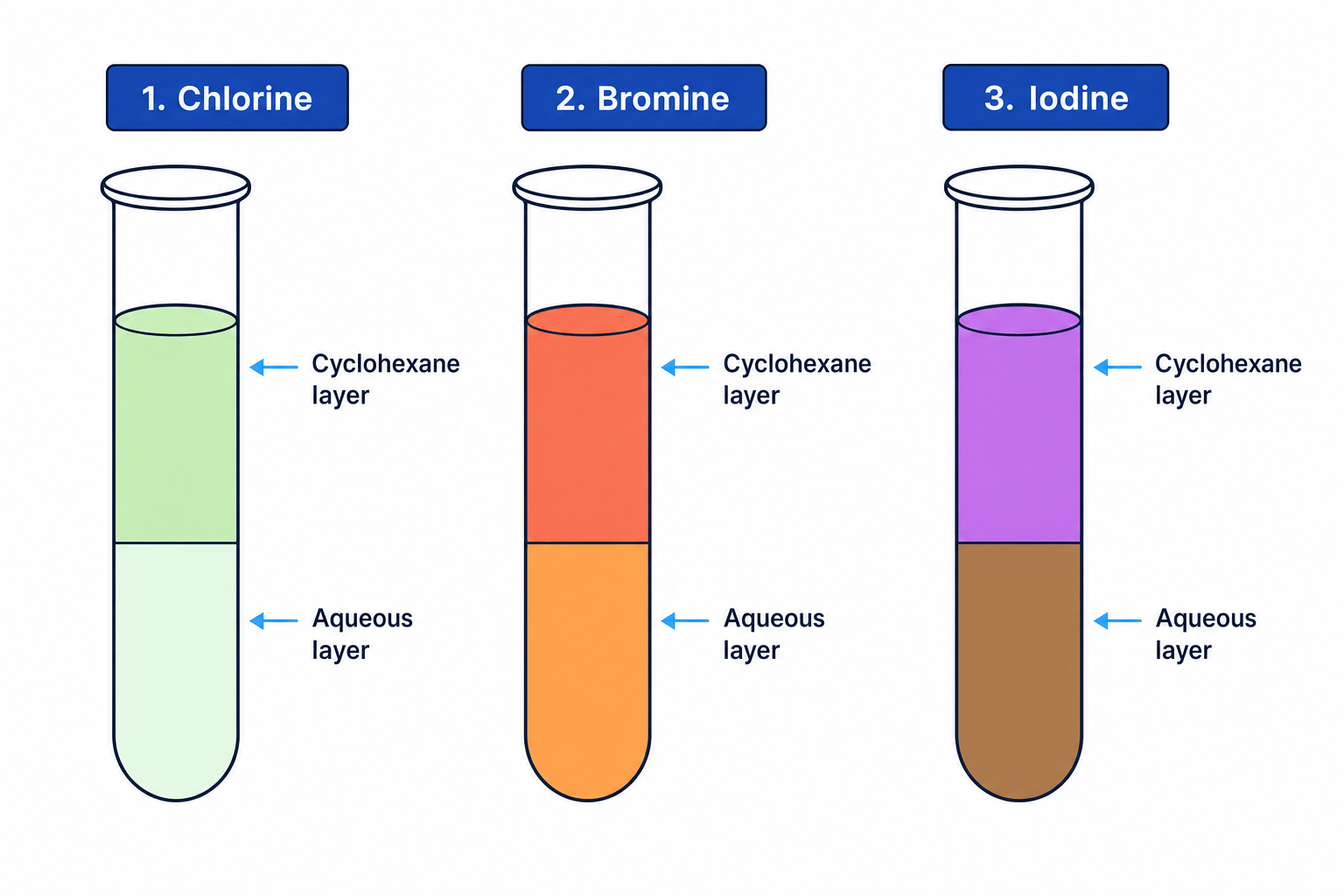
To overcome this, we add a non-polar organic solvent like cyclohexane and shake the mixture. Because halogens are non-polar, they dissolve much more readily in cyclohexane than in polar water. The cyclohexane layer is less dense than water and floats as a distinct layer on top, showing highly vivid colours:
- Chlorine in cyclohexane: Pale green
- Bromine in cyclohexane: Orange/red
- Iodine in cyclohexane: Deep violet/purple
Writing and interpreting displacement ionic equations
Suppose you add aqueous chlorine (Cl2(aq)\text{Cl}_2\text{(aq)}Cl2(aq)) to a solution of potassium iodide (KI(aq)\text{KI(aq)}KI(aq)) in a test tube, shake it with cyclohexane, and observe a violet organic layer. Let's walk through representing this reaction.
- Identify the active species and write the full chemical equation: Chlorine is more reactive than iodine, so a displacement reaction occurs:
- Deduce the ionic equation by removing spectator ions: Potassium ions (K+\text{K}^+K+) do not change their state or oxidation number. Eliminating them yields the ionic equation:
-
Determine the oxidation number changes:
- The oxidation number of chlorine changes from 000 in Cl2\text{Cl}_2Cl2 to −1-1−1 in Cl−\text{Cl}^-Cl− (it has been reduced).
- The oxidation number of iodine changes from −1-1−1 in I−\text{I}^-I− to 000 in I2\text{I}_2I2 (it has been oxidised).
-
Identify the oxidising and reducing agents: Because chlorine gained electrons and caused iodide to be oxidised, Cl2\text{Cl}_2Cl2 is the oxidising agent. Because iodide ions donated electrons to chlorine, I−\text{I}^-I− is the reducing agent.
3. Disproportionation
You must be able to define and write equations for reactions involving disproportionation.
Disproportionation
Disproportionation is a specific redox reaction in which the same element is simultaneously oxidised and reduced.
OCR require you to know two specific disproportionation reactions of chlorine.
I. Chlorine with Water (Water Treatment)
When a small amount of chlorine is added to water, a reversible disproportionation reaction occurs:
Cl2(aq)+H2O(l)⇌HClO(aq)+HCl(aq) \text{Cl}_2\text{(aq)} + \text{H}_2\text{O(l)} \rightleftharpoons \text{HClO(aq)} + \text{HCl(aq)} Cl2(aq)+H2O(l)⇌HClO(aq)+HCl(aq)Let's analyze the oxidation numbers of chlorine in this reaction:
- In reactants: Cl2\text{Cl}_2Cl2 has an oxidation state of 000.
- In products:
- HCl\text{HCl}HCl (hydrochloric acid): Chlorine has an oxidation state of −1-1−1 (reduced).
- HClO\text{HClO}HClO (chloric(I) acid): Chlorine has an oxidation state of +1+1+1 (oxidised).
The chloric(I) acid (HClO\text{HClO}HClO) produced acts as a powerful sanitising agent. It kills bacteria and pathogens, making water safe for human consumption.
II. Chlorine with Cold, Dilute Sodium Hydroxide (Bleach Synthesis)
If chlorine is reacted with cold, dilute aqueous sodium hydroxide (NaOH\text{NaOH}NaOH) at room temperature, household bleach (NaClO\text{NaClO}NaClO) is formed:
Cl2(aq)+2NaOH(aq)→NaClO(aq)+NaCl(aq)+H2O(l) \text{Cl}_2\text{(aq)} + 2\text{NaOH(aq)} \to \text{NaClO(aq)} + \text{NaCl(aq)} + \text{H}_2\text{O(l)} Cl2(aq)+2NaOH(aq)→NaClO(aq)+NaCl(aq)+H2O(l)Again, this is a disproportionation reaction:
- The oxidation state of chlorine starts at 000 in Cl2\text{Cl}_2Cl2.
- It is reduced to −1-1−1 in sodium chloride (NaCl\text{NaCl}NaCl).
- It is oxidised to +1+1+1 in sodium chlorate(I) (NaClO\text{NaClO}NaClO).
Temperature and Concentration
This reaction only forms bleach (NaClO\text{NaClO}NaClO) with cold, dilute alkali. If hot, concentrated NaOH\text{NaOH}NaOH is used instead, chlorine is oxidised further to form sodium chlorate(V) (NaClO3\text{NaClO}_3NaClO3), which is a strong weedkiller, not household bleach:
3Cl2+6NaOH→NaClO3+5NaCl+3H2O 3\text{Cl}_2 + 6\text{NaOH} \to \text{NaClO}_3 + 5\text{NaCl} + 3\text{H}_2\text{O} 3Cl2+6NaOH→NaClO3+5NaCl+3H2OAlways double-check that you specify "cold and dilute" for bleach production!
Analogous Reactions
The other halogens undergo analogous disproportionation reactions. For instance, bromine reacts with cold, dilute sodium hydroxide in exactly the same way:
Br2(aq)+2NaOH(aq)→NaBrO(aq)+NaBr(aq)+H2O(l) \text{Br}_2\text{(aq)} + 2\text{NaOH(aq)} \to \text{NaBrO(aq)} + \text{NaBr(aq)} + \text{H}_2\text{O(l)} Br2(aq)+2NaOH(aq)→NaBrO(aq)+NaBr(aq)+H2O(l)4. The Benefits and Risks of Chlorination
The addition of chlorine to public drinking water supplies is a highly discussed socio-scientific topic. You need to weigh both sides of the argument:
Benefits
- Saves lives: It effectively destroys waterborne pathogens that cause lethal epidemics like cholera and typhoid.
- Residual protection: Chlorine remains active in the water pipes after treatment, preventing recontamination during transit to homes.
Risks
- Toxicity: Chlorine gas is highly toxic and can cause severe respiratory distress if there is a chemical leak at a treatment plant.
- Carcinogenic by-products: Chlorine can react with naturally occurring organic matter (such as decaying plant material) in water to form chlorinated hydrocarbons (such as trihalomethanes, e.g. chloroform, CHCl3\text{CHCl}_3CHCl3). These chemicals are suspected carcinogens and have been linked to long-term health risks.
Ethical Considerations & Alternatives
Some people object to the chlorination of drinking water because it removes their personal freedom to choose what substances they ingest (often referred to as an ethical issue of "mass medication").
Alternative purification methods include:
- Ozone (O3\text{O}_3O3): An extremely strong oxidising agent that kills viruses and bacteria without leaving a chemical taste, but it is expensive to run and provides no residual protection once the water leaves the plant.
- Ultraviolet (UV) radiation: Very effective at destroying microbial DNA, but it is expensive and offers no ongoing protection in the water mains.
5. Qualitative Testing for Halide Ions (PAG 4)
We can identify unknown halide ions (Cl−\text{Cl}^-Cl−, Br−\text{Br}^-Br−, and I−\text{I}^-I−) in solution using a sequential precipitation test.
Step 1: Acidification with Nitric Acid
Before adding the testing reagent, you must add dilute nitric acid (HNO3\text{HNO}_3HNO3).
- The purpose: To react with and remove any carbonate (CO32−\text{CO}_3^{2-}CO32−) or hydroxide (OH−\text{OH}^-OH−) impurities in the sample.
- If left in the sample, these ions would react with silver ions to form silver carbonate (Ag2CO3\text{Ag}_2\text{CO}_3Ag2CO3) or silver hydroxide (AgOH\text{AgOH}AgOH), which are both precipitates that would produce a false-positive result.
Using HCl or H₂SO₄ for Acidification
Never use hydrochloric acid (HCl\text{HCl}HCl) or sulfuric acid (H2SO4\text{H}_2\text{SO}_4H2SO4) to acidify your sample.
- HCl\text{HCl}HCl introduces chloride ions (Cl−\text{Cl}^-Cl−) which will react with silver nitrate to form a dense white precipitate, instantly invalidating the test.
- H2SO4\text{H}_2\text{SO}_4H2SO4 can react to form silver sulfate, which is marginally soluble and can interfere with results. Only use nitric acid (HNO3\text{HNO}_3HNO3).
Step 2: Addition of Silver Nitrate
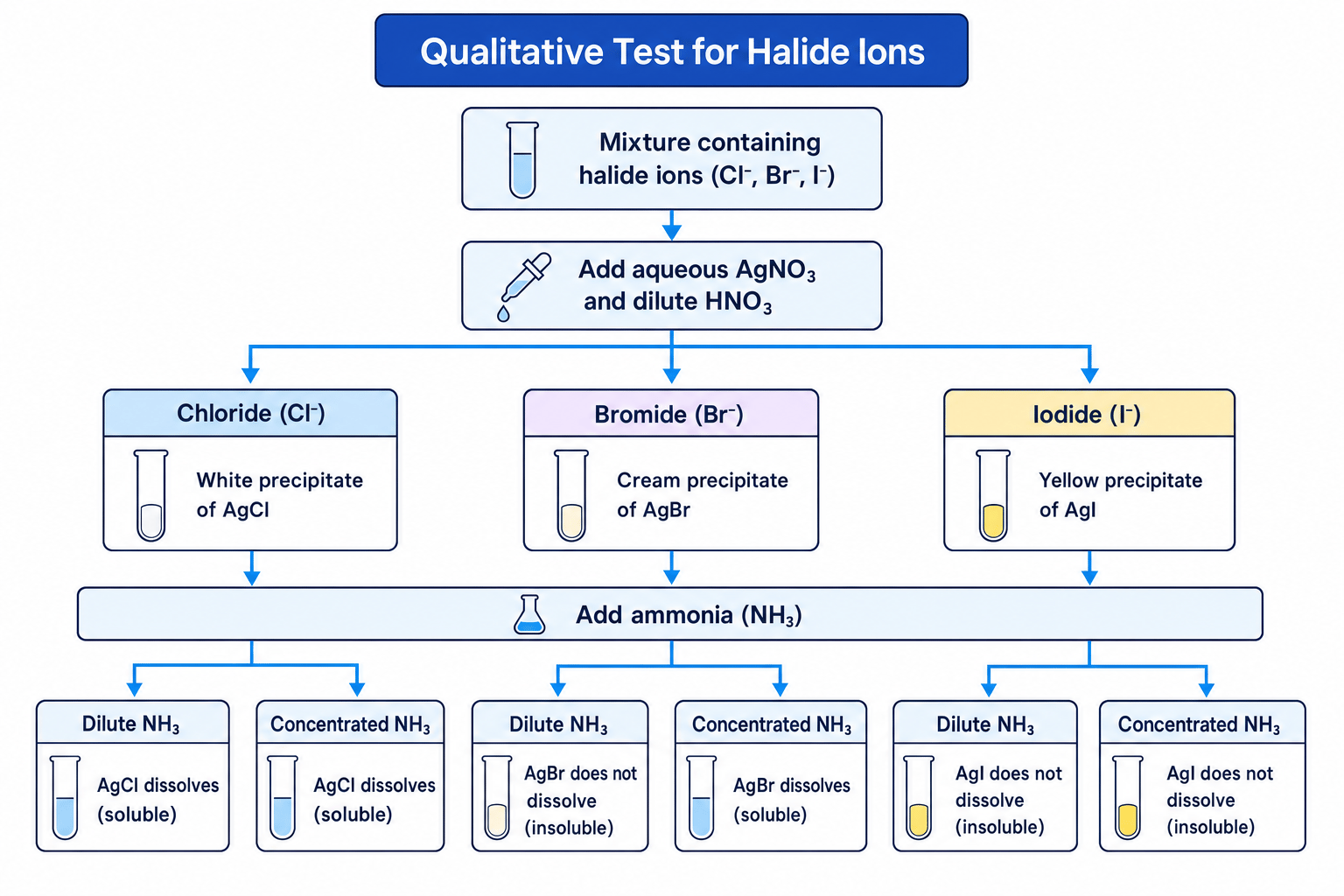
Add aqueous silver nitrate (AgNO3(aq)\text{AgNO}_3\text{(aq)}AgNO3(aq)). Silver ions react with the halide ions to form insoluble silver halide precipitates:
Ag+(aq)+X−(aq)→AgX(s) \text{Ag}^+\text{(aq)} + \text{X}^-\text{(aq)} \to \text{AgX(s)} Ag+(aq)+X−(aq)→AgX(s)- Chloride (Cl−\text{Cl}^-Cl−) forms a white precipitate (AgCl\text{AgCl}AgCl):
- Bromide (Br−\text{Br}^-Br−) forms a cream precipitate (AgBr\text{AgBr}AgBr):
- Iodide (I−\text{I}^-I−) forms a yellow precipitate (AgI\text{AgI}AgI):
Step 3: Confirmation with Aqueous Ammonia
Because white, cream, and yellow can be difficult to tell apart with the naked eye under lab lighting, we add aqueous ammonia (NH3(aq)\text{NH}_3\text{(aq)}NH3(aq)) of different concentrations to differentiate them:
- Silver chloride (AgCl\text{AgCl}AgCl): The precipitate dissolves in dilute ammonia to form a colourless solution.
- Silver bromide (AgBr\text{AgBr}AgBr): The precipitate is insoluble in dilute ammonia but dissolves in concentrated ammonia.
- Silver iodide (AgI\text{AgI}AgI): The precipitate is insoluble in both dilute and concentrated ammonia.
In the exam
- Be precise with state symbols: For halide tests, the reactants are aqueous (Ag+(aq)\text{Ag}^+\text{(aq)}Ag+(aq), X−(aq)\text{X}^-\text{(aq)}X−(aq)) and the products are precipitates, so they must have the solid state symbol (AgX(s)\text{AgX(s)}AgX(s)).
- Structure periodic trend explanations systematically: Always address three distinct points: atomic radius, electron shielding, and nuclear attraction. Conclude by explicitly stating how this affects the ease of electron gain or loss.
- Don't lose marks on the NaOH conditions: When describing bleach synthesis, always state that the sodium hydroxide must be cold and dilute.
Check yourself
- Explain why iodine has a higher boiling point than chlorine, despite chlorine being far more reactive.
- Write the full chemical and ionic equations for the reaction of bromine water with sodium iodide solution, and describe the colour changes you would see before and after adding cyclohexane.
- A student tests an unknown solution by adding nitric acid, silver nitrate, and then concentrated ammonia. A precipitate remains at the end of the test. What halide ion(s) could be present?
