4. Reactions of Group 2 Oxides and Hydroxide Solubility
Group 2 oxides and hydroxides are basic compounds. Understanding their behaviour in water is a key part of the OCR syllabus.
Action of Water on Group 2 Oxides
When a Group 2 oxide is added to water, it reacts to form a metal hydroxide. The general equation is:
MO(s)+H2O(l)→M(OH)2(aq) \text{MO(s)} + \text{H}_2\text{O(l)} \to \text{M(OH)}_2\text{(aq)} MO(s)+H2O(l)→M(OH)2(aq)For example, when calcium oxide (quicklime) reacts with water, it forms calcium hydroxide (slaked lime):
CaO(s)+H2O(l)→Ca(OH)2(s/aq) \text{CaO(s)} + \text{H}_2\text{O(l)} \to \text{Ca(OH)}_2\text{(s/aq)} CaO(s)+H2O(l)→Ca(OH)2(s/aq)The resulting hydroxides dissolve in water, releasing hydroxide (OH−\text{OH}^-OH−) ions:
M(OH)2(s)⇌M2+(aq)+2OH−(aq) \text{M(OH)}_2\text{(s)} \rightleftharpoons \text{M}^{2+}\text{(aq)} + 2\text{OH}^-\text{(aq)} M(OH)2(s)⇌M2+(aq)+2OH−(aq)The Trend in Solubility and Alkalinity
The solubility of Group 2 hydroxides increases down the group.
- Magnesium hydroxide, Mg(OH)2\text{Mg(OH)}_2Mg(OH)2, is only sparingly soluble in water. When placed in water, very few OH−\text{OH}^-OH− ions are released into the solution. This results in a low concentration of hydroxide ions and a weakly alkaline solution (pH≈8−9\text{pH} \approx 8 - 9pH≈8−9).
- Barium hydroxide, Ba(OH)2\text{Ba(OH)}_2Ba(OH)2, is highly soluble. When dissolved, it releases a high concentration of OH−\text{OH}^-OH− ions, yielding a strongly alkaline solution (pH≈13\text{pH} \approx 13pH≈13).
As a result, as you go down Group 2:
- The solubility of the metal hydroxides increases.
- The concentration of dissolved hydroxide ions (OH−\text{OH}^-OH−) increases.
- The alkalinity and the pH of the resulting solution increases.
Solubility and pH trend
Moving down Group 2, hydroxides become MORE soluble, releasing more OH⁻ ions into solution, which causes the pH to INCREASE.
5. Uses of Group 2 Compounds as Bases
Because Group 2 oxides, hydroxides, and carbonates act as bases, they are widely used to neutralise acids in everyday life. You need to know the specific equations and context for these uses.
(i) Agriculture: Calcium Hydroxide, Ca(OH)2\text{Ca(OH)}_2Ca(OH)2
Acidic soils can reduce crop yields because many plants cannot absorb nutrients effectively in low-pH soils. Farmers add calcium hydroxide (often referred to as slaked lime) to fields to neutralise the excess acid and raise the soil pH.
The hydroxide ions (OH−\text{OH}^-OH−) react with the hydrogen ions (H+\text{H}^+H+) in the soil to form water:
Ca(OH)2(s)+2H+(aq)→Ca2+(aq)+2H2O(l) \text{Ca(OH)}_2\text{(s)} + 2\text{H}^+\text{(aq)} \to \text{Ca}^{2+}\text{(aq)} + 2\text{H}_2\text{O(l)} Ca(OH)2(s)+2H+(aq)→Ca2+(aq)+2H2O(l)(ii) Medicine: Antacids
Excess hydrochloric acid (HCl\text{HCl}HCl) in the stomach can cause acid indigestion or heartburn. Weak bases are used as "antacids" to neutralise this excess acid without damaging stomach tissue.
- Magnesium hydroxide, Mg(OH)2\text{Mg(OH)}_2Mg(OH)2 (often sold as a suspension called 'Milk of Magnesia'), is used as an antacid. Because Mg(OH)2\text{Mg(OH)}_2Mg(OH)2 is only sparingly soluble, it is safe to ingest and will not make the mouth or throat excessively alkaline, but it successfully neutralises the strong stomach acid:
- Calcium carbonate, CaCO3\text{CaCO}_3CaCO3, is also commonly used in chewable antacid tablets. The carbonate ion (CO32−\text{CO}_3^{2-}CO32−) neutralises the acid, producing a salt, water, and carbon dioxide gas (which can cause burping!):
In the exam
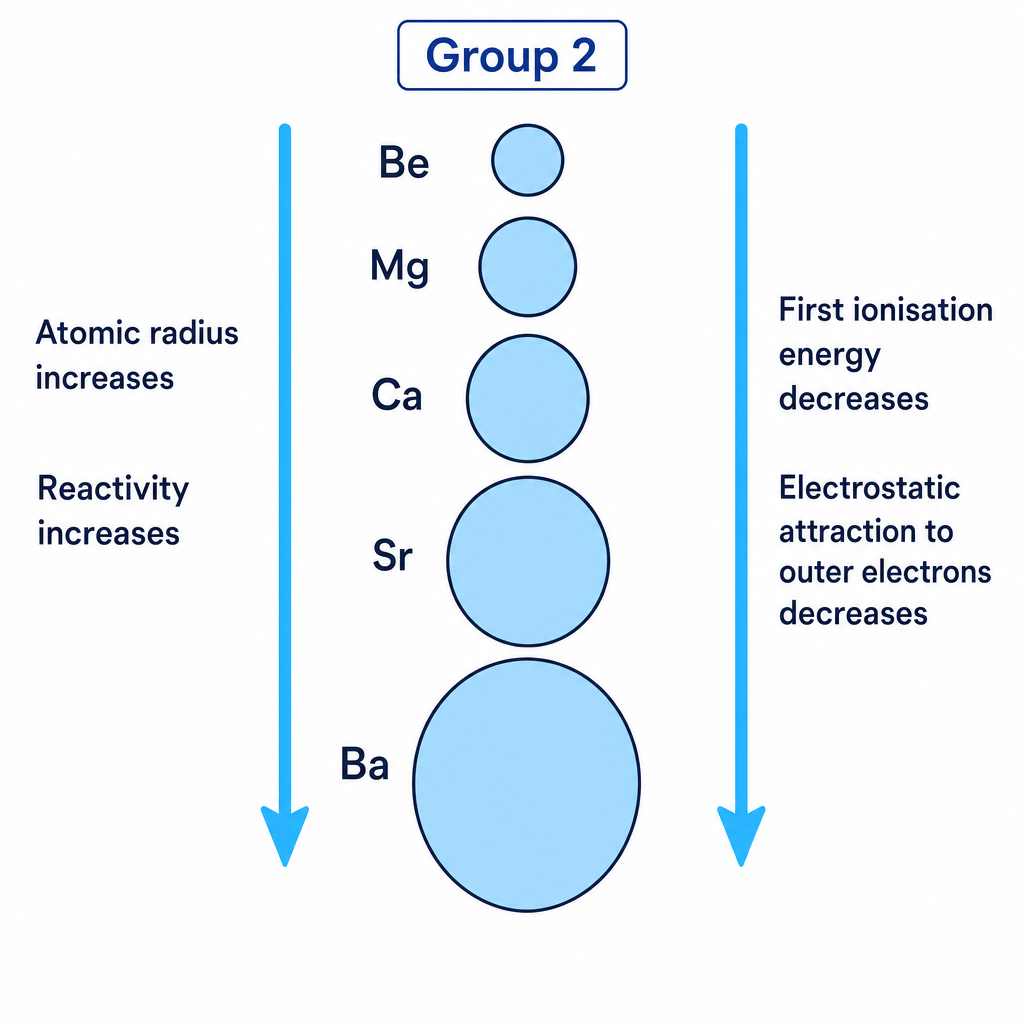
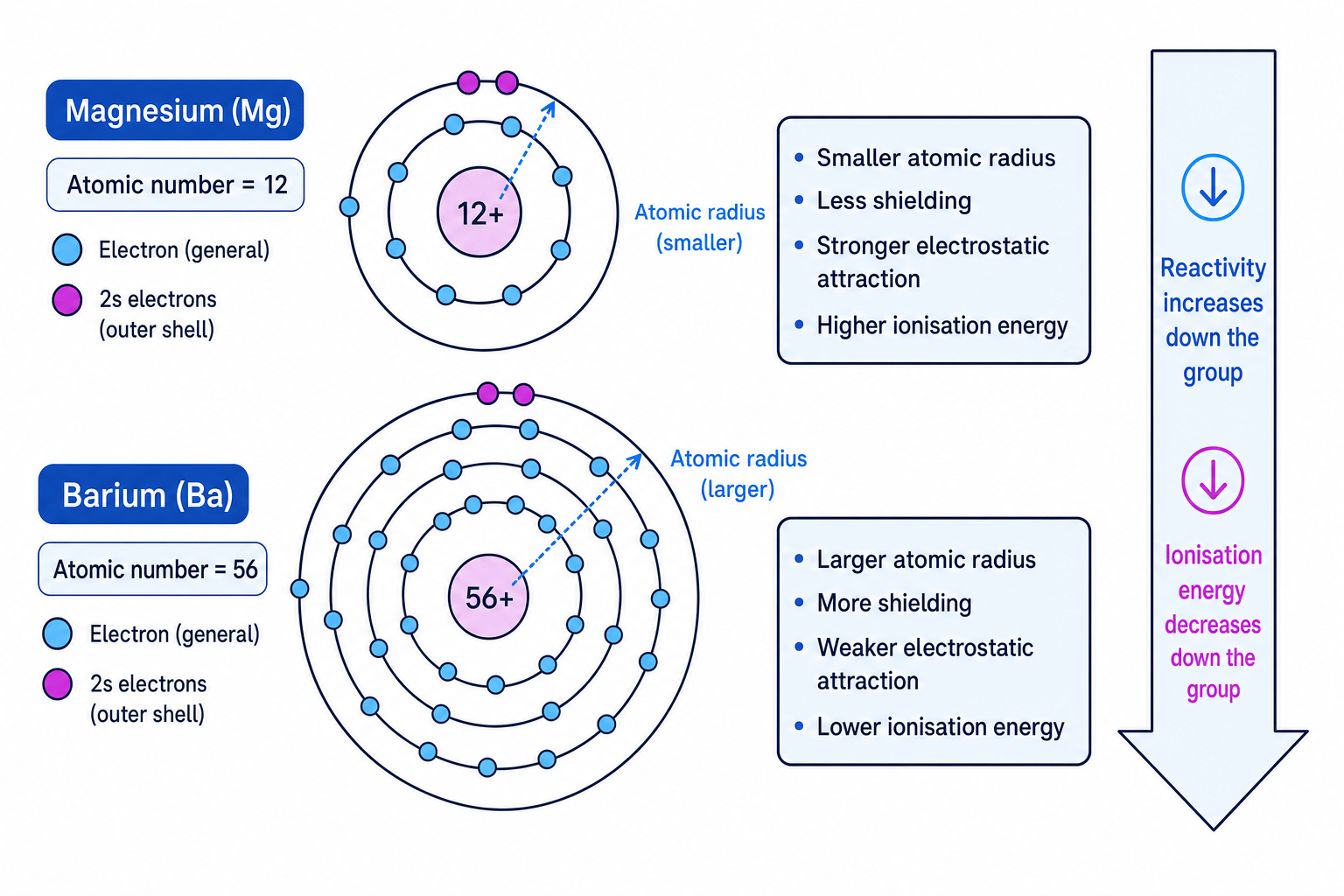
- Explain the trend in reactivity using all three factors: When asked to explain why Group 2 reactivity increases down the group, always mention: (a) increased atomic radius, (b) increased shielding, and (c) weaker nuclear attraction to the outer electrons. This is a very common 3-mark question.
- Do not confuse the terms "solubility" and "reactivity": Reactivity increases down the group because of ionisation energy. Solubility of hydroxides also increases down the group, but this is a physical equilibrium property, not a redox property.
- Be careful with state symbols: When writing equations for ionisation energy, state symbols are strictly required to be gas (g\text{g}g).
- State the products of the steam reaction correctly: If the question specifies magnesium reacting with steam, ensure your product is MgO\text{MgO}MgO and NOT Mg(OH)2\text{Mg(OH)}_2Mg(OH)2.
Check yourself
- Write the full chemical equation, including state symbols, for the reaction of calcium metal with cold water.
- Explain in terms of electrostatic attraction why the second ionisation energy of calcium is higher than the first ionisation energy of calcium.
- Which Group 2 hydroxide would you expect to produce a solution with a higher pH when added to water: magnesium hydroxide or strontium hydroxide? Explain your answer.