

In chemistry, we often need to find out what is in a sample without necessarily measuring how much of it is there. This is the realm of qualitative analysis.
Qualitative tests must be quick, reliable, and produce distinct visual changes—such as color changes, gas evolution, or the formation of an insoluble solid. In this guide, you will learn the exact chemical tests and the strict sequence required to identify key anions and cations under the OCR A specification.
What you'll learn
- How to test for carbonate, sulfate, and halide ions on a test-tube scale.
- Why a strict sequence of testing is absolutely vital to prevent false-positive results.
- How to identify the ammonium cation (NH4+NH_4^+NH4+) using a simple chemical test.
Defining Qualitative Analysis
Before diving into the specific test procedures, we must define our key terms.
Qualitative analysis
Qualitative analysis is the experimental identification of the chemical species (such as elements, ions, or functional groups) present in a substance. Unlike quantitative analysis, it does not measure the amount or concentration of the species.
Precipitation reaction
A precipitation reaction is a reaction in which soluble ions in separate aqueous solutions react together to form an insoluble solid product, known as a precipitate.
Anion Testing: The Individual Tests
Anions are negatively charged ions. For your A-Level exams, you must know the tests for three main classes of anions: carbonates (CO32−\text{CO}_3^{2-}CO32−), sulfates (SO42−\text{SO}_4^{2-}SO42−), and halides (Cl−\text{Cl}^-Cl−, Br−\text{Br}^-Br−, and I−\text{I}^-I−).
1. The Carbonate Test
To test for the presence of a carbonate ion (CO32−\text{CO}_3^{2-}CO32−):
- Method: Add a dilute strong acid, such as dilute nitric acid (HNO3(aq)\text{HNO}_3\text{(aq)}HNO3(aq)), to the solid or aqueous sample at room temperature.
- Observation: If carbonate ions are present, you will observe immediate effervescence (bubbling) as carbon dioxide gas (CO2\text{CO}_2CO2) is released.
- Confirmation: To prove the gas is CO2\text{CO}_2CO2, bubble it through aqueous calcium hydroxide (limewater). The limewater will turn cloudy due to the formation of a white precipitate of calcium carbonate (CaCO3\text{CaCO}_3CaCO3).
The ionic equation for the primary test is:
CO32−(aq)+2H+(aq)→CO2(g)+H2O(l) \text{CO}_3^{2-}(\text{aq}) + 2\text{H}^+(\text{aq}) \to \text{CO}_2(\text{g}) + \text{H}_2\text{O}(\text{l}) CO32−(aq)+2H+(aq)→CO2(g)+H2O(l)The confirmation reaction in limewater is:
Ca(OH)2(aq)+CO2(g)→CaCO3(s)+H2O(l) \text{Ca(OH)}_2(\text{aq}) + \text{CO}_2(\text{g}) \to \text{CaCO}_3(\text{s}) + \text{H}_2\text{O}(\text{l}) Ca(OH)2(aq)+CO2(g)→CaCO3(s)+H2O(l)2. The Sulfate Test
To test for the presence of a sulfate ion (SO42−\text{SO}_4^{2-}SO42−):
- Method: Add aqueous barium ions (Ba2+(aq)\text{Ba}^{2+}\text{(aq)}Ba2+(aq)) to the sample. This is typically added as barium chloride (BaCl2(aq)\text{BaCl}_2\text{(aq)}BaCl2(aq)) or barium nitrate (Ba(NO3)2(aq)\text{Ba(NO}_3)_2\text{(aq)}Ba(NO3)2(aq)).
- Observation: If sulfate ions are present, a dense white precipitate of barium sulfate (BaSO4\text{BaSO}_4BaSO4) forms immediately.
The ionic equation for this precipitation reaction is:
Ba2+(aq)+SO42−(aq)→BaSO4(s) \text{Ba}^{2+}(\text{aq}) + \text{SO}_4^{2-}(\text{aq}) \to \text{BaSO}_4(\text{s}) Ba2+(aq)+SO42−(aq)→BaSO4(s)Choice of barium reagent
If you intend to test for halides after the sulfate test on the same sample, do not use barium chloride (BaCl2\text{BaCl}_2BaCl2) for the sulfate test! Doing so introduces chloride ions (Cl−\text{Cl}^-Cl−) into your solution, which will ruin any subsequent halide tests. Always use barium nitrate (Ba(NO3)2\text{Ba(NO}_3)_2Ba(NO3)2) if you are running sequential tests.
3. The Halide Test
To test for halide ions—chloride (Cl−\text{Cl}^-Cl−), bromide (Br−\text{Br}^-Br−), and iodide (I−\text{I}^-I−):
- Method: First, add dilute nitric acid (HNO3(aq)\text{HNO}_3\text{(aq)}HNO3(aq)) to remove any interfering carbonate ions. Then, add aqueous silver nitrate (AgNO3(aq)\text{AgNO}_3\text{(aq)}AgNO3(aq)).
- Observation: Silver ions react with halide ions to form colored silver halide precipitates:
- Chloride (Cl−\text{Cl}^-Cl−): Forms a white precipitate (AgCl\text{AgCl}AgCl).
- Bromide (Br−\text{Br}^-Br−): Forms a cream precipitate (AgBr\text{AgBr}AgBr).
- Iodide (I−\text{I}^-I−): Forms a yellow precipitate (AgI\text{AgI}AgI).
The general ionic equation is:
Ag+(aq)+X−(aq)→AgX(s) \text{Ag}^+(\text{aq}) + \text{X}^-(\text{aq}) \to \text{AgX}(\text{s}) Ag+(aq)+X−(aq)→AgX(s)Confirming Halides with Ammonia
Because white, cream, and yellow can look highly subjective and similar under test-tube conditions, you must confirm the halide using aqueous ammonia (NH3(aq)\text{NH}_3\text{(aq)}NH3(aq)):
- Silver chloride (AgCl\text{AgCl}AgCl): Precipitate dissolves in dilute ammonia solution to form a colorless solution.
- Silver bromide (AgBr\text{AgBr}AgBr): Precipitate is insoluble in dilute ammonia, but dissolves in concentrated ammonia solution.
- Silver iodide (AgI\text{AgI}AgI): Precipitate is completely insoluble in both dilute and concentrated ammonia.
The Crucial Sequence: Carbonate →\to→ Sulfate →\to→ Halide
If you are handed an unknown solution that could contain a mixture of ions, you cannot simply perform these tests in any random order. Doing so will lead to chemistry-induced errors called false positives.
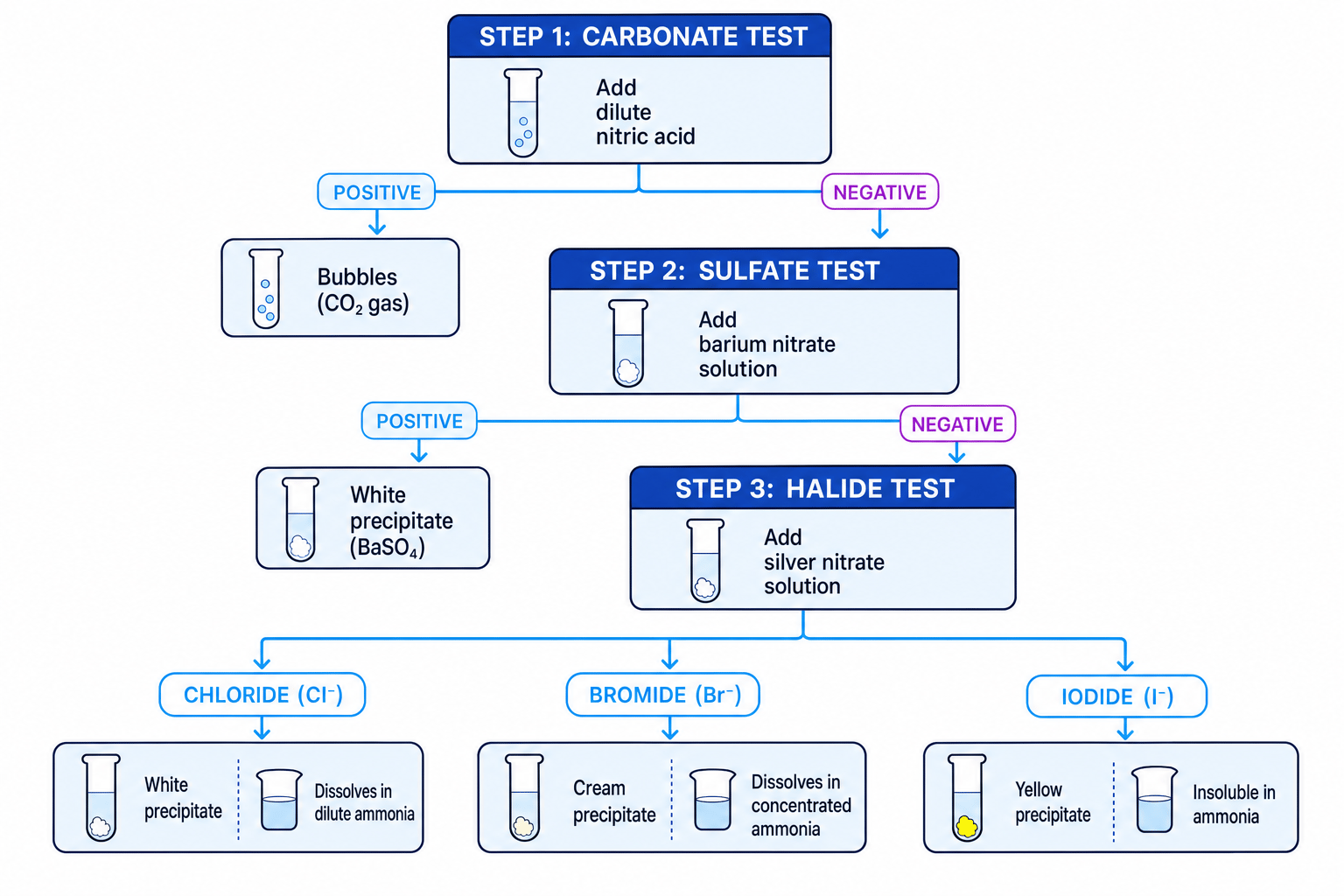
The Correct Sequence
Always perform the tests in this exact order:
- Carbonate (CO32−\text{CO}_3^{2-}CO32−)
- Sulfate (SO42−\text{SO}_4^{2-}SO42−)
- Halide (Cl−\text{Cl}^-Cl−, Br−\text{Br}^-Br−, I−\text{I}^-I−)
Why is this sequence necessary?
Let us break down the chemistry of what happens if you do these tests in the wrong order:
- Why Carbonate must come before Sulfate: If you add barium ions (Ba2+\text{Ba}^{2+}Ba2+) to an unknown solution that contains carbonate ions, you will get a white precipitate of barium carbonate (BaCO3(s)\text{BaCO}_3\text{(s)}BaCO3(s)) because barium carbonate is also insoluble in water!
You would mistake this for a positive sulfate result. Because the carbonate test is done first (by adding acid), any carbonate ions are destroyed and bubbled away as CO2\text{CO}_2CO2 before you move on to the sulfate test.
- Why Sulfate must come before Halide: If you add silver ions (Ag+\text{Ag}^+Ag+) to a solution containing sulfate ions, you can form a precipitate of silver sulfate (Ag2SO4(s)\text{Ag}_2\text{SO}_4\text{(s)}Ag2SO4(s)) because silver sulfate is only sparingly soluble in water.
This white precipitate would easily be confused with a white silver chloride (AgCl\text{AgCl}AgCl) precipitate, giving you a false positive for chloride. Doing the sulfate test first allows you to precipitate out and filter off all sulfate ions before adding silver nitrate.
How to remember the sequence
Use the alphabetical mnemonic C-S-H: Carbonate, then Sulfate, then Halide. ("Chemistry Students Happy").
Testing for a Cation: The Ammonium Ion (NH4+\text{NH}_4^+NH4+)
The main cation test specified in this section of the OCR A syllabus is the test for the ammonium ion (NH4+\text{NH}_4^+NH4+).
- Method: Add aqueous sodium hydroxide (NaOH(aq)\text{NaOH}\text{(aq)}NaOH(aq)) to the solid or solution in a test tube, and warm the mixture gently in a water bath or over a Bunsen burner.
- Observation: No precipitate forms, but ammonia gas (NH3\text{NH}_3NH3) is evolved.
- Detection: You can detect the presence of NH3\text{NH}_3NH3 gas in two ways:
- It has a highly pungent, choking smell.
- Hold damp red litmus paper near the mouth of the test tube. The alkaline ammonia gas dissolves in the water on the paper, turning the litmus paper blue.
The ionic equation for this reaction is:
NH4+(aq)+OH−(aq)→NH3(g)+H2O(l) \text{NH}_4^+(\text{aq}) + \text{OH}^-(\text{aq}) \to \text{NH}_3(\text{g}) + \text{H}_2\text{O}(\text{l}) NH4+(aq)+OH−(aq)→NH3(g)+H2O(l)Why damp litmus paper?
The litmus paper must be damp. Ammonia gas is not alkaline on its own; it must dissolve in water to produce hydroxide ions (OH−\text{OH}^-OH−) which turn the indicator blue:
NH3(g)+H2O(l)⇌NH4+(aq)+OH−(aq) \text{NH}_3(\text{g}) + \text{H}_2\text{O}(\text{l}) \rightleftharpoons \text{NH}_4^+(\text{aq}) + \text{OH}^-(\text{aq}) NH3(g)+H2O(l)⇌NH4+(aq)+OH−(aq)If you use dry litmus paper, the test will not work!
Worked Example: Deductive Qualitative Analysis
Here is how you apply this logical sequential testing to an unknown mixture in a real laboratory scenario.
Analyzing an unknown mixture of ions
You are given a single test tube containing an unknown aqueous mixture of two anions and one cation. Describe the exact experimental steps you would take, including the observations you would make, to identify all three ions. Assume the mixture contains a combination of the ions studied above.
-
Step 1: Test for the Carbonate Ion (CO32−\text{CO}_3^{2-}CO32−) Add dilute nitric acid (HNO3(aq)\text{HNO}_3\text{(aq)}HNO3(aq)) to a sample of the mixture in a test tube. If you observe immediate effervescence, bubble the gas produced through limewater. If the limewater turns cloudy, this confirms the presence of the carbonate ion (CO32−\text{CO}_3^{2-}CO32−). Crucial note: Keep adding dilute nitric acid until all effervescence completely stops. This ensures that every single carbonate ion in the mixture has been destroyed and converted to CO2\text{CO}_2CO2 gas, preventing them from interfering in later steps.
-
Step 2: Test for the Sulfate Ion (SO42−\text{SO}_4^{2-}SO42−) To the exact same test tube from Step 1 (which now contains excess H+\text{H}^+H+ and NO3−\text{NO}_3^-NO3− ions, but zero carbonate ions), add an excess of aqueous barium nitrate (Ba(NO3)2(aq)\text{Ba(NO}_3)_2\text{(aq)}Ba(NO3)2(aq)). If a dense white precipitate forms, the sulfate ion (SO42−\text{SO}_4^{2-}SO42−) is present. Crucial note: To prepare the mixture for the halide test, you must now completely remove this solid barium sulfate precipitate. Filter the mixture or use a centrifuge to obtain a clear, solid-free filtrate in a clean test tube.
-
Step 3: Test for the Halide Ion (Cl−\text{Cl}^-Cl−, Br−\text{Br}^-Br−, or I−\text{I}^-I−) To the clear filtrate from Step 2 (which now contains no carbonate and no sulfate ions), add aqueous silver nitrate (AgNO3(aq)\text{AgNO}_3\text{(aq)}AgNO3(aq)). If a precipitate forms, note its color: white (Cl−\text{Cl}^-Cl−), cream (Br−\text{Br}^-Br−), or yellow (I−\text{I}^-I−). To confirm, add dilute ammonia (NH3(aq)\text{NH}_3\text{(aq)}NH3(aq)). If the precipitate dissolves, it is chloride (Cl−\text{Cl}^-Cl−). If it does not dissolve, add concentrated ammonia. If it dissolves now, it is bromide (Br−\text{Br}^-Br−); if it remains insoluble, it is iodide (I−\text{I}^-I−).
-
Step 4: Test for the Ammonium Cation (NH4+\text{NH}_4^+NH4+) Take a fresh, separate sample of the original mixture. Add aqueous sodium hydroxide (NaOH(aq)\text{NaOH}\text{(aq)}NaOH(aq)) and warm the tube gently. Hold damp red litmus paper over the mouth of the test tube. If the paper turns blue, the mixture contains the ammonium ion (NH4+\text{NH}_4^+NH4+).
In the exam
- Never use hydrochloric acid (HCl\text{HCl}HCl) or sulfuric acid (H2SO4\text{H}_2\text{SO}_4H2SO4) when testing for carbonates if you plan to test for halides or sulfates later. HCl\text{HCl}HCl introduces Cl−\text{Cl}^-Cl− ions, and H2SO4\text{H}_2\text{SO}_4H2SO4 introduces SO42−\text{SO}_4^{2-}SO42− ions, which will lead to false-positive results in those respective tests. Always use nitric acid (HNO3\text{HNO}_3HNO3).
- Include state symbols in your ionic equations. Examiners frequently award a mark specifically for state symbols in precipitation reactions (e.g., (aq)+(aq)→(s)(\text{aq}) + (\text{aq}) \to (\text{s})(aq)+(aq)→(s)) and gas-evolution reactions.
- When describing the halide test, specify dilute and concentrated ammonia. You will lose marks if you simply write "add ammonia" without distinguishing between the concentrations used to differentiate Cl−\text{Cl}^-Cl− and Br−\text{Br}^-Br−.
Check yourself
- Why is it incorrect to test for halide ions before testing for sulfate ions? Use ionic equations to support your answer.
- What is the chemical reason that limewater turns cloudy when carbon dioxide is bubbled through it?
- A student performs the ammonium test by adding NaOH(aq)\text{NaOH(aq)}NaOH(aq) and heating. They hold dry red litmus paper over the tube, but it remains red. Explain the student's mistake.
