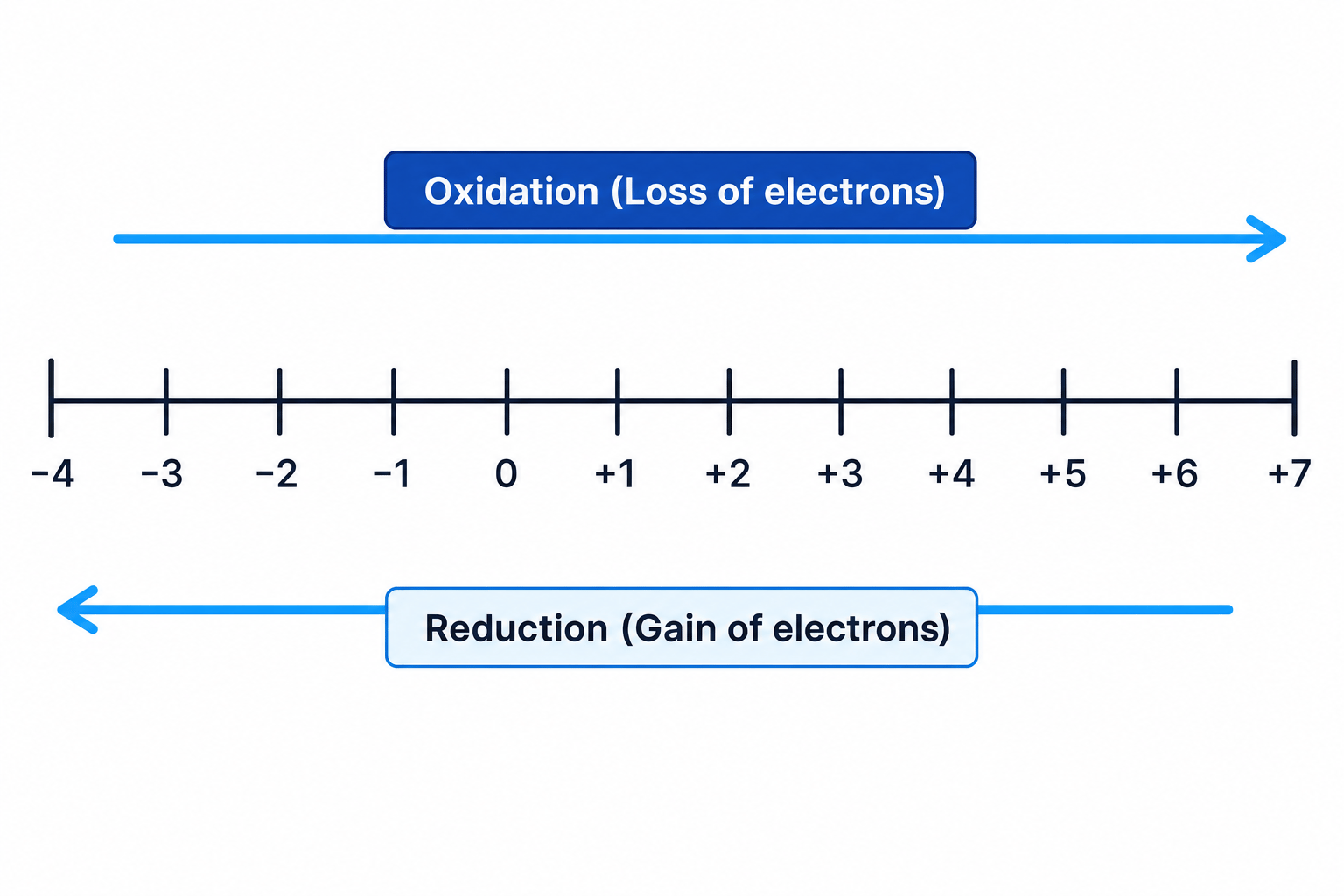
Welcome to your study notes on Redox. In GCSE, you likely learned that oxidation is the "gain of oxygen" and reduction is the "loss of oxygen", or memorised the acronym OIL RIG (Oxidation Is Loss, Reduction Is Gain of electrons). At A-Level, we expand these definitions using oxidation numbers (also called oxidation states). This mathematical tool allows you to track electron movement in complex reactions where oxygen isn't even present.
What you'll learn:
- How to apply the fundamental rules to assign oxidation numbers to any element, compound, or ion.
- How to write and interpret chemical formulae using systematic Roman numeral nomenclature.
- How to identify what has been oxidised and what has been reduced in a reaction using electron transfer and oxidation numbers.
- How to write full balanced equations for the redox reactions of s-, p-, and d-block metals with acids.
1. Defining Oxidation and Reduction
To understand redox chemistry, we must first look at the process in two ways: in terms of electron transfer and in terms of oxidation number changes.
Redox Reaction
A chemical reaction in which both reduction and oxidation take place simultaneously. One species loses electrons while another species gains them.
At A-Level, we use these precise definitions:
Oxidation
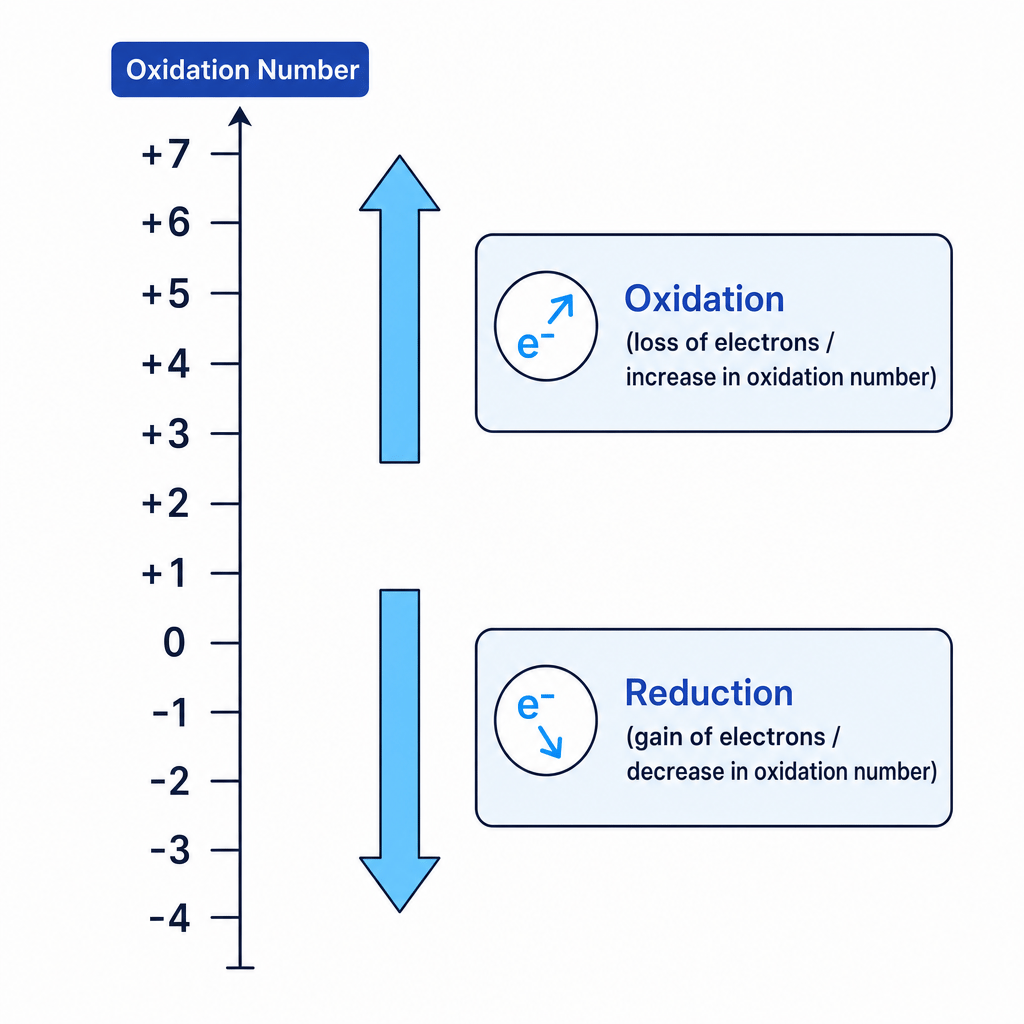
The loss of electrons by an atom, molecule, or ion, corresponding to an increase in oxidation number.
Reduction
The gain of electrons by an atom, molecule, or ion, corresponding to a decrease in oxidation number.
Below is a visual guide representing how oxidation states shift during these processes:
2. Rules for Assigning Oxidation Numbers
An oxidation number is a formal value assigned to each atom in a compound or ion. It represents the hypothetical charge the atom would carry if all of its bonds were 100% ionic.
To determine the oxidation number of any atom, you must apply a set of hierarchical rules.
The Hierarchy of Oxidation Rules
- Uncombined elements: The oxidation number of any element in its elemental form (e.g., O2\text{O}_2O2, Cl2\text{Cl}_2Cl2, Na\text{Na}Na, S8\text{S}_8S8) is always 0.
- Simple monoatomic ions: The oxidation number is equal to the charge on the ion (e.g., Na+\text{Na}^+Na+ is +1, Mg2+\text{Mg}^{2+}Mg2+ is +2, Cl−\text{Cl}^-Cl− is -1).
- Neutral compounds: The sum of all oxidation numbers in a neutral compound must equal 0.
- Polyatomic ions: The sum of all oxidation numbers must equal the overall charge of the ion.
- Group 1 metals: Always +1 in compounds.
- Group 2 metals: Always +2 in compounds.
- Aluminium: Always +3 in compounds.
- Fluorine: Always -1 in compounds (it is the most electronegative element).
- Hydrogen: Always +1 in compounds, except in metal hydrides (e.g., NaH\text{NaH}NaH, CaH2\text{CaH}_2CaH2) where it is -1.
- Oxygen: Always -2 in compounds, except in peroxides (e.g., H2O2\text{H}_2\text{O}_2H2O2) where it is -1, and in compounds with fluorine (e.g., F2O\text{F}_2\text{O}F2O) where it is +2.
- Chlorine, Bromine, Iodine: Always -1, except when combined with oxygen or fluorine.
Peroxides and Metal Hydrides
Examiners love to test the exceptions to the rules. If you see hydrogen bonded only to a metal (e.g., NaH\text{NaH}NaH), remember that hydrogen is more electronegative than the metal, so its oxidation number is -1. If you see oxygen in a peroxide (like hydrogen peroxide, H2O2\text{H}_2\text{O}_2H2O2), the oxidation number of oxygen is -1.
Calculating an Unknown Oxidation Number
When an element can exhibit multiple oxidation states (such as transition metals or non-metals like sulfur and chlorine), we use the rules above to calculate its specific oxidation number in a given species.
Calculating the Oxidation State of Chlorine
Find the oxidation number of chlorine in the chlorate(V) ion, ClO3−\text{ClO}_3^-ClO3−.
- Set up an algebraic equation where the sum of the oxidation numbers of all atoms in the species is equated to the overall charge of the ion (which is -1):
- Substitute the standard oxidation number of oxygen (-2) into the equation:
- Simplify the equation and solve for the unknown chlorine oxidation state (xxx):
Missing the Charge Sign
Oxidation numbers must always be written with their sign (+ or -) in front of the number (e.g., +5, -2). Writing simply "5" or "2-" (which represents ionic charge, not oxidation state) can cost you marks in the exam.
3. Writing Formulae and Systematic Nomenclature
Since many transition metals and p-block elements can form ions with different oxidation states, scientists use Roman numerals in names to avoid ambiguity. This systematic nomenclature ensures clear chemical communication.
For example:
- Iron(II) chloride contains Fe2+\text{Fe}^{2+}Fe2+, so its formula is FeCl2\text{FeCl}_2FeCl2.
- Iron(III) chloride contains Fe3+\text{Fe}^{3+}Fe3+, so its formula is FeCl3\text{FeCl}_3FeCl3.
This system is also applied to polyatomic ions containing oxygen (oxyanions), such as chlorates, sulfates, and nitrates.
Unlabeled Oxyanion Defaults
If an exam question mentions nitrate or sulfate without a Roman numeral, the OCR specification dictates that you must assume they refer to the standard ions:
- Nitrate is always the nitrate(V) ion: NO3−\text{NO}_3^-NO3−
- Sulfate is always the sulfate(VI) ion: SO42−\text{SO}_4^{2-}SO42−
Deriving the Formula of Calcium Chlorate(III)
Write the chemical formula for calcium chlorate(III).
- Determine the charge on the chlorate(III) ion. A chlorate ion consists of one chlorine atom in a specified oxidation state (+3 in this case) combined with yyy oxygen atoms (each with an oxidation state of -2) to form a mono-negative ion overall:
Therefore, the chlorate(III) ion is ClO2−\text{ClO}_2^-ClO2−.
-
Identify the charge on the calcium ion. Calcium is a Group 2 metal, meaning it always forms a Ca2+\text{Ca}^{2+}Ca2+ ion in compounds.
-
Balance the charges of the calcium ion (Ca2+\text{Ca}^{2+}Ca2+) and the chlorate(III) ion (ClO2−\text{ClO}_2^-ClO2−) to achieve electrical neutrality. Two single-negative chlorate(III) ions are needed to balance one double-positive calcium ion:
4. Redox Reactions of Metals with Acids
A classic demonstration of redox chemistry is the reaction between a reactive metal and an acid. In these reactions, the metal is oxidised to form a salt, and the hydrogen ions in the acid are reduced to form hydrogen gas.
Metal(s)+Acid(aq)→Salt(aq)+Hydrogen(g) \text{Metal(s)} + \text{Acid(aq)} \to \text{Salt(aq)} + \text{Hydrogen(g)} Metal(s)+Acid(aq)→Salt(aq)+Hydrogen(g)Let's examine how s-, p-, and d-block metals undergo redox when reacting with common acids like hydrochloric acid (HCl\text{HCl}HCl) or sulfuric acid (H2SO4\text{H}_2\text{SO}_4H2SO4).
s-block Metal: Magnesium (Mg)
Magnesium reacts vigorously with hydrochloric acid:
Mg(s)+2HCl(aq)→MgCl2(aq)+H2(g) \text{Mg(s)} + 2\text{HCl(aq)} \to \text{MgCl}_2\text{(aq)} + \text{H}_2\text{(g)} Mg(s)+2HCl(aq)→MgCl2(aq)+H2(g)- Oxidation: Mg\text{Mg}Mg starts as an element (oxidation state 0) and is oxidised to +2+2+2 in MgCl2\text{MgCl}_2MgCl2. Each magnesium atom loses 2 electrons.
- Reduction: H\text{H}H starts at +1+1+1 in HCl\text{HCl}HCl and is reduced to 0 in H2\text{H}_2H2. Each hydrogen ion gains 1 electron.
p-block Metal: Aluminium (Al)
Aluminium reacts with sulfuric acid to form aluminium sulfate and hydrogen gas:
2Al(s)+3H2SO4(aq)→Al2(SO4)3(aq)+3H2(g) 2\text{Al(s)} + 3\text{H}_2\text{SO}_4\text{(aq)} \to \text{Al}_2(\text{SO}_4)_3\text{(aq)} + 3\text{H}_2\text{(g)} 2Al(s)+3H2SO4(aq)→Al2(SO4)3(aq)+3H2(g)- Oxidation: Al\text{Al}Al is oxidised from 0 to +3+3+3.
- Reduction: H\text{H}H is reduced from +1+1+1 to 0.
d-block Metal: Zinc (Zn) or Iron (Fe)
Zinc reacts with hydrochloric acid to form zinc chloride:
Zn(s)+2HCl(aq)→ZnCl2(aq)+H2(g) \text{Zn(s)} + 2\text{HCl(aq)} \to \text{ZnCl}_2\text{(aq)} + \text{H}_2\text{(g)} Zn(s)+2HCl(aq)→ZnCl2(aq)+H2(g)- Oxidation: Zn\text{Zn}Zn is oxidised from 0 to +2+2+2.
- Reduction: H\text{H}H is reduced from +1+1+1 to 0.
(Note: When iron reacts with non-oxidising acids like HCl\text{HCl}HCl, it forms iron(II) salts: Fe(s)+2HCl(aq)→FeCl2(aq)+H2(g)\text{Fe(s)} + 2\text{HCl(aq)} \to \text{FeCl}_2\text{(aq)} + \text{H}_2\text{(g)}Fe(s)+2HCl(aq)→FeCl2(aq)+H2(g)).
5. Analyzing Unfamiliar Redox Reactions
In your exams, you will be presented with complex, unfamiliar equations and asked to identify which species have been oxidised and reduced. The most robust way to approach this is to write the oxidation number above every element in the equation.
Analyzing an Unfamiliar Redox Equation
Consider the following reaction:
MnO2(s)+4HCl(aq)→MnCl2(aq)+2H2O(l)+Cl2(g) \text{MnO}_2\text{(s)} + 4\text{HCl(aq)} \to \text{MnCl}_2\text{(aq)} + 2\text{H}_2\text{O(l)} + \text{Cl}_2\text{(g)} MnO2(s)+4HCl(aq)→MnCl2(aq)+2H2O(l)+Cl2(g)Identify which element is oxidised and which element is reduced, explaining your answer in terms of electron transfer and oxidation numbers.
-
Assign oxidation numbers to every atom on the reactant side:
- In MnO2\text{MnO}_2MnO2: O\text{O}O is -2, so Mn\text{Mn}Mn must be +4+4+4.
- In HCl\text{HCl}HCl: H\text{H}H is +1+1+1, so Cl\text{Cl}Cl is -1.
-
Assign oxidation numbers to every atom on the product side:
- In MnCl2\text{MnCl}_2MnCl2: Cl\text{Cl}Cl is -1, so Mn\text{Mn}Mn must be +2+2+2.
- In H2O\text{H}_2\text{O}H2O: H\text{H}H is +1+1+1, O\text{O}O is -2.
- In Cl2\text{Cl}_2Cl2: This is an uncombined diatomic element, so Cl\text{Cl}Cl is 0.
-
Compare the reactant and product oxidation numbers to identify the changes:
- Manganese changes from +4+4+4 to +2+2+2. Since its oxidation number decreased, manganese has been reduced by gaining electrons.
- Chlorine changes from -1 (in HCl\text{HCl}HCl) to 0 (in Cl2\text{Cl}_2Cl2). Since its oxidation number increased, chlorine has been oxidised by losing electrons. (Note that the chlorine atoms that ended up in MnCl2\text{MnCl}_2MnCl2 remained at -1 and did not participate in the redox change).
In the exam
- Explicitly state starting and ending oxidation states: When explaining a redox reaction, always structure your sentence as: "Element X is [oxidised/reduced] because its oxidation state changes from [Value A] to [Value B], which corresponds to a [loss/gain] of electrons."
- Handle subscripts carefully: When calculating oxidation numbers in polyatomic ions (like Cr2O72−\text{Cr}_2\text{O}_7^{2-}Cr2O72−), remember to multiply the oxygen's state (-2) by its subscript (7) and divide the remaining charge evenly across the transition metal atoms (2 chromiums).
- Be vigilant with hydrogen and oxygen exceptions: Check if hydrogen is bound to a metal (e.g., NaH\text{NaH}NaH) or if oxygen is in a peroxide (e.g., H2O2\text{H}_2\text{O}_2H2O2) before assigning their standard +1 and -2 values.
Check yourself
- Why does the oxidation state of oxygen change to +2 when it bonded to fluorine in F2O\text{F}_2\text{O}F2O?
- What is the oxidation number of sulfur in the thiosulfate ion, S2O32−\text{S}_2\text{O}_3^{2-}S2O32−?
- Write a balanced symbol equation for the reaction of aluminium metal with hydrochloric acid, and state which element undergoes oxidation.