

Welcome to one of the foundation topics of OCR A-Level Chemistry! Acids, bases, and neutralisation reactions underpin many major areas of chemistry, from buffer systems in biological fluids to analytical techniques in industrial laboratories.
In this set of study notes, we will build your understanding from the essential definitions up to the hands-on practical skills required to perform highly precise volumetric analysis (titrations).
What you'll learn:
- How to define and identify common strong and weak acids and alkalis.
- The chemistry of neutralisation reactions and how to write full and ionic equations for salt formation.
- The exact experimental procedures for preparing a standard solution and performing an acid–base titration (PAG 2).
- How to solve structured and unstructured titration calculations.
1. What is an Acid and an Alkali?
At this level, we focus on the behaviour of acids and bases in aqueous solutions (dissolved in water).
Acid
An acid is a species that releases hydrogen ions, H+(aq)\text{H}^+(\text{aq})H+(aq) (protons), into aqueous solution.
You must memorise the formulae of the four common acids specified by the OCR syllabus:
- Hydrochloric acid: HCl(aq)\text{HCl}(\text{aq})HCl(aq)
- Sulfuric acid: H2SO4(aq)\text{H}_2\text{SO}_4(\text{aq})H2SO4(aq)
- Nitric acid: HNO3(aq)\text{HNO}_3(\text{aq})HNO3(aq)
- Ethanoic acid: CH3COOH(aq)\text{CH}_3\text{COOH}(\text{aq})CH3COOH(aq)
When these acids dissolve in water, they release (or "donate") their acidic hydrogen atoms as solvated H+\text{H}^+H+ ions. For example:
HCl(aq)→H+(aq)+Cl−(aq) \text{HCl(aq)} \to \text{H}^+\text{(aq)} + \text{Cl}^-\text{(aq)} HCl(aq)→H+(aq)+Cl−(aq)Base and Alkali
A base is a chemical species that readily accepts H+\text{H}^+H+ ions (protons) from an acid.
An alkali is a specific type of base that dissolves in water, releasing hydroxide ions, OH−(aq)\text{OH}^-(\text{aq})OH−(aq), into the solution.
Alkalis are soluble bases
All alkalis are bases, but not all bases are alkalis. For example, copper(II) oxide (CuO\text{CuO}CuO) is an insoluble base because it reacts with acids but does not dissolve in water. Sodium hydroxide (NaOH\text{NaOH}NaOH) is both a base and an alkali because it dissolves in water to release OH−\text{OH}^-OH− ions.
The three common alkalis you must know are:
- Sodium hydroxide: NaOH(aq)\text{NaOH}(\text{aq})NaOH(aq)
- Potassium hydroxide: KOH(aq)\text{KOH}(\text{aq})KOH(aq)
- Ammonia: NH3(aq)\text{NH}_3(\text{aq})NH3(aq)
In aqueous solution, soluble metal hydroxides dissociate completely to release hydroxide ions:
NaOH(aq)→Na+(aq)+OH−(aq) \text{NaOH(aq)} \to \text{Na}^+\text{(aq)} + \text{OH}^-\text{(aq)} NaOH(aq)→Na+(aq)+OH−(aq)Ammonia behaves slightly differently. Instead of containing hydroxide ions in its formula, it reacts with water molecules to produce them:
NH3(aq)+H2O(l)⇌NH4+(aq)+OH−(aq) \text{NH}_3(\text{aq}) + \text{H}_2\text{O}(\text{l}) \rightleftharpoons \text{NH}_4^+(\text{aq}) + \text{OH}^-(\text{aq}) NH3(aq)+H2O(l)⇌NH4+(aq)+OH−(aq)2. Strong vs. Weak Acids
Not all acids release their H+\text{H}^+H+ ions with the same ease. We classify acids as either strong or weak based on their degree of dissociation (how much they split up into ions) in water.
Strong Acids
A strong acid fully dissociates (fully ionises) in aqueous solution.
Every single molecule of a strong acid splits apart, releasing all its acidic hydrogen atoms as H+\text{H}^+H+ ions. HCl\text{HCl}HCl, HNO3\text{HNO}_3HNO3, and H2SO4\text{H}_2\text{SO}_4H2SO4 are all strong acids. We use a single forward arrow (→\to→) to show complete dissociation:
HCl(aq)→H+(aq)+Cl−(aq) \text{HCl(aq)} \to \text{H}^+\text{(aq)} + \text{Cl}^-\text{(aq)} HCl(aq)→H+(aq)+Cl−(aq)If you have a 0.10 mol dm−30.10\text{ mol dm}^{-3}0.10 mol dm−3 solution of HCl\text{HCl}HCl, the concentration of H+(aq)\text{H}^+(\text{aq})H+(aq) ions will also be exactly 0.10 mol dm−30.10\text{ mol dm}^{-3}0.10 mol dm−3.
Weak Acids
A weak acid only partially dissociates (partially ionises) in aqueous solution.
Only a small fraction of the weak acid molecules split up to release H+\text{H}^+H+ ions, whilst the vast majority of the molecules remain intact. Ethanoic acid (CH3COOH\text{CH}_3\text{COOH}CH3COOH) is a classic weak acid. We use an equilibrium sign (⇌\rightleftharpoons⇌) to represent this partial dissociation:
CH3COOH(aq)⇌CH3COO−(aq)+H+(aq) \text{CH}_3\text{COOH(aq)} \rightleftharpoons \text{CH}_3\text{COO}^-\text{(aq)} + \text{H}^+\text{(aq)} CH3COOH(aq)⇌CH3COO−(aq)+H+(aq)In a 0.10 mol dm−30.10\text{ mol dm}^{-3}0.10 mol dm−3 solution of ethanoic acid, the concentration of H+(aq)\text{H}^+(\text{aq})H+(aq) is typically much less than 0.002 mol dm−30.002\text{ mol dm}^{-3}0.002 mol dm−3 because the position of the equilibrium lies heavily to the left-hand side.
Confusing strength with concentration
Acid strength and acid concentration are completely different concepts:
- Strength refers to the proportion of acid molecules that dissociate into H+\text{H}^+H+ ions in water (a constant property of the specific chemical).
- Concentration refers to the amount of acid dissolved per unit volume of water (something you can change by diluting it).
You can have a concentrated solution of a weak acid (e.g., 10 mol dm−310\text{ mol dm}^{-3}10 mol dm−3 ethanoic acid) or a dilute solution of a strong acid (e.g., 0.001 mol dm−30.001\text{ mol dm}^{-3}0.001 mol dm−3 hydrochloric acid).
3. Neutralisation and Salt Formation
Neutralisation is the fundamental reaction between an acid and a base.
Neutralisation
A reaction in which H+\text{H}^+H+ ions from an acid react with a base (such as OH−\text{OH}^-OH− ions or carbonates) to form a neutral salt and water.
At its core, the ionic equation for the neutralisation of an acid by an alkali is always:
H+(aq)+OH−(aq)→H2O(l) \text{H}^+\text{(aq)} + \text{OH}^-\text{(aq)} \to \text{H}_2\text{O(l)} H+(aq)+OH−(aq)→H2O(l)During neutralisation, the hydrogen ions in the acid are replaced by metal ions (or ammonium ions) to form a salt. The identity of the salt depends on the acid used:
- Hydrochloric acid produces chlorides (Cl−\text{Cl}^-Cl−)
- Sulfuric acid produces sulfates (SO42−\text{SO}_4^{2-}SO42−)
- Nitric acid produces nitrates (NO3−\text{NO}_3^-NO3−)
- Ethanoic acid produces ethanoates (CH3COO−\text{CH}_3\text{COO}^-CH3COO−)
Types of Neutralisation Reactions
You must be able to write balanced, state-symbol-equipped chemical equations for the reactions of acids with three main classes of bases.
1. Acid + Metal Oxide (Insoluble Base) →\to→ Salt + Water
H2SO4(aq)+CuO(s)→CuSO4(aq)+H2O(l) \text{H}_2\text{SO}_4\text{(aq)} + \text{CuO(s)} \to \text{CuSO}_4\text{(aq)} + \text{H}_2\text{O(l)} H2SO4(aq)+CuO(s)→CuSO4(aq)+H2O(l)2. Acid + Metal Hydroxide (Alkali) →\to→ Salt + Water
HCl(aq)+NaOH(aq)→NaCl(aq)+H2O(l) \text{HCl(aq)} + \text{NaOH(aq)} \to \text{NaCl(aq)} + \text{H}_2\text{O(l)} HCl(aq)+NaOH(aq)→NaCl(aq)+H2O(l)3. Acid + Metal Carbonate →\to→ Salt + Water + Carbon Dioxide
2HNO3(aq)+Na2CO3(aq)→2NaNO3(aq)+H2O(l)+CO2(g) \text{2HNO}_3\text{(aq)} + \text{Na}_2\text{CO}_3\text{(aq)} \to \text{2NaNO}_3\text{(aq)} + \text{H}_2\text{O(l)} + \text{CO}_2\text{(g)} 2HNO3(aq)+Na2CO3(aq)→2NaNO3(aq)+H2O(l)+CO2(g)Observe that carbonates produce effervescence due to the generation of carbon dioxide gas.
4. Preparing a Standard Solution (PAG 2.1)
Before carrying out a titration to find the concentration of an unknown chemical, you must prepare a standard solution of known concentration from a primary solid standard (like anhydrous sodium carbonate, Na2CO3\text{Na}_2\text{CO}_3Na2CO3).
Standard Solution
A solution of an accurately known concentration used as a reference in chemical analysis.
The preparation of a standard solution is a vital practical skill assessed in the Practical Endorsement (PAG 2) and in written exams. The diagram below illustrates the process step by step:
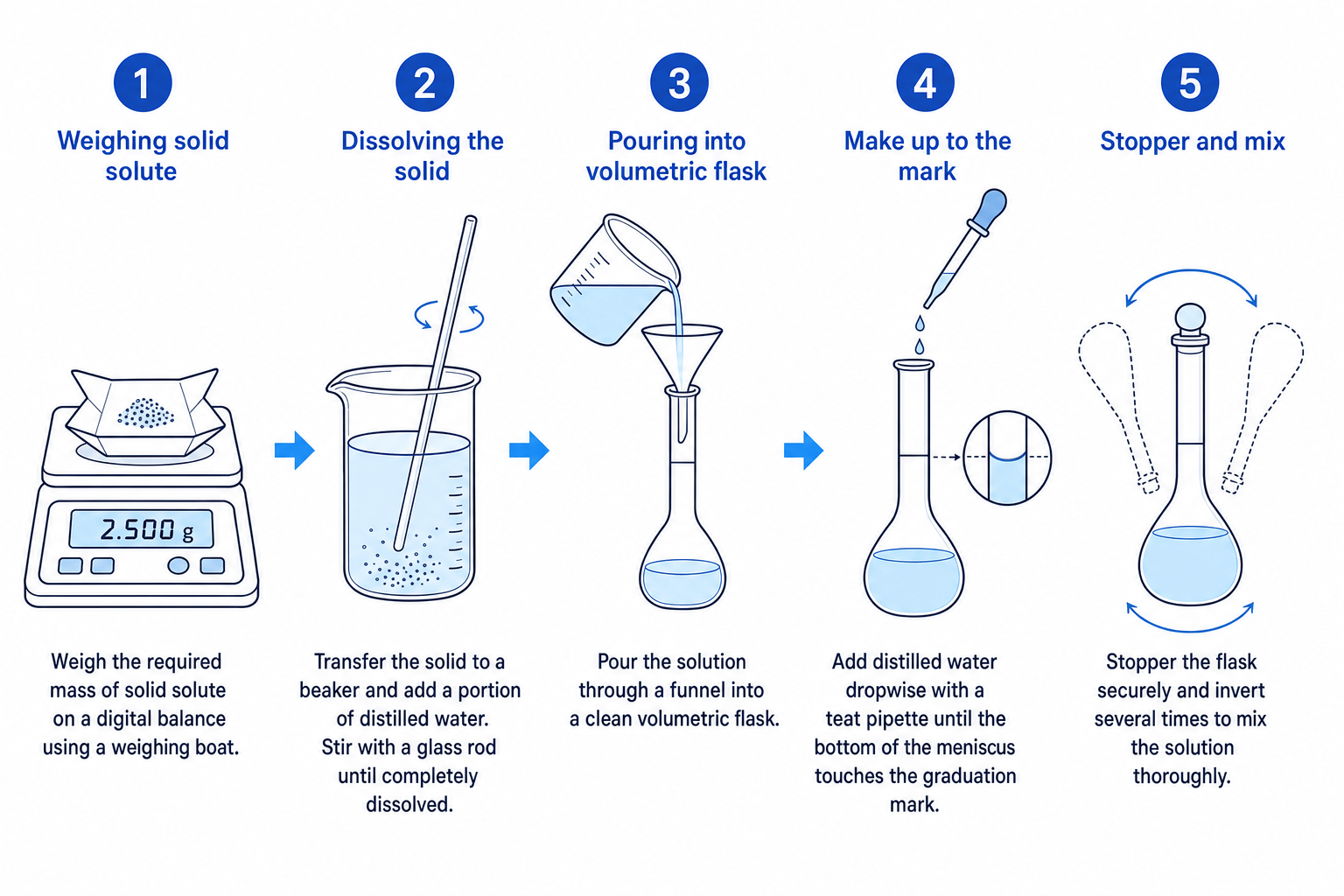
The Experimental Procedure
- Weigh the solid accurately: Place a weighing boat on a digital balance (reading to at least 2 decimal places) and tare it. Add the calculated mass of solid solute and record the mass.
- Dissolve the solute: Transfer the solid to a clean beaker. Re-weigh the empty weighing boat to calculate the exact mass transferred (this technique is called weighing by difference). Add approximately 100 cm3100\text{ cm}^3100 cm3 of distilled water and stir with a clean glass rod until all the solid has completely dissolved.
- Transfer to a volumetric flask: Pour the solution carefully through a clean plastic funnel into a volumetric flask (usually 250 cm3250\text{ cm}^3250 cm3).
- Rinse the apparatus: Use distilled water from a wash bottle to rinse the beaker, the glass rod, and the funnel. Transfer all these washings into the volumetric flask. This ensures no solute is left behind.
- Make up to the mark: Add distilled water to the flask until the level is close to the graduated line. Use a teat pipette to add the final drops of distilled water slowly until the bottom of the meniscus is perfectly aligned with the graduation mark at eye level.
- Mix thoroughly: Insert a stopper into the flask and invert it securely several times to ensure the solution is completely homogeneous.
Ignoring the inversion step
Failing to invert the volumetric flask is a classic practical error. Water is less dense than the concentrated solution at the bottom; without inversion, the concentration will be highly uneven, ruining the accuracy of subsequent titrations.
5. Carrying out a Titration (PAG 2.2)
Once you have your standard solution, you can use it to determine the concentration of another solution via an acid–base titration.
Titration Procedure
- Prepare the burette: Rinse the burette with a small volume of the solution you are about to fill it with (to prevent dilution from any residual water), then fill it. Ensure that the space below the tap (the burette jet) is filled with liquid and contains no air bubbles. Record the initial burette reading to the nearest 0.05 cm30.05\text{ cm}^30.05 cm3.
- Prepare the conical flask: Rinse a volumetric pipette with a small volume of the solution of unknown concentration. Use a pipette filler to measure exactly 25.0 cm325.0\text{ cm}^325.0 cm3 of this solution and transfer it into a clean conical flask.
- Add indicator: Add 3–4 drops of an appropriate acid-base indicator (such as methyl orange or phenolphthalein) to the conical flask. Place the flask on a white tile directly under the burette tip so that the colour change is easily visible.
- Run a trial titre: Perform a rough titration by adding the solution from the burette while constantly swirling the conical flask. Note the approximate volume at which the indicator permanently changes colour.
- Perform accurate titrations: Repeat the titration. This time, run the solution in rapidly until you are within 2 cm32\text{ cm}^32 cm3 of the rough end-point. From this point, add the solution dropwise, swirling continuously, until a single drop causes a permanent, sharp colour change. Record the final burette reading.
- Repeat to find concordancy: Repeat the process until you obtain at least two concordant titres (results that agree within 0.10 cm30.10\text{ cm}^30.10 cm3 of each other).
Identifying Concordant Titres
When calculating your mean titre, only average your concordant results. Never include your rough trial or any titres that lie outside the 0.10 cm30.10\text{ cm}^30.10 cm3 range.
| Titre | Trial | Titre 1 | Titre 2 | Titre 3 |
|---|---|---|---|---|
| Volume (cm3\text{cm}^3cm3) | 24.50 | 23.85 | 24.10 | 23.90 |
In this table, only Titre 1 (23.85 cm323.85\text{ cm}^323.85 cm3) and Titre 3 (23.90 cm323.90\text{ cm}^323.90 cm3) are concordant. The mean titre is calculated as:
Mean Titre=23.85+23.902=23.88 cm3 \text{Mean Titre} = \frac{23.85 + 23.90}{2} = 23.88\text{ cm}^3 Mean Titre=223.85+23.90=23.88 cm36. Titration Calculations
To master titration calculations, you must confidently apply two core formulas linking chemical quantities:
n=mMandn=c×V n = \frac{m}{M} \quad \text{and} \quad n = c \times V n=Mmandn=c×VWhere:
- nnn = amount of substance (mol\text{mol}mol)
- mmm = mass of substance (g\text{g}g)
- MMM = molar mass (g mol−1\text{g mol}^{-1}g mol−1)
- ccc = concentration (mol dm−3\text{mol dm}^{-3}mol dm−3)
- VVV = volume (dm3\text{dm}^3dm3) — remember to convert cm3\text{cm}^3cm3 to dm3\text{dm}^3dm3 by dividing by 1000!
Calculating the concentration of an unknown acid
A student prepared a standard solution of sodium carbonate, Na2CO3\text{Na}_2\text{CO}_3Na2CO3. They dissolved 1.325 g1.325\text{ g}1.325 g of Na2CO3\text{Na}_2\text{CO}_3Na2CO3 in distilled water to make exactly 250.0 cm3250.0\text{ cm}^3250.0 cm3 of standard solution.
A 25.00 cm325.00\text{ cm}^325.00 cm3 sample of this standard solution required exactly 22.45 cm322.45\text{ cm}^322.45 cm3 of hydrochloric acid, HCl(aq)\text{HCl}(\text{aq})HCl(aq), for complete neutralisation.
Calculate the concentration of the hydrochloric acid in mol dm−3\text{mol dm}^{-3}mol dm−3. Give your answer to 3 significant figures.
Na2CO3(aq)+2HCl(aq)→2NaCl(aq)+H2O(l)+CO2(g) \text{Na}_2\text{CO}_3\text{(aq)} + \text{2HCl(aq)} \to \text{2NaCl(aq)} + \text{H}_2\text{O(l)} + \text{CO}_2\text{(g)} Na2CO3(aq)+2HCl(aq)→2NaCl(aq)+H2O(l)+CO2(g)Step 1: Calculate the concentration of the standard sodium carbonate solution
First, find the molar mass (MMM) of Na2CO3\text{Na}_2\text{CO}_3Na2CO3:
M(Na2CO3)=(22.99×2)+12.01+(16.00×3)=105.99 g mol−1 M(\text{Na}_2\text{CO}_3) = (22.99 \times 2) + 12.01 + (16.00 \times 3) = 105.99\text{ g mol}^{-1} M(Na2CO3)=(22.99×2)+12.01+(16.00×3)=105.99 g mol−1Now, find the amount in moles of Na2CO3\text{Na}_2\text{CO}_3Na2CO3 dissolved in the 250.0 cm3250.0\text{ cm}^3250.0 cm3 flask:
n=mM=1.325 g105.99 g mol−1=0.012501 mol n = \frac{m}{M} = \frac{1.325\text{ g}}{105.99\text{ g mol}^{-1}} = 0.012501\text{ mol} n=Mm=105.99 g mol−11.325 g=0.012501 molConvert the flask volume to dm3\text{dm}^3dm3:
V=250.0 cm31000=0.2500 dm3 V = \frac{250.0\text{ cm}^3}{1000} = 0.2500\text{ dm}^3 V=1000250.0 cm3=0.2500 dm3Calculate the concentration (ccc) of the sodium carbonate solution:
c=nV=0.012501 mol0.2500 dm3=0.05000 mol dm−3 c = \frac{n}{V} = \frac{0.012501\text{ mol}}{0.2500\text{ dm}^3} = 0.05000\text{ mol dm}^{-3} c=Vn=0.2500 dm30.012501 mol=0.05000 mol dm−3Step 2: Calculate the moles of sodium carbonate used in the titration pipette
The student used a pipette to transfer 25.00 cm325.00\text{ cm}^325.00 cm3 of this solution to the conical flask.
V=25.00 cm31000=0.02500 dm3 V = \frac{25.00\text{ cm}^3}{1000} = 0.02500\text{ dm}^3 V=100025.00 cm3=0.02500 dm3 n(Na2CO3)=c×V=0.05000 mol dm−3×0.02500 dm3=1.250×10⁻³ mol n(\text{Na}_2\text{CO}_3) = c \times V = 0.05000\text{ mol dm}^{-3} \times 0.02500\text{ dm}^3 = 1.250 \times 10^{-3}\text{ mol} n(Na2CO3)=c×V=0.05000 mol dm−3×0.02500 dm3=1.250×10⁻³ molStep 3: Use the balanced equation to find the moles of reacting hydrochloric acid
Looking at the stoichiometry of the reaction:
1 mol of Na2CO3 reacts with 2 mol of HCl \text{1 mol of Na}_2\text{CO}_3 \text{ reacts with 2 mol of HCl} 1 mol of Na2CO3 reacts with 2 mol of HClTherefore:
n(HCl)=2×n(Na2CO3)=2×1.250×10−3 mol=2.500×10⁻³ mol n(\text{HCl}) = 2 \times n(\text{Na}_2\text{CO}_3) = 2 \times 1.250 \times 10^{-3}\text{ mol} = 2.500 \times 10^{-3}\text{ mol} n(HCl)=2×n(Na2CO3)=2×1.250×10−3 mol=2.500×10⁻³ molStep 4: Calculate the concentration of the hydrochloric acid
The volume of HCl\text{HCl}HCl used from the burette was 22.45 cm322.45\text{ cm}^322.45 cm3.
V=22.45 cm31000=0.02245 dm3 V = \frac{22.45\text{ cm}^3}{1000} = 0.02245\text{ dm}^3 V=100022.45 cm3=0.02245 dm3 c(HCl)=nV=2.500×10⁻³ mol0.02245 dm3=0.11136 mol dm−3 c(\text{HCl}) = \frac{n}{V} = \frac{2.500 \times 10^{-3}\text{ mol}}{0.02245\text{ dm}^3} = 0.11136\text{ mol dm}^{-3} c(HCl)=Vn=0.02245 dm32.500×10−3 mol=0.11136 mol dm−3Rounding to 3 significant figures gives:
c(HCl)=0.111 mol dm−3 c(\text{HCl}) = 0.111\text{ mol dm}^{-3} c(HCl)=0.111 mol dm−3In the exam
- State symbols in equations: Always write out full balanced equations with state symbols when asked. Remember that metal oxides are typically solid (s)(\text{s})(s), acids and alkalis are aqueous (aq)(\text{aq})(aq), and carbon dioxide is gaseous (g)(\text{g})(g).
- Pipette vs. Volumetric Flask volumes: Pay close attention to scaling in titration calculations. If you make a 250.0 cm3250.0\text{ cm}^3250.0 cm3 standard solution but only titrate a 25.00 cm325.00\text{ cm}^325.00 cm3 portion, make sure you divide the total moles in the flask by 10 to find the moles of reactant in the conical flask!
- Significant figures: Always round your final numerical answer to the number of significant figures matching the least precise data value provided in the question (typically 3 or 4 significant figures). Keep full unrounded figures stored on your calculator during intermediate steps.
Check yourself
- Write the balanced chemical equation, including state symbols, for the reaction between aqueous ethanoic acid and solid calcium carbonate.
- Explain, in terms of dissociation, why 0.10 mol dm−30.10\text{ mol dm}^{-3}0.10 mol dm−3 hydrochloric acid has a much higher concentration of H+\text{H}^+H+ ions than 0.10 mol dm−30.10\text{ mol dm}^{-3}0.10 mol dm−3 ethanoic acid.
- Why is it necessary to rinse the inside of the conical flask with distilled water during a titration, and why does this water not affect the final titre value?
