What you'll learn
- What entropy means, and why gases usually have much higher entropy than solids.
- How to calculate an entropy change, ΔS\Delta SΔS, from entropy data.
- How enthalpy, entropy and temperature combine in the Gibbs equation.
- Why a negative ΔG\Delta GΔG predicts thermodynamic feasibility, but not necessarily a fast reaction.
The starting point: enthalpy changes
You already know that reactions involve energy transfers. The enthalpy change, ΔH\Delta HΔH, is the heat energy change of a reaction at constant pressure.
- ΔH<0\Delta H < 0ΔH<0: exothermic, energy is released to the surroundings.
- ΔH>0\Delta H > 0ΔH>0: endothermic, energy is taken in from the surroundings.
For this topic, enthalpy is only part of the story. Some endothermic processes still happen, so we need another idea: entropy.
Enthalpy change
The enthalpy change, ΔH\Delta HΔH, is the heat energy change of a system at constant pressure, usually measured in kJ mol⁻¹.
Entropy: energy dispersal and disorder
Entropy is about how spread out energy is, and how many ways particles and energy can be arranged.
Entropy
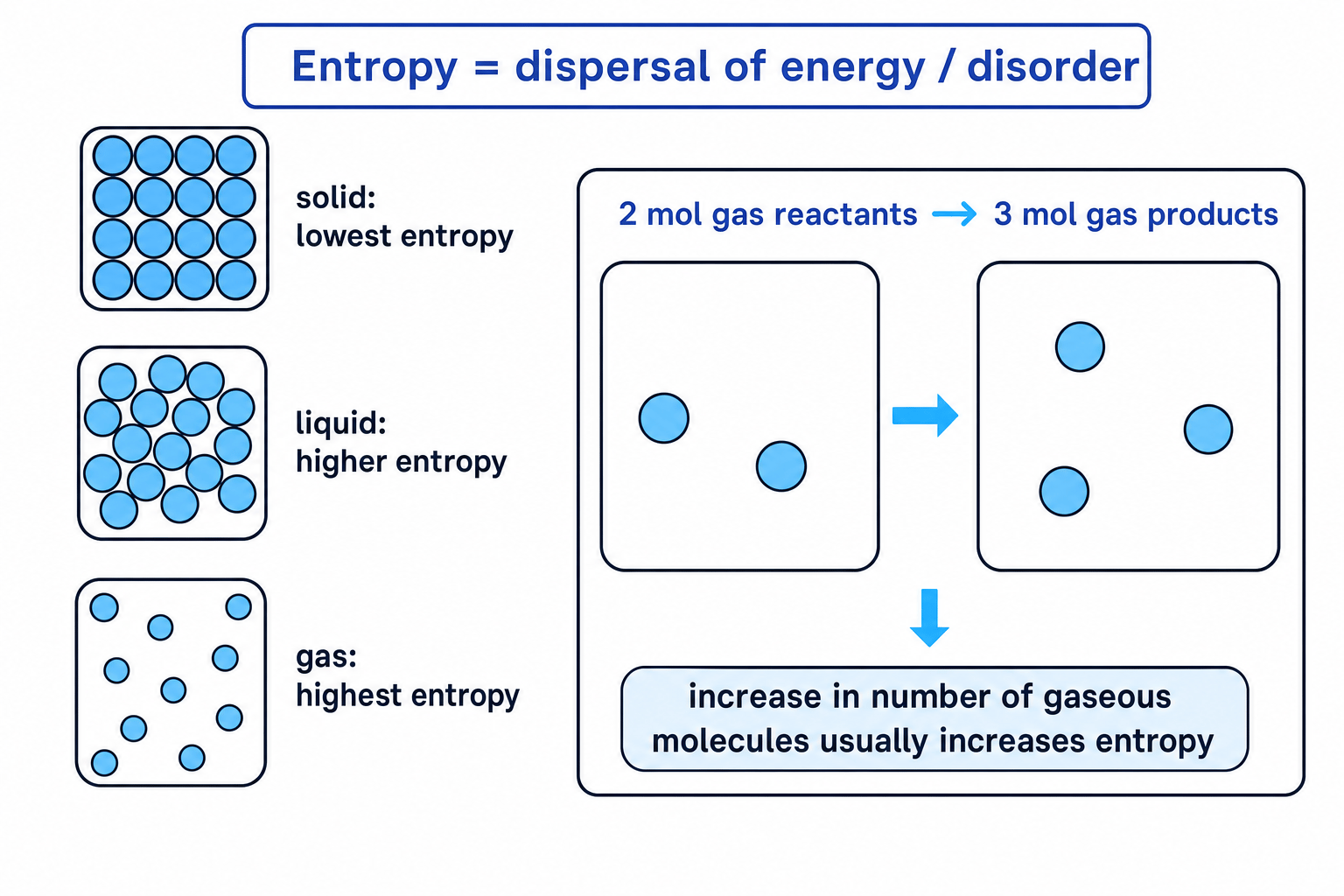
Entropy, SSS, is a measure of the dispersal of energy in a system. A system has greater entropy when it is more disordered.
A “system” means the chemicals or process you are focusing on. For example, in a reaction mixture, the reactants and products are the system.
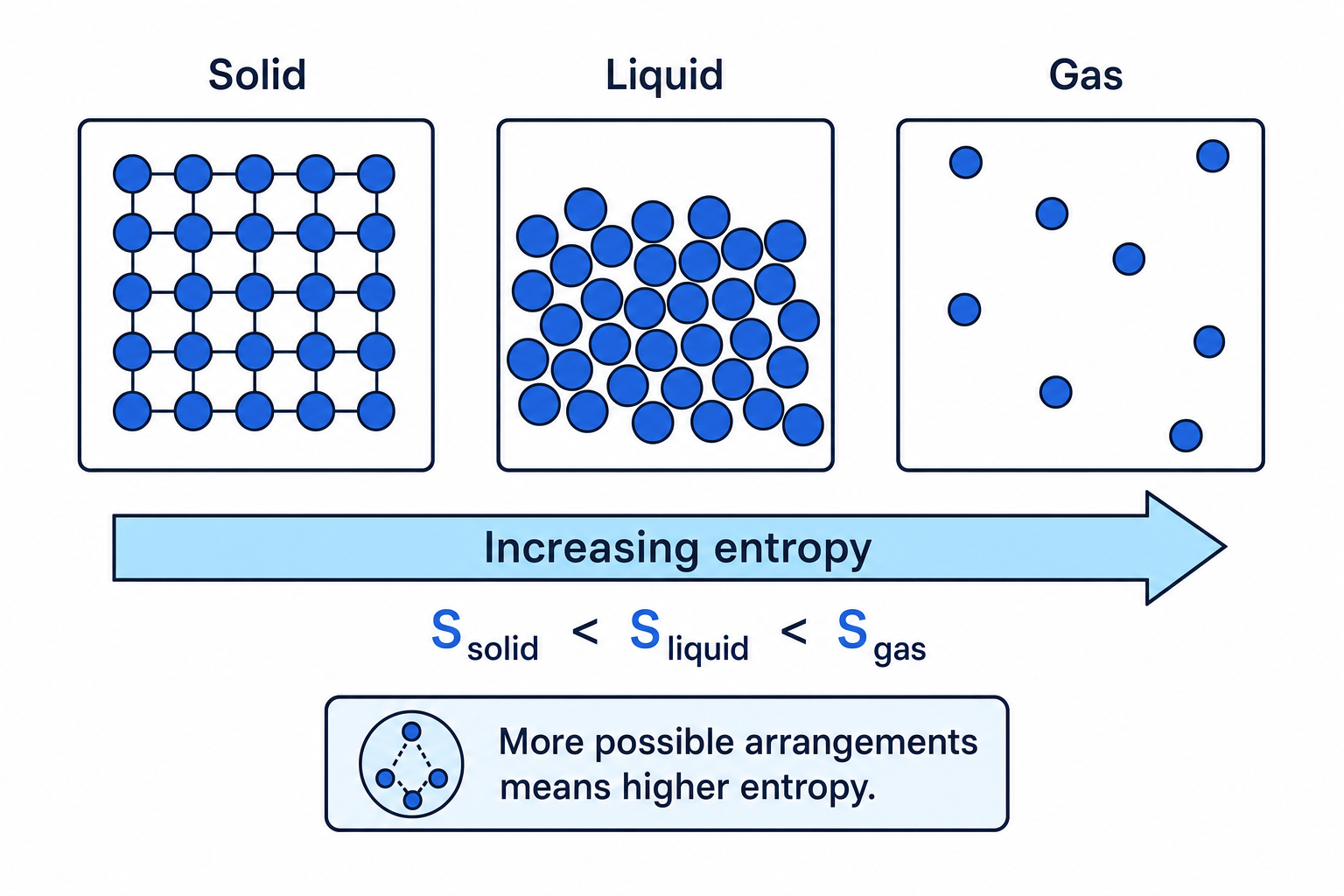
The key model is: more possible arrangements = greater entropy. Gas particles can spread out through a large volume and move freely, so they have many more possible arrangements than particles locked into a solid lattice.
Entropy of solids, liquids and gases
For the same substance, entropy usually increases in this order:
Ssolid<Sliquid<SgasS_{\text{solid}} < S_{\text{liquid}} < S_{\text{gas}}Ssolid<Sliquid<SgasThis is why melting and boiling have positive entropy changes: particles become more free to move, and energy becomes more dispersed.
State and entropy
Gases have much larger entropy values than liquids or solids because gas particles are much more spread out and have far more possible arrangements.
Predicting the sign of an entropy change
Predict the sign of ΔS\Delta SΔS for:
H2O(l)→H2O(g)\mathrm{H_2O(l)} \to \mathrm{H_2O(g)}H2O(l)→H2O(g)
- Compare the physical states: the reactant is a liquid and the product is a gas.
- A gas has much greater entropy than a liquid because its particles are more spread out and move more freely.
- Therefore the entropy change is positive: ΔS>0\Delta S > 0ΔS>0.
Entropy changes in reactions involving gases
A very important A-Level shortcut is to look at the number of gaseous molecules.
If a reaction produces more moles of gas than it uses up, entropy usually increases. If it uses up more moles of gas than it produces, entropy usually decreases.
For example:
CaCO3(s)→CaO(s)+CO2(g)\mathrm{CaCO_3(s)} \to \mathrm{CaO(s)} + \mathrm{CO_2(g)}CaCO3(s)→CaO(s)+CO2(g)This produces a gas from solids, so ΔS\Delta SΔS is usually positive.
Fast entropy sign check
When gases are involved, count moles of gas on each side first. A change from fewer gas molecules to more gas molecules usually means ΔS>0\Delta S > 0ΔS>0.
Ignoring state symbols
Do not just count total moles in the equation. Entropy changes are often dominated by gases, so state symbols such as (s), (l), (g) and (aq) matter.
Using gaseous moles to predict entropy
Predict the likely sign of ΔS\Delta SΔS for the Haber process:
N2(g)+3H2(g)→2NH3(g)\mathrm{N_2(g)} + 3\mathrm{H_2(g)} \to 2\mathrm{NH_3(g)}N2(g)+3H2(g)→2NH3(g)
- Count gaseous moles on the reactant side: 1 mol of N2\mathrm{N_2}N2 plus 3 mol of H2\mathrm{H_2}H2 gives 4 mol of gas.
- Count gaseous moles on the product side: 2 mol of NH3\mathrm{NH_3}NH3 gives 2 mol of gas.
- The reaction goes from 4 mol of gas to 2 mol of gas, so disorder decreases and ΔS\Delta SΔS is likely to be negative.
Calculating entropy change, ΔS\Delta SΔS
Entropy values are usually given as standard molar entropies, S∘S^\circS∘, in J K⁻¹ mol⁻¹.
Standard molar entropy
The standard molar entropy, S∘S^\circS∘, is the entropy of one mole of a substance under standard conditions, measured in J K⁻¹ mol⁻¹.
To calculate the entropy change of a reaction:
ΔS=∑Sproducts−∑Sreactants\Delta S = \sum S_{\text{products}} - \sum S_{\text{reactants}}ΔS=∑Sproducts−∑SreactantsYou must multiply each entropy value by the balancing number in the equation.
Calculating entropy change from entropy data
Calculate ΔS\Delta SΔS for:
N2(g)+3H2(g)→2NH3(g)\mathrm{N_2(g)} + 3\mathrm{H_2(g)} \to 2\mathrm{NH_3(g)}N2(g)+3H2(g)→2NH3(g)
Use these standard entropy values:
- N2(g)\mathrm{N_2(g)}N2(g): 192 J K⁻¹ mol⁻¹
- H2(g)\mathrm{H_2(g)}H2(g): 131 J K⁻¹ mol⁻¹
- NH3(g)\mathrm{NH_3(g)}NH3(g): 193 J K⁻¹ mol⁻¹
-
Calculate the total entropy of the products:
∑Sproducts=2×193=386 J K−1 mol−1\sum S_{\text{products}} = 2 \times 193 = 386\ \text{J K}^{-1}\text{ mol}^{-1}∑Sproducts=2×193=386 J K−1 mol−1 -
Calculate the total entropy of the reactants:
∑Sreactants=192+(3×131)=585 J K−1 mol−1\sum S_{\text{reactants}} = 192 + \left(3 \times 131\right) = 585\ \text{J K}^{-1}\text{ mol}^{-1}∑Sreactants=192+(3×131)=585 J K−1 mol−1 -
Subtract reactants from products:
ΔS=386−585=−199 J K−1 mol−1\Delta S = 386 - 585 = -199\ \text{J K}^{-1}\text{ mol}^{-1}ΔS=386−585=−199 J K−1 mol−1 -
Interpret the sign: ΔS\Delta SΔS is negative, which matches the reaction going from 4 mol of gas to 2 mol of gas.
Free energy and feasibility
A process is feasible if it is thermodynamically possible under the stated conditions. OCR links feasibility to the Gibbs free energy change, ΔG\Delta GΔG.
Gibbs free energy change
The Gibbs free energy change, ΔG\Delta GΔG, combines enthalpy change, entropy change and temperature to predict whether a process is thermodynamically feasible.
The equation is:
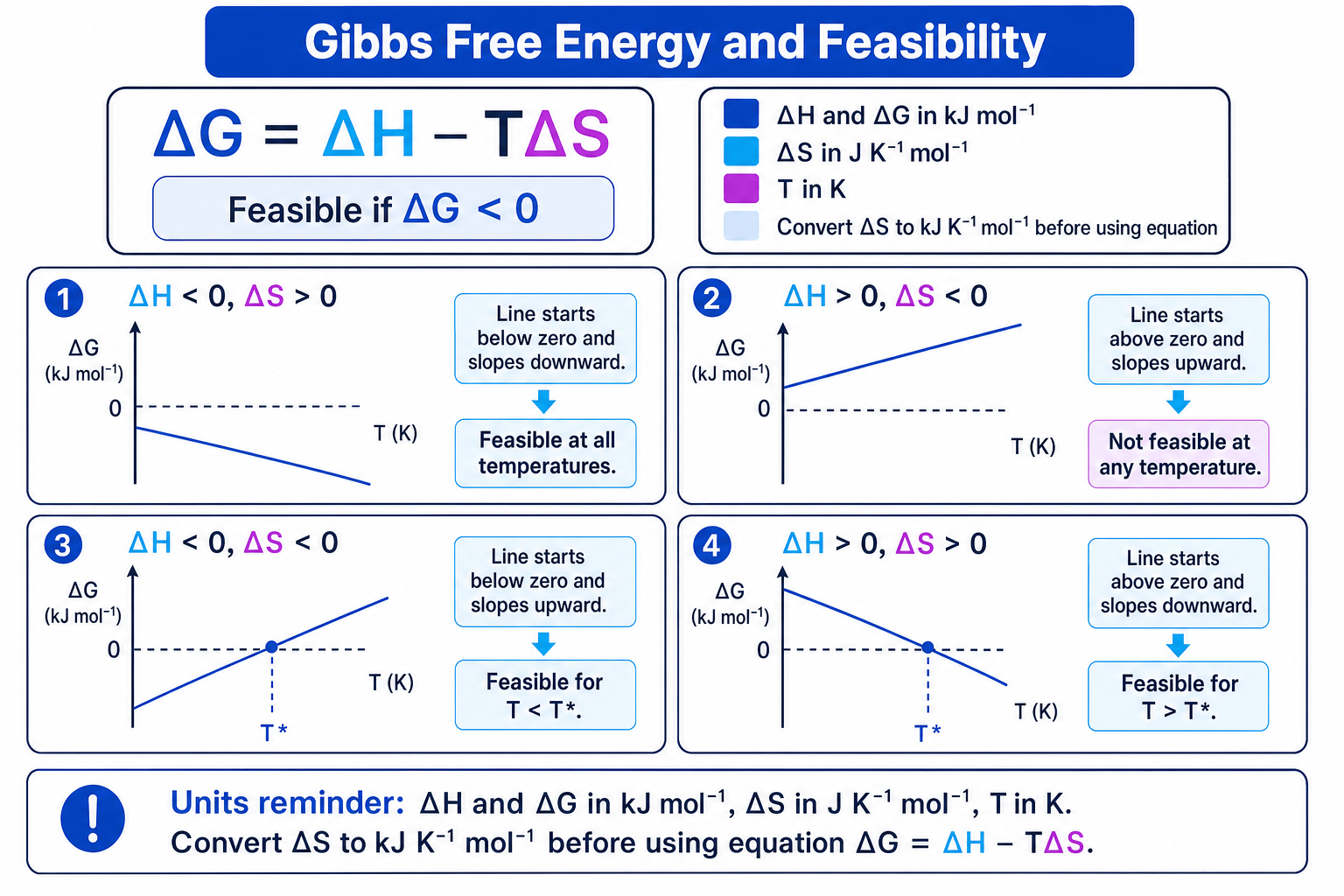
ΔG=ΔH−TΔS\Delta G = \Delta H - T\Delta SΔG=ΔH−TΔSwhere:
- ΔG\Delta GΔG is in kJ mol⁻¹
- ΔH\Delta HΔH is in kJ mol⁻¹
- TTT is temperature in K
- ΔS\Delta SΔS must be in kJ K⁻¹ mol⁻¹ when used in the equation
A process is feasible when:
ΔG<0\Delta G < 0ΔG<0At ΔG=0\Delta G = 0ΔG=0, the system is at equilibrium under those conditions.
Mixing entropy units
Entropy data are usually given in J K⁻¹ mol⁻¹, but ΔH\Delta HΔH and ΔG\Delta GΔG are usually in kJ mol⁻¹. Divide ΔS\Delta SΔS by 1000 before using ΔG=ΔH−TΔS\Delta G = \Delta H - T\Delta SΔG=ΔH−TΔS.
Calculating Gibbs free energy
For the Haber process at 298 K:
N2(g)+3H2(g)→2NH3(g)\mathrm{N_2(g)} + 3\mathrm{H_2(g)} \to 2\mathrm{NH_3(g)}N2(g)+3H2(g)→2NH3(g)
Use ΔH=−92.0 kJ mol−1\Delta H = -92.0\ \text{kJ mol}^{-1}ΔH=−92.0 kJ mol−1 and ΔS=−199 J K−1 mol−1\Delta S = -199\ \text{J K}^{-1}\text{ mol}^{-1}ΔS=−199 J K−1 mol−1. Calculate ΔG\Delta GΔG and decide whether the reaction is feasible.
-
Convert entropy into kJ K⁻¹ mol⁻¹:
ΔS=−1991000=−0.199 kJ K−1 mol−1\Delta S = \frac{-199}{1000} = -0.199\ \text{kJ K}^{-1}\text{ mol}^{-1}ΔS=1000−199=−0.199 kJ K−1 mol−1 -
Substitute into the Gibbs equation:
ΔG=−92.0−(298×−0.199)\Delta G = -92.0 - \left(298 \times -0.199\right)ΔG=−92.0−(298×−0.199) -
Calculate the temperature–entropy term and final value:
ΔG=−92.0+59.3=−32.7 kJ mol−1\Delta G = -92.0 + 59.3 = -32.7\ \text{kJ mol}^{-1}ΔG=−92.0+59.3=−32.7 kJ mol−1 -
Interpret the sign: ΔG\Delta GΔG is negative, so the reaction is thermodynamically feasible at 298 K.
How temperature affects feasibility
The term TΔST\Delta STΔS means temperature can change whether a process is feasible.
There are four common sign combinations:
- ΔH<0\Delta H < 0ΔH<0 and ΔS>0\Delta S > 0ΔS>0: always feasible.
- ΔH>0\Delta H > 0ΔH>0 and ΔS<0\Delta S < 0ΔS<0: never feasible.
- ΔH<0\Delta H < 0ΔH<0 and ΔS<0\Delta S < 0ΔS<0: feasible at low temperature.
- ΔH>0\Delta H > 0ΔH>0 and ΔS>0\Delta S > 0ΔS>0: feasible at high temperature.
This explains why some endothermic reactions can happen: a large positive entropy change can outweigh the positive enthalpy change at high temperature.
Finding the temperature for feasibility
Calcium carbonate decomposes as follows:
CaCO3(s)→CaO(s)+CO2(g)\mathrm{CaCO_3(s)} \to \mathrm{CaO(s)} + \mathrm{CO_2(g)}CaCO3(s)→CaO(s)+CO2(g)
Use ΔH=+178 kJ mol−1\Delta H = +178\ \text{kJ mol}^{-1}ΔH=+178 kJ mol−1 and ΔS=+161 J K−1 mol−1\Delta S = +161\ \text{J K}^{-1}\text{ mol}^{-1}ΔS=+161 J K−1 mol−1. Estimate the temperature above which the reaction becomes feasible.
-
At the boundary between feasible and not feasible, set ΔG=0\Delta G = 0ΔG=0:
0=ΔH−TΔS0 = \Delta H - T\Delta S0=ΔH−TΔS -
Rearrange for temperature:
T=ΔHΔST = \frac{\Delta H}{\Delta S}T=ΔSΔH -
Convert ΔS\Delta SΔS into kJ K⁻¹ mol⁻¹:
ΔS=1611000=0.161 kJ K−1 mol−1\Delta S = \frac{161}{1000} = 0.161\ \text{kJ K}^{-1}\text{ mol}^{-1}ΔS=1000161=0.161 kJ K−1 mol−1 -
Substitute values:
T=1780.161=1106 KT = \frac{178}{0.161} = 1106\ \text{K}T=0.161178=1106 K -
Interpret the result: because ΔH>0\Delta H > 0ΔH>0 and ΔS>0\Delta S > 0ΔS>0, the reaction is feasible at temperatures above about 1110 K.
Limitations: feasibility is not the same as rate
A negative ΔG\Delta GΔG tells you that a process is thermodynamically feasible. It does not tell you whether it happens quickly.
Many feasible reactions are extremely slow because they have a high activation energy, EaE_aEa. Particles may not have enough energy to start the reaction, even if the products are more stable overall.
Activation energy
Activation energy, EaE_aEa, is the minimum energy particles need for a successful reaction to occur.
Feasibility versus rate
Hydrogen and oxygen can react to form water:
2H2(g)+O2(g)→2H2O(l)2\mathrm{H_2(g)} + \mathrm{O_2(g)} \to 2\mathrm{H_2O(l)}2H2(g)+O2(g)→2H2O(l)
- The reaction has a large negative ΔH\Delta HΔH, so forming water is energetically favourable.
- The overall ΔG\Delta GΔG is negative under normal conditions, so the reaction is thermodynamically feasible.
- However, a mixture of hydrogen and oxygen can remain unchanged until a spark is provided because the activation energy is high.
- The spark helps particles overcome EaE_aEa, so the reaction then occurs rapidly.
What ΔG cannot tell you
ΔG\Delta GΔG predicts thermodynamic feasibility, not reaction speed. For rate, you need kinetic ideas such as activation energy, collision frequency and catalysts.
In the exam
- Always check units before using ΔG=ΔH−TΔS\Delta G = \Delta H - T\Delta SΔG=ΔH−TΔS: convert ΔS\Delta SΔS from J K⁻¹ mol⁻¹ to kJ K⁻¹ mol⁻¹ if ΔH\Delta HΔH is in kJ mol⁻¹.
- For entropy predictions, look first at state symbols and the change in moles of gas.
- After calculating ΔG\Delta GΔG, state the conclusion clearly: negative means feasible; positive means not feasible under those conditions; zero means equilibrium.
Check yourself
- Why does a gas usually have a much higher entropy than a solid?
- In ΔG=ΔH−TΔS\Delta G = \Delta H - T\Delta SΔG=ΔH−TΔS, why must temperature be in K rather than °C?
- Give one reason why a reaction with negative ΔG\Delta GΔG might still appear not to happen.