

Welcome to one of the most elegant and applied areas of organic chemistry: condensation polymers. Unlike addition polymers (which you met in Module 4), condensation polymers make up many of the high-performance materials we use daily, from Kevlar in bulletproof vests to biodegradable plastics. Understanding how they are formed and how they break down is highly examinable.
What you'll learn
- How condensation polymerisation differs fundamentally from addition polymerisation.
- How to draw and write equations for the formation of polyesters and polyamides from their monomers.
- How to predict the exact structures of products formed during the acid and base hydrolysis of these polymers.
- How to deduce the monomers of a polymer from its repeat unit, or vice versa.
Introduction to Condensation Polymerisation
Before diving into the specific polymers, let's clarify what "condensation" means in this context.
Condensation Polymerisation
Condensation polymerisation is the reaction of monomer molecules containing two functional groups, which link together to form a long polymer chain with the simultaneous elimination of a small molecule (usually water, H2O\text{H}_2\text{O}H2O, or hydrogen chloride, HCl\text{HCl}HCl).
This is fundamentally different from addition polymerisation in several ways:
| Feature | Addition Polymerisation | Condensation Polymerisation |
|---|---|---|
| Monomer requirement | Must contain a C=C double bond. | Must contain two reactive functional groups per monomer. |
| Byproducts | None (100% atom economy). | A small molecule (e.g., H2O\text{H}_2\text{O}H2O or HCl\text{HCl}HCl) is lost for each link formed. |
| Backbone atoms | Continuous chain of carbon atoms only. | Backbone contains heteroatoms (oxygen or nitrogen) as well as carbon. |
Spotting the Polymer Type Instantly
Look at the continuous backbone of the polymer chain. If it consists entirely of carbon atoms (—C—C—C—C—\text{—C—C—C—C—}—C—C—C—C—), it is an addition polymer. If there are nitrogen or oxygen atoms embedded directly in the main chain (—C—C—O—C—C—O—\text{—C—C—O—C—C—O—}—C—C—O—C—C—O— or —C—C—N—C—C—N—\text{—C—C—N—C—C—N—}—C—C—N—C—C—N—), it is a condensation polymer.
Polyesters
A polyester is formed when monomer molecules link together via ester groups (−COO−-\text{COO}-−COO−). To make a continuous polymer chain, the reacting functional groups must be on both ends of the monomers.
There are two main synthetic routes to form a polyester:
Route 1: Diol + Dicarboxylic Acid
When a diol (containing two −OH-\text{OH}−OH groups) reacts with a dicarboxylic acid (containing two −COOH-\text{COOH}−COOH groups), an ester link is formed at each end with the loss of a water molecule.
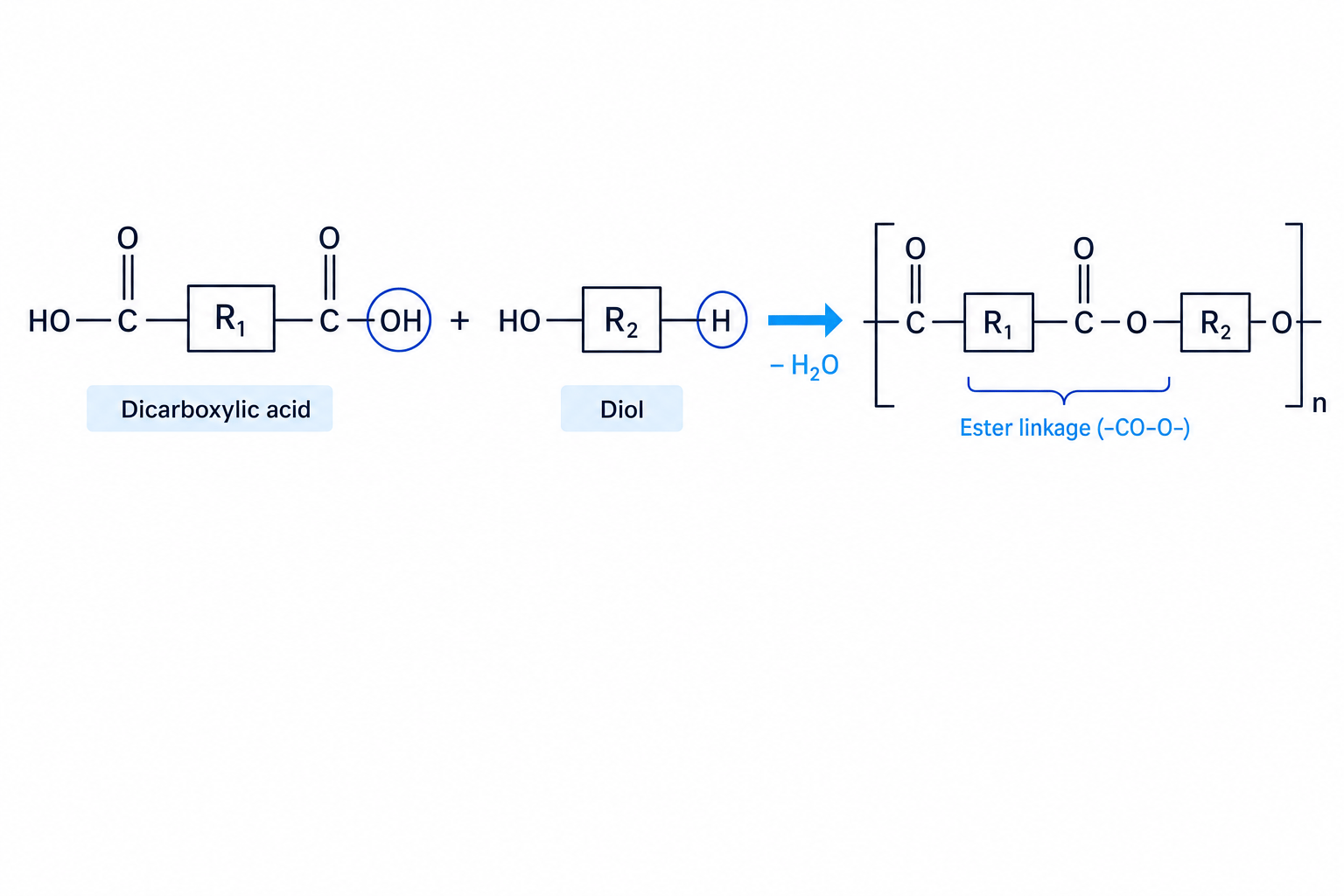
If we react nnn molecules of a diol with nnn molecules of a dicarboxylic acid, they link alternately to form a long polymer chain:
n HO-R1-OH+n HOOC-R2-COOH⟶—[ O-R1-O-CO-R2-CO ]n—+(2n−1) H2O n\,\text{HO-R}_1\text{-OH} + n\,\text{HOOC-R}_2\text{-COOH} \longrightarrow \text{—[ O-R}_1\text{-O-CO-R}_2\text{-CO ]}_n\text{—} + (2n-1)\,\text{H}_2\text{O} nHO-R1-OH+nHOOC-R2-COOH⟶—[ O-R1-O-CO-R2-CO ]n—+(2n−1)H2OSimplifying H₂O in Equations
In OCR A exams, when writing an equation for the formation of a condensation polymer from nnn moles of each monomer, you can write +2n H2O+ 2n\,\text{H}_2\text{O}+2nH2O as a simplified representation of the eliminated water molecules.
Route 2: Diol + Diacyl Chloride
Instead of a dicarboxylic acid, we can react a diol with a diacyl chloride (containing two −COCl-\text{COCl}−COCl groups). The hydroxyl group on the diol reacts with the acyl chloride group to form an ester link, eliminating a molecule of hydrogen chloride (HCl\text{HCl}HCl) instead of water:
n HO-R1-OH+n ClOC-R2-COCl⟶—[ O-R1-O-CO-R2-CO ]n—+2n HCl n\,\text{HO-R}_1\text{-OH} + n\,\text{ClOC-R}_2\text{-COCl} \longrightarrow \text{—[ O-R}_1\text{-O-CO-R}_2\text{-CO ]}_n\text{—} + 2n\,\text{HCl} nHO-R1-OH+nClOC-R2-COCl⟶—[ O-R1-O-CO-R2-CO ]n—+2nHClAcyl Chlorides vs. Carboxylic Acids
If an exam question asks you to choose monomers to synthesise a polyester rapidly and with a high yield at room temperature, choose the diacyl chloride rather than the dicarboxylic acid. Diacyl chlorides are much more reactive, meaning the reaction does not require an acid catalyst or heating. However, be aware that toxic, misty fumes of HCl\text{HCl}HCl gas are evolved.
Route 3: Single Monomer containing both -OH and -COOH
A polyester can also be made from a single monomer that contains both a carboxylic acid (or acyl chloride) and an alcohol group. A classic example is a hydroxycarboxylic acid (such as lactic acid, CH3CH(OH)COOH\text{CH}_3\text{CH(OH)COOH}CH3CH(OH)COOH):
n HO-R-COOH⟶—[ O-R-CO ]n—+n H2O n\,\text{HO-R-COOH} \longrightarrow \text{—[ O-R-CO ]}_n\text{—} + n\,\text{H}_2\text{O} nHO-R-COOH⟶—[ O-R-CO ]n—+nH2OPolyamides
A polyamide is formed when monomers link together via amide groups (−CONH−-\text{CONH}-−CONH−, also called peptide bonds in biochemistry). Just like polyesters, we have two primary laboratory/industrial routes to form them.
Route 1: Diamine + Dicarboxylic Acid
When a diamine (containing two −NH2-\text{NH}_2−NH2 groups) reacts with a dicarboxylic acid, the nitrogen's lone pair attacks the carbonyl carbon, forming an amide link and eliminating a water molecule:
n H2N-R1-NH2+n HOOC-R2-COOH⟶—[ HN-R1-NH-CO-R2-CO ]n—+2n H2O n\,\text{H}_2\text{N-R}_1\text{-NH}_2 + n\,\text{HOOC-R}_2\text{-COOH} \longrightarrow \text{—[ HN-R}_1\text{-NH-CO-R}_2\text{-CO ]}_n\text{—} + 2n\,\text{H}_2\text{O} nH2N-R1-NH2+nHOOC-R2-COOH⟶—[ HN-R1-NH-CO-R2-CO ]n—+2nH2OSynthetic polyamides like Nylon-6,6 are produced this way. (You do not need to memorise these structures, but you must be able to work with them if they are provided in a question!).
Route 2: Diamine + Diacyl Chloride
Reacting a diamine with a diacyl chloride is highly vigorous and occurs at room temperature without a catalyst, eliminating HCl\text{HCl}HCl gas:
n H2N-R1-NH2+n ClOC-R2-COCl⟶—[ HN-R1-NH-CO-R2-CO ]n—+2n HCl n\,\text{H}_2\text{N-R}_1\text{-NH}_2 + n\,\text{ClOC-R}_2\text{-COCl} \longrightarrow \text{—[ HN-R}_1\text{-NH-CO-R}_2\text{-CO ]}_n\text{—} + 2n\,\text{HCl} nH2N-R1-NH2+nClOC-R2-COCl⟶—[ HN-R1-NH-CO-R2-CO ]n—+2nHClPAG 10 Connection
In your practical endorsement (PAG 10), you may prepare Nylon-6,10 using the "Nylon Rope Trick". Decanedioyl dichloride (a diacyl chloride) dissolved in an organic solvent is poured carefully onto hexane-1,6-diamine dissolved in water. Because the liquids are immiscible, they form two layers, and the nylon polymer forms instantly at the interface. It can be wound out continuously on a glass rod!
Route 3: Amino Acids
A single monomer containing both an amine group (−NH2-\text{NH}_2−NH2) and a carboxylic acid group (−COOH-\text{COOH}−COOH), such as an amino acid, can polymerise with itself to form a polyamide:
n H2N-R-COOH⟶—[ HN-R-CO ]n—+n H2O n\,\text{H}_2\text{N-R-COOH} \longrightarrow \text{—[ HN-R-CO ]}_n\text{—} + n\,\text{H}_2\text{O} nH2N-R-COOH⟶—[ HN-R-CO ]n—+nH2OHydrolysis of Condensation Polymers
Because condensation polymers contain polar ester or amide links, they can be broken down by water. This process is called hydrolysis.
While pure water reacts incredibly slowly, the rate of hydrolysis can be significantly increased by heating the polymer under reflux with either a dilute aqueous acid (such as HCl(aq)\text{HCl}\text{(aq)}HCl(aq)) or a dilute aqueous alkali (such as NaOH(aq)\text{NaOH}\text{(aq)}NaOH(aq)).
The products obtained depend heavily on whether acidic or alkaline conditions are used.
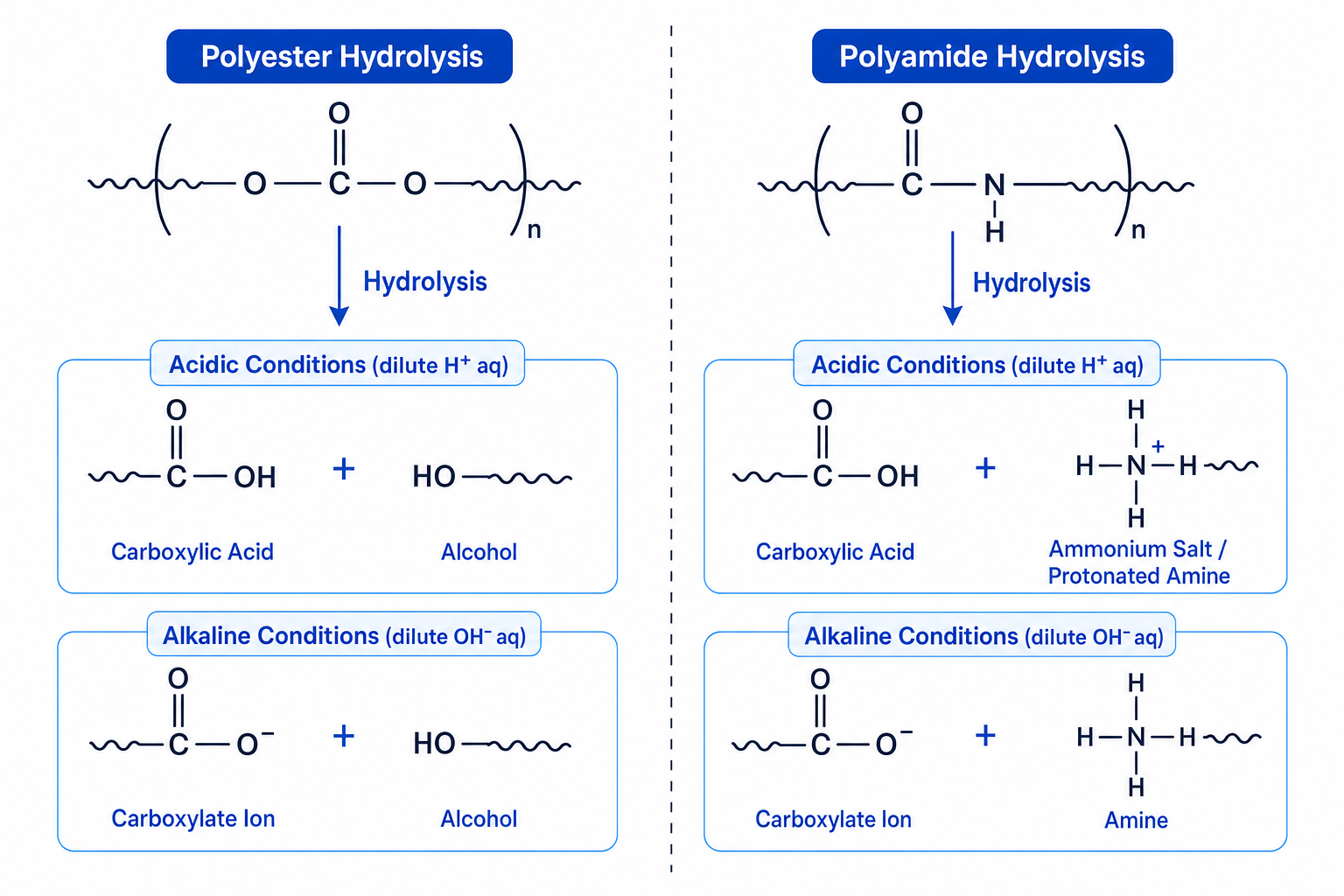
Hydrolysis of Polyesters
- Acid Hydrolysis (H+/H2O\text{H}^+\text{/H}_2\text{O}H+/H2O): The ester bond is cleaved. The products are the original diol and the dicarboxylic acid. Both of these organic molecules are stable in acidic conditions.
- Alkaline Hydrolysis (OH−/H2O\text{OH}^-\text{/H}_2\text{O}OH−/H2O): The ester bond is cleaved. The diol is unaffected, but the dicarboxylic acid reacts immediately with the excess base (OH−\text{OH}^-OH−) to form a dicarboxylate salt.
Hydrolysis of Polyamides
- Acid Hydrolysis (H+/H2O\text{H}^+\text{/H}_2\text{O}H+/H2O): The amide bond is cleaved. The dicarboxylic acid is stable in acid, but the basic diamine reacts with the excess H+\text{H}^+H+ ions to form a diammonium salt (where the −NH2-\text{NH}_2−NH2 groups are protonated to −NH3+-\text{NH}_3^+−NH3+).
- Alkaline Hydrolysis (OH−/H2O\text{OH}^-\text{/H}_2\text{O}OH−/H2O): The amide bond is cleaved. The diamine is stable in basic conditions, but the dicarboxylic acid reacts with the base to form a dicarboxylate salt.
Forgetting the Salt in Hydrolysis
In exams, a very common error is writing down the neutral carboxylic acid as a product of alkaline hydrolysis, or the neutral amine as a product of acid hydrolysis. Always check the pH of the reaction conditions specified in the question and adjust your functional groups accordingly: acids become carboxylate salts in base; amines become ammonium salts in acid!
Let's walk through how to apply this to a specific exam-style problem.
Determining the products of alkaline polyamide hydrolysis
Predict the organic products formed when the polyamide Kevlar, shown below, is heated under reflux with excess aqueous sodium hydroxide:
—[ HN-C6H4-NH-CO-C6H4-CO ]n— \text{—[ HN-C}_6\text{H}_4\text{-NH-CO-C}_6\text{H}_4\text{-CO ]}_n\text{—} —[ HN-C6H4-NH-CO-C6H4-CO ]n—- Locate and cleave the amide bonds. Find the amide linkage (—NH—CO—\text{—NH—CO—}—NH—CO—) inside the repeat unit and imagine cutting it.
This splits the polymer into two carbon-containing fragments: a diamine-derived skeleton (—NH-C6H4-NH—\text{—NH-C}_6\text{H}_4\text{-NH—}—NH-C6H4-NH—) and a dicarboxylic acid-derived skeleton (—CO-C6H4-CO—\text{—CO-C}_6\text{H}_4\text{-CO—}—CO-C6H4-CO—).
- Determine the intermediate neutral products. Add −H-\text{H}−H back to the nitrogen atoms and −OH-\text{OH}−OH back to the carbonyl carbon atoms to construct the hypothetical neutral monomers:
- Diamine monomer: H2N-C6H4-NH2\text{H}_2\text{N-C}_6\text{H}_4\text{-NH}_2H2N-C6H4-NH2 (benzene-1,4-diamine)
- Dicarboxylic acid monomer: HOOC-C6H4-COOH\text{HOOC-C}_6\text{H}_4\text{-COOH}HOOC-C6H4-COOH (benzene-1,4-dicarboxylic acid)
- Adjust the functional groups for the alkaline conditions (NaOH(aq)\text{NaOH}\text{(aq)}NaOH(aq)).
- The basic amine groups (−NH2-\text{NH}_2−NH2) do not react with sodium hydroxide, so benzene-1,4-diamine (H2N-C6H4-NH2\text{H}_2\text{N-C}_6\text{H}_4\text{-NH}_2H2N-C6H4-NH2) is your first product.
- The acidic carboxylic acid groups (−COOH-\text{COOH}−COOH) will react with the OH−\text{OH}^-OH− ions to form carboxylate ions. Therefore, you must draw the sodium salt: sodium benzene-1,4-dicarboxylate (Na+ −OOC-C6H4-COO− Na+\text{Na}^+ \, ^-\text{OOC-C}_6\text{H}_4\text{-COO}^- \, \text{Na}^+Na+−OOC-C6H4-COO−Na+).
Predicting Monomers and Repeat Units
You must be able to move confidently back and forth between monomers and polymers.
Deducing the Repeat Unit from Monomers
- Draw the two monomers facing each other (e.g., diol on the left, dicarboxylic acid on the right).
- Identify the atoms to be removed: the −OH-\text{OH}−OH from the carboxylic acid, and the −H-\text{H}−H from the alcohol or amine.
- Link the remaining atoms together with a new single covalent bond (the ester or amide link).
- Draw square brackets around the structure, ensuring that the "open-ended" bonds pass directly through the brackets to show the polymer chain continues. Add an 'nnn' subscript.
Deducing Monomers from a Polymer Section
If you are given a section of a polymer and asked to identify the monomer(s):
Deducing the monomers of a condensation polymer
Identify the monomers used to make the following polyester section:
—[ O-CH2-CH2-O-CO-CH2-CO-O-CH2-CH2-O-CO-CH2-CO ]— \text{—[ O-CH}_2\text{-CH}_2\text{-O-CO-CH}_2\text{-CO-O-CH}_2\text{-CH}_2\text{-O-CO-CH}_2\text{-CO ]—} —[ O-CH2-CH2-O-CO-CH2-CO-O-CH2-CH2-O-CO-CH2-CO ]—-
Identify the polymer type and ester linkages. Scan the backbone and find the ester linkages (−COO−-\text{COO}-−COO−). There are several in this section. Identify the single covalent bond that connects the carbonyl carbon (C=O\text{C}=\text{O}C=O) to the single-bonded oxygen (O\text{O}O).
-
Conceptually "cut" the ester linkages. Cut every single ester bond in the chain:
This reveals that the polymer is made from alternating repeating blocks of two different carbon chains: —O-CH2-CH2-O—\text{—O-CH}_2\text{-CH}_2\text{-O—}—O-CH2-CH2-O— and —CO-CH2-CO—\text{—CO-CH}_2\text{-CO—}—CO-CH2-CO—.
- Restore the original monomer functional groups.
- Add −H-\text{H}−H atoms back onto the oxygen atoms to restore the diol: ethane-1,2-diol (HO-CH2-CH2-OH\text{HO-CH}_2\text{-CH}_2\text{-OH}HO-CH2-CH2-OH).
- Add −OH-\text{OH}−OH groups back onto the carbonyl carbons to restore the dicarboxylic acid: propanedioic acid (HOOC-CH2-COOH\text{HOOC-CH}_2\text{-COOH}HOOC-CH2-COOH).
In the exam
- Count your carbons: When drawing monomers from a polymer (or vice versa), count the carbons in each alkyl chain very carefully. It is extremely common to accidentally lose or add a −CH2−-\text{CH}_2-−CH2− group when copying structures.
- Brackets and extension bonds: When drawing a repeat unit, make sure the bonds at each end extend clearly through the square brackets. If the bonds stop inside the brackets, you will lose the mark.
- Acid vs Base Hydrolysis checklist: When asked for hydrolysis products, always write down "Acid" or "Base" on your scrap paper and immediately apply the rule:
- Acid = Protonated amine (−NH3+-\text{NH}_3^+−NH3+) + Neutral carboxylic acid (−COOH-\text{COOH}−COOH).
- Base = Neutral amine (−NH2-\text{NH}_2−NH2) + Carboxylate salt (−COO−-\text{COO}^-−COO−).
Check yourself
- A polymer has the repeat unit —[ O-CH2-C6H4-O-CO-CH2-CO ]n—\text{—[ O-CH}_2\text{-C}_6\text{H}_4\text{-O-CO-CH}_2\text{-CO ]}_n\text{—}—[ O-CH2-C6H4-O-CO-CH2-CO ]n—. Write down the structures of the two monomers used to form this polymer.
- State the organic products formed when the polyamide —[ HN-(CH2)6-NH-CO-(CH2)4-CO ]n—\text{—[ HN-(CH}_2)_6\text{-NH-CO-(CH}_2)_4\text{-CO ]}_n\text{—}—[ HN-(CH2)6-NH-CO-(CH2)4-CO ]n— undergoes acid hydrolysis using hot, aqueous hydrochloric acid.
- Explain why polyesters and polyamides can biodegrade in the environment, whereas addition polymers like poly(ethene) do not. (Hint: Think about bond polarity and nucleophilic attack).
