

Welcome to one of the most exciting areas of organic chemistry! Here, we bridge the gap between simple organic molecules and the complex biochemistry of life. By looking at how different functional groups interact within the same molecule, you will understand how nature builds proteins and why the 3D shape of a molecule can determine whether a drug is a lifesaver or completely inactive.
What you'll learn
- How amino acids behave as both acids and bases.
- The structures of primary and secondary amides.
- What optical isomerism is and how to draw chiral molecules in 3D.
- How to locate chiral centres in complex molecules.
1. Structure and Reactions of Amino Acids
An amino acid is a bifunctional compound; it contains both a basic amine group (-NH2\text{-NH}_2-NH2) and an acidic carboxylic acid group (-COOH\text{-COOH}-COOH).
In an α\alphaα-amino acid, both of these groups are attached to the same carbon atom (known as the α\alphaα-carbon).
α-amino acid
An α\alphaα-amino acid is an organic compound with the general formula RCH(NH2)COOH\text{RCH(NH}_2\text{)COOH}RCH(NH2)COOH, where the amine group is attached to the carbon atom adjacent to the carboxyl carbon.
Because they contain both acidic and basic groups, amino acids can undergo reactions characteristic of both functional groups.
Acidic Reactions (Carboxylic Acid Group)
The carboxylic acid group (-COOH\text{-COOH}-COOH) can react with alkalis to form salts, or with alcohols to form esters.
1. Reaction with Alkalis
When treated with an alkali such as aqueous sodium hydroxide (NaOH\text{NaOH}NaOH), the carboxylic acid group loses a proton to form a carboxylate salt and water:
RCH(NH2)COOH+NaOH→RCH(NH2)COO−Na++H2O \text{RCH(NH}_2\text{)COOH} + \text{NaOH} \to \text{RCH(NH}_2\text{)COO}^-\text{Na}^+ + \text{H}_2\text{O} RCH(NH2)COOH+NaOH→RCH(NH2)COO−Na++H2O2. Reaction with Alcohols (Esterification)
When heated with an alcohol in the presence of a concentrated sulfuric acid catalyst (H2SO4\text{H}_2\text{SO}_4H2SO4) under reflux, the carboxylic acid group undergoes esterification.
The Esterification Trap
Because esterification requires a strong acid catalyst (H2SO4\text{H}_2\text{SO}_4H2SO4), the basic amine group (-NH2\text{-NH}_2-NH2) in the amino acid will also react with the acid. It accepts a proton to form an ammonium ion (-NH3+\text{-NH}_3^+-NH3+). You must show this protonated amine group in your final product structure!
The equation for the esterification of an α\alphaα-amino acid with methanol in the presence of H2SO4\text{H}_2\text{SO}_4H2SO4 is:
RCH(NH2)COOH+CH3OH+H+→[RCH(NH3)COOCH3]++H2O \text{RCH(NH}_2\text{)COOH} + \text{CH}_3\text{OH} + \text{H}^+ \to [\text{RCH(NH}_3\text{)COOCH}_3]^+ + \text{H}_2\text{O} RCH(NH2)COOH+CH3OH+H+→[RCH(NH3)COOCH3]++H2OBasic Reactions (Amine Group)
The amine group (-NH2\text{-NH}_2-NH2) has a lone pair of electrons on the nitrogen atom, allowing it to act as a proton acceptor (a Brønsted-Lowry base).
Reaction with Acids
When an amino acid reacts with a strong mineral acid such as hydrochloric acid (HCl\text{HCl}HCl), the amine group is protonated to form an ammonium salt:
RCH(NH2)COOH+HCl→[RCH(NH3)COOH]+Cl− \text{RCH(NH}_2\text{)COOH} + \text{HCl} \to [\text{RCH(NH}_3\text{)COOH}]^+\text{Cl}^- RCH(NH2)COOH+HCl→[RCH(NH3)COOH]+Cl−Amphoteric Nature
Because amino acids react with both acids and bases, they are described as amphoteric. This dual nature is crucial for buffer systems in biological fluids.
Let's look at how to predict and draw these structures in a typical synthesis question.
Predicting amino acid reaction products
Alanine is an α\alphaα-amino acid where the R-group is a methyl group (-CH3\text{-CH}_3-CH3), giving the formula CH3CH(NH2)COOH\text{CH}_3\text{CH(NH}_2\text{)COOH}CH3CH(NH2)COOH. Predict the organic product formed when alanine reacts with:
- Aqueous potassium hydroxide (KOH\text{KOH}KOH).
- Excess dilute hydrochloric acid (HCl\text{HCl}HCl).
- Ethanol (CH3CH2OH\text{CH}_3\text{CH}_2\text{OH}CH3CH2OH) in the presence of concentrated sulfuric acid under reflux.
Step-by-step solution:
- Identify the reacting functional group for KOH: Potassium hydroxide is a strong base. It will react only with the acidic carboxylic acid group (-COOH\text{-COOH}-COOH) of alanine, deprotonating it to form a potassium carboxylate salt.
- Identify the reacting functional group for HCl: Hydrochloric acid is a strong acid. It will react only with the basic amine group (-NH2\text{-NH}_2-NH2), protonating it to form a chloride salt.
- Determine the reaction conditions and dual consequences for ethanol + H₂SO₄: This is an esterification reaction. The alcohol reacts with the carboxylic acid group to form an ethyl ester (-COOCH2CH3\text{-COOCH}_2\text{CH}_3-COOCH2CH3). However, because concentrated H2SO4\text{H}_2\text{SO}_4H2SO4 is present, the basic amine group is also protonated to -NH3+\text{-NH}_3^+-NH3+.
2. Amides
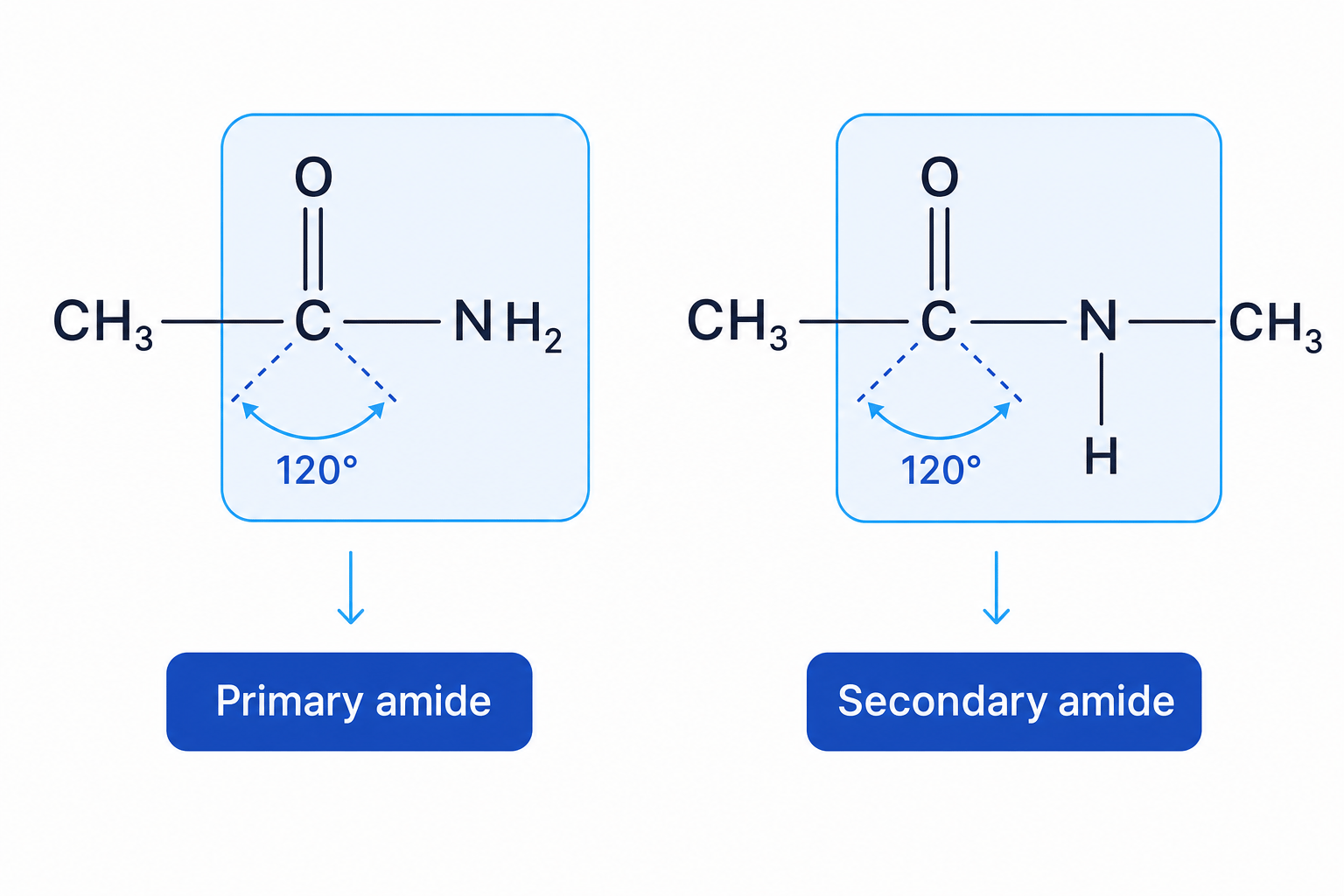
Amides are nitrogen-containing organic compounds containing a carbonyl group (C=O\text{C=O}C=O) directly linked to a nitrogen atom. They are closely related to carboxylic acids and are classified based on the number of carbon groups attached to the nitrogen atom.
Primary Amides
In a primary amide, the nitrogen atom is bonded to only one carbon atom (the carbonyl carbon). The general formula for a primary amide is RCONH2\text{RCONH}_2RCONH2.
- Example: Ethanamide, CH3CONH2\text{CH}_3\text{CONH}_2CH3CONH2.
Secondary Amides
In a secondary amide, the nitrogen atom is bonded to two carbon atoms: the carbonyl carbon and an alkyl (or aryl) group. The general formula for a secondary amide is RCONHR′\text{RCONHR}'RCONHR′.
- Example: N-methylethanamide, CH3CONHCH3\text{CH}_3\text{CONHCH}_3CH3CONHCH3.
- Note on naming: The prefix "N-" indicates that the substituent (in this case, a methyl group) is attached directly to the nitrogen atom.
Confusing Amides and Amines
An amine contains a nitrogen atom bonded directly to carbon atoms that are part of alkyl chains, but not directly to a carbonyl group (e.g., CH3CH2NH2\text{CH}_3\text{CH}_2\text{NH}_2CH3CH2NH2). An amide must have the nitrogen directly bonded to a carbonyl group (-C(=O)N-\text{-C(=O)N-}-C(=O)N-). This changes the chemical properties completely; amides are not basic because the lone pair on the nitrogen is delocalised into the carbonyl group.
3. Chirality and Optical Isomerism
Optical isomerism is a form of stereoisomerism.
Stereoisomerism
Stereoisomers are compounds with the same structural formula but a different arrangement of atoms in 3D space.
Optical isomerism occurs in molecules that contain a chiral centre (sometimes called an asymmetric carbon atom).
Chiral Centre
A chiral centre is a carbon atom that is bonded to four different atoms or groups of atoms. It is conventionally marked with an asterisk (*\text{*}*).
What are Optical Isomers?
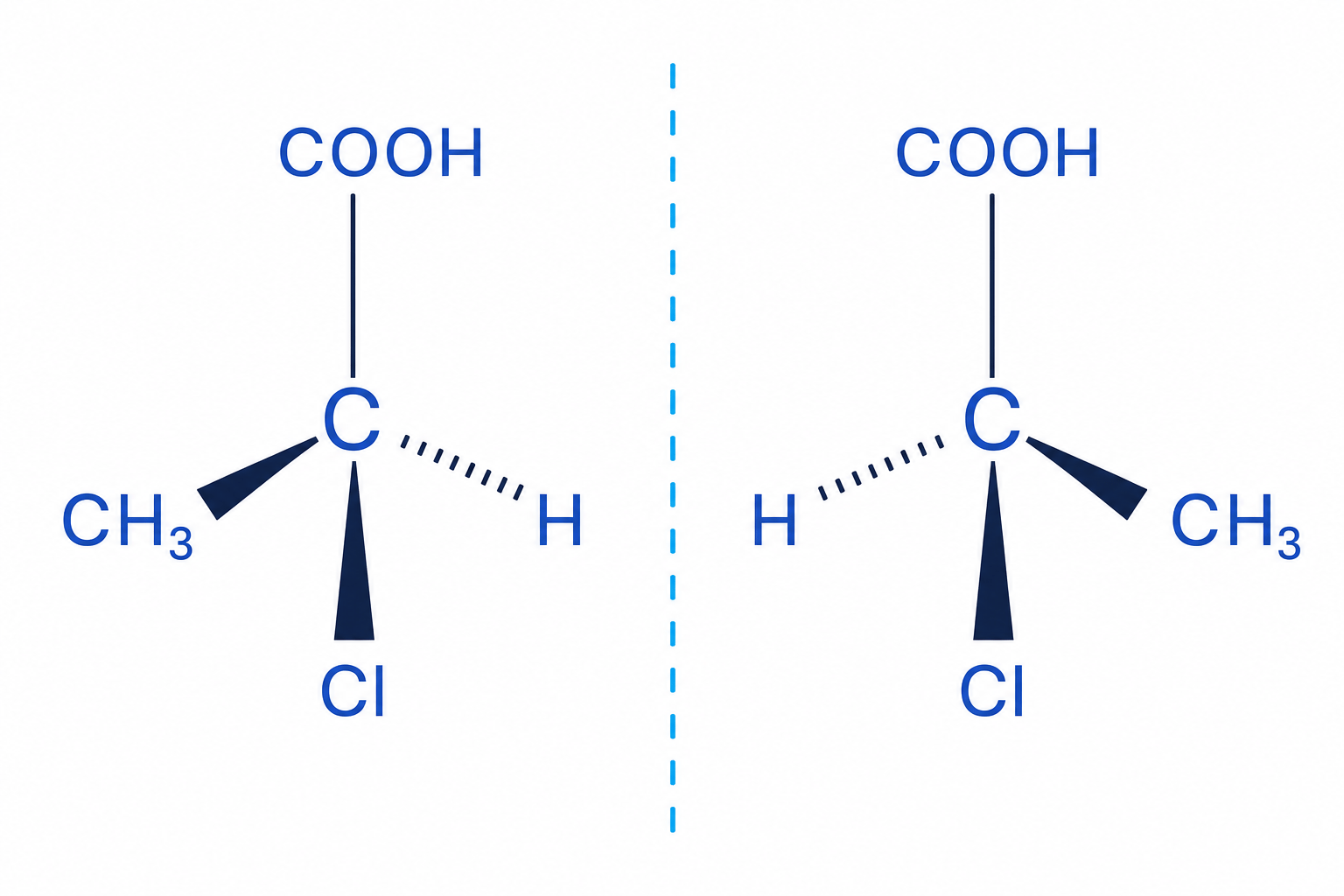
When a molecule has a chiral centre, it can exist as two non-superimposable mirror images. These two mirror-image forms are called optical isomers or enantiomers.
Hands and Chirality
Your left and right hands are mirror images of each other. If you hold them palm-to-palm, they match perfectly. However, if you try to place your right hand directly on top of your left hand (both palms facing down), they do not superimpose—your thumbs point in opposite directions. Your hands are chiral!
Drawing Optical Isomers in 3D
To secure full marks in written papers, you must be able to draw 3D representations of optical isomers showing their tetrahedral geometry.
When drawing:
- Use a flat line ( — ) for bonds in the plane of the paper.
- Use a solid wedge ( ◄ ) for bonds pointing out of the page towards you.
- Use a dashed wedge ( ⫾⫾⫾ ) for bonds pointing into the page away from you.
- Always draw a vertical dashed line to represent the mirror plane between the two enantiomers.
Symmetry Drawing Check
Ensure that your second isomer is a true reflection of the first. If group A is pointing towards the mirror on the left, it must point towards the mirror on the right!
4. Identifying Chiral Centres in Complex Molecules
In your exams, you will be given skeletal formulas of complex organic molecules (such as pharmaceutical drugs) and asked to identify any chiral centres.
To identify a chiral centre:
- Ignore any carbon atoms that cannot be chiral (e.g., -CH2-\text{-CH}_2\text{-}-CH2- groups, -CH3\text{-CH}_3-CH3 groups, and any carbon involved in a double bond like C=C\text{C=C}C=C or C=O\text{C=O}C=O, as these are bonded to fewer than 4 different groups).
- Look at each remaining -CH-\text{-CH-}-CH- or bare carbon atom.
- Trace outward along each of the four paths from that carbon. If the paths lead to different sequences of atoms, the carbon is a chiral centre.
Let's put this into practice with a detailed worked example.
Identifying chiral centres in a structural formula
The structure below represents a molecule of butan-2-ol:
CH3CH(OH)CH2CH3 \text{CH}_3\text{CH(OH)CH}_2\text{CH}_3 CH3CH(OH)CH2CH3Identify whether this molecule contains a chiral centre, and draw 3D representations of its two optical isomers.
Step-by-step solution:
-
Analyse each carbon atom to find four different attached groups:
- Carbon 1 (-CH3\text{-CH}_3-CH3): Bonded to three identical hydrogen atoms. Not chiral.
- Carbon 3 (-CH2-\text{-CH}_2\text{-}-CH2-): Bonded to two identical hydrogen atoms. Not chiral.
- Carbon 4 (-CH3\text{-CH}_3-CH3): Bonded to three identical hydrogen atoms. Not chiral.
- Carbon 2 (-CH(OH)-\text{-CH(OH)-}-CH(OH)-): Bonded to:
- A hydrogen atom (-H\text{-H}-H)
- A hydroxyl group (-OH\text{-OH}-OH)
- A methyl group (-CH3\text{-CH}_3-CH3)
- An ethyl group (-CH2CH3\text{-CH}_2\text{CH}_3-CH2CH3)
Since Carbon 2 is bonded to four entirely different groups, it is a chiral centre (C*\text{C*}C*).
-
Set up the 3D tetrahedral framework: Draw a central carbon atom with two bonds in the plane of the page (typically one vertical and one angled), one wedged bond, and one dashed bond.
-
Assign the groups to the bonds and reflect: Place the four groups (-H\text{-H}-H, -OH\text{-OH}-OH, -CH3\text{-CH}_3-CH3, -CH2CH3\text{-CH}_2\text{CH}_3-CH2CH3) on the bonds. Draw a dashed mirror line, and then draw the exact mirror image on the other side.
       CH3                       CH3
        |                         |
     *  |  _                   _  |  *
  HO--- C                 C ---OH
       / \                       / \
      /   \                     /   \
  H3C-H2C  H                   H   CH2-CH3
  (wedge) (dash)           (dash) (wedge)

           |  MIRROR PLANE  |
In the exam
- Always read reaction conditions carefully: If an amino acid is reacted with an alcohol and concentrated H2SO4\text{H}_2\text{SO}_4H2SO4, do not forget to protonate the amine group in your final drawn product (-NH3+\text{-NH}_3^+-NH3+).
- Be precise with 3D tetrahedral structures: Ensure the wedges and dashes are clearly drawn. The angle between the bonds in your drawing should look approximately tetrahedral (≈109.5∘\approx 109.5^\circ≈109.5∘).
- Ring systems and chirality: When checking for chiral centres in cyclic compounds, trace clockwise and anticlockwise around the ring from a carbon. If the two paths are different, the carbon is a chiral centre.
Check yourself
- State the reagents and conditions required to convert the carboxylic acid group of an amino acid into an ester.
- Explain the structural difference between a primary amide and a secondary amide, giving the IUPAC name of one example of each.
- A molecule has the formula CH3CH2CH(CH3)CH2OH\text{CH}_3\text{CH}_2\text{CH(CH}_3\text{)CH}_2\text{OH}CH3CH2CH(CH3)CH2OH. Identify the chiral carbon and sketch the two optical isomers as 3D representations.
