

What you'll learn
- How chemists increase carbon chain length during organic synthesis.
- How cyanide ions form new carbon–carbon bonds with haloalkanes and carbonyl compounds.
- How nitriles can be converted into amines or carboxylic acids.
- How Friedel–Crafts alkylation and acylation put carbon groups onto benzene rings.
Why carbon–carbon bond formation matters
In organic synthesis, you often need to make a molecule with more carbon atoms than your starting material. A reaction that forms a new carbon–carbon bond lets you build up the carbon skeleton of the target molecule.
Carbon skeleton
The carbon skeleton is the chain or ring framework of carbon atoms in an organic molecule. Functional groups can then be changed around this framework.
This topic focuses on two big ways to make new carbon–carbon bonds:
- using cyanide ions, CN−, to introduce a nitrile group;
- using Friedel–Crafts reactions to attach carbon groups to benzene rings.
The synthesis idea
A new carbon–carbon bond is valuable because it usually gives you a molecule with a longer or more complex carbon skeleton, which can then be converted into other functional groups.
Planning a one-carbon chain extension
You need to make butanoic acid from 1-bromopropane.
-
Identify the carbon count: 1-bromopropane has three carbon atoms, while butanoic acid has four. So the synthesis needs to add one carbon atom.
-
Choose cyanide substitution because CN− adds one carbon:
CH3CH2CH2Br → CH3CH2CH2CN
The product is butanenitrile, because the nitrile carbon counts as carbon 1 of the parent chain. -
Convert the nitrile into the carboxylic acid by acid hydrolysis:
CH3CH2CH2CN → CH3CH2CH2COOH -
State the route with reagents and conditions:
1-bromopropane → butanenitrile using ethanolic KCN, heat under reflux; then butanenitrile → butanoic acid using dilute acid, heat under reflux.
Cyanide ions and nitriles
A nucleophile is an electron-pair donor. The cyanide ion, CN−, is a nucleophile because it has a lone pair and a negative charge.
Nitrile
A nitrile contains the −C≡N functional group. The carbon of the −C≡N group is part of the carbon chain when naming the molecule.
The important point is that CN− attacks through its carbon atom, forming a new carbon–carbon bond. The nitrogen stays triple-bonded to that carbon.
Attacking through nitrogen
Do not draw the new bond through the nitrogen atom of CN−. For this OCR route, the carbon end of CN− forms the new C–C bond.
Haloalkanes + CN−: nucleophilic substitution
A haloalkane contains a carbon–halogen bond, such as C–Br or C–Cl. The carbon bonded to the halogen is electron-deficient because halogens are more electronegative than carbon.
In a nucleophilic substitution reaction, a nucleophile replaces another atom or group. Here, CN− replaces the halide ion.
General reaction:
R–X + CN− → R–CN + X−
Typical reagents and conditions:
- KCN or NaCN;
- ethanol as the solvent;
- heat under reflux.
For example:
CH3CH2Br + CN− → CH3CH2CN + Br−
This converts bromoethane into propanenitrile, increasing the carbon chain from two carbons to three.
The diagram shows the two cyanide reactions you need: nucleophilic substitution of a haloalkane and nucleophilic addition to a carbonyl compound.
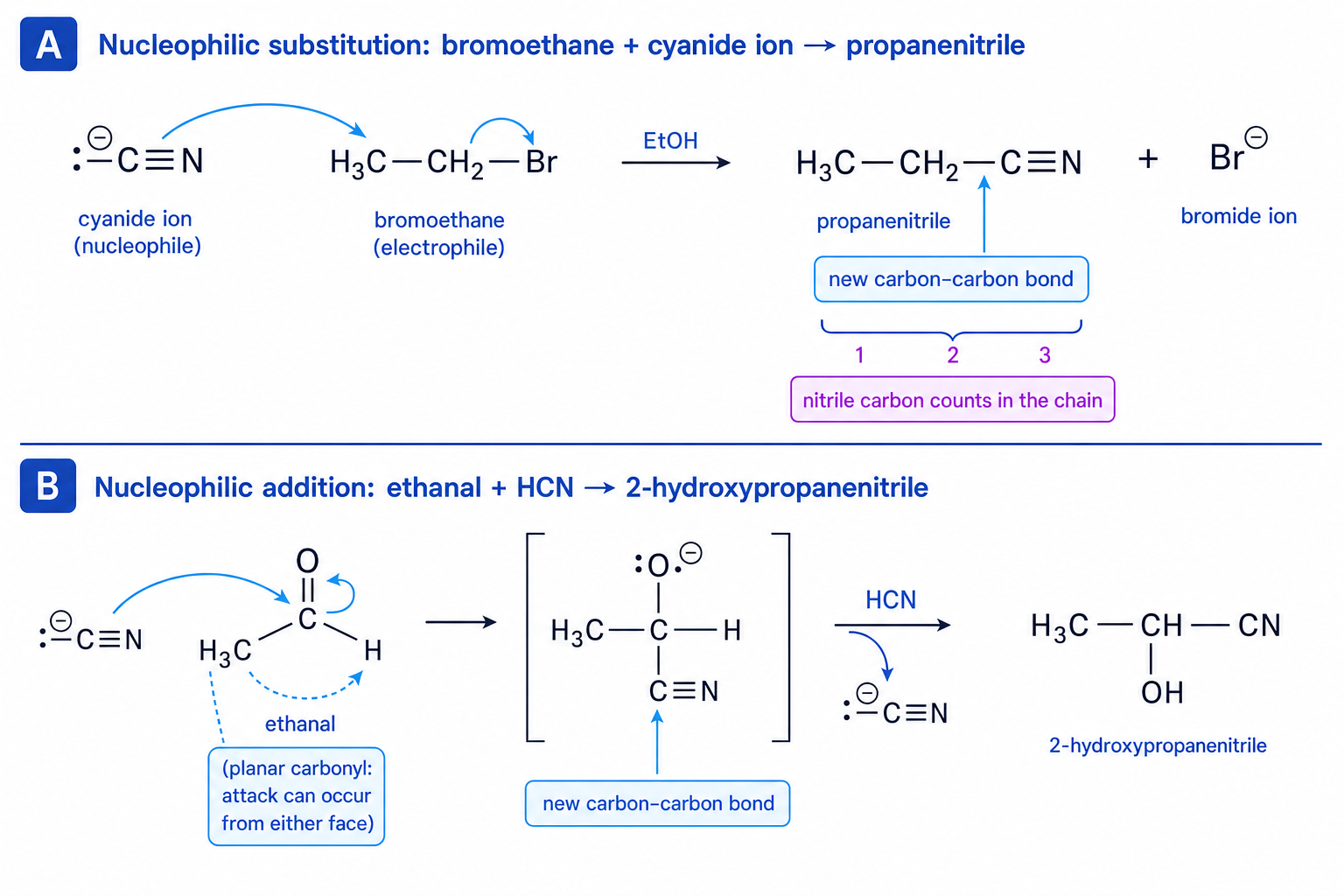
Drawing cyanide substitution of bromoethane
-
Mark the reacting centres: the carbon in CN− has a lone pair and acts as the nucleophile; the carbon attached to Br in bromoethane is electron-deficient.
-
Draw a curly arrow from the lone pair on the carbon of CN− to the carbon bonded to Br. This represents formation of the new C–C bond.
-
Draw a curly arrow from the C–Br bond to Br. This represents heterolytic bond breaking and formation of Br−.
-
Write the organic product as CH3CH2CN, not CH3CH2NC. The product is propanenitrile because the nitrile carbon is included in the three-carbon chain.
Carbonyl compounds + HCN: nucleophilic addition
A carbonyl compound contains the C=O group. Aldehydes have the group −CHO; ketones have the group >C=O within a carbon chain.
The C=O bond is polar:
- oxygen is δ−;
- the carbonyl carbon is δ+.
That δ+ carbon is attacked by CN−. This forms a hydroxynitrile, a molecule containing both −OH and −C≡N.
General reactions:
- Aldehyde: RCHO + HCN → RCH(OH)CN
- Ketone: R2CO + HCN → R2C(OH)CN
The reaction uses HCN, usually with a small amount of CN− present to act as the nucleophile.
HCN is extremely toxic
In school chemistry you focus on the mechanism and products. In real practical work, HCN is highly poisonous, so cyanide chemistry requires strict safety controls.
Drawing cyanide addition to ethanal
-
Identify the electrophilic atom: in CH3CHO, the carbonyl carbon is δ+ because oxygen pulls electron density away through the C=O bond.
-
Draw a curly arrow from the lone pair on the carbon of CN− to the carbonyl carbon. This makes the new C–C bond.
-
Draw a curly arrow from the C=O π bond to the oxygen atom. This breaks the π bond and forms an alkoxide intermediate, CH3CH(O−)CN.
-
Protonate the alkoxide using HCN: the O− gains H+, giving CH3CH(OH)CN. The CN− is regenerated, so it can continue acting as the nucleophile.
Spotting the product name
For aldehydes and ketones reacting with HCN, the product name usually contains hydroxy and nitrile. For example, ethanal forms 2-hydroxypropanenitrile.
If a planar carbonyl compound forms a product with a new chiral centre, CN− can attack from either side of the C=O plane. This can form a racemic mixture, meaning equal amounts of two optical isomers.
Reactions of nitriles
Once you have made a nitrile, the −C≡N group can be converted into other useful functional groups. The carbon chain length is retained because the nitrile carbon remains in the molecule.
Reduction of nitriles to amines
Reduction is a reaction in which a molecule gains hydrogen, loses oxygen, or gains electrons. Nitriles can be reduced to primary amines, which contain the −NH2 group attached to a carbon chain.
General reaction:
R–CN + 2H2 → R–CH2NH2
Reagents and conditions:
- hydrogen, H2;
- nickel catalyst, Ni;
- heat.
For example:
CH3CH2CN + 2H2 → CH3CH2CH2NH2
Propanenitrile forms propan-1-amine.
Predicting the amine from a nitrile
-
Keep the carbon skeleton the same: butanenitrile has four carbons, and the product amine will also have four carbons.
-
Convert the −C≡N end into −CH2NH2. This turns CH3CH2CH2CN into CH3CH2CH2CH2NH2.
-
Name the product from the longest chain containing the amine: the product is butan-1-amine.
Acid hydrolysis of nitriles to carboxylic acids
Hydrolysis means breaking a bond by reaction with water. Nitriles undergo acid hydrolysis to form carboxylic acids.
General ionic equation:
R–CN + 2H2O + H+ → R–COOH + NH4+
Reagents and conditions:
- dilute acid, such as dilute HCl or dilute H2SO4;
- heat under reflux.
For example:
CH3CH2CN + 2H2O + H+ → CH3CH2COOH + NH4+
Propanenitrile forms propanoic acid.
Losing the nitrile carbon
The carbon in −C≡N becomes the carbon in −COOH. Do not remove it when drawing or naming the carboxylic acid product.
Friedel–Crafts reactions: adding carbon groups to benzene
Benzene is unusually stable because of its delocalised π electron system. It reacts mainly by electrophilic substitution, where an electrophile replaces a hydrogen atom on the ring and aromatic stability is restored.
Friedel–Crafts reaction
A Friedel–Crafts reaction is an electrophilic substitution reaction that forms a carbon–carbon bond between a benzene ring and an alkyl or acyl group.
A halogen carrier is a Lewis acid catalyst that accepts a halide ion and helps generate a strong electrophile. In this topic, the usual halogen carrier is anhydrous AlCl3.
Forgetting anhydrous conditions
AlCl3 reacts with water, so Friedel–Crafts reactions are carried out under anhydrous conditions. Do not write aqueous AlCl3.
The diagram summarises the two mechanisms: alkylation using a haloalkane and acylation using an acyl chloride.
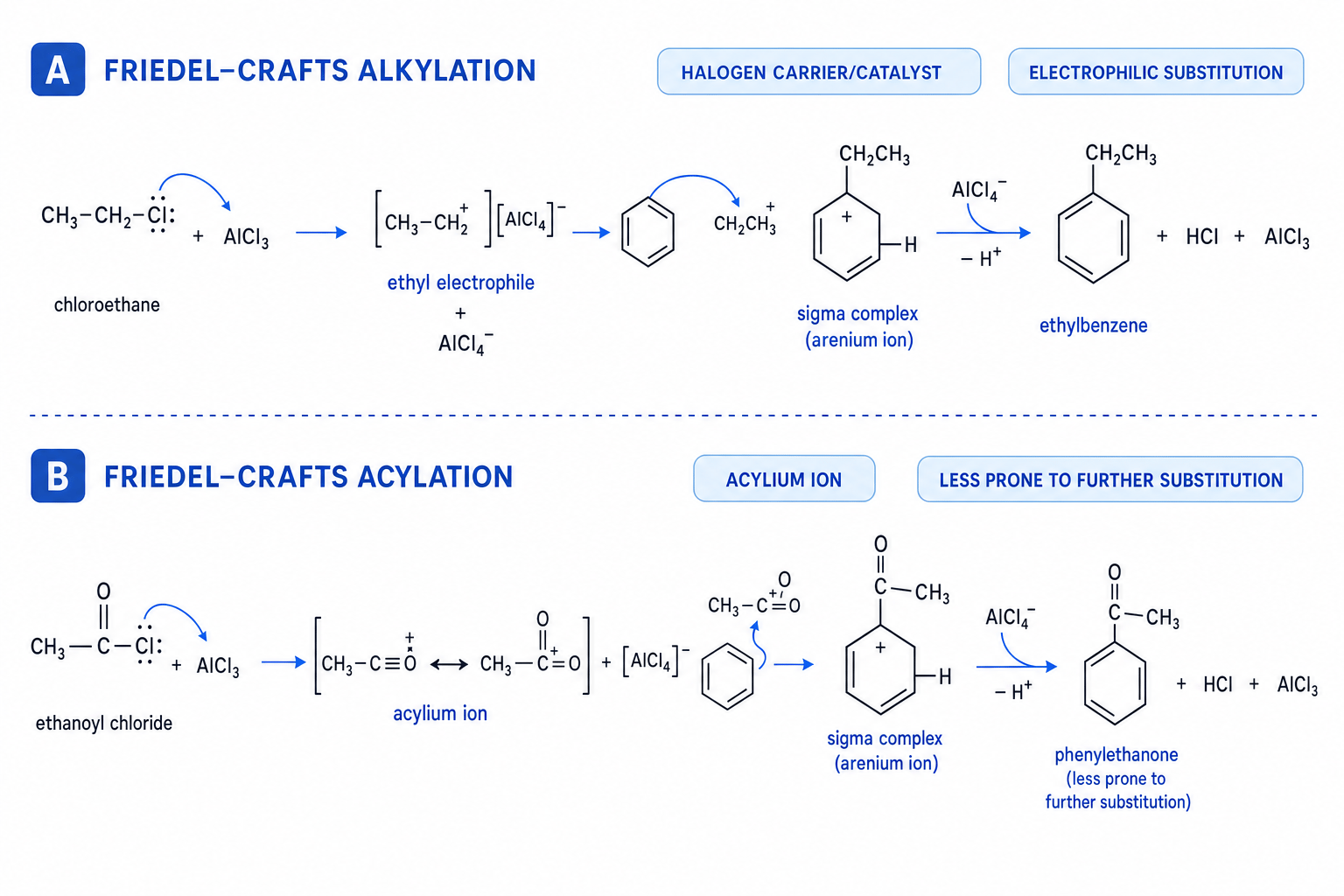
Friedel–Crafts alkylation
In alkylation, an alkyl group such as CH3− or CH3CH2− is attached to benzene.
Example:
C6H6 + CH3CH2Cl → C6H5CH2CH3 + HCl
Conditions: chloroalkane or bromoalkane with anhydrous AlCl3.
Mechanism for Friedel–Crafts alkylation
-
Generate the electrophile: chloroethane reacts with AlCl3. The C–Cl bond is polarised and an ethyl electrophile is produced, along with AlCl4−.
-
Use the benzene π system: draw a curly arrow from the delocalised ring electrons to the ethyl electrophile. This forms a new C–C bond and a positively charged sigma complex.
-
Restore aromaticity: AlCl4− removes H+ from the carbon that gained the ethyl group. The electrons from the C–H bond return to the ring.
-
Write the products: ethylbenzene, HCl and regenerated AlCl3.
Friedel–Crafts acylation
An acyl group has the structure RCO−. In Friedel–Crafts acylation, benzene reacts with an acyl chloride, RCOCl, to form a phenyl ketone.
Example:
C6H6 + CH3COCl → C6H5COCH3 + HCl
Conditions: acyl chloride with anhydrous AlCl3.
The key electrophile is the acylium ion, RCO+. It can be represented as R−C≡O+ or R−C+=O.
Mechanism for Friedel–Crafts acylation
-
Generate the acylium ion: ethanoyl chloride reacts with AlCl3, forming CH3CO+ and AlCl4−.
-
Form the new C–C bond: draw a curly arrow from the benzene π electrons to the carbon of the acylium ion. This gives a sigma complex.
-
Restore the benzene ring: AlCl4− removes H+, and the C–H bond electrons return to the ring.
-
State the products: phenylethanone, HCl and regenerated AlCl3.
Alkylation versus acylation
Alkylation attaches an alkyl group, R−. Acylation attaches an acyl group, RCO−, giving a ketone directly bonded to the benzene ring.
In the exam
-
Count carbons carefully: the carbon in CN− becomes part of the product chain, and the nitrile carbon is not lost during reduction or hydrolysis.
-
For mechanisms, make curly arrows start from electron pairs or bonds, not from charges. Show attack by the carbon end of CN−.
-
For Friedel–Crafts reactions, always include anhydrous AlCl3, the electrophile, the sigma complex, and regeneration of the benzene ring.
Check yourself
- What product forms when 1-chlorobutane reacts with ethanolic KCN under reflux?
- How would you convert propanenitrile into propanoic acid, including reagents and conditions?
- In Friedel–Crafts acylation, what is the electrophile and how is it generated?
