

Organic synthesis is the art and science of constructing complex target molecules from simpler starting materials. In this topic, you will bring together all the organic reactions you have studied across the entire A-Level course. You will also master the practical techniques used in the laboratory to prepare, isolate, purify, and verify the identity of organic solids.
What you'll learn
- How to use Quickfit apparatus for heating under reflux and distillation.
- The rigorous step-by-step process of purifying an organic solid using recrystallisation and filtration under reduced pressure.
- How to identify functional groups in multi-functional compounds and predict their properties.
- The strategy of retrosynthetic analysis to design multi-stage organic synthetic pathways.
1. Preparing Organic Compounds: Laboratory Techniques
Before you can purify a compound, you must synthesise it. Because organic reactions are often slow and organic compounds are highly volatile and flammable, we cannot simply boil them in an open beaker. We use specialised ground-glass glassware known as Quickfit apparatus to safely conduct reactions.
Heating Under Reflux
Heating under reflux
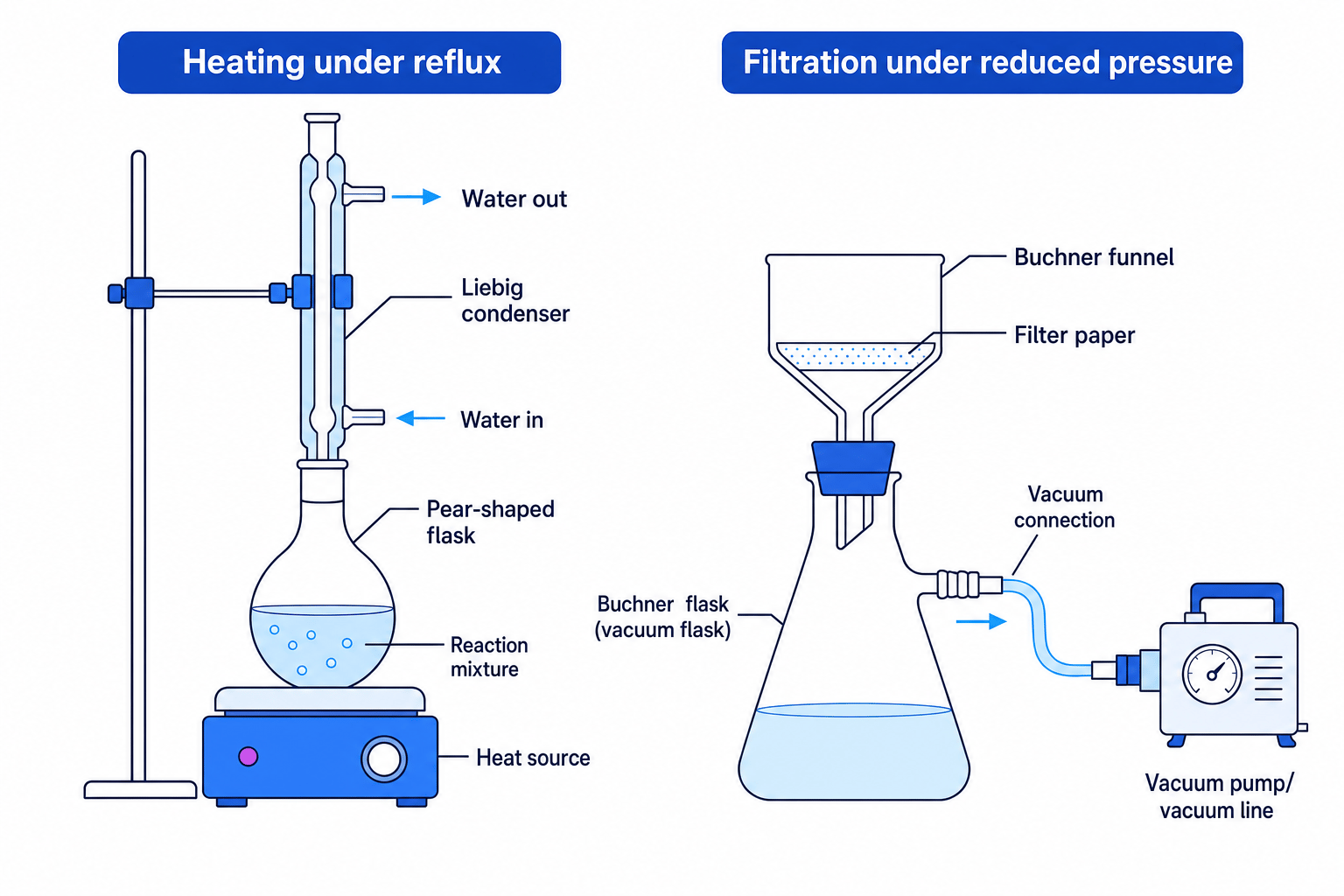
The continuous boiling and condensing of a reaction mixture in a vertical condenser. This technique allows a reaction to be heated for prolonged periods without volatile reactants, products, or solvents escaping into the laboratory.
When heating under reflux:
- The reaction mixture is placed in a pear-shaped or round-bottomed flask.
- Anti-bumping granules are added to the flask before heating. These provide nucleation sites, ensuring smooth, even boiling and preventing large, violent bubbles from bumping and splashing liquid up the condenser.
- A condenser is fitted vertically into the flask. Water enters the jacket at the bottom and leaves at the top to ensure the condenser jacket is completely filled with cold water, maximising cooling efficiency.
- The top of the condenser must remain open to the air. Sealing it would create a closed system, leading to a dangerous build-up of gas pressure and a high risk of explosion.
Distillation
Distillation
A separation technique used to isolate a volatile liquid from a reaction mixture by boiling it and condensing the vapour into a separate receiving flask.
In distillation, the condenser is placed horizontally/angled downwards. The component with the lowest boiling point vaporises first, rises, enters the condenser, and condenses back into a liquid (the distillate) which is collected. This is commonly used when oxidising primary alcohols to aldehydes, where the aldehyde must be distilled off immediately to prevent further oxidation to a carboxylic acid.
2. Purifying an Organic Solid (PAG 6)
Once a reaction is complete, the crude product is typically a mixture of the desired solid product, unreacted starting materials, catalysts, and side-products. To isolate a pure sample of an organic solid, you must follow a highly specific sequence of purification steps.
Step 1: Filtration Under Reduced Pressure
This technique is used to separate a solid product from liquid impurities or solvent quickly and efficiently.
- A Buchner funnel containing a flat piece of filter paper is placed on top of a Buchner flask (a thick-walled flask with a side-arm).
- The side-arm is connected via rubber tubing to a vacuum pump or water aspirator.
- The vacuum creates a pressure gradient. When the mixture is poured into the funnel, the liquid is pulled rapidly through the filter paper into the flask, leaving the damp solid product on the filter paper.
Step 2: Recrystallisation
Recrystallisation
A purification technique used to remove impurities from an organic solid based on differences in solubility in a chosen solvent.
The success of recrystallisation depends entirely on choosing a solvent in which the desired product is highly soluble at high temperatures but sparingly soluble at low temperatures.
Here is the precise laboratory procedure:
-
Dissolve the impure solid in the minimum volume of hot solvent.
TipWhy minimum volume?
Using the minimum volume ensures the solution is saturated. If you use too much solvent, a significant proportion of your product will remain dissolved even when cooled, drastically reducing your percentage yield.
-
Filter the hot solution (optional, but standard) through filter paper in a warmed funnel to remove any insoluble impurities.
-
Cool the filtrate slowly to room temperature, then place it in an ice bath. As the temperature drops, the solubility of the product falls, and pure crystals of the compound will precipitate out of the solution. Soluble impurities remain dissolved in the solvent because they are present in much smaller quantities and do not saturate the solution.
-
Filter the cold mixture under reduced pressure using a Buchner funnel to separate the pure solid crystals from the solvent containing the soluble impurities.
-
Wash the crystals with a small portion of ice-cold solvent. This removes any remaining soluble impurities adhering to the surface of the crystals without dissolving the crystals themselves.
-
Dry the crystals in a warm oven or a desiccator to remove all traces of water or solvent.
Washing with warm solvent
Never wash your purified crystals with warm or hot solvent! This will dissolve your hard-earned crystals, sending them straight through the Buchner funnel into the waste filtrate and ruining your yield.
Step 3: Verifying Purity (Melting Point Determination)
To confirm that your recrystallised solid is pure, you measure its melting point range and compare it to known database values.
- Place a small, dry sample of the solid into a capillary tube sealed at one end.
- Heat the sample slowly using a melting point apparatus or a Thiele tube.
- Record the temperature at which the solid starts to melt and the temperature at which it has completely melted. This is your melting point range.
Melting point and purity
- A pure organic solid has a sharp, well-defined melting point range (typically within 1 ∘C1\text{ }^\circ\text{C}1 ∘C to 2 ∘C2\text{ }^\circ\text{C}2 ∘C of the literature value).
- An impure organic solid melts over a wide range of temperatures and at a significantly lower temperature than the pure substance.
Calculating the percentage yield of a purified organic solid
A student prepared aspirin (C9H8O4\text{C}_9\text{H}_8\text{O}_4C9H8O4, Mr=180.0 g mol−1M_r = 180.0\text{ g mol}^{-1}Mr=180.0 g mol−1) by reacting salicylic acid (C7H6O3\text{C}_7\text{H}_6\text{O}_3C7H6O3, Mr=138.0 g mol−1M_r = 138.0\text{ g mol}^{-1}Mr=138.0 g mol−1) with excess ethanoic anhydride.
The student reacted 5.00 g5.00\text{ g}5.00 g of salicylic acid. After recrystallisation and drying, they obtained 4.25 g4.25\text{ g}4.25 g of pure aspirin crystals. Determine the percentage yield of the reaction.
- Calculate the amount, in moles, of the starting material (salicylic acid): Using the equation n=mMn = \frac{m}{M}n=Mm:
- Determine the theoretical yield of aspirin in moles: The stoichiometry of the reaction is 1:11:11:1. Therefore, the theoretical moles of aspirin produced is:
- Calculate the theoretical mass of aspirin: Using the rearranged mass equation m=n×Mm = n \times Mm=n×M:
- Calculate the percentage yield:
3. Designing Multi-Stage Synthetic Routes
In the exam, you will be asked to propose a synthetic pathway to convert a starting organic molecule into a target molecule. This requires:
- Identifying the functional groups in both the starting material and target molecule.
- Recalling the reagents and conditions needed to convert one functional group to another.
- Tracking changes in the carbon backbone (e.g., adding carbons using nitrile chemistry).
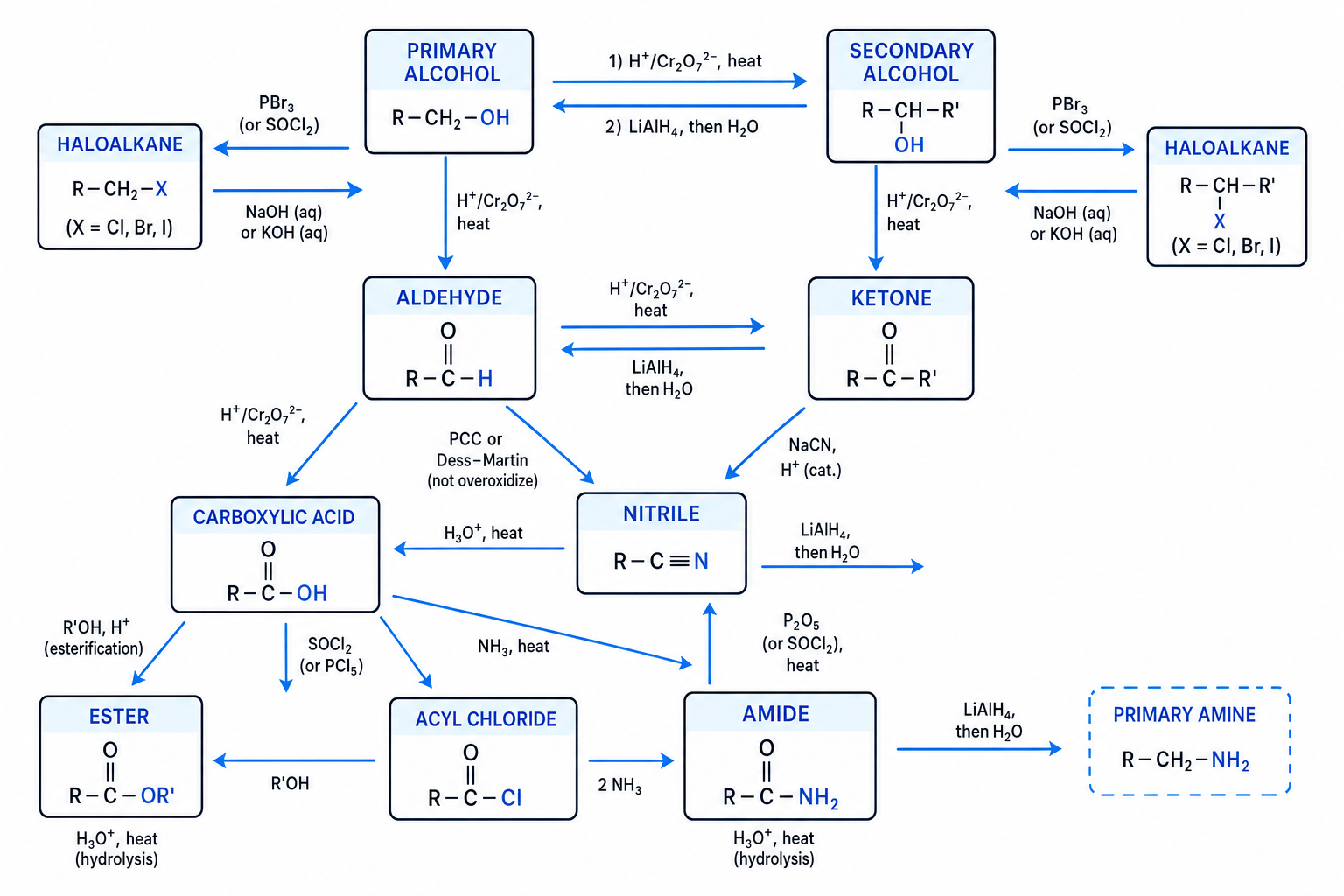
Organic Functional Group Interconversion Map
The map below summarises the primary synthetic pathways you are expected to know for OCR A-Level Chemistry. Use it to navigate between aliphatic molecules, carbonyls, carboxylic acids, and their derivatives.
Key Tools for Chain Lengthening
To build up a carbon chain, look for reactions that form carbon-carbon bonds:
- Nucleophilic substitution of haloalkanes with cyanide: Reacting a haloalkane with NaCN\text{NaCN}NaCN or KCN\text{KCN}KCN in ethanol under reflux adds one carbon atom, forming a nitrile (−C≡N-\text{C}\equiv\text{N}−C≡N).
- Nucleophilic addition of carbonyls with cyanide: Reacting an aldehyde or ketone with HCN\text{HCN}HCN (generated in situ from NaCN\text{NaCN}NaCN and H2SO4\text{H}_2\text{SO}_4H2SO4) yields a hydroxynitrile, adding one carbon atom to the main chain.
Nitration vs. Friedel-Crafts
For aromatic compounds, carbon-carbon bond formation is achieved via Friedel-Crafts alkylation or acylation using a halogen carrier catalyst (e.g., AlCl3\text{AlCl}_3AlCl3). Do not confuse this with nitration, which introduces a nitrogen atom (−NO2-\text{NO}_2−NO2), not a carbon atom!
Designing a multi-stage synthesis
Propose a two-stage synthesis to convert 1-bromopropane (CH3CH2CH2Br\text{CH}_3\text{CH}_2\text{CH}_2\text{Br}CH3CH2CH2Br) into butanoic acid (CH3CH2CH2COOH\text{CH}_3\text{CH}_2\text{CH}_2\text{COOH}CH3CH2CH2COOH). For each stage, state the organic intermediate formed, the required reagents, and the reaction conditions.
-
Analyse the starting material and target molecule: The starting material has 3 carbons (1-bromopropane). The target molecule has 4 carbons (butanoic acid). Therefore, we must lengthen the carbon chain by one carbon atom.
-
Determine the first stage (chain-lengthening): We can introduce a nitrile group by reacting the haloalkane with sodium cyanide.
- Reagent: NaCN\text{NaCN}NaCN (or KCN\text{KCN}KCN) in ethanol
- Conditions: Heat under reflux
- Intermediate: Butanenitrile (CH3CH2CH2CN\text{CH}_3\text{CH}_2\text{CH}_2\text{CN}CH3CH2CH2CN)
-
Determine the second stage (nitrile to carboxylic acid): Nitriles can be hydrolysed to carboxylic acids under acidic conditions.
- Reagent: Dilute aqueous acid (e.g., dilute HCl\text{HCl}HCl or dilute H2SO4\text{H}_2\text{SO}_4H2SO4)
- Conditions: Heat under reflux
- Target: Butanoic acid (CH3CH2CH2COOH\text{CH}_3\text{CH}_2\text{CH}_2\text{COOH}CH3CH2CH2COOH)
In the exam
- Draw out the skeletal structures: When faced with a synthesis question, draw out the starting material and target molecule side-by-side. Count the carbons in the longest chain immediately to check if the carbon backbone must change.
- State reagents and conditions fully: Never just write the formula of a reagent. If the exam asks for reagents and conditions, specify states or concentrations where relevant (e.g., write "hot, concentrated HNO3\text{HNO}_3HNO3 and concentrated H2SO4\text{H}_2\text{SO}_4H2SO4" rather than just "acid").
- Handle aromatic steps carefully: Remember that introducing substituents onto a benzene ring requires a halogen carrier catalyst (like AlCl3\text{AlCl}_3AlCl3 or FeBr3\text{FeBr}_3FeBr3) for electrophilic substitution.
- Learn the practical steps chronologically: Exam questions frequently ask you to describe the recrystallisation process. Be ready to justify why we use "minimum volume of hot solvent" and "ice-cold washing solvent".
Check yourself
- Why is it critical to use a minimum volume of hot solvent during the recrystallisation process?
- An organic product was found to melt over a range of 112 ∘C112\text{ }^\circ\text{C}112 ∘C to 119 ∘C119\text{ }^\circ\text{C}119 ∘C. The database value for the pure product is 122 ∘C122\text{ }^\circ\text{C}122 ∘C. State two conclusions you can draw about this sample.
- What reagents and conditions are required to convert benzamide (C6H5CONH2\text{C}_6\text{H}_5\text{CONH}_2C6H5CONH2) into benzoic acid (C6H5COOH\text{C}_6\text{H}_5\text{COOH}C6H5COOH)?
