

Analytical chemistry is the detective work of the chemical world. When you synthesise an organic compound in the laboratory or isolate a natural product from a plant, you are often left with two fundamental questions: Is it pure? and What actually is it?
In these study notes, we will look at how chromatography separates mixtures to determine their purity and how a sequence of elegant test-tube reactions can systematically identify organic functional groups.
What you'll learn
- How to perform and interpret Thin-Layer Chromatography (TLC), including calculating and using RfR_fRf values.
- How Gas Chromatography (GC) separates volatile mixtures, and how to use integration values and external calibration curves to find concentrations.
- How to systematically identify organic functional groups on a test-tube scale using classic qualitative chemical tests.
1. Principles of Chromatography
Chromatography is an analytical technique used to separate the components within a mixture. Every chromatographic technique relies on the distribution of substances between two phases: a stationary phase and a mobile phase.
Stationary Phase
The stationary phase is the phase that does not move. It can be a solid surface (such as silica on a TLC plate) or a highly viscous liquid supported on a solid.
Mobile Phase
The Mobile phase is the phase that moves through or over the stationary phase. It is always a fluid (a liquid solvent or an inert carrier gas).
The separation of different components in a mixture depends on their relative affinity for each phase. This distribution is governed by two main physical processes:
- Adsorption: The process by which chemical species temporarily bond to the surface of the stationary phase. In TLC, this usually involves weak intermolecular forces (such as hydrogen bonds or dipole-dipole interactions) forming between the compounds in the mixture and the polar solid stationary phase.
- Solubility: The extent to which a component dissolves in the mobile phase. Components that are highly soluble in the mobile phase spend more time dissolved and move faster and further.
Components with a high affinity for the mobile phase (high solubility) travel quickly, whereas components with a high affinity for the stationary phase (strong adsorption) travel slowly.
2. Thin-Layer Chromatography (TLC)
In Thin-Layer Chromatography (TLC), the stationary phase is a thin layer of an inert adsorbent (typically silica gel, SiO2\text{SiO}_2SiO2, or alumina, Al2O3\text{Al}_2\text{O}_3Al2O3) coated onto a rigid plastic or glass plate. The mobile phase is a liquid solvent or mixture of solvents, known as the eluent.
How to Run a TLC Plate (PAG 6)
- Draw a baseline in pencil about 1 cm1\text{ cm}1 cm from the bottom of the TLC plate. Never use a pen, as ink is soluble in the solvent and will chromatograph along with the spots, ruining the plate.
- Spot the sample: Use a capillary tube to place a tiny drop of your concentrated sample mixture onto the baseline.
- Develop the plate: Place the plate vertically inside a beaker containing a small depth of the solvent (ensuring the solvent level is below the pencil baseline). Cover the beaker with a watch glass to saturate the air inside with solvent vapour, preventing evaporation of the mobile phase from the plate.
- Mark the solvent front: Allow the solvent to rise up the plate by capillary action. Before it reaches the very top, remove the plate and immediately draw a pencil line marking the furthest height the solvent reached.
- Visualise the spots: Many organic compounds are colourless. To see them, you must either view the plate under an ultra-violet (UV) lamp or spray it with a chemical locating agent (such as iodine vapour or ninhydrin).
Calculating RfR_fRf Values
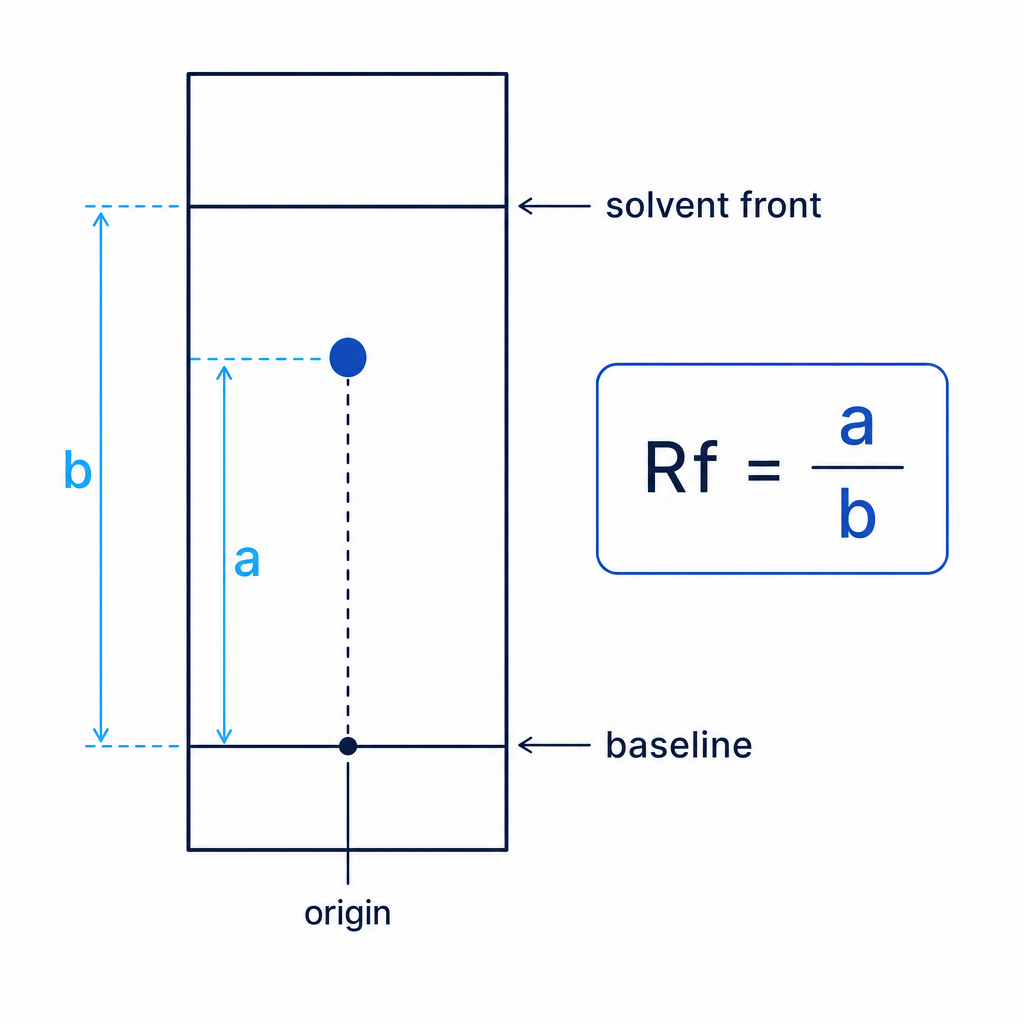
The retardation factor (RfR_fRf) is a ratio that quantifies how far a substance has travelled relative to the solvent.
Retardation Factor ()
The RfR_fRf value of a compound is calculated using the formula:
Rf=Distance travelled by the componentDistance travelled by the solvent R_f = \frac{\text{Distance travelled by the component}}{\text{Distance travelled by the solvent}} Rf=Distance travelled by the solventDistance travelled by the componentThese distances must always be measured from the pencil baseline, not the bottom of the plate.
Incorrect Rf values > 1
Because different compounds have different structures, they will exhibit different balances of adsorption to the silica and solubility in the solvent, giving rise to unique RfR_fRf values.
A Polar Stationary Phase
Silica gel (SiO2\text{SiO}_2SiO2) contains polar −O−H-\text{O}-\text{H}−O−H groups on its surface.
- Polar compounds form hydrogen bonds or strong dipole-dipole attractions with the silica surface. They adsorb strongly, move slowly, and have low RfR_fRf values.
- Non-polar compounds only form weak London forces with the silica. They dissolve readily in a non-polar solvent, move quickly, and have high RfR_fRf values.
Calculating TLC Retardation Factors
A student wants to identify an unknown organic compound using TLC. After developing the plate and viewing it under UV light, they record the following measurements:
- Distance from the pencil baseline to the solvent front = 8.4 cm8.4\text{ cm}8.4 cm
- Distance from the pencil baseline to the centre of the sample spot = 5.2 cm5.2\text{ cm}5.2 cm
Calculate the RfR_fRf value of the sample, giving your answer to 2 significant figures.
- Identify the variables: The distance travelled by the spot (aaa) is 5.2 cm5.2\text{ cm}5.2 cm. The distance travelled by the solvent front (bbb) is 8.4 cm8.4\text{ cm}8.4 cm.
- Apply the formula: Substitute the values into the retardation factor equation:
- Calculate and round:
Rounded to 2 significant figures, this gives 0.620.620.62. Because it is a ratio of distances, the RfR_fRf value is dimensionless (it has no units).
3. Gas Chromatography (GC)
Gas chromatography (GC) is used to separate and analyse volatile organic compounds (compounds that can be easily turned into gases).
How GC Works
- Mobile phase: An inert carrier gas (such as helium, He\text{He}He, or nitrogen, N2\text{N}_2N2).
- Stationary phase: A thin layer of a non-volatile liquid (e.g., a high-boiling-point liquid hydrocarbon or polymer) coated on the inside wall of a long, thin capillary column housed inside a temperature-controlled oven.
The sample mixture is injected into the GC instrument, where it is instantly vaporised. The carrier gas sweeps the vaporised mixture through the capillary column.
Retention Time
Retention time is the time taken for a component to travel from the injection port to the detector at the end of the gas chromatography column.
The separation is governed by how a compound partition-balances between the gas mobile phase and the liquid stationary phase:
- A compound that is highly soluble in the liquid stationary phase will spend more time dissolved in it. It moves through the column slowly, resulting in a longer retention time.
- A compound that is highly volatile and has low solubility in the stationary phase will spend almost all of its time in the gas carrier phase. It moves through the column quickly, resulting in a shorter retention time.
Interpreting Gas Chromatograms
A gas chromatogram consists of a series of peaks plotted against retention time on the x-axis:
- The number of peaks tells you the minimum number of components present in the mixture.
- The retention times are characteristic of specific compounds under set conditions (column material, oven temperature, gas flow rate), allowing you to identify components by comparing them to database values.
- The peak area (often provided as an integration value) is directly proportional to the amount (concentration) of that compound present in the mixture.
External Calibration Curves
While peak area tells us the relative proportions of components, we cannot find the absolute concentration from a single peak area alone. To do this, we must build and use an external calibration curve.
- Prepare several standard solutions of the compound at known concentrations.
- Run each standard solution through the gas chromatograph under identical conditions and record the peak area for each.
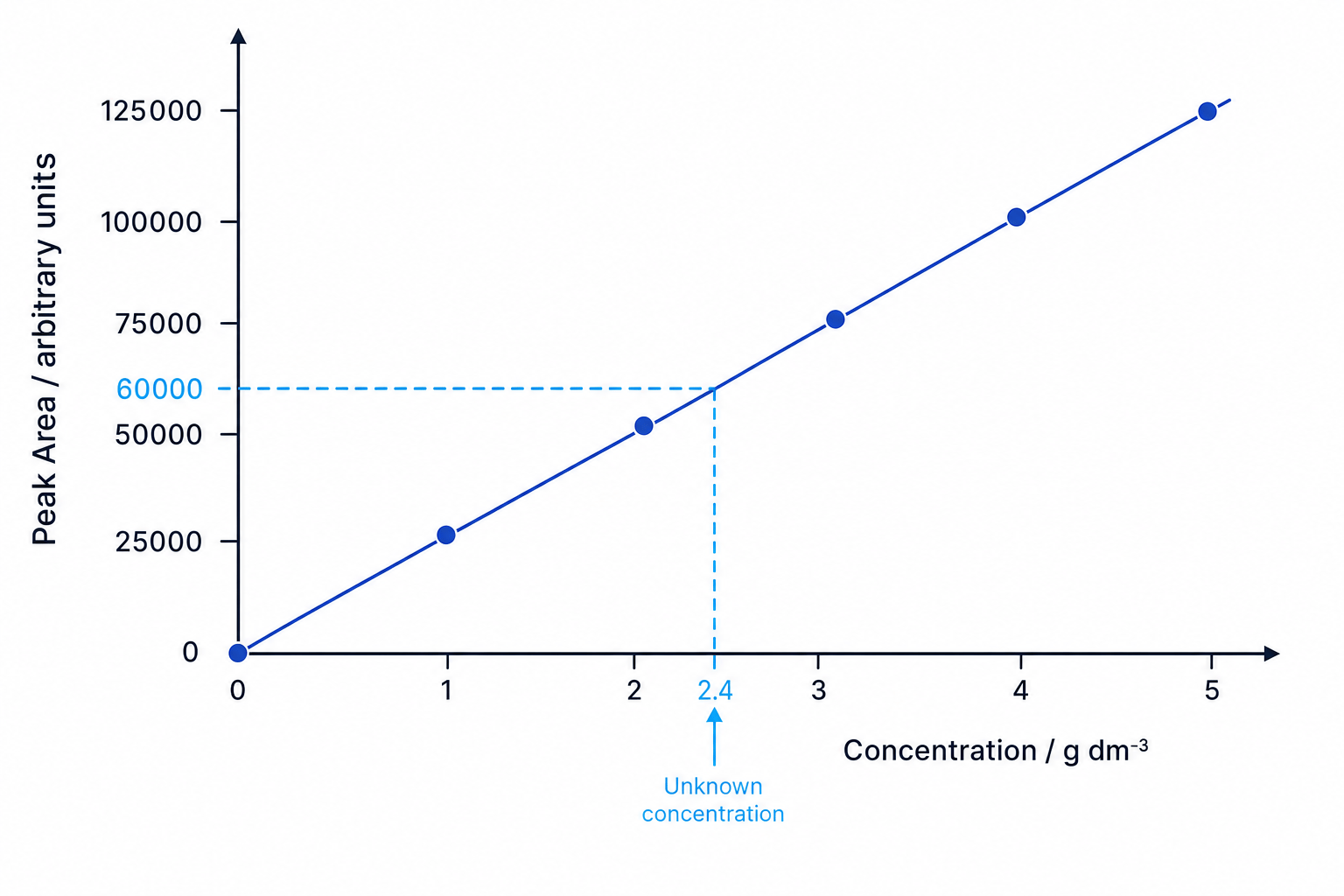
- Plot a graph of Peak Area (y-axis) against Concentration (x-axis) and draw a line of best fit (which should pass through the origin).
- Run your unknown sample, measure its peak area, and use the calibration curve to read off the corresponding concentration.
Determining Concentration from Gas Chromatography Data
A chemist is verifying the concentration of ethyl ethanoate in an organic solvent mixture. They construct a calibration curve using standard solutions. The line of best fit through the origin yields the mathematical relationship:
Peak Area=25000×Concentration (in g dm−3) \text{Peak Area} = 25000 \times \text{Concentration} \text{ (in g dm}^{-3}\text{)} Peak Area=25000×Concentration (in g dm−3)An unknown sample of the mixture is run under identical conditions, producing a peak for ethyl ethanoate with an integration area of 600006000060000 arbitrary units. Calculate the concentration of ethyl ethanoate in the unknown sample.
- State the relationship: Use the equation derived from the linear calibration curve:
- Substitute the known values: Plug the measured peak area of the unknown into the equation:
- Solve for concentration: Rearrange the equation and compute the final concentration:
4. Qualitative Analysis of Organic Functional Groups
In the laboratory, you must be able to carry out rapid, test-tube scale reactions to confirm the identity of functional groups in an unknown sample. These qualitative tests (PAG 7) rely on observing distinct physical changes, such as colour changes, precipitate formation, or gas evolution.
Key Chemical Tests to Memorise
1. Alkenes (C=C\text{C}=\text{C}C=C)
- Reagent: Bromine water, Br2(aq)\text{Br}_2(\text{aq})Br2(aq).
- Observation: Orange solution is decolourised (turns colourless).
- Reaction Type: Electrophilic addition.
2. Haloalkanes (R−X\text{R}-\text{X}R−X)
- Reagents: Warm with aqueous sodium hydroxide, NaOH(aq)\text{NaOH(aq)}NaOH(aq) (to hydrolyse the haloalkane and release halide ions), acidify with dilute nitric acid, HNO3(aq)\text{HNO}_3(\text{aq})HNO3(aq), and then add aqueous silver nitrate, AgNO3(aq)\text{AgNO}_3(\text{aq})AgNO3(aq), in ethanol.
- Why ethanol? Haloalkanes are insoluble in water. Ethanol acts as a mutual solvent, allowing the organic and aqueous layers to mix and react.
- Observations:
- Chloroalkane: White precipitate (AgCl\text{AgCl}AgCl) which dissolves easily in dilute NH3(aq)\text{NH}_3(\text{aq})NH3(aq).
- Bromoalkane: Cream precipitate (AgBr\text{AgBr}AgBr) which is insoluble in dilute NH3(aq)\text{NH}_3(\text{aq})NH3(aq) but dissolves in concentrated NH3(aq)\text{NH}_3(\text{aq})NH3(aq).
- Iodoalkane: Yellow precipitate (AgI\text{AgI}AgI) which is insoluble in both dilute and concentrated NH3(aq)\text{NH}_3(\text{aq})NH3(aq).
3. Phenols (C6H5OH\text{C}_6\text{H}_5\text{OH}C6H5OH)
- Test: Phenols are weakly acidic. Test with a strong base (such as aqueous NaOH\text{NaOH}NaOH) and a carbonate (such as aqueous Na2CO3\text{Na}_2\text{CO}_3Na2CO3).
- Observations: Phenols will react with and dissolve in NaOH(aq)\text{NaOH(aq)}NaOH(aq) but will not react with carbonate solutions. No effervescence is observed with CO32−\text{CO}_3^{2-}CO32−.
- Significance: This distinguishes phenol from carboxylic acids (which do react with carbonates to produce gas).
4. Carbonyl Compounds (C=O\text{C}=\text{O}C=O in Aldehydes and Ketones)
- Reagent: 2,4-dinitrophenylhydrazine (known as 2,4-DNP or Brady's reagent).
- Observation: Formation of a bright orange or yellow precipitate.
- Identifying the specific compound: This test only confirms the presence of a carbonyl group. To identify the exact aldehyde or ketone, you filter the precipitate, purify it by recrystallisation, measure its melting point, and compare the melting point to a database of known 2,4-DNP derivatives.
5. Aldehydes (R−CHO\text{R}-\text{CHO}R−CHO)
- Reagent: Tollens' reagent (ammoniacal silver nitrate, containing the [Ag(NH3)2]+[\text{Ag}(\text{NH}_3)_2]^+[Ag(NH3)2]+ complex ion). Warm gently in a water bath.
- Observation: Formation of a silver mirror on the inside wall of the test tube.
- Reaction: Aldehydes are easily oxidised to carboxylic acids, reducing the silver ions to metallic silver:
Ketones cannot be easily oxidised, so they give a negative result (no silver mirror).
6. Alcohols and Aldehydes
- Reagent: Acidified potassium dichromate, H+/Cr2O72−(aq)\text{H}^+ / \text{Cr}_2\text{O}_7^{2-}(\text{aq})H+/Cr2O72−(aq), warmed.
- Observation: Orange solution turns green.
- What is oxidised? Primary alcohols, secondary alcohols, and aldehydes can all be oxidised, reducing the orange dichromate ion (Cr2O72−\text{Cr}_2\text{O}_7^{2-}Cr2O72−) to the green chromium(III) ion (Cr3+\text{Cr}^{3+}Cr3+). Tertiary alcohols cannot be oxidised, so the solution remains orange.
7. Carboxylic Acids (R−COOH\text{R}-\text{COOH}R−COOH)
- Reagent: Any aqueous metal carbonate or hydrogencarbonate (e.g., Na2CO3(aq)\text{Na}_2\text{CO}_3(\text{aq})Na2CO3(aq) or NaHCO3(aq)\text{NaHCO}_3(\text{aq})NaHCO3(aq)).
- Observation: Effervescence (fizzing) as carbon dioxide gas, CO2(g)\text{CO}_2(\text{g})CO2(g), is evolved. Bubbling this gas through limewater turns it cloudy.
- Reaction:
Phenol vs. Carboxylic Acids
Do not confuse phenol with a carboxylic acid. Both turn blue litmus paper red because they are acidic. However, only the carboxylic acid is a strong enough acid to react with weak carbonate bases like sodium carbonate (Na2CO3\text{Na}_2\text{CO}_3Na2CO3) to release carbon dioxide gas. This is a common and highly tested distinction in exams!
In the exam
- Always cite specific observations: If a question asks you how to distinguish between two compounds, don't just state the test and what happens to the positive sample. You must state the observation for both substances (e.g. "butanal turns acidified potassium dichromate from orange to green, whereas butanone remains orange").
- Specify conditions: When discussing Tollens' reagent or acidified potassium dichromate, make sure to explicitly state that gentle warming is required.
- Be precise with Rf definitions: When measuring distances on a TLC plate, always state that measurements are taken from the pencil baseline to the centre of the spot.
- Identify the solvent role: Remember that ethanol is added during the haloalkane test specifically as a solvent to allow the aqueous silver nitrate and the insoluble organic haloalkane to mix into a single phase.
Check yourself
- A mixture contains propan-1-ol and propanoic acid. Explain how you could use a simple, single-step chemical test to distinguish between them without using oxidation.
- Why does a highly polar compound generally have a lower RfR_fRf value on a standard silica TLC plate than a non-polar compound?
- In gas chromatography, compound XXX has a retention time of 2.1 minutes2.1\text{ minutes}2.1 minutes and compound YYY has a retention time of 6.5 minutes6.5\text{ minutes}6.5 minutes. What does this tell you about the relative interactions of XXX and YYY with the stationary phase?
