

Welcome to your study notes on Haloalkanes. This topic explores how polar organic molecules undergo substitution reactions, how we can measure their reactivity experimentally, and the vital role haloalkane chemistry plays in environmental global policy.
What you'll learn:
- How haloalkanes react via nucleophilic substitution, using curly arrows to show electron movement.
- How to experimentally investigate and explain the trends in the rates of hydrolysis of different carbon–halogen bonds.
- How chlorofluorocarbons (CFCs) and other radicals catalytically destroy the Earth's protective ozone layer.
1. Structure and Bond Polarity
Haloalkanes are saturated organic compounds containing one or more halogen atoms (fluorine, chlorine, bromine, or iodine) covalently bonded to a carbon chain.
The reactivity of haloalkanes is primarily driven by the polarity of the carbon–halogen bond (C−X\text{C}-\text{X}C−X). Halogen atoms are highly electronegative compared to carbon.
Electronegativity
The power of an atom to attract the shared pair of electrons in a covalent bond towards itself.
Because the halogen atom (X\text{X}X) has a higher electronegativity than carbon, it pulls the electron density in the C−X\text{C}-\text{X}C−X σ\sigmaσ-bond toward itself. This creates a permanent dipole across the bond:
- The carbon atom becomes electron-deficient, carrying a partial positive charge (δ+\delta+δ+).
- The halogen atom carries a partial negative charge (δ−\delta-δ−).
The electron-deficient carbon (Cδ+\text{C}^{\delta+}Cδ+) acts as an attractive target for electron-rich species known as nucleophiles.
2. Nucleophiles and Nucleophilic Substitution
Before looking at reactions, we must precisely define what a nucleophile is.
Nucleophile
An electron pair donor.
Common nucleophiles you need to know for A-Level Chemistry include:
- The hydroxide ion, OH−\text{OH}^-OH− (specifically from aqueous alkalis like NaOH\text{NaOH}NaOH or KOH\text{KOH}KOH).
- Water molecules, H2O\text{H}_2\text{O}H2O.
- Ammonia molecules, NH3\text{NH}_3NH3.
All nucleophiles must possess at least one lone pair of electrons on an electronegative atom, which they can donate to form a new dative covalent bond with a carbon atom.
Hydrolysis of Primary Haloalkanes by Aqueous Alkali
When a primary haloalkane is warmed with an aqueous alkali (such as aqueous sodium hydroxide, NaOH(aq)\text{NaOH}\text{(aq)}NaOH(aq)), it undergoes a hydrolysis reaction. This is a type of nucleophilic substitution.
Hydrolysis
A chemical reaction in which a bond is broken by its reaction with water or an aqueous hydroxide solution.
During this reaction, the halogen atom is substituted by a hydroxyl (−OH-\text{OH}−OH) group to form an alcohol and a halide ion.
R-X+OH−→R-OH+X− \text{R-X} + \text{OH}^- \to \text{R-OH} + \text{X}^- R-X+OH−→R-OH+X−The Reaction Mechanism
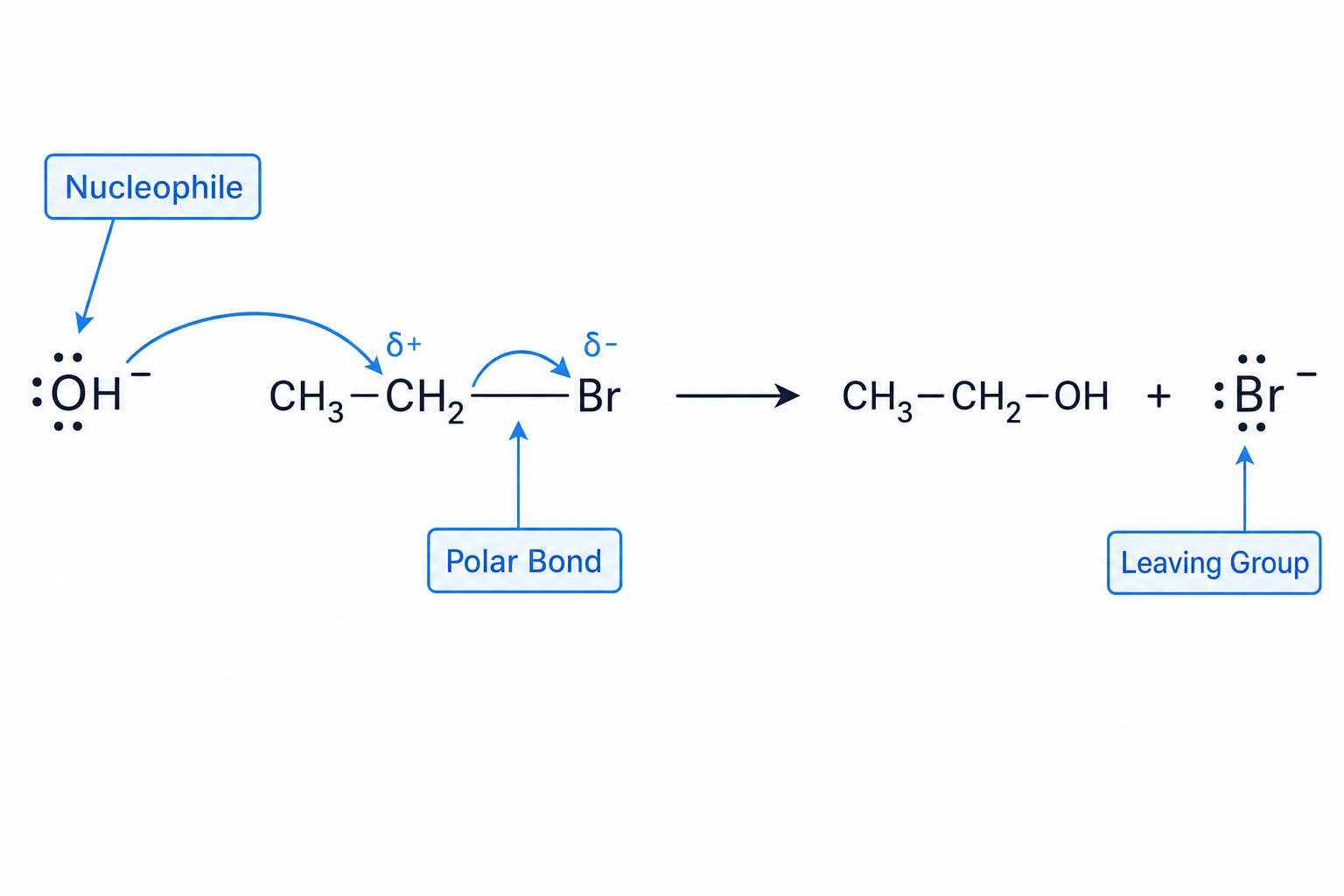
To explain how this reaction occurs, we use a reaction mechanism. A mechanism uses curly arrows to map the movement of pairs of electrons.
- The nucleophile (OH−\text{OH}^-OH−) approaches the electron-deficient carbon (Cδ+\text{C}^{\delta+}Cδ+) from the opposite side of the halogen atom to minimise charge repulsion.
- A curly arrow starts from a lone pair on the oxygen of the hydroxide ion and points directly to the Cδ+\text{C}^{\delta+}Cδ+ atom, indicating the formation of a new dative C−O\text{C}-\text{O}C−O covalent bond.
- Simultaneously, the polar carbon-halogen bond breaks heterolytically. A curly arrow starts from the middle of the C−X\text{C}-\text{X}C−X bond and points directly to the halogen atom (X\text{X}X), showing both electrons in the bond moving onto the halogen to form a stable halide ion leaving group (X−\text{X}^-X−).
3. Investigating the Rates of Hydrolysis (PAG 7)
We can compare how quickly different carbon-halogen bonds break by carrying out a classic practical investigation (part of your Practical Endorsement, PAG 7).
The Experimental Setup
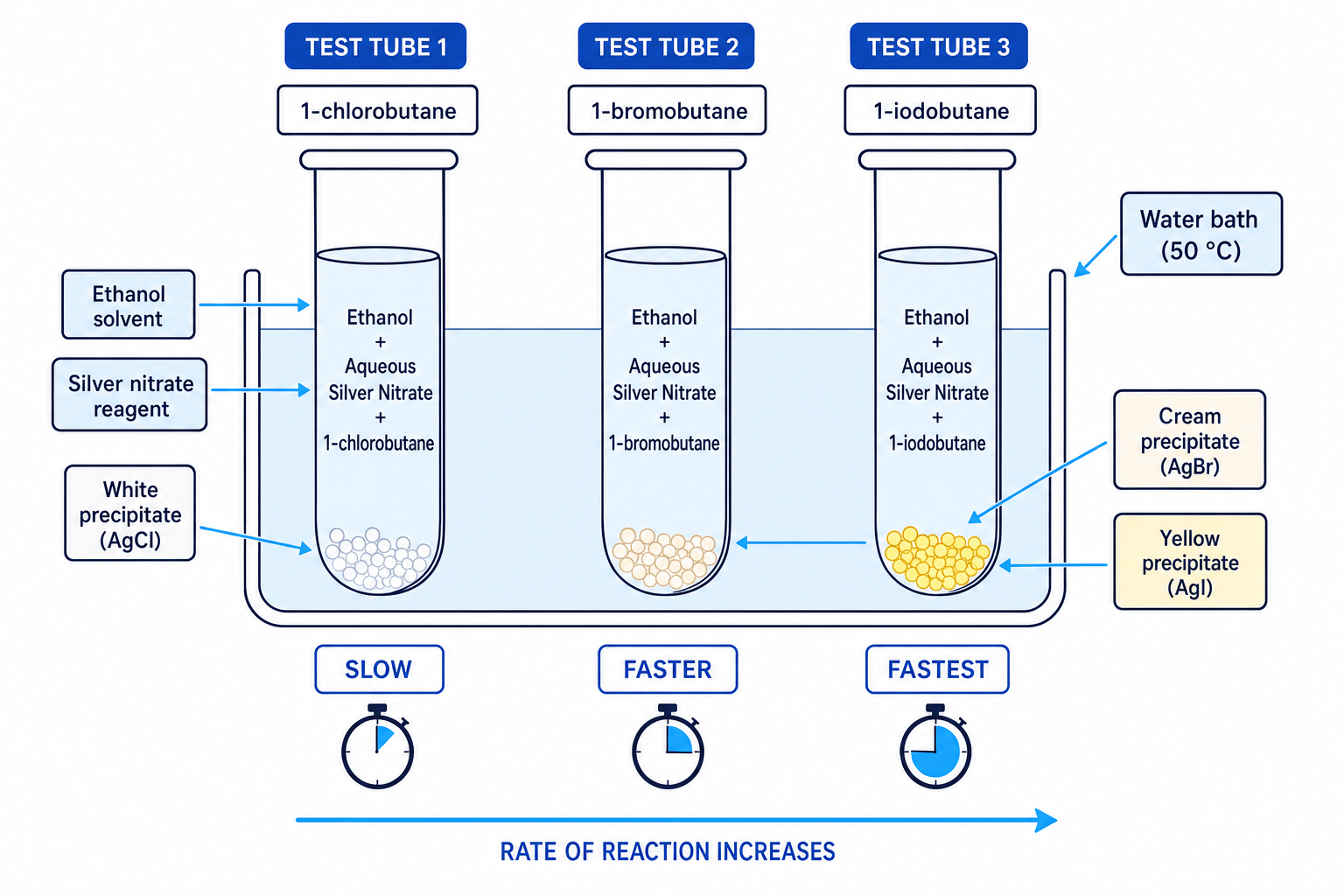
To compare the hydrolysis rates of 1-chlorobutane, 1-bromobutane, and 1-iodobutane, we set up three separate test tubes in a warm water bath (50 ∘C50\ ^\circ\text{C}50 ∘C). Each tube contains:
- The specific haloalkane.
- Aqueous silver nitrate (AgNO3(aq)\text{AgNO}_3\text{(aq)}AgNO3(aq)) — this acts as the source of water (the nucleophile) and silver ions (Ag+\text{Ag}^+Ag+) to detect the released halide ions.
- Ethanol — which acts as a co-solvent.
The Role of Silver Nitrate and Ethanol
Do not list silver nitrate (AgNO3\text{AgNO}_3AgNO3) as the reactant that causes hydrolysis. The nucleophile is actually water (H2O\text{H}_2\text{O}H2O) from the aqueous silver nitrate solution. The silver ions (Ag+\text{Ag}^+Ag+) are there solely as an indicator to precipitate the released halide ions, and ethanol is merely the co-solvent.
Because haloalkanes are insoluble in water, they would normally form two immiscible layers, preventing a reaction. Ethanol dissolves both the organic haloalkanes and the inorganic aqueous silver nitrate, allowing them to mix and react in a single homogeneous phase.
Observing the Rate of Precipitation
As hydrolysis proceeds, halide ions (Cl−\text{Cl}^-Cl−, Br−\text{Br}^-Br−, or I−\text{I}^-I−) are continuously produced. These immediately react with the silver ions (Ag+\text{Ag}^+Ag+) in solution to form insoluble silver halide precipitates:
Ag+(aq)+X−(aq)→AgX(s) \text{Ag}^+\text{(aq)} + \text{X}^-\text{(aq)} \to \text{AgX}\text{(s)} Ag+(aq)+X−(aq)→AgX(s)By timing how long it takes for each precipitate to appear, we can determine the relative rates of reaction.
Remembering Precipitate Colours
A simple alphabetical mnemonic can help you recall the silver halide precipitate colours in order of increasing atomic mass of the halogen (Cl to Br to I):
- Chloride = White (C comes first, White is the lightest shade)
- Bromide = Cream (B comes next, Cream is intermediate)
- Iodide = Yellow (I comes last, Yellow is the deepest colour)
4. Explaining the Rate Trend: Bond Enthalpy vs. Polarity
The experimental results show a clear trend in the rate of hydrolysis:
Iodoalkanes (Fastest)>Bromoalkanes>Chloroalkanes≫Fluoroalkanes (Unreactive) \text{Iodoalkanes (Fastest)} > \text{Bromoalkanes} > \text{Chloroalkanes} \gg \text{Fluoroalkanes (Unreactive)} Iodoalkanes (Fastest)>Bromoalkanes>Chloroalkanes≫Fluoroalkanes (Unreactive)This trend can be explained by comparing two competing factors: bond polarity and bond enthalpy.
1. Bond Polarity
If bond polarity were the dominant factor, we would expect fluoroalkanes to react fastest. Fluorine is the most electronegative halogen, making the C−F\text{C}-\text{F}C−F bond the most polar, which gives the carbon atom the largest δ+\delta+δ+ charge to attract nucleophiles.
2. Bond Enthalpy
For substitution to occur, the carbon-halogen covalent bond must be broken. The average bond enthalpies down Group 17 are as follows:
| Bond | Average Bond Enthalpy / kJ mol−1\text{kJ mol}^{-1}kJ mol−1 |
|---|---|
| C−F\text{C}-\text{F}C−F | 467467467 (Strongest) |
| C−Cl\text{C}-\text{Cl}C−Cl | 340340340 |
| C−Br\text{C}-\text{Br}C−Br | 280280280 |
| C−I\text{C}-\text{I}C−I | 240240240 (Weakest) |
Because the atomic radius of the halogen increases down the group, the shared pair of electrons in the C−X\text{C}-\text{X}C−X bond is further from the halogen nucleus. This results in a weaker electrostatic attraction and a lower bond enthalpy down the group.
The Deciding Factor
Bond enthalpy outweighs bond polarity when determining the reactivity of haloalkanes. Because the C−I\text{C}-\text{I}C−I bond has the lowest bond enthalpy, it requires the least energy to break. Consequently, iodoalkanes undergo nucleophilic substitution reactions the fastest.
Reactivity Trend Pitfall
A very common exam error is stating that 1-chlorobutane reacts slowest because "chlorine is less reactive than iodine". This is a confusion with GCSE displacement chemistry of halogens as elements. Always explain the reactivity of organic haloalkanes in terms of carbon-halogen bond enthalpies.
5. Environmental Concerns: Ozone Depletion
Chlorofluorocarbons (CFCs) are synthetic organohalogen compounds containing only chlorine, fluorine, and carbon (e.g., dichlorodifluoromethane, CF2Cl2\text{CF}_2\text{Cl}_2CF2Cl2).
Due to their high chemical stability, low toxicity, and volatility, CFCs were widely used throughout the 20th century as refrigerants, aerosol propellants, and air conditioning blowing agents. However, this stability became an environmental disaster.
Radical Production in the Upper Atmosphere
Because CFCs are exceptionally stable in the lower atmosphere (troposphere), they do not break down. Over decades, they diffuse upward into the stratosphere.
Here, they are exposed to high-energy ultraviolet (UV) radiation, which possesses enough energy to break the relatively weak C−Cl\text{C}-\text{Cl}C−Cl bond homolytically (photodissociation), producing highly reactive chlorine radicals (Cl∙\text{Cl}^\bulletCl∙).
CF2Cl2→UVCF2Cl∙+Cl∙ \text{CF}_2\text{Cl}_2 \xrightarrow{\text{UV}} \text{CF}_2\text{Cl}^\bullet + \text{Cl}^\bullet CF2Cl2UVCF2Cl∙+Cl∙Do Not Break the Wrong Bond!
In exams, when showing the photodissociation of a CFC, always break the C−Cl\text{C}-\text{Cl}C−Cl bond, never the C−F\text{C}-\text{F}C−F bond. The C−F\text{C}-\text{F}C−F bond enthalpy (467 kJ mol−1467\text{ kJ mol}^{-1}467 kJ mol−1) is too strong to be broken by stratospheric UV light, whereas the weaker C−Cl\text{C}-\text{Cl}C−Cl bond (340 kJ mol−1340\text{ kJ mol}^{-1}340 kJ mol−1) breaks easily.
Catalytic Breakdown of Ozone
The chlorine radical (Cl∙\text{Cl}^\bulletCl∙) acts as a homogeneous catalyst in the destruction of the ozone layer (O3\text{O}_3O3), which protects Earth from harmful UVB radiation. This destruction occurs via a two-step propagation cycle:
- Propagation Step 1: The chlorine radical reacts with an ozone molecule, forming a chlorine monoxide radical and oxygen gas.
- Propagation Step 2: The chlorine monoxide radical reacts with a monoatomic oxygen atom (present in the stratosphere), regenerating the chlorine radical catalyst and producing more oxygen gas.
By adding these two propagation steps together and cancelling species that appear on both sides (Cl∙\text{Cl}^\bulletCl∙ and ClO∙\text{ClO}^\bulletClO∙), we get the overall equation for the reaction:
O3+O→2O2 \text{O}_3 + \text{O} \to 2\text{O}_2 O3+O→2O2Because the Cl∙\text{Cl}^\bulletCl∙ radical is regenerated at the end of the cycle, it can go on to destroy up to 100,000 ozone molecules before undergoing a termination step.
Other Radicals Destroying Ozone
Chlorine is not the only radical catalyst responsible for ozone depletion. Nitrogen monoxide radicals (NO∙\text{NO}^\bulletNO∙), formed naturally by lightning strikes and artificially by aircraft engines operating at high altitudes, undergo an identical catalytic cycle.
Constructing catalytic ozone depletion cycles for nitrogen monoxide radicals
Construct the propagation steps and overall equation showing how nitrogen monoxide radicals (∙NO^{\bullet}\text{NO}∙NO) catalytically destroy ozone.
- Identify the attacking radical catalyst and react it with ozone: The nitrogen monoxide radical (∙NO^{\bullet}\text{NO}∙NO) abstracts an oxygen atom from ozone (O3\text{O}_3O3), forming a nitrogen dioxide radical (∙NO2^{\bullet}\text{NO}_2∙NO2) and stable oxygen gas (O2\text{O}_2O2).
- React the intermediate radical to regenerate the catalyst: The intermediate nitrogen dioxide radical (∙NO2^{\bullet}\text{NO}_2∙NO2) reacts with a highly reactive monoatomic oxygen atom (O\text{O}O) in the stratosphere. This regenerates the original nitrogen monoxide radical (∙NO^{\bullet}\text{NO}∙NO) catalyst and produces a second molecule of oxygen gas (O2\text{O}_2O2).
- Construct the overall equation by cancelling species: Write the combined equation of both steps and cancel out the species that appear as both reactants and products (∙NO^{\bullet}\text{NO}∙NO and ∙NO2^{\bullet}\text{NO}_2∙NO2):
In the exam
- Draw curly arrows accurately: Always start curly arrows from a lone pair or a covalent bond, and point them directly to the target atom or bond being formed. Marks are frequently lost for arrows starting in "empty space".
- Prioritise bond enthalpy over polarity: When asked to explain the rate of hydrolysis of haloalkanes, structure your answer around the decrease in carbon-halogen bond enthalpy down Group 17, and explicitly state that this outweighs the opposing trend in bond polarity.
- Represent radicals with clear dots: When writing equations for ozone depletion, ensure the radical dot (∙\bullet∙) is explicitly placed next to the correct atom (e.g., ∙Cl^{\bullet}\text{Cl}∙Cl or ∙NO^{\bullet}\text{NO}∙NO) to show it has an unpaired electron.
Check yourself
- Why is ethanol essential in the reaction mixture used to compare the rates of hydrolysis of haloalkanes?
- What are the steps and the overall equation for the catalytic breakdown of ozone by chlorine radicals?
- Explain why 1-iodobutane reacts faster than 1-chlorobutane, despite the C-Cl bond being more polar than the C-I bond.
