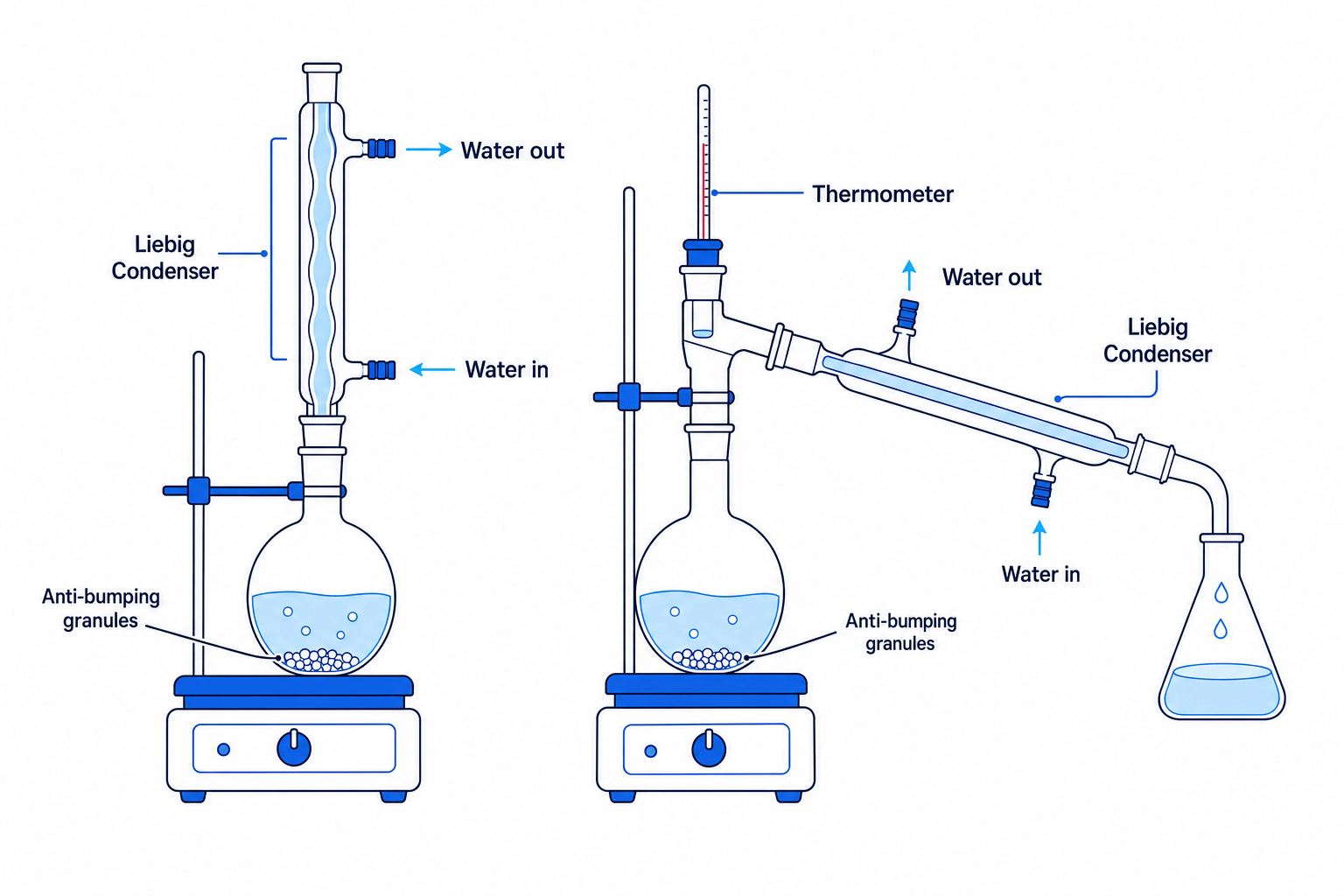
Organic synthesis is the art and science of constructing complex organic molecules from simpler starting materials. In your A-Level studies, this involves masterfully combining physical laboratory techniques with a deep understanding of reaction mechanisms and functional group chemistry.
What you'll learn
- How to set up and use Quickfit apparatus for heating under reflux and distillation.
- The step-by-step laboratory procedures to isolate, wash, dry, and purify an organic liquid product.
- How to identify multiple functional groups within a single organic molecule and predict their chemical behavior.
- How to design logical, two-stage synthetic routes to interconvert functional groups.
1. Practical Techniques in Organic Synthesis
When preparing an organic liquid, you must be able to assemble specialised glassware safely, run the reaction to completion, and isolate your target compound from a complex mixture of unreacted starting materials, catalysts, and by-products.
Heating Under Reflux
Many organic reactions are slow at room temperature and require heating. However, organic compounds are often highly volatile and flammable. If you heated them in an open beaker or flask, the reactants and products would vaporise and escape, or worse, catch fire.
To prevent this, we heat under reflux.
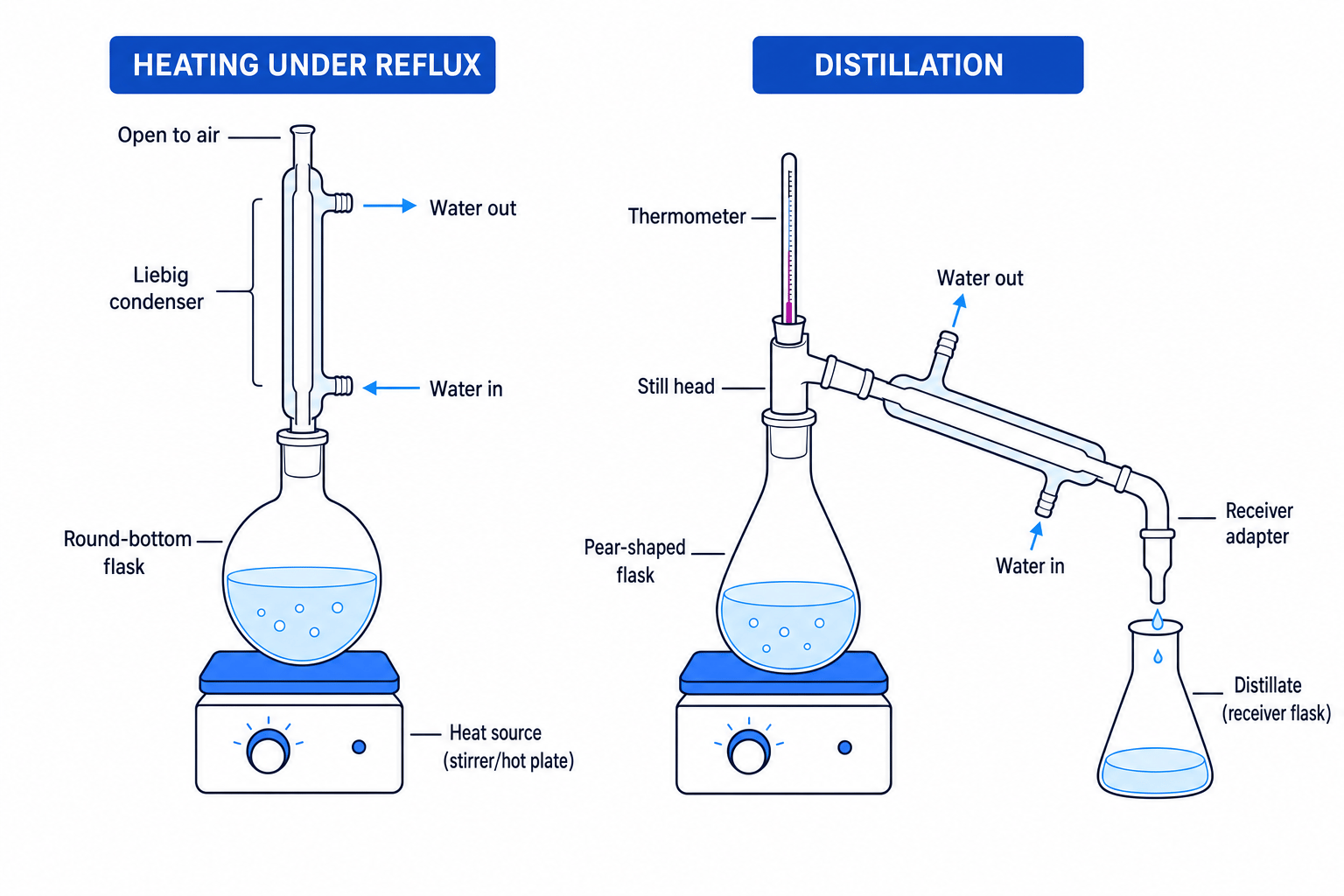
Key features of the reflux setup include:
- Vertical Condenser: A Liebig condenser is fitted vertically into the neck of a round-bottomed or pear-shaped flask. Vaporised solvent and reactants rise, cool against the water jacket, condense back into liquids, and drip back down into the reaction flask.
- Water Flow: Water always enters the condenser at the bottom and exits at the top. This ensures the condenser jacket is completely filled with cold water at all times, preventing air bubbles from forming and ensuring maximum cooling efficiency.
- Anti-bumping Granules: These are small, uneven pieces of silica or alumina added to the flask before heating. They provide nucleation sites that promote smooth, even boiling, preventing large, dangerous bubbles ("bumping") from violently splashing liquid out of the flask.
- Never Seal the Top: The top of the condenser must remain open to the atmosphere. Sealing the apparatus creates a closed system. As the gas inside is heated, the pressure will rapidly build up, leading to a dangerous explosion of glass and chemicals.
Distillation
Where reflux keeps everything in the flask to react, distillation is used to separate a volatile liquid from a mixture of liquids with different boiling points.
During distillation, the mixture is heated. The component with the lowest boiling point vaporises first. Its vapours rise, pass the thermometer bulb, enter the downward-sloping Liebig condenser, condense back into a liquid, and are collected in a receiving flask.
Positioning the thermometer
The bulb of the thermometer must be placed exactly level with the T-junction of the still head. This ensures it measures the true temperature of the vapour entering the condenser, allowing you to accurately identify the substance being distilled.
2. Purification of an Organic Liquid
Once a reaction is complete, the crude mixture in your flask will contain your desired product alongside impurities (unreacted reactants, acid catalysts, water, and side-products). To isolate a pure sample of an organic liquid, you must perform a multi-step purification sequence (PAG 5).
Step 1: Liquid-Liquid Extraction (Separating Funnel)
If water is present in the crude mixture, you will obtain two immiscible layers: an aqueous layer and an organic layer.
- Pour the mixture into a separating funnel and add water (or an aqueous wash, such as aqueous sodium hydrogencarbonate, NaHCO3(aq)\text{NaHCO}_3\text{(aq)}NaHCO3(aq), to neutralise any acid catalysts).
- Insert the stopper, invert the funnel gently, and open the tap periodically to release any built-up pressure (especially important when using hydrogencarbonates, which release CO2(g)\text{CO}_2\text{(g)}CO2(g)).
- Allow the layers to separate completely.
- Identify the organic layer: This is typically determined by density. Most organic solvents are less dense than water and float on top. Halogenated solvents (like dichloromethane) are denser than water and sink to the bottom. If you are unsure, add a few drops of water to the funnel and observe which layer they merge into.
- Remove the stopper and run off the lower layer into a beaker, then collect your target organic layer in a separate, clean conical flask.
Discarding the wrong layer
Never discard any liquid layer from your separating funnel until you are absolutely certain which layer contains your product! Keep both layers in separate, labelled beakers until your final yield is secured.
Step 2: Drying the Organic Product
Even after separation, the organic layer will contain trace amounts of dissolved water. This water must be removed using an anhydrous inorganic salt, which acts as a drying agent.
Drying Agent
A drying agent is an anhydrous inorganic salt that readily hydrates when in contact with water, absorbing moisture from an organic liquid without chemically reacting with the organic compound itself.
Common drying agents specified in OCR A include:
- Anhydrous magnesium sulfate (MgSO4\text{MgSO}_4MgSO4): A general-purpose, fast-acting drying agent.
- Anhydrous calcium chloride (CaCl2\text{CaCl}_2CaCl2): Ideal for drying hydrocarbons or haloalkanes (but avoids alcohols as it can coordinate with them).
To dry your product:
- Add a spatula of the anhydrous salt to the organic liquid in a conical flask and swirl.
- Initially, the salt will clump together due to water absorption.
- Continue adding small amounts of the salt and swirling until the salt remains as a fine, free-flowing powder dispersing through the liquid like a snow globe.
- Leave the flask stoppered for about 10 minutes.
- Gravity filter or decant the clear organic liquid away from the solid drying agent.
Step 3: Redistillation
The final step is redistillation, which separates your target organic liquid from any remaining organic impurities or unreacted starting materials.
- Set up a clean, dry distillation apparatus.
- Heat the dried organic liquid gently.
- Collect only the distillate that boils within a very narrow range (typically ±2∘C\pm 2^\circ\text{C}±2∘C) centered around the known literature boiling point of your target pure compound.
3. Multi-Functional Organic Compounds
As you progress through organic chemistry, you will encounter molecules containing more than one functional group. You must be able to:
- Identify each functional group.
- Predict how they will react independently or simultaneously.
For example, consider hydroxybenzoic acid (which contains both a phenol group and a carboxylic acid group) or hex-4-en-1-ol (which contains an alkene and a primary alcohol).

When predicting reactions of multi-functional molecules:
- Selective Reactions: Some reagents only target one specific functional group. For example, adding bromine water, Br2(aq)\text{Br}_2\text{(aq)}Br2(aq), to a compound containing both an alkene and an alcohol will only react with the alkene (decolourising the orange solution).
- Non-Selective Reactions: Strong oxidising agents like acidified potassium dichromate(VI), H+/Cr2O72−\text{H}^+/\text{Cr}_2\text{O}_7^{2-}H+/Cr2O72−, will oxidise alcohols but will not affect alkenes or carboxylic acids.
Functional Group Independence
In general, each functional group in a multi-functional molecule behaves exactly as it would if it were on its own, provided the reaction conditions do not affect the other groups. Always look at each functional group in isolation first when predicting a reaction.
4. Designing Two-Stage Synthetic Routes
Devising a synthetic route involves linking reactions together to convert a starting material into a desired target molecule. At this stage, you are expected to construct two-stage synthetic routes using any of the reactions from Module 4.
The Module 4 Toolbox
Before starting, make sure you have memorised the standard interconversions:
| Starting Group | Target Group | Reagents & Conditions | Reaction Type |
|---|---|---|---|
| Alkene | Haloalkane | Hydrogen halide (e.g. HCl\text{HCl}HCl or HBr\text{HBr}HBr), room temperature | Electrophilic addition |
| Alkene | Alcohol | Steam (H2O(g)\text{H}_2\text{O}\text{(g)}H2O(g)), acid catalyst (H3PO4\text{H}_3\text{PO}_4H3PO4), high temperature & pressure | Hydration / Addition |
| Haloalkane | Alcohol | Aqueous sodium hydroxide (NaOH(aq)\text{NaOH}\text{(aq)}NaOH(aq)), heat under reflux | Nucleophilic substitution |
| Alcohol | Haloalkane | Sodium halide (e.g. NaBr\text{NaBr}NaBr) and concentrated sulfuric acid (H2SO4\text{H}_2\text{SO}_4H2SO4) | Nucleophilic substitution |
| Alcohol | Alkene | Concentrated sulfuric acid (H2SO4\text{H}_2\text{SO}_4H2SO4) or phosphoric acid (H3PO4\text{H}_3\text{PO}_4H3PO4), heat | Dehydration / Elimination |
| Primary Alcohol | Aldehyde | Acidified potassium dichromate(VI) (H+/Cr2O72−\text{H}^+/\text{Cr}_2\text{O}_7^{2-}H+/Cr2O72−), distillation | Partial oxidation |
| Primary Alcohol | Carboxylic Acid | Acidified potassium dichromate(VI) (H+/Cr2O72−\text{H}^+/\text{Cr}_2\text{O}_7^{2-}H+/Cr2O72−), reflux | Full oxidation |
| Secondary Alcohol | Ketone | Acidified potassium dichromate(VI) (H+/Cr2O72−\text{H}^+/\text{Cr}_2\text{O}_7^{2-}H+/Cr2O72−), reflux | Oxidation |
Designing a two-stage synthesis
Devise a two-stage synthetic route to prepare propanal starting from 1-bromopropane. Identify the intermediate compound, state the reagents and conditions for each step, and write balanced chemical equations.
-
Identify the functional groups of the starting material and target compound:
- Starting material: 1-bromopropane (a haloalkane).
- Target compound: propanal (an aldehyde).
-
Work backwards (retrosynthetic analysis) to find the common intermediate:
- To make an aldehyde (propanal), we must oxidise a primary alcohol (propan-1-ol).
- Can we synthesise propan-1-ol from 1-bromopropane? Yes, via nucleophilic substitution.
- Therefore, the intermediate is propan-1-ol.
-
Determine the reagents and conditions for Step 1:
- Conversion: 1-bromopropane →\rightarrow→ propan-1-ol.
- Reagents: Aqueous sodium hydroxide, NaOH(aq)\text{NaOH}\text{(aq)}NaOH(aq).
- Conditions: Heat under reflux.
- Equation:
- Determine the reagents and conditions for Step 2:
- Conversion: propan-1-ol →\rightarrow→ propanal.
- Reagent: Acidified potassium dichromate(VI), H+/Cr2O72−\text{H}^+/\text{Cr}_2\text{O}_7^{2-}H+/Cr2O72− (using K2Cr2O7\text{K}_2\text{Cr}_2\text{O}_7K2Cr2O7 and dilute H2SO4\text{H}_2\text{SO}_4H2SO4).
- Conditions: Heat gently and distil off the product immediately to prevent further oxidation to propanoic acid.
- Equation:
In the exam
- Always specify conditions: When writing reagents, do not just write "potassium dichromate". You must write acidified potassium dichromate (or H+/Cr2O72−\text{H}^+/\text{Cr}_2\text{O}_7^{2-}H+/Cr2O72−). If the product is an aldehyde, state distillation; if it is a ketone or carboxylic acid, state reflux.
- Handle organic equations with [O][\text{O}][O] and [H][\text{H}][H] correctly: Remember that oxidation equations involving [O][\text{O}][O] often produce H2O\text{H}_2\text{O}H2O as a co-product. Ensure your hydrogen and oxygen atoms balance on both sides of the equation.
- Use structural or skeletal formulae: When asked for synthetic routes, draw clear structural or skeletal structures. Ambiguous molecular formulae (like C3H6O\text{C}_3\text{H}_6\text{O}C3H6O) will lose marks because they represent multiple structural isomers.
- Identify layers clearly: In questions about separating funnels, explain that you can identify the aqueous layer by adding a small amount of water and seeing which layer increases in volume.
Check yourself
- Why is it dangerous to heat a reflux setup that has a stopper placed in the top of the condenser?
- A student prepares cyclohexene from cyclohexanol. Identify the reaction type, the catalyst required, and outline how the student would remove water from the crude cyclohexene layer.
- Propose a two-stage synthetic route to prepare propanoic acid starting from 1-chloropropane. Specify all intermediate compounds, reagents, and reaction conditions.