

What you'll learn
- Why alcohols are polar, hydrogen-bonding molecules with different physical properties from alkanes.
- How to classify alcohols as primary, secondary or tertiary.
- The key reactions of alcohols: combustion, oxidation, dehydration and substitution.
- How reaction conditions control oxidation products, especially for primary alcohols.
The alcohol functional group
An alcohol is an organic compound containing the hydroxyl functional group, –OH, bonded to a saturated carbon atom.
Functional group
A functional group is an atom or group of atoms that gives an organic compound its characteristic reactions.
Examples include:
- methanol: CH₃OH
- ethanol: CH₃CH₂OH
- propan-2-ol: CH₃CH(OH)CH₃
The general idea is: the carbon chain behaves rather like an alkane chain, but the –OH group changes the physical properties and reactions significantly.
Polarity and hydrogen bonding
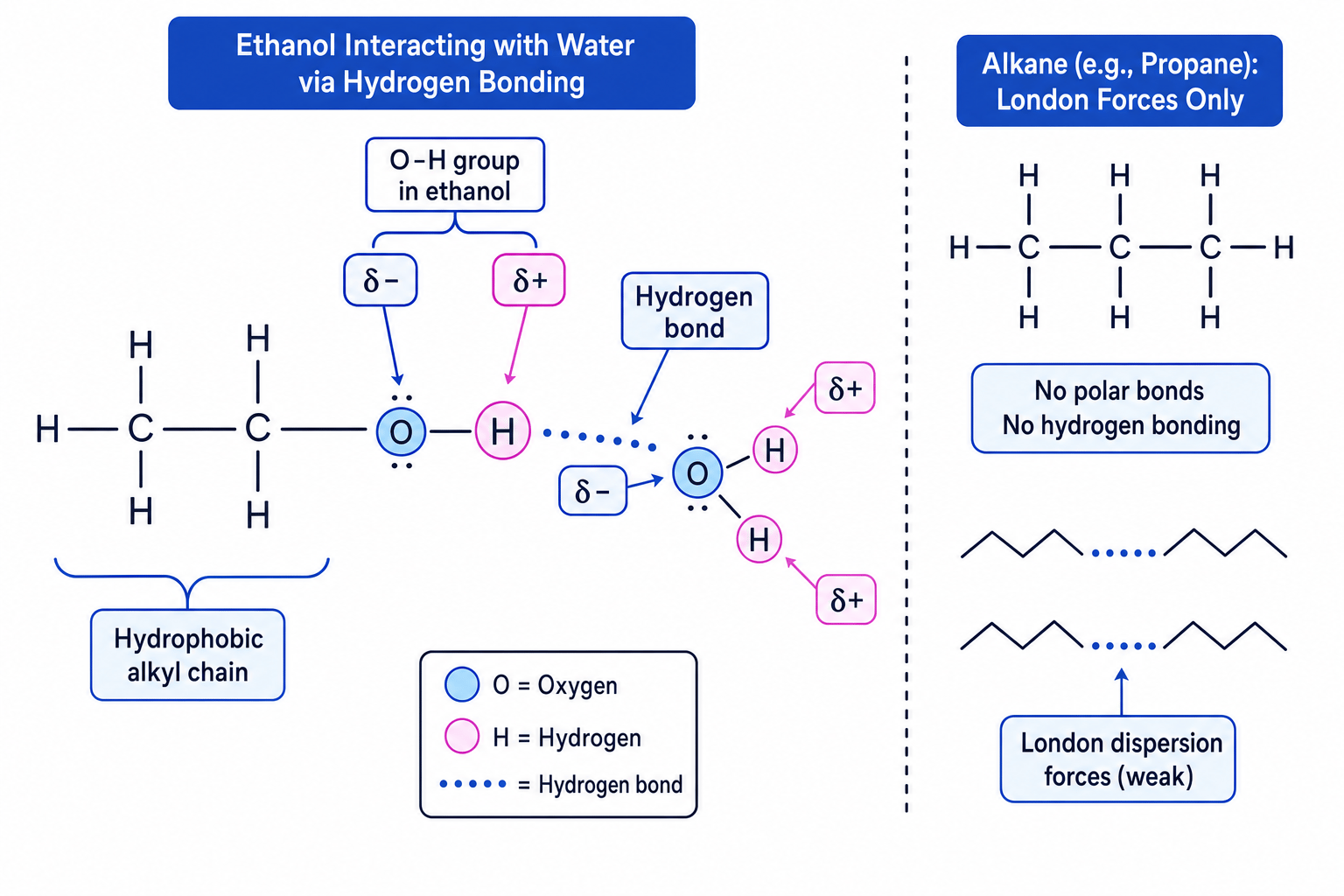
The O–H bond in an alcohol is polar because oxygen is more electronegative than hydrogen. Oxygen attracts the bonding pair of electrons more strongly, so oxygen is δ− and hydrogen is δ+.
Hydrogen bond
A hydrogen bond is an intermolecular attraction between a δ+ hydrogen atom bonded to O, N or F and a lone pair on an O, N or F atom in another molecule.
Alcohol molecules can form hydrogen bonds with each other and with water molecules.
Solubility in water
Short-chain alcohols, such as methanol, ethanol and propan-1-ol, are soluble in water because they can form hydrogen bonds with water.
As the hydrocarbon chain gets longer, solubility decreases. The non-polar alkyl chain cannot hydrogen bond with water, so it becomes a larger part of the molecule’s behaviour.
Volatility compared with alkanes
Volatility means how easily a substance evaporates.
Alcohols are less volatile than alkanes of similar molar mass because alcohol molecules form hydrogen bonds with each other. More energy is needed to overcome these intermolecular forces, so alcohols have higher boiling points and evaporate less easily.
Physical properties of alcohols
The –OH group makes alcohols polar and able to hydrogen bond, giving short-chain alcohols good water solubility and lower volatility than comparable alkanes.
Comparing volatility
Compare ethanol, CH₃CH₂OH, with propane, CH₃CH₂CH₃.
- Ethanol contains an O–H bond, so ethanol molecules can form hydrogen bonds with each other.
- Propane is non-polar overall and has only London forces between molecules.
- Hydrogen bonds are stronger than London forces for molecules of similar size, so more energy is needed to separate ethanol molecules.
- Therefore ethanol is less volatile and has a higher boiling point than propane.
Classifying alcohols
Alcohols are classified by looking at the carbon atom bonded to the –OH group.
Primary, secondary and tertiary alcohols
A primary alcohol has the –OH carbon bonded to one other carbon atom, a secondary alcohol has it bonded to two other carbon atoms, and a tertiary alcohol has it bonded to three other carbon atoms. Methanol is usually treated with primary alcohols for oxidation.
Useful patterns:
- Primary: RCH₂OH, for example CH₃CH₂OH
- Secondary: R₂CHOH, for example CH₃CH(OH)CH₃
- Tertiary: R₃COH, for example (CH₃)₃COH
Classifying an alcohol
Classify CH₃CH₂CH(OH)CH₃.
- Identify the carbon bonded to the –OH group: it is the third carbon as written, in the CH(OH) part.
- Count how many carbon atoms are directly bonded to that –OH carbon: one CH₂ group on the left and one CH₃ group on the right.
- The –OH carbon is bonded to two other carbon atoms, so the compound is a secondary alcohol.
- Its name is butan-2-ol.
Counting the wrong carbon atoms
Do not count every carbon in the molecule. Only count the carbon atoms directly attached to the carbon carrying the –OH group.
Overview of alcohol reactions
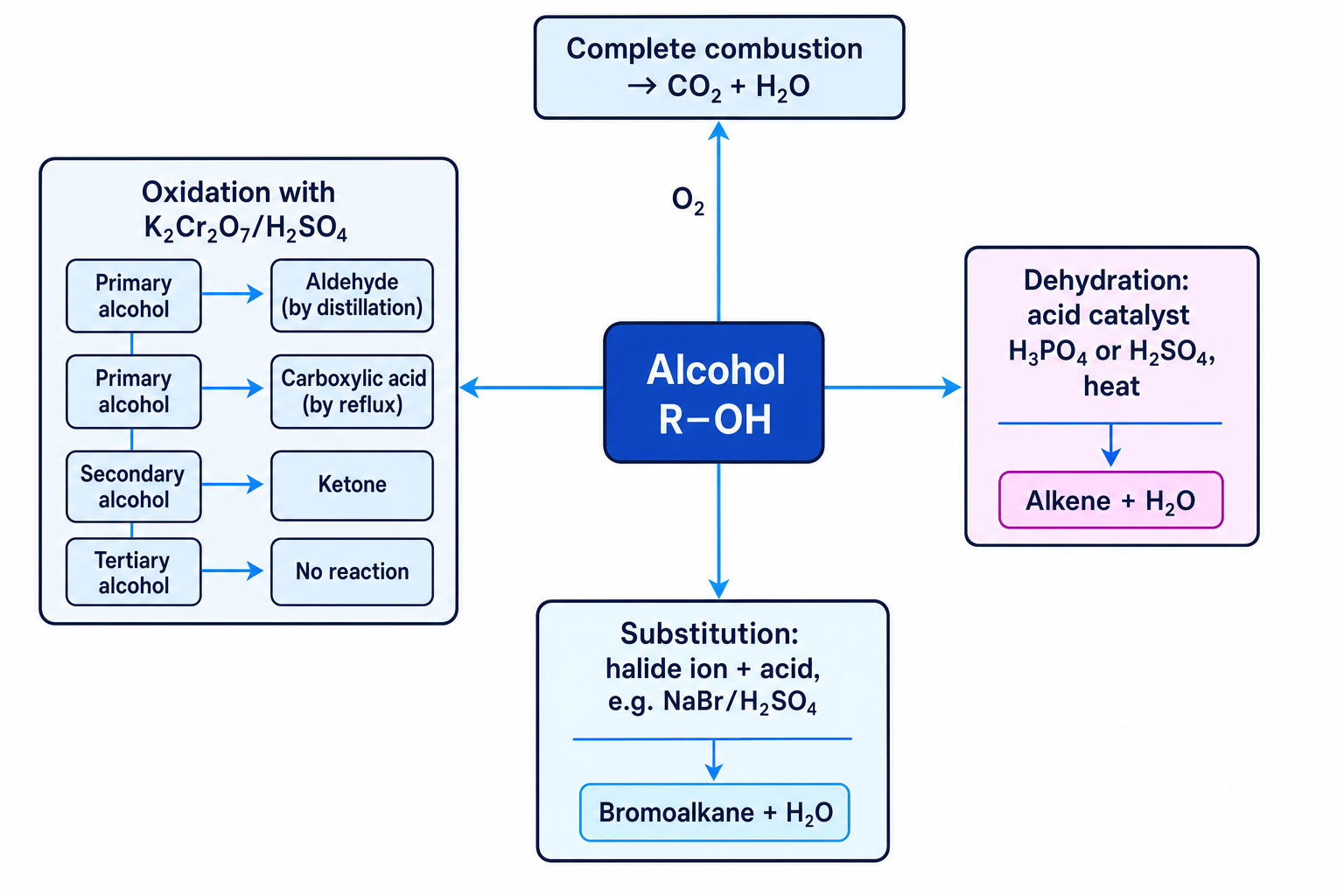
Alcohols have several important reactions in OCR A-Level Chemistry: combustion, oxidation, elimination and substitution.
Combustion of alcohols
Alcohols burn in oxygen. In complete combustion, the products are carbon dioxide and water.
For ethanol:
CH₃CH₂OH(l) + 3O₂(g) → 2CO₂(g) + 3H₂O(l)
Combustion is exothermic, meaning it releases energy to the surroundings.
Complete combustion
Complete combustion is reaction with oxygen in excess oxygen, producing carbon dioxide and water from an organic compound containing carbon, hydrogen and oxygen.
Balancing an alcohol combustion equation
Balance the complete combustion of propan-1-ol, C₃H₇OH.
- Write the unbalanced equation using complete combustion products: C₃H₇OH + O₂ → CO₂ + H₂O.
- Balance carbon atoms first: there are three carbon atoms, so form 3CO₂.
- Balance hydrogen atoms next: C₃H₇OH contains eight hydrogen atoms in total, so form 4H₂O.
- Count oxygen atoms on the product side: 3CO₂ contains six oxygen atoms and 4H₂O contains four oxygen atoms, making ten oxygen atoms total.
- The alcohol already contains one oxygen atom, so oxygen gas must provide nine more oxygen atoms, which is 4.5O₂.
- Multiply through by two if you want whole-number coefficients: 2C₃H₇OH + 9O₂ → 6CO₂ + 8H₂O.
Oxidation of alcohols
Alcohols can be oxidised using acidified potassium dichromate(VI), written as K₂Cr₂O₇/H₂SO₄. In equations, OCR expects the oxidising agent to be represented using [O].
The dichromate(VI) ions, Cr₂O₇²⁻, are orange and are reduced to green Cr³⁺ ions during oxidation. This colour change is a useful observation in practical work.
Oxidation in organic chemistry
In this topic, oxidation usually means adding oxygen to an organic molecule or removing hydrogen from it.
Primary alcohols: aldehydes or carboxylic acids
Primary alcohols can be oxidised in two stages.
First stage: primary alcohol → aldehyde
CH₃CH₂OH + [O] → CH₃CHO + H₂O
Second stage: aldehyde → carboxylic acid
CH₃CHO + [O] → CH₃COOH
Overall:
CH₃CH₂OH + 2[O] → CH₃COOH + H₂O
The product depends on the conditions.
- To make an aldehyde, use gentle heating and distil the aldehyde off as it forms.
- To make a carboxylic acid, heat under reflux with excess oxidising agent.
Reflux and distillation
Reflux heats a reaction mixture without losing volatile substances, because vapours condense and return to the flask. Distillation allows a volatile product to leave the reaction mixture and be collected.
Secondary alcohols: ketones
Secondary alcohols are oxidised to ketones.
For propan-2-ol:
CH₃CH(OH)CH₃ + [O] → CH₃COCH₃ + H₂O
The product, propanone, is a ketone.
Tertiary alcohols: resistant to oxidation
Tertiary alcohols are not oxidised by acidified dichromate(VI) under these conditions. There is usually no orange-to-green colour change.
Oxidation pattern
Primary alcohols can form aldehydes or carboxylic acids, secondary alcohols form ketones, and tertiary alcohols resist oxidation.
Choosing oxidation conditions
You want to prepare propanal from propan-1-ol using K₂Cr₂O₇/H₂SO₄.
- Propan-1-ol is a primary alcohol, so it can be oxidised first to an aldehyde and then further to a carboxylic acid.
- The target product, propanal, is the aldehyde, so you must prevent further oxidation to propanoic acid.
- Use gentle heating and distillation so propanal is removed from the oxidising mixture as it forms.
- The equation is: CH₃CH₂CH₂OH + [O] → CH₃CH₂CHO + H₂O.
Using reflux for an aldehyde
If you heat a primary alcohol under reflux with excess acidified dichromate(VI), the aldehyde is not the final product. It is further oxidised to a carboxylic acid.
Practical link
Distillation and reflux are core organic preparation skills. In practical questions, think about why the apparatus is chosen: distillation removes a volatile product, while reflux allows prolonged heating without loss of reactants or products.
Elimination: dehydration to alkenes
An elimination reaction removes atoms or groups from a molecule to form a multiple bond. Alcohols undergo elimination by losing H₂O, so this reaction is also called dehydration.
Alcohol vapour is passed over hot aluminium oxide in some courses, but for this OCR section you should know dehydration using an acid catalyst such as concentrated H₃PO₄ or H₂SO₄ and heat.
For ethanol:
CH₃CH₂OH → CH₂=CH₂ + H₂O
Conditions: H₃PO₄ or H₂SO₄, heat.
The acid acts as a catalyst, so it is not used up overall.
Mechanism not required here
OCR does not require the elimination mechanism for dehydration of alcohols in this section. Focus on the product, conditions and balanced equation.
Predicting a dehydration product
Predict the organic product when propan-2-ol is heated with concentrated H₂SO₄.
- Dehydration removes H₂O from the alcohol, so the product must be an alkene.
- The –OH group is on carbon 2. A hydrogen is removed from an adjacent carbon, forming a C=C bond.
- In propan-2-ol, either adjacent end gives the same alkene.
- The product is propene: CH₃CH(OH)CH₃ → CH₂=CHCH₃ + H₂O.
Substitution: forming haloalkanes
A substitution reaction replaces one atom or group with another. Alcohols can react with halide ions in acidic conditions to form haloalkanes.
For example, ethanol reacts with bromide ions in acid:
CH₃CH₂OH + HBr → CH₃CH₂Br + H₂O
In practice, HBr can be generated in the reaction mixture using NaBr and H₂SO₄.
Conditions: NaBr/H₂SO₄, often with warming or heating.
Haloalkane
A haloalkane is an organic compound containing a halogen atom, such as chlorine, bromine or iodine, bonded to an alkyl group.
Writing a substitution product
Write the organic product when propan-1-ol reacts with NaBr/H₂SO₄.
- NaBr/H₂SO₄ provides bromide ions in acidic conditions, so the alcohol is converted into a bromoalkane.
- The –OH group in propan-1-ol is on carbon 1, so bromine replaces the –OH group on carbon 1.
- The product is 1-bromopropane, CH₃CH₂CH₂Br.
- The overall organic equation can be written as: CH₃CH₂CH₂OH + HBr → CH₃CH₂CH₂Br + H₂O.
Mechanism not required here
OCR does not require the substitution mechanism for converting alcohols into haloalkanes in this section. You need the reagent, acidic conditions and product.
Naming products: a quick pattern check
When predicting products, focus on what happens to the –OH group.
- Combustion destroys the carbon skeleton: CO₂ and H₂O form.
- Oxidation changes the carbon attached to –OH into C=O-containing products.
- Dehydration removes H₂O and forms C=C.
- Substitution replaces –OH with a halogen.
In the exam
- For physical property questions, explicitly mention hydrogen bonding and compare it with the intermolecular forces in alkanes.
- For oxidation questions, identify the alcohol class first, then choose the product and conditions: distillation for aldehydes, reflux for carboxylic acids.
- Use [O] in oxidation equations, as OCR expects, and include H₂O where needed to balance organic oxidation equations.
- If a mechanism is not required by the specification, do not waste time drawing one; give reagents, conditions, observations and products clearly.
Check yourself
- Why is ethanol more soluble in water than hexan-1-ol?
- What product forms when butan-2-ol is oxidised with acidified potassium dichromate(VI)?
- What conditions would you use to convert ethanol into ethene?
