

What you'll learn
- How to decide whether a reaction is exothermic or endothermic from its enthalpy change.
- How to draw and interpret enthalpy profile diagrams, including activation energy.
- How to calculate enthalpy changes from experiments using q=mcΔTq = mc\Delta Tq=mcΔT.
- How to use bond enthalpies and Hess’ law cycles to find enthalpy changes indirectly.
1. Enthalpy changes: the basic idea
Chemical reactions often involve heat energy being transferred between the reaction mixture and its surroundings.
Enthalpy change, ΔH
An enthalpy change, ΔH\Delta HΔH, is the heat energy change for a reaction at constant pressure. At A-Level, it is usually given in kJ mol⁻¹.
If a reaction releases heat to the surroundings, the surroundings get warmer. This is exothermic, and ΔH\Delta HΔH is negative.
If a reaction takes in heat from the surroundings, the surroundings get cooler. This is endothermic, and ΔH\Delta HΔH is positive.
Sign of ΔH
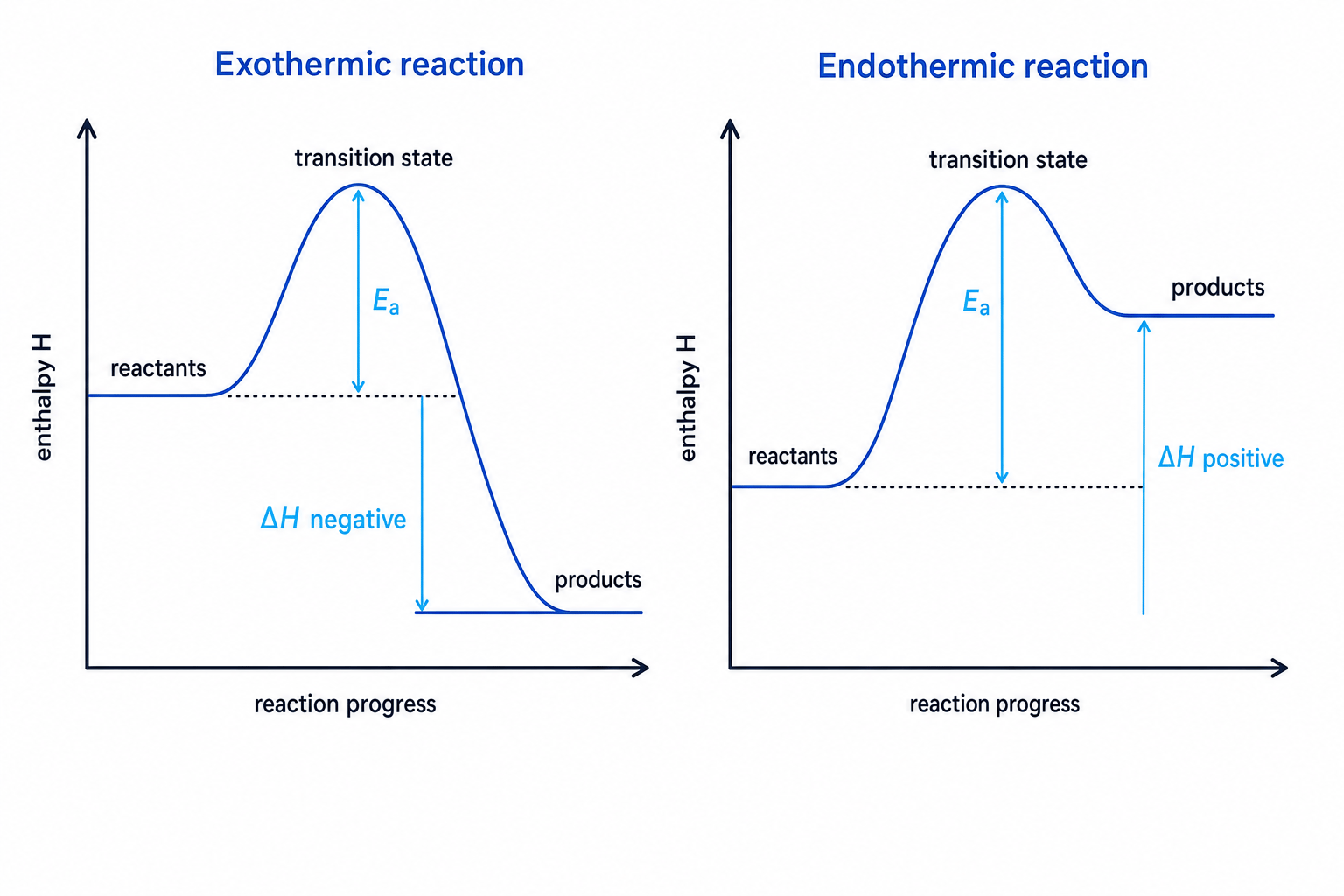
For an exothermic reaction, products have lower enthalpy than reactants, so ΔH<0\Delta H < 0ΔH<0. For an endothermic reaction, products have higher enthalpy than reactants, so ΔH>0\Delta H > 0ΔH>0.
2. Enthalpy profile diagrams
An enthalpy profile diagram shows how enthalpy changes as a reaction proceeds. The vertical axis is enthalpy, HHH, and the horizontal axis is reaction progress.
The diagram compares the enthalpy of the reactants with the enthalpy of the products. It also shows the “hill” that particles must get over for reaction to occur.
Activation energy
The activation energy, EaE_aEa, is the minimum energy required for a reaction to take place.
Even exothermic reactions need activation energy. Bonds in the reactants must start to break before new bonds can form, so the reaction has to pass through a high-energy stage.
Interpreting an enthalpy profile
A reaction has reactants at 80 kJ mol⁻¹, products at 25 kJ mol⁻¹, and a peak at 140 kJ mol⁻¹.
-
Compare products with reactants: products are lower in enthalpy, so the reaction is exothermic.
-
Calculate the enthalpy change:
- Calculate the activation energy from reactants to the peak:
Measuring activation energy from the wrong place
Activation energy is measured from the reactants up to the peak, not from the products up to the peak.
3. Standard conditions and standard states
Enthalpy changes depend on conditions such as temperature, pressure, concentration, and physical state. To make values comparable, chemists use standard conditions.
Standard conditions and standard states
For OCR A, standard conditions can be taken as 100 kPa and a stated temperature, usually 298 K. A standard state is the physical state of a substance under those standard conditions.
For example, under standard conditions, water is H₂O(l), oxygen is O₂(g), and carbon is C(s, graphite).
Always include state symbols
For enthalpy definitions and equations, state symbols matter. H₂O(l) and H₂O(g) have different enthalpies.
4. Types of enthalpy change
Enthalpy change of reaction, ΔᵣH
Enthalpy change of reaction
The enthalpy change of reaction, ΔrH\Delta_rHΔrH, is the enthalpy change associated with a stated chemical equation, in the molar quantities shown by that equation.
For example:
CH₄(g) + 2O₂(g) → CO₂(g) + 2H₂O(l)
The value of ΔrH\Delta_rHΔrH applies to exactly that equation as written.
Enthalpy change of formation, ΔfH
Enthalpy change of formation
The enthalpy change of formation, ΔfH\Delta_fHΔfH, is the enthalpy change when 1 mol of a compound is formed from its elements in their standard states.
Example formation equation:
C(s, graphite) + 2H₂(g) → CH₄(g)
Notice that exactly 1 mol of CH₄ is formed.
Enthalpy change of combustion, ΔcH
Enthalpy change of combustion
The enthalpy change of combustion, ΔcH\Delta_cHΔcH, is the enthalpy change when 1 mol of a substance is completely burned in oxygen.
Example:
CH₄(g) + 2O₂(g) → CO₂(g) + 2H₂O(l)
Complete combustion of carbon-containing substances forms CO₂, not CO.
Enthalpy change of neutralisation, ΔneutH
Enthalpy change of neutralisation
The enthalpy change of neutralisation, ΔneutH\Delta_{\text{neut}}HΔneutH, is the enthalpy change when 1 mol of water is formed in a neutralisation reaction.
For a strong acid and strong alkali, the ionic equation is:
H⁺(aq) + OH⁻(aq) → H₂O(l)
5. Measuring enthalpy changes directly: calorimetry
In school laboratory calorimetry, the heat energy change is often found from the temperature change of water or an aqueous solution.
The key equation is:
q=mcΔT q = mc\Delta T q=mcΔTwhere:
- qqq is heat energy transferred, usually in J
- mmm is the mass of solution in g
- ccc is the specific heat capacity, usually 4.18 J g⁻¹ K⁻¹ for aqueous solutions
- ΔT\Delta TΔT is the temperature change in K or °C
Because a temperature change of 1 K is the same size as a temperature change of 1 °C, you can use °C for ΔT\Delta TΔT.
Calculating an enthalpy change of neutralisation
25.0 cm³ of 1.00 mol dm⁻³ HCl is mixed with 25.0 cm³ of 1.00 mol dm⁻³ NaOH. The temperature rises by 6.8 °C. Assume the solution has density 1.00 g cm⁻³ and c=4.18 J g−1K−1c = 4.18\ \text{J g}^{-1}\text{K}^{-1}c=4.18 J g−1K−1.
-
Find the total mass of solution. The total volume is 50.0 cm³, so the mass is 50.0 g.
-
Calculate the heat released to the solution:
- Find the amount of water formed. HCl and NaOH react 1:1, so:
- Convert heat energy to kJ mol⁻¹ and use a negative sign because the temperature increased, meaning the reaction is exothermic:
Forgetting the sign
If the solution temperature rises, the reaction released heat, so the reaction enthalpy change is negative.
Practical evaluation
Simple calorimetry often gives less exothermic values than data-book values because heat is lost to the surroundings and absorbed by the apparatus.
6. Bond enthalpies
A chemical reaction involves bonds being broken and new bonds being made.
Breaking bonds requires energy, so it is endothermic. Making bonds releases energy, so it is exothermic.
Average bond enthalpy
An average bond enthalpy is the energy needed to break 1 mol of a particular type of bond in gaseous molecules.
OCR does not require a formal definition beyond this idea, but you do need to know that bond enthalpies are average values. A C–H bond in methane is not exactly identical to a C–H bond in ethane, so calculated values are approximate.
The calculation is:
ΔH=∑bond enthalpies of bonds broken−∑bond enthalpies of bonds made \Delta H = \sum \text{bond enthalpies of bonds broken} - \sum \text{bond enthalpies of bonds made} ΔH=∑bond enthalpies of bonds broken−∑bond enthalpies of bonds madeBonds broken minus bonds made
Breaking bonds costs energy. Making bonds releases energy. So use:
ΔH=energy in−energy out\Delta H = \text{energy in} - \text{energy out}ΔH=energy in−energy out.
Calculating ΔH from bond enthalpies
Estimate ΔH\Delta HΔH for:
CH₄(g) + 2O₂(g) → CO₂(g) + 2H₂O(g)
Use bond enthalpies: C–H = 413, O=O = 498, C=O in CO₂ = 805, O–H = 464 kJ mol⁻¹.
- Count the bonds broken in the reactants: four C–H bonds in CH₄ and two O=O bonds in 2O₂.
- Count the bonds made in the products: two C=O bonds in CO₂ and four O–H bonds in 2H₂O.
- Subtract bonds made from bonds broken:
Bond enthalpies need gaseous molecules
Average bond enthalpies apply to bonds in gaseous molecules, so equations using bond enthalpies often use H₂O(g), not H₂O(l).
7. Hess’ law and enthalpy cycles
Some enthalpy changes cannot be measured directly. Hess’ law lets you calculate them indirectly.
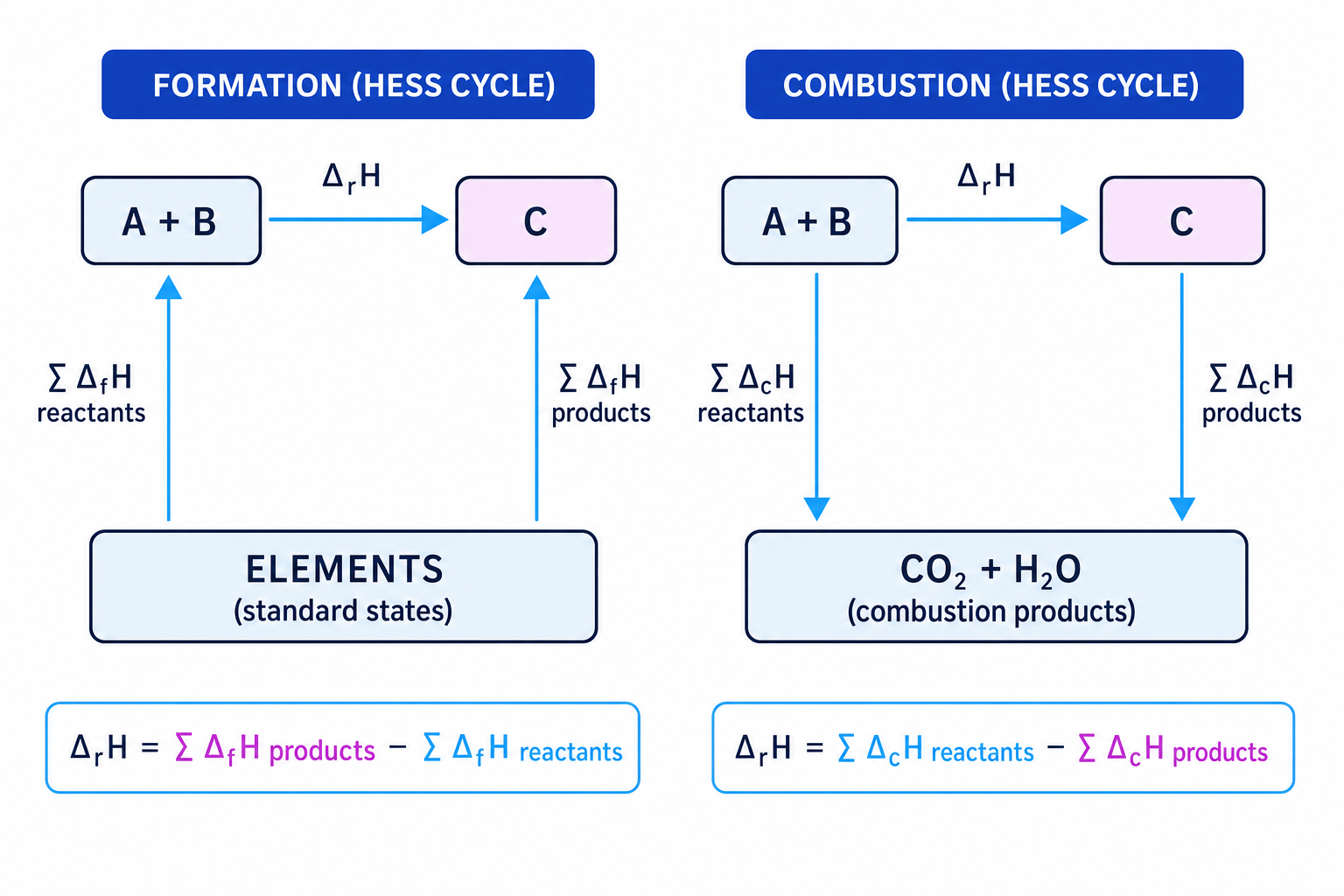
The important principle is conservation of energy: if reactants become products, the overall enthalpy change is the same no matter which route is taken.
Using enthalpies of formation
For formation data:
ΔrH=∑ΔfH(products)−∑ΔfH(reactants) \Delta_rH = \sum \Delta_fH(\text{products}) - \sum \Delta_fH(\text{reactants}) ΔrH=∑ΔfH(products)−∑ΔfH(reactants)Remember: elements in their standard states have ΔfH=0\Delta_fH = 0ΔfH=0.
Using formation enthalpies
Calculate ΔrH\Delta_rHΔrH for:
CH₄(g) + 2O₂(g) → CO₂(g) + 2H₂O(l)
Use ΔfH\Delta_fHΔfH: CH₄(g) = −75, CO₂(g) = −394, H₂O(l) = −286 kJ mol⁻¹. Oxygen is an element in its standard state.
- Add the formation enthalpies of the products, including coefficients:
- Add the formation enthalpies of the reactants:
- Apply products minus reactants:
Using enthalpies of combustion
For combustion data, both reactants and products are taken down to the same combustion products, usually CO₂ and H₂O.
For combustion cycles:
ΔrH=∑ΔcH(reactants)−∑ΔcH(products) \Delta_rH = \sum \Delta_cH(\text{reactants}) - \sum \Delta_cH(\text{products}) ΔrH=∑ΔcH(reactants)−∑ΔcH(products)Using combustion enthalpies
Calculate ΔrH\Delta_rHΔrH for:
C₂H₄(g) + H₂(g) → C₂H₆(g)
Use ΔcH\Delta_cHΔcH: C₂H₄(g) = −1411, H₂(g) = −286, C₂H₆(g) = −1560 kJ mol⁻¹.
- Add the combustion enthalpies of the reactants:
- Add the combustion enthalpies of the products:
- Apply reactants minus products:
Mixing up the Hess formulae
For formation cycles, use products minus reactants. For combustion cycles, use reactants minus products. This happens because the arrows point in different directions.
8. Direct and indirect determination: choosing the method
You can determine enthalpy changes directly by experiment, or indirectly using data.
Direct methods include:
- measuring temperature changes in solution reactions, such as neutralisation
- burning fuels and measuring heat transferred to water
- using q=mcΔTq = mc\Delta Tq=mcΔT and then dividing by the amount in mol
Indirect methods include:
- using average bond enthalpies
- using enthalpies of formation
- using enthalpies of combustion
- constructing unfamiliar Hess cycles from given arrows and data
In practical work, you should be able to describe the procedure, process the data, and evaluate limitations such as heat loss, incomplete combustion, evaporation, and uncertainty in temperature readings.
In the exam
-
Check exactly what 1 mol refers to: fuel burned, compound formed, or water produced.
-
Keep qqq in J for q=mcΔTq = mc\Delta Tq=mcΔT, then convert to kJ before calculating kJ mol⁻¹.
-
For Hess cycles, follow the arrows and coefficients carefully; multiply enthalpy values by the number of moles in the balanced equation.
Check yourself
- Why is ΔH\Delta HΔH negative for an exothermic reaction?
- How would you calculate ΔneutH\Delta_{\text{neut}}HΔneutH from masses, temperature change, and concentration data?
- When using combustion enthalpies in a Hess cycle, why is the formula reactants minus products?
