

Carboxylic acids, esters, and their derivatives are fundamental functional groups in organic chemistry. They are widespread in nature—responsible for the sharp tang of vinegar, the pleasant aromas of fruits, and the structure of fats and oils. In this guide, we will explore their physical properties, chemical reactivity, and synthesis pathways, focusing on the high-yielding derivatives: acid anhydrides and acyl chlorides.
What you'll learn
- Explain the physical and chemical properties of carboxylic acids, including water solubility and acidity.
- Compare the conditions, reagents, and yields of esterification and ester hydrolysis.
- Master the preparation and synthetic applications of highly reactive acyl chlorides to produce esters, amides, and carboxylic acids.
1. Physical Properties of Carboxylic Acids
Carboxylic acids are organic compounds characterized by the carboxyl functional group: -COOH\text{-COOH}-COOH. This group is a combination of a carbonyl group (C=O\text{C=O}C=O) and a hydroxyl group (-OH\text{-OH}-OH) attached to the same carbon atom.
Carboxyl Group
The carboxyl group is the functional group -COOH\text{-COOH}-COOH, consisting of a carbon atom double-bonded to an oxygen atom and single-bonded to a hydroxyl group.
Water Solubility and Hydrogen Bonding
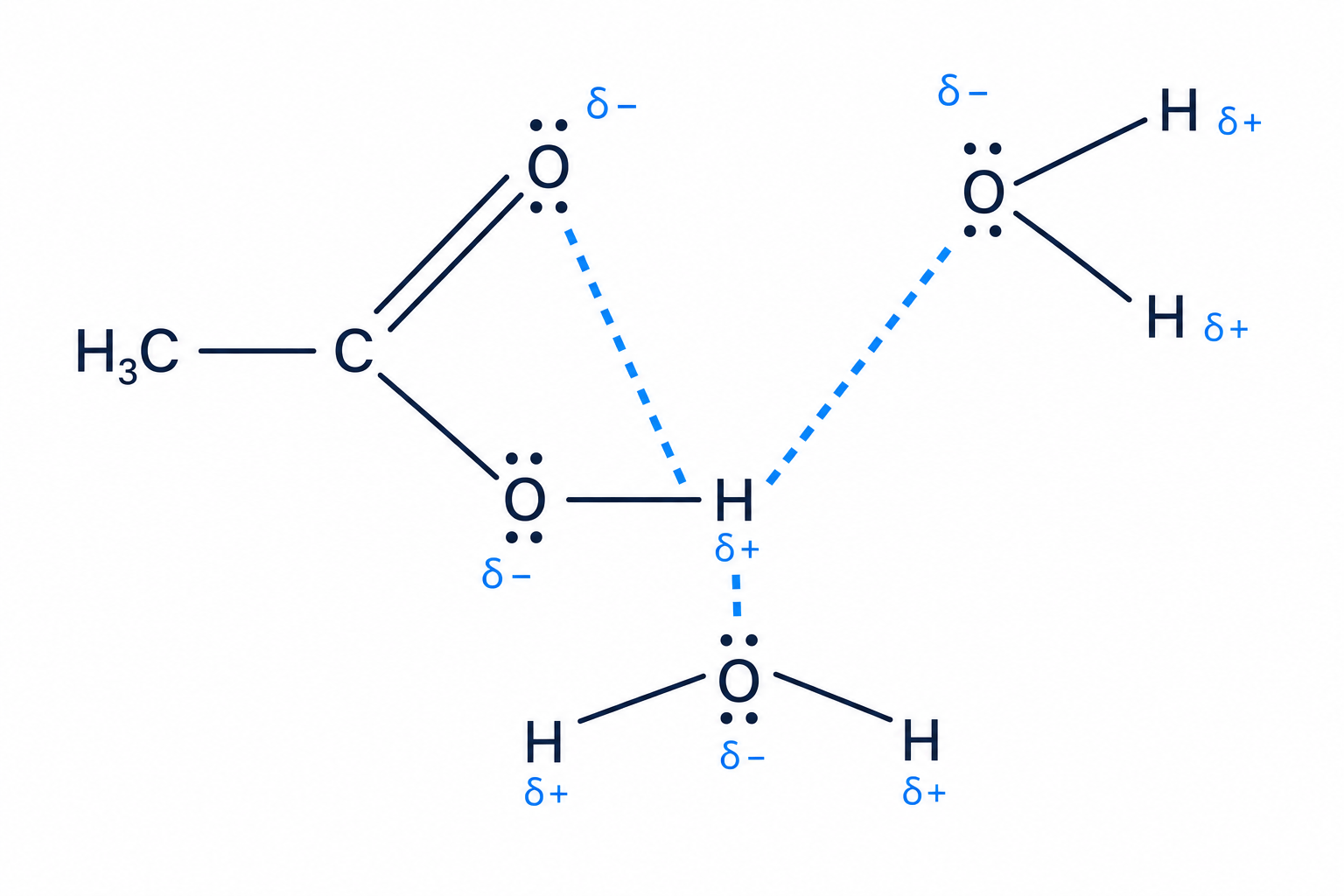
The highly polar nature of both the C=O\text{C=O}C=O and -OH\text{-OH}-OH bonds within the carboxyl group allows carboxylic acids to form strong hydrogen bonds with water molecules.
- Mechanism: The oxygen atoms in the carboxylic acid carry lone pairs of electrons (δ−\delta-δ−) which attract the electron-deficient hydrogen atoms (δ+\delta+δ+) of water molecules. Simultaneously, the hydrogen atom of the acid's hydroxyl group (δ+\delta+δ+) forms a hydrogen bond with the lone pair on a water molecule's oxygen atom (δ−\delta-δ−).
- Solubility Trend: Small carboxylic acids (methanoic, ethanoic, propanoic, and butanoic acids) are completely miscible in water. However, as the carbon chain length increases, solubility decreases. This occurs because the longer non-polar, hydrophobic hydrocarbon chain disrupts the hydrogen-bonding network between water molecules without forming strong attractions of its own.
2. Chemical Properties: Acidic Reactions
Carboxylic acids behave as weak acids in aqueous solutions. They partially dissociate into a carboxylate ion and a proton:
RCOOH(aq)⇌RCOO−(aq)+H+(aq) \text{RCOOH(aq)} \rightleftharpoons \text{RCOO}^-\text{(aq)} + \text{H}^+\text{(aq)} RCOOH(aq)⇌RCOO−(aq)+H+(aq)Because they are acids, they undergo typical acid reactions with metals, metal oxides, alkalis, and carbonates to form carboxylate salts.
Key Acid Reactions
- Reaction with Metals (Redox):
Observation: Effervescence (bubbles of hydrogen gas) and the metal dissolves.
- Reaction with Metal Oxides (Neutralisation):
- Reaction with Alkalis (Neutralisation):
- Reaction with Carbonates (Neutralisation):
Observation: Vigorous effervescence (carbon dioxide gas).
Distinguishing Carboxylic Acids from Phenols
Both carboxylic acids and phenols are weak acids, but only carboxylic acids are strong enough acids to react with weak bases like carbonates. Phenols will not produce carbon dioxide gas when sodium carbonate or sodium hydrogencarbonate is added. This is a classic qualitative test in OCR exams!
Calculating the volume of gas produced in an acid-carbonate reaction
A student reacts 50.0 cm350.0\text{ cm}^350.0 cm3 of 0.400 mol dm−30.400\text{ mol dm}^{-3}0.400 mol dm−3 aqueous ethanoic acid with an excess of solid sodium carbonate. Calculate the volume of carbon dioxide gas produced, in cm3\text{cm}^3cm3, measured at room temperature and pressure (RTP). [Molar volume of gas at RTP =24.0 dm3 mol−1= 24.0\text{ dm}^3\text{ mol}^{-1}=24.0 dm3 mol−1]
- Calculate the moles of ethanoic acid used in the reaction: Using the equation n=cVn = cVn=cV:
- Determine the moles of carbon dioxide produced using the stoichiometric ratio: From the balanced equation:
The molar ratio of CH3COOH:CO2\text{CH}_3\text{COOH} : \text{CO}_2CH3COOH:CO2 is 2:12:12:1. Therefore:
n(CO2)=0.0200 mol2=0.0100 mol n(\text{CO}_2) = \frac{0.0200\text{ mol}}{2} = 0.0100\text{ mol} n(CO2)=20.0200 mol=0.0100 mol- Calculate the volume of gas in cm3\text{cm}^3cm3 at RTP: Convert the molar volume to cm3\text{cm}^3cm3 (24.0 dm3=24 000 cm324.0\text{ dm}^3 = 24\,000\text{ cm}^324.0 dm3=24000 cm3):
3. Esters and Esterification
An ester is a carboxylic acid derivative where the hydrogen of the hydroxyl group is replaced by an alkyl or aryl group.
Esterification
Esterification is a condensation reaction in which a carboxylic acid (or derivative) reacts with an alcohol to form an ester and water (or another small molecule).
Method A: Carboxylic Acid + Alcohol
This is the standard laboratory method.
- Reagents: Carboxylic acid and alcohol.
- Conditions: Heated under reflux with a concentrated sulfuric acid (H2SO4\text{H}_2\text{SO}_4H2SO4) catalyst.
- Equation:
- Nature of reaction: Reversible equilibrium. The yield is relatively low unless water is removed or an excess of one reactant is used.
Forgetting the Catalytic Conditions
When writing the equation or conditions for standard esterification, always specify concentrated H2SO4\text{H}_2\text{SO}_4H2SO4. Dilute sulfuric acid contains too much water, which will drive the reversible reaction backwards towards the reactants (Le Chatelier's principle).
Method B: Acid Anhydride + Alcohol
To obtain a much higher yield of ester without using harsh acid catalysts, acid anhydrides are used.
- Reagents: Acid anhydride and alcohol.
- Conditions: Gentle warming.
- Equation:
- Advantages:
- The reaction is non-reversible, giving a much higher yield of the ester.
- No strong acid catalyst is required.
- The byproduct is a carboxylic acid, which is easier to separate from the product mixture than water.
4. Hydrolysis of Esters
Hydrolysis is the chemical breakdown of a compound due to reaction with water. Esters can be hydrolysed using either aqueous acid or aqueous alkali.
Acid Hydrolysis
- Reagents: Dilute aqueous acid (e.g., dilute HCl\text{HCl}HCl or dilute H2SO4\text{H}_2\text{SO}_4H2SO4).
- Conditions: Heated under reflux.
- Products: Carboxylic acid and alcohol.
- Equation:
- Key Point: The reaction is reversible. An excess of water (dilute acid) is required to push the position of equilibrium to the right.
Alkaline Hydrolysis (Saponification)
- Reagents: Dilute aqueous alkali (e.g., NaOH(aq)\text{NaOH(aq)}NaOH(aq)).
- Conditions: Heated under reflux.
- Products: Carboxylate salt and alcohol.
- Equation:
- Key Point: This reaction is irreversible because the carboxylic acid product is instantly deprotonated by the alkali to form the stable carboxylate salt (CH3COO−\text{CH}_3\text{COO}^-CH3COO−). This prevents the reverse reaction from occurring.
Regenerating the Carboxylic Acid
To obtain the free carboxylic acid after alkaline hydrolysis, you must add a strong acid (such as dilute HCl\text{HCl}HCl) to protonate the carboxylate salt:
CH3COO−(aq)+H+(aq)→CH3COOH(aq) \text{CH}_3\text{COO}^-\text{(aq)} + \text{H}^+\text{(aq)} \to \text{CH}_3\text{COOH(aq)} CH3COO−(aq)+H+(aq)→CH3COOH(aq)5. Acyl Chlorides
Acyl chlorides are highly reactive organic compounds containing the functional group -COCl\text{-COCl}-COCl. They are crucial synthetic intermediates.
Preparation of Acyl Chlorides
Acyl chlorides are prepared by reacting a carboxylic acid with liquid thionyl chloride (SOCl2\text{SOCl}_2SOCl2).
- Equation:
- Why this reaction is favored: The byproducts (SO2\text{SO}_2SO2 and HCl\text{HCl}HCl) are both gases that escape the reaction mixture, leaving a pure liquid acyl chloride product.
- Safety: This must be carried out in a fume cupboard because both gaseous byproducts are highly toxic and acidic.
6. Reactions of Acyl Chlorides in Synthesis
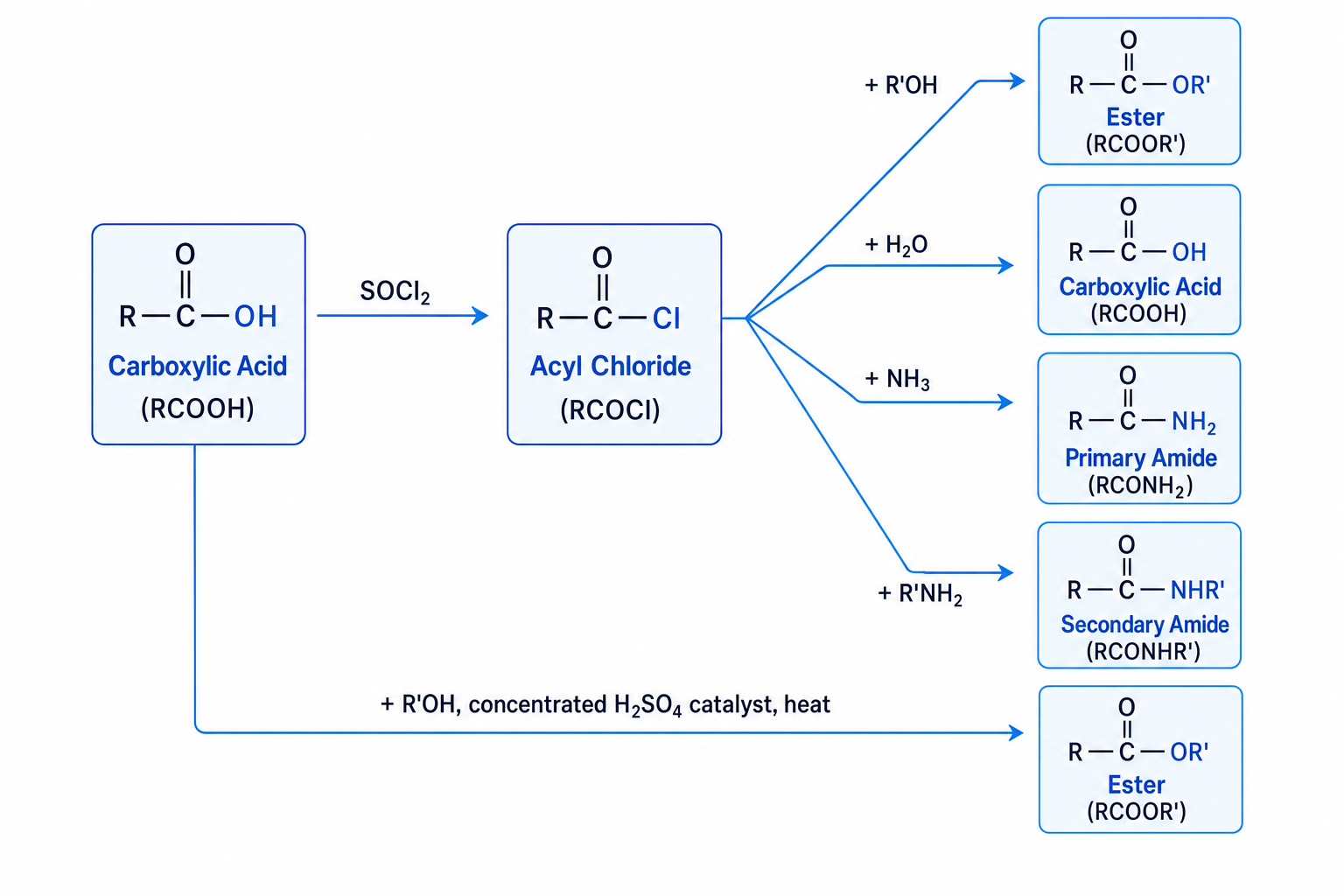
Acyl chlorides are much more reactive than carboxylic acids because the carbon in the -COCl\text{-COCl}-COCl group is bonded to two highly electronegative atoms (oxygen and chlorine), making it extremely electron-deficient (δ+\delta+δ+) and highly susceptible to nucleophilic attack.
The reaction pathways of acyl chlorides are summarized in the synthesis map below:
1. Reacting with Water to form Carboxylic Acids
- Reagent: Water.
- Conditions: Room temperature (violent reaction).
- Equation:
- Observation: Violent fizzing and dense white steamy fumes of HCl\text{HCl}HCl gas.
2. Reacting with Alcohols to form Esters
- Reagent: Alcohol.
- Conditions: Room temperature.
- Equation:
- Advantage: Rapid, non-reversible reaction with high yield, requiring no acid catalyst.
3. Esterification of Phenol
Phenol is a weak nucleophile because the lone pair of electrons on its oxygen atom is partially delocalised into the benzene π\piπ-ring system.
- Problem: Carboxylic acids are not reactive enough to esterify phenol directly.
- Solution: Acyl chlorides are highly reactive and react readily with phenol to form phenyl esters:
4. Reacting with Ammonia to form Primary Amides
- Reagent: Concentrated ammonia (NH3\text{NH}_3NH3).
- Conditions: Room temperature.
- Equation:
Why 2 Moles of Ammonia are Required
One mole of ammonia acts as a nucleophile to form the primary amide. The second mole of ammonia acts as a base to neutralise the acidic byproduct (HCl\text{HCl}HCl), forming the salt ammonium chloride (NH4Cl\text{NH}_4\text{Cl}NH4Cl).
5. Reacting with Primary Amines to form Secondary Amides
- Reagent: Primary amine (e.g., R’NH2\text{R'NH}_2R’NH2).
- Conditions: Room temperature.
- Equation:
In the exam
- Differentiate Phenol and Carboxylic Acid: If a question asks you to distinguish between phenol and a carboxylic acid chemically, use sodium carbonate. The carboxylic acid will fizz (CO2\text{CO}_2CO2 gas), whereas phenol will show no reaction.
- State Symbols and Yields: Remember that acid hydrolysis of esters is reversible (equilibrium arrows ⇌\rightleftharpoons⇌ required), whereas alkaline hydrolysis goes to completion (single arrow →\to→ required).
- Synthesis Pathways: In multi-step synthesis questions, if you need to make an ester from phenol, you must convert your carboxylic acid into an acyl chloride using SOCl2\text{SOCl}_2SOCl2 first, then react it with phenol. Direct reaction of a carboxylic acid with phenol yields nothing.
Check yourself
- Why are longer-chain carboxylic acids less soluble in water than shorter-chain ones?
- State the reagents and conditions needed to convert propanoic acid into propyl propanoate.
- Write the balanced equation for the reaction of benzoyl chloride (C6H5COCl\text{C}_6\text{H}_5\text{COCl}C6H5COCl) with methylamine (CH3NH2\text{CH}_3\text{NH}_2CH3NH2). What type of amide is formed?
