

Welcome to your study notes on Amines. This topic forms a crucial part of Module 6 (Section 6.2.1) of your OCR A-Level Chemistry specification. Amines are organic derivatives of ammonia (NH3\text{NH}_3NH3) where one or more hydrogen atoms have been replaced by alkyl or aryl carbon groups. They are found throughout nature—from the amino acids that build proteins to neurotransmitters like adrenaline.
What you'll learn:
- How the lone pair of electrons on the nitrogen atom enables amines to act as bases.
- How amines react with dilute inorganic acids to form soluble salts.
- How to prepare aliphatic amines via nucleophilic substitution, and how to control the reaction.
- How to synthesize aromatic amines from nitroarenes.
What is an Amine?
Before we look at their reactions, let’s define how amines are classified. Amines are classified as primary (1∘1^\circ1∘), secondary (2∘2^\circ2∘), or tertiary (3∘3^\circ3∘) depending on the number of alkyl or aryl groups attached directly to the nitrogen atom.
Primary, Secondary, and Tertiary Amines
- Primary (1∘1^\circ1∘) amine: An amine in which the nitrogen atom is bonded to exactly one carbon group (e.g., methylamine, CH3NH2\text{CH}_3\text{NH}_2CH3NH2).
- Secondary (2∘2^\circ2∘) amine: An amine in which the nitrogen atom is bonded to two carbon groups (e.g., dimethylamine, (CH3)2NH(\text{CH}_3)_2\text{NH}(CH3)2NH).
- Tertiary (3∘3^\circ3∘) amine: An amine in which the nitrogen atom is bonded to three carbon groups (e.g., trimethylamine, (CH3)3N(\text{CH}_3)_3\text{N}(CH3)3N).
When naming amines, we use the suffix -amine. For example, CH3CH2NH2\text{CH}_3\text{CH}_2\text{NH}_2CH3CH2NH2 is ethylamine. If there are other functional groups of higher priority present (such as a carboxylic acid), the amine group is named using the prefix amino- (e.g., 2-aminopropanoic acid).
The Basicity of Amines
The defining chemical property of amines is their ability to act as Brønsted–Lowry bases.
Brønsted–Lowry Base
A proton (H+\text{H}^+H+) acceptor.
The Nitrogen Lone Pair
Why are amines basic? The nitrogen atom in an amine molecule has a lone pair of electrons in an sp3\text{sp}^3sp3 hybrid orbital. This lone pair can form a dative covalent (co-ordinate) bond by donating both electrons to an electron-deficient hydrogen ion (H+\text{H}^+H+).
The Base Mechanism
The nitrogen atom acts as a nucleophile or base, accepting the proton and converting the neutral amine into a positively charged alkylammonium ion.
Reaction with Dilute Acids
Because they are bases, amines react readily with dilute inorganic acids (such as hydrochloric acid, HCl(aq)\text{HCl(aq)}HCl(aq), or sulfuric acid, H2SO4(aq)\text{H}_2\text{SO}_4\text{(aq)}H2SO4(aq)) to form soluble, ionic ammonium salts.
For example, when ethylamine reacts with dilute hydrochloric acid:
CH3CH2NH2(aq)+HCl(aq)→CH3CH2NH3+Cl−(aq) \text{CH}_3\text{CH}_2\text{NH}_2\text{(aq)} + \text{HCl(aq)} \rightarrow \text{CH}_3\text{CH}_2\text{NH}_3^+\text{Cl}^-\text{(aq)} CH3CH2NH2(aq)+HCl(aq)→CH3CH2NH3+Cl−(aq)The product is ethylammonium chloride. If the water is evaporated, you are left with a white crystalline salt.
If you react a secondary amine such as diethylamine with sulfuric acid, the ionic equation is:
2(CH3CH2)2NH+H2SO4→[(CH3CH2)2NH2]2+SO42− 2(\text{CH}_3\text{CH}_2)_2\text{NH} + \text{H}_2\text{SO}_4 \rightarrow [(\text{CH}_3\text{CH}_2)_2\text{NH}_2]_2^+\text{SO}_4^{2-} 2(CH3CH2)2NH+H2SO4→[(CH3CH2)2NH2]2+SO42−The product is diethylammonium sulfate.
Regenerating the Amine
You can regenerate the free, insoluble or volatile amine from its salt by adding a strong aqueous base like sodium hydroxide (NaOH(aq)\text{NaOH(aq)}NaOH(aq)):
R-NH3+Cl−(aq)+OH−(aq)→R-NH2(aq)+H2O(l)+Cl−(aq) \text{R-NH}_3^+\text{Cl}^-\text{(aq)} + \text{OH}^-\text{(aq)} \rightarrow \text{R-NH}_2\text{(aq)} + \text{H}_2\text{O(l)} + \text{Cl}^-\text{(aq)} R-NH3+Cl−(aq)+OH−(aq)→R-NH2(aq)+H2O(l)+Cl−(aq)This is a very common step in organic syntheses and separation mixtures.
Preparation of Aliphatic Amines
Aliphatic amines (amines containing straight or branched carbon chains, but no aromatic benzene rings directly attached to the nitrogen) can be synthesized through nucleophilic substitution of haloalkanes.
1. Reaction with Ammonia (To Make Primary Amines)
When a haloalkane is heated with ammonia, the ammonia acts as a nucleophile, attacking the polar carbon bonded to the halogen.
- Reagents: Excess ammonia dissolved in ethanol (ethanolic ammonia).
- Conditions: Heated under pressure in a sealed tube (not open reflux, as ammonia gas is highly volatile and would escape the condenser).
The Reaction Mechanism:
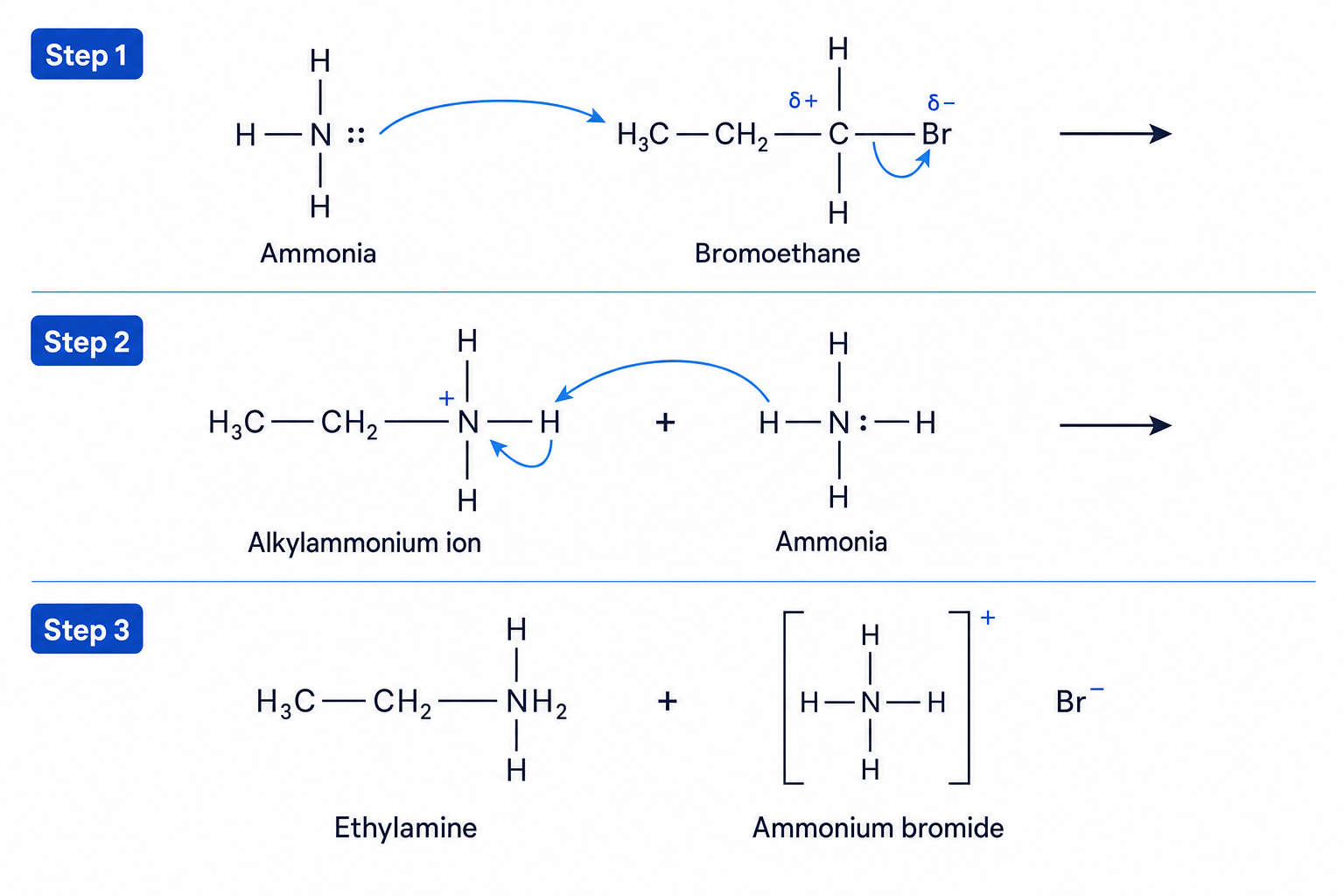
- Step 1: The lone pair on the ammonia nitrogen attacks the δ+\delta^+δ+ carbon of the haloalkane, displacing the halide ion. This forms an intermediate alkylammonium salt.
- Step 2: A second ammonia molecule acts as a base, removing a proton (H+\text{H}^+H+) from the intermediate to liberate the primary amine.
- Step 3: The products are a primary amine and an ammonium halide salt.
Using Aqueous Ammonia
Do not use aqueous ammonia (NH3(aq)\text{NH}_3\text{(aq)}NH3(aq)). Water acts as a competing nucleophile, which will hydrolyse your haloalkane to form an alcohol (R-OH\text{R-OH}R-OH) instead of an amine. Always state ethanolic ammonia.
2. Preventing Further Substitution
A major problem with this reaction is that the product (the primary amine) still has a lone pair of electrons on its nitrogen atom. This makes it just as nucleophilic as ammonia!
The primary amine can go on to attack another molecule of the haloalkane, leading to a secondary amine. This process continues, yielding a mixture of primary, secondary, and tertiary amines, as well as quaternary ammonium salts.
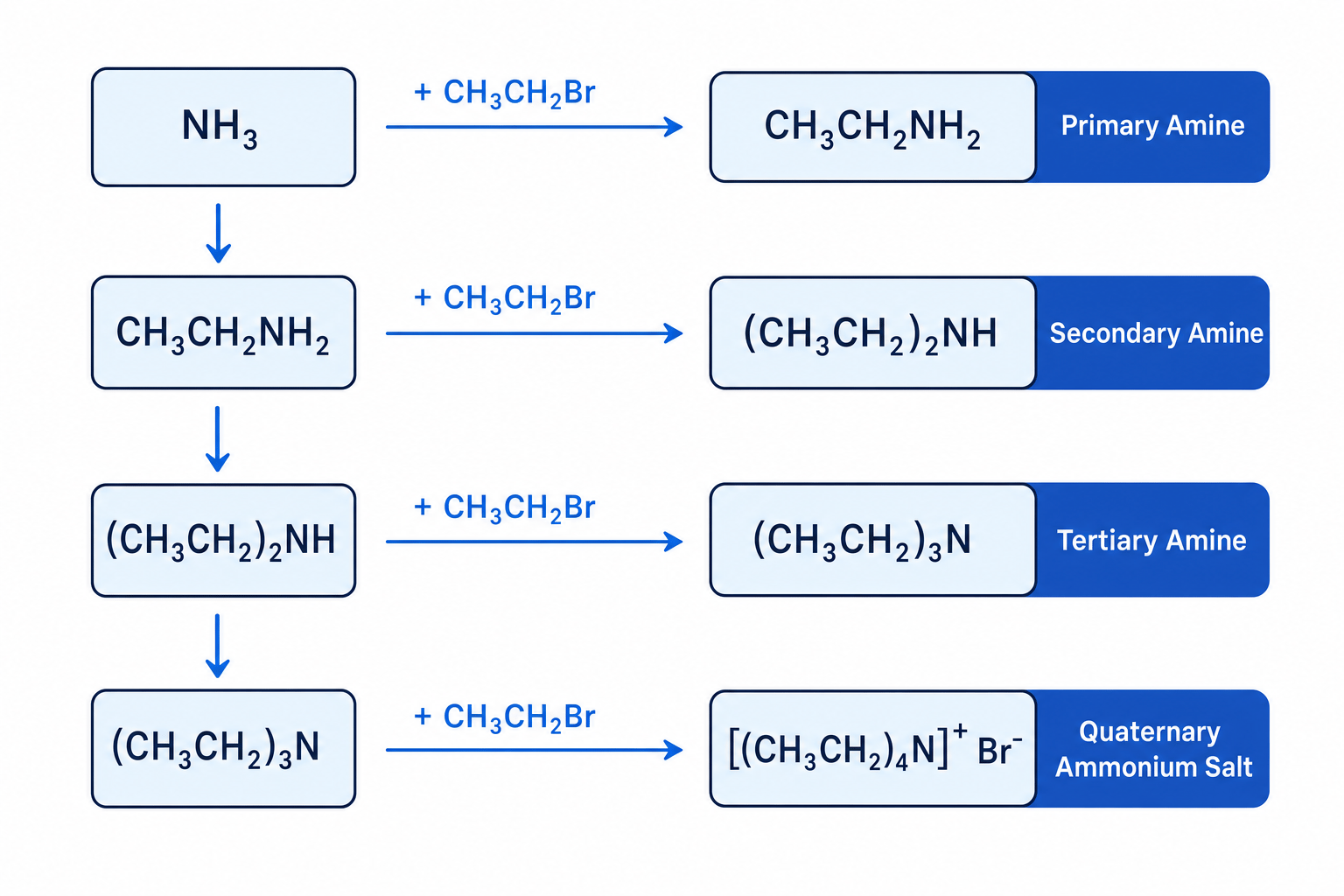
To prevent this further substitution and maximize the yield of the primary amine, you must use a large excess of ammonia. This ensures that any haloalkane molecule is far more likely to collide with an ammonia molecule than with a newly formed amine molecule.
Targeting Secondary or Tertiary Amines
If your goal is to deliberately synthesize a secondary or tertiary amine, you change the stoichiometry: you react a primary or secondary amine with a haloalkane under controlled ratios, rather than using excess ammonia.
Preparation of Aromatic Amines
Aromatic amines, such as phenylamine (C6H5NH2\text{C}_6\text{H}_5\text{NH}_2C6H5NH2), cannot be prepared easily by reacting chlorobenzene with ammonia. The carbon-halogen bond in chlorobenzene is too strong to be broken by nucleophiles because the lone pair of electrons on the chlorine atom overlaps and delocalises with the π\piπ-system of the benzene ring.
Instead, aromatic amines are prepared in a two-step process starting from benzene:
- Nitration of benzene to form nitrobenzene (C6H5NO2\text{C}_6\text{H}_5\text{NO}_2C6H5NO2) using concentrated HNO3\text{HNO}_3HNO3 and concentrated H2SO4\text{H}_2\text{SO}_4H2SO4 catalyst (covered in section 6.1.1).
- Reduction of nitrobenzene to phenylamine.
The Reduction Step
To convert nitrobenzene to phenylamine, you must reduce the nitro group (−NO2-\text{NO}_2−NO2) to an amine group (−NH2-\text{NH}_2−NH2).
- Reagents: Tin (Sn\text{Sn}Sn) and concentrated hydrochloric acid (HCl\text{HCl}HCl).
- Conditions: Heated under reflux.
Because the reaction is carried out in strongly acidic conditions (HCl\text{HCl}HCl), the amine forms its protonated salt, phenylammonium chloride (C6H5NH3+Cl−\text{C}_6\text{H}_5\text{NH}_3^+\text{Cl}^-C6H5NH3+Cl−), rather than the free amine.
To liberate the phenylamine from this salt, aqueous sodium hydroxide (NaOH(aq)\text{NaOH(aq)}NaOH(aq)) must be added to the mixture after the reflux is complete.
The overall reduction equation is represented using the symbol [H][\text{H}][H] for the reducing agent:
C6H5NO2+6[H]→C6H5NH2+2H2O \text{C}_6\text{H}_5\text{NO}_2 + 6[\text{H}] \rightarrow \text{C}_6\text{H}_5\text{NH}_2 + 2\text{H}_2\text{O} C6H5NO2+6[H]→C6H5NH2+2H2ONotice that 6[H]6[\text{H}]6[H] are required to reduce one nitro group because four are needed to remove the oxygen atoms as water, and two are needed to form the −NH2-\text{NH}_2−NH2 group.
Worked Example: Synthesis Calculation
Here is how you apply these stoichiometric principles to a multi-step synthesis calculation.
Calculating mass of reactant for aromatic amine preparation
A student synthesises phenylamine (C6H5NH2\text{C}_6\text{H}_5\text{NH}_2C6H5NH2, Mr=93.0M_r = 93.0Mr=93.0) by reducing nitrobenzene (C6H5NO2\text{C}_6\text{H}_5\text{NO}_2C6H5NO2, Mr=123.0M_r = 123.0Mr=123.0) using tin and concentrated hydrochloric acid.
Calculate the minimum mass of nitrobenzene required to produce 5.40 g5.40\text{ g}5.40 g of phenylamine, assuming the percentage yield of this reduction step is 68.0%68.0\%68.0%.
- Write down the stoichiometry of the reaction. The reduction equation is:
The molar ratio of nitrobenzene to phenylamine is 1:11:11:1.
- Calculate the theoretical yield of phenylamine needed. Since the reaction has a 68.0%68.0\%68.0% yield, the theoretical mass (mtheoreticalm_{\text{theoretical}}mtheoretical) of phenylamine required to obtain 5.40 g5.40\text{ g}5.40 g of actual product is:
- Convert the theoretical mass of phenylamine to moles. Using n=mMn = \frac{m}{M}n=Mm:
- Determine the required moles of nitrobenzene. Using the 1:11:11:1 molar ratio:
- Convert the moles of nitrobenzene to mass. Using m=n×Mm = n \times Mm=n×M:
Rounding to 3 significant figures (matching the input data):
Mass of nitrobenzene=10.5 g \text{Mass of nitrobenzene} = 10.5\text{ g} Mass of nitrobenzene=10.5 gIn the exam
- Specify the reaction conditions clearly: When asked for the preparation of a primary aliphatic amine, always state excess ammonia in ethanol, and heating in a sealed container (or under pressure). Simply writing "ammonia" or "aqueous ammonia" will lose you marks.
- Remember the NaOH step for aromatic amines: In questions asking for the reduction of nitrobenzene, do not forget to state that the initial reflux with Sn\text{Sn}Sn and conc. HCl\text{HCl}HCl produces an amine salt. You must explicitly add a strong alkali like NaOH\text{NaOH}NaOH to obtain the final organic base (phenylamine).
- Represent the reducing agent properly: Use 6[H]6[\text{H}]6[H] in balanced equations for the reduction of a single nitro group, and remember that 2H2O2\text{H}_2\text{O}2H2O are produced as a side product.
Check yourself
- Write the chemical equation for the reaction of propylamine (CH3CH2CH2NH2\text{CH}_3\text{CH}_2\text{CH}_2\text{NH}_2CH3CH2CH2NH2) with dilute sulfuric acid. What is the IUPAC name of the salt formed?
- Explain why a mixture of organic products is obtained when bromoethane is reacted with a limited amount of ammonia.
- Why is it impossible to prepare phenylamine directly by reacting chlorobenzene with ethanolic ammonia?
