

What you'll learn
- How to name simple organic compounds using IUPAC rules.
- How to interpret structural, displayed, skeletal and general formulae.
- How homologous series, functional groups and structural isomers work.
- How bond fission, radicals and curly arrows are used in reaction mechanisms.
Why organic names are systematic
Organic chemistry contains millions of carbon compounds, so common names quickly become confusing. The IUPAC system, developed by the International Union of Pure and Applied Chemistry, gives a systematic framework so each structure can be communicated clearly and unambiguously.
Systematic names encode structure
An IUPAC name tells you the carbon chain length, the functional group, any branches, and the positions of important groups using numbers called locants.
The first ten alkanes and their alkyl groups
An alkane is a saturated hydrocarbon with only carbon–carbon single bonds. An alkyl group is formed by removing one H atom from an alkane; it has general formula CₙH₂ₙ₊₁ and is often shown as R.
| Number of carbons | Alkane | Alkyl group |
|---|---|---|
| 1 | methane, CH₄ | methyl, CH₃– |
| 2 | ethane, C₂H₆ | ethyl, C₂H₅– |
| 3 | propane, C₃H₈ | propyl, C₃H₇– |
| 4 | butane, C₄H₁₀ | butyl, C₄H₉– |
| 5 | pentane, C₅H₁₂ | pentyl, C₅H₁₁– |
| 6 | hexane, C₆H₁₄ | hexyl, C₆H₁₃– |
| 7 | heptane, C₇H₁₆ | heptyl, C₇H₁₅– |
| 8 | octane, C₈H₁₈ | octyl, C₈H₁₇– |
| 9 | nonane, C₉H₂₀ | nonyl, C₉H₁₉– |
| 10 | decane, C₁₀H₂₂ | decyl, C₁₀H₂₁– |
Naming organic compounds
For OCR H432, naming is limited to the functional groups in the specification, but the core method is always the same:
- Find the longest carbon chain containing the main functional group.
- Choose the parent name from the chain length, such as but- for four carbons.
- Number the chain to give the main functional group the lowest possible locant.
- Add prefixes for branches, such as methyl-, with their locants.
- Add the suffix for the main functional group, such as -ane, -ene or -ol.
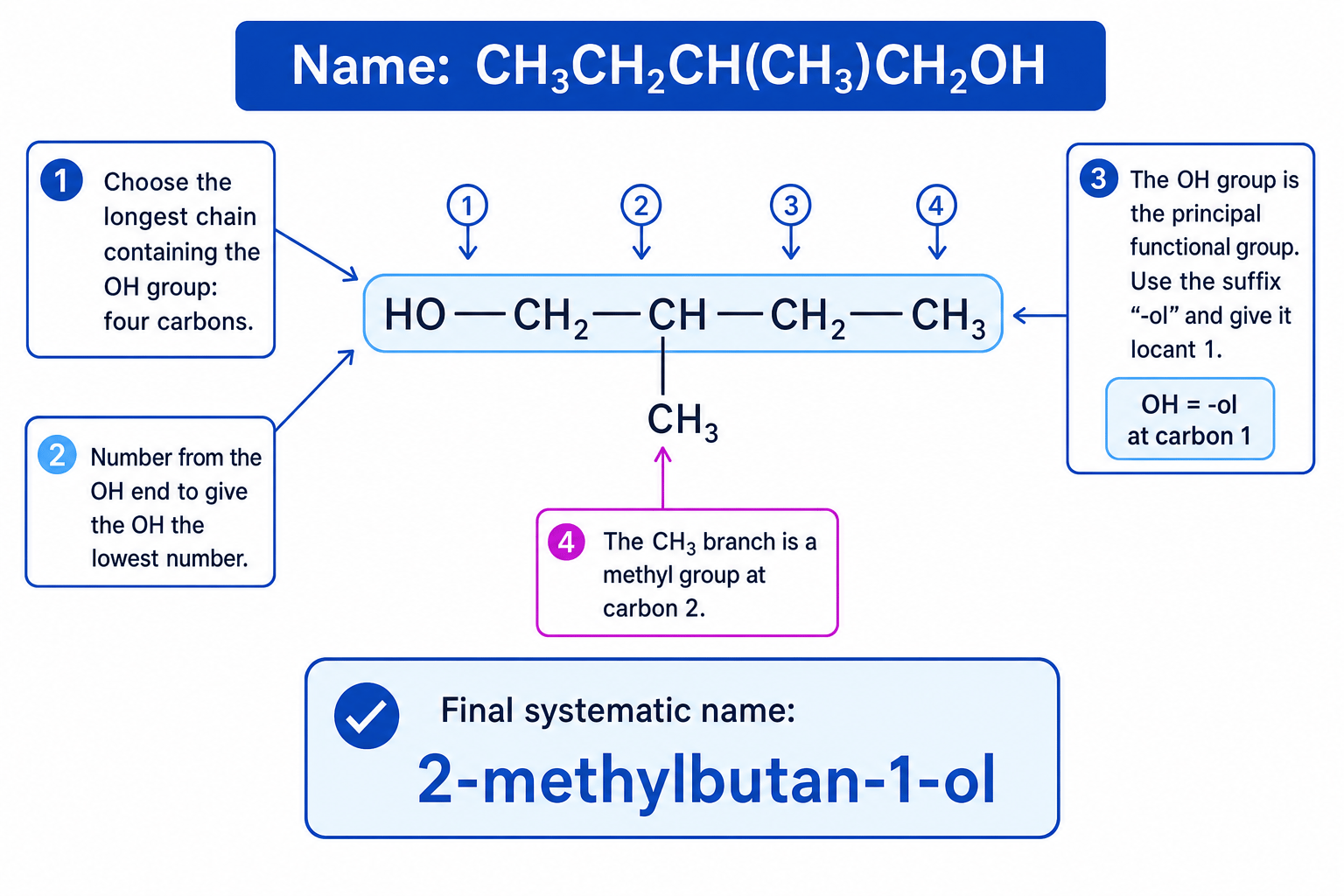
The labelled structure below shows how the name 2-methylbutan-1-ol is built.
Naming a branched alcohol
Name CH₃CH₂CH(CH₃)CH₂OH.
- Choose the longest chain containing the OH group: it has four carbon atoms, so the parent chain is butan-.
- Number from the OH end so the OH group is on carbon 1, giving the suffix butan-1-ol.
- Identify the branch: there is a CH₃ group attached to carbon 2, so the prefix is 2-methyl-.
- Combine the parts to give 2-methylbutan-1-ol.
Numbering from the wrong end
Do not number from the end nearest a branch if a main functional group is present. In alcohols, the OH group must get the lowest possible locant.
Formulae: different ways to represent molecules
A molecular formula gives the actual number of each type of atom in a molecule, such as C₂H₆O. Organic chemists often need more detail than that, because the same molecular formula can represent different structures.
Four useful formula types
- General formula: the simplest algebraic formula for any member of a homologous series, e.g. alkanes are CnH2n+2\mathrm{C_nH_{2n+2}}CnH2n+2.
- Structural formula: the minimum detail needed to show how atoms are arranged, e.g. CH₃CH₂CH₂CH₃ or CH₃(CH₂)₂CH₃.
- Displayed formula: shows the relative positions of all atoms and all bonds.
- Skeletal formula: a simplified formula where carbon atoms in chains are shown as line ends or vertices, and H atoms on carbon are omitted.
The diagram compares the main formula types, plus the OCR symbols for cyclohexane and benzene.
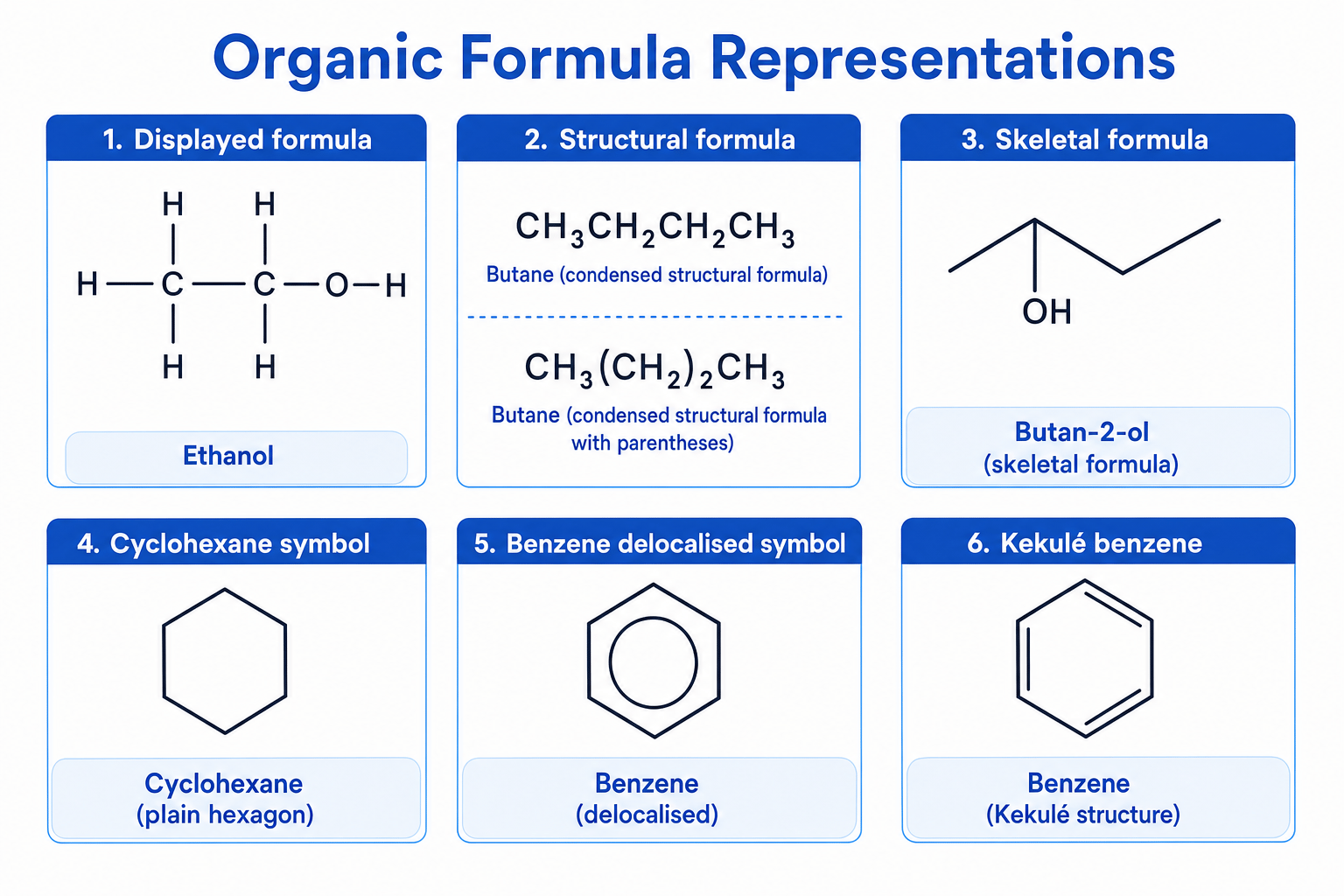
In structural formulae, OCR represents a carboxyl group as COOH and an ester group as COO. Benzene may be drawn either as a hexagon with a circle inside, showing delocalisation, or as a Kekulé structure with three alternating double bonds.
Reading skeletal formulae
Every unlabelled line end and corner is a carbon atom. Add enough H atoms to each carbon to make four bonds. Heteroatoms such as O, N, Cl and Br are written explicitly.
Functional groups and homologous series
A functional group is the atom or group of atoms responsible for the characteristic reactions of a compound. For example, the OH group controls many reactions of alcohols.
Homologous series
A homologous series is a series of organic compounds with the same functional group, where each successive member differs by CH₂.
Members of a homologous series have similar chemical reactions because they have the same functional group. Their physical properties, such as boiling point, usually change gradually as chain length increases.
You also need these classification terms:
- Aliphatic: carbon and hydrogen joined in straight chains, branched chains or non-aromatic rings.
- Alicyclic: an aliphatic compound arranged in a non-aromatic ring, with or without side chains.
- Aromatic: contains a benzene ring.
- Saturated: contains carbon–carbon single bonds only.
- Unsaturated: contains multiple carbon–carbon bonds, including C=C, C≡C or aromatic rings.
Unsaturated has a specific meaning here
For this topic, unsaturated means multiple carbon–carbon bonding or an aromatic ring. A C=O bond alone is not counted as unsaturation in this OCR definition.
Using a general formula
You can use the general formula of a homologous series to predict the formula of any member.
Predicting the formula of an alkane
Find the molecular formula of the alkane with eight carbon atoms.
- Use the alkane general formula: CnH2n+2\mathrm{C_nH_{2n+2}}CnH2n+2.
- Substitute n=8n=8n=8: the carbon part is C8\mathrm{C_8}C8 and the hydrogen number is 2(8)+2=182(8)+2=182(8)+2=18.
- Therefore the molecular formula is C8H18\mathrm{C_8H_{18}}C8H18.
Structural isomerism
Structural isomers
Structural isomers are compounds with the same molecular formula but different structural formulae.
Structural isomers have the same atoms overall, but the atoms are connected differently. When finding possible isomers, keep the molecular formula fixed and change the carbon skeleton, the position of a functional group, or the functional group itself where appropriate.
Finding structural isomers of C4H10
Determine the structural isomers with molecular formula C₄H₁₀.
- Draw the straight-chain structure using all four carbons: CH₃CH₂CH₂CH₃, called butane.
- Try a branched carbon skeleton: a three-carbon chain with a methyl branch on carbon 2 gives CH₃CH(CH₃)CH₃, called 2-methylpropane.
- Check for duplicates: putting the branch on carbon 1 would just recreate butane, and carbon 3 is equivalent to carbon 1 after flipping the chain.
- Therefore C₄H₁₀ has two structural isomers: butane and 2-methylpropane.
Bond fission: breaking covalent bonds
Covalent bond fission means breaking a covalent bond. The two important types are homolytic and heterolytic fission.
Homolytic and heterolytic fission
- Homolytic fission: each bonded atom receives one electron from the shared pair, forming radicals.
- Heterolytic fission: one bonded atom receives both electrons from the shared pair, forming ions.
A radical is a species with an unpaired electron. OCR requires a dot for species with one unpaired electron, such as Cl• or CH₃•. Radical mechanisms are shown using a sequence of equations; half curly arrows are not required here.
For example, chlorine can undergo homolytic fission under ultraviolet light:
Cl₂(g) → 2Cl•(g)
In heterolytic fission, the bonding pair moves to one atom. For example, a polar C–Br bond may break so Br takes both bonding electrons, forming Br⁻.
Curly arrows and mechanisms
A reaction mechanism is a step-by-step model showing how bonds break and form during a reaction.
Curly arrow
A curly arrow shows the movement of an electron pair. It must start from a bond, a lone pair or a negative charge, and point to where the electron pair goes.
Relevant dipoles should be shown in mechanisms. A dipole uses δ+ and δ− to show that a bond is polar because electrons are attracted more strongly to one atom.
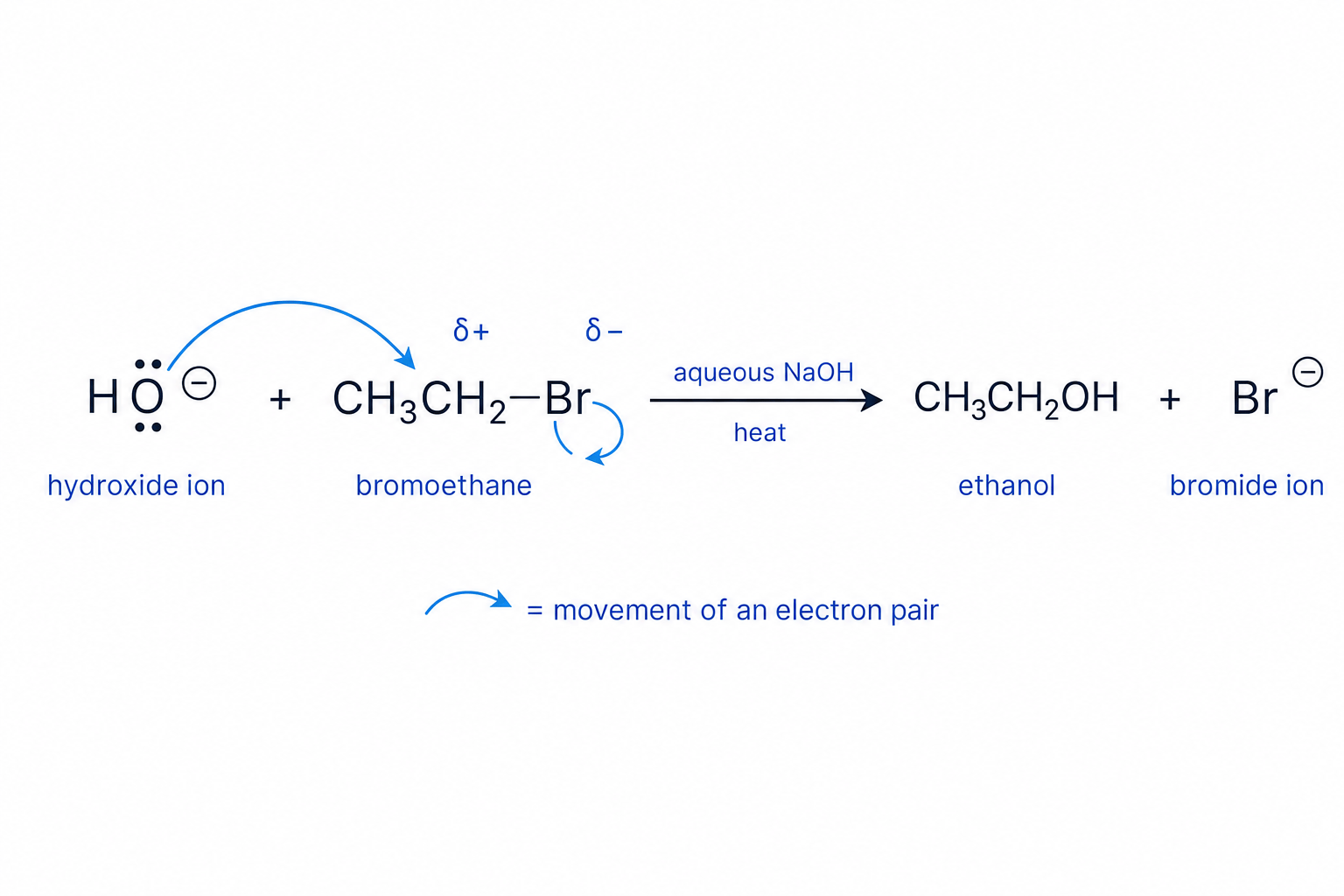
The mechanism below uses bromoethane reacting with aqueous sodium hydroxide on heating. This is a useful model for how curly arrows show electron-pair movement.
Using curly arrows in nucleophilic substitution
Explain the electron movement when bromoethane reacts with hydroxide ions.
- The C–Br bond is polar because Br is more electronegative than C, so the carbon bonded to Br is δ+ and Br is δ−.
- The hydroxide ion, OH⁻, has a lone pair on oxygen; a curly arrow from this lone pair to the δ+ carbon shows formation of a new C–O bond.
- A second curly arrow from the C–Br bond to Br shows heterolytic fission of the C–Br bond, producing Br⁻.
- The overall reaction is CH3CH2Br+OH−→CH3CH2OH+Br−\mathrm{CH_3CH_2Br + OH^- \to CH_3CH_2OH + Br^-}CH3CH2Br+OH−→CH3CH2OH+Br−, using aqueous NaOH and heat.
Starting curly arrows from atoms
A curly arrow should not start from the centre of an atom unless you are clearly showing a lone pair there. Start it from the electron pair being moved: a bond, lone pair or negative charge.
In the exam
- For names, choose the longest chain containing the main functional group, then number to give the lowest locants.
- For skeletal formulae, count every vertex and line end as carbon unless another atom is written.
- For mechanisms, include dipoles where relevant and make every curly arrow start from electrons, not from a positive centre.
Check yourself
- What is the difference between a structural formula and a displayed formula?
- How many structural isomers does C₄H₁₀ have, and how do you know you have not counted duplicates?
- In a curly-arrow mechanism, what three places can a curly arrow start from?
