Alkanes are the simplest family of organic compounds. Despite their relatively low reactivity, they are of immense industrial importance as the primary components of crude oil and fuels. This topic explores how their molecular structure dictates their physical properties, combustion behaviour, and reactions with halogens.
What you'll learn
- How the direct overlap of atomic orbitals forms covalent σ\sigmaσ-bonds (sigma bonds), giving alkanes a tetrahedral shape.
- Why boiling points vary with carbon-chain length and structural branching due to changes in London forces.
- The chemical reasons behind the low reactivity of alkanes and the equations representing their complete and incomplete combustion.
- How to construct the free-radical substitution mechanism and explain its limitations in organic synthesis.
1. Structure and Bonding in Alkanes
Alkanes are saturated hydrocarbons.
Saturated Hydrocarbon
A compound containing only carbon and hydrogen atoms, where all carbon-to-carbon bonds are single covalent bonds.
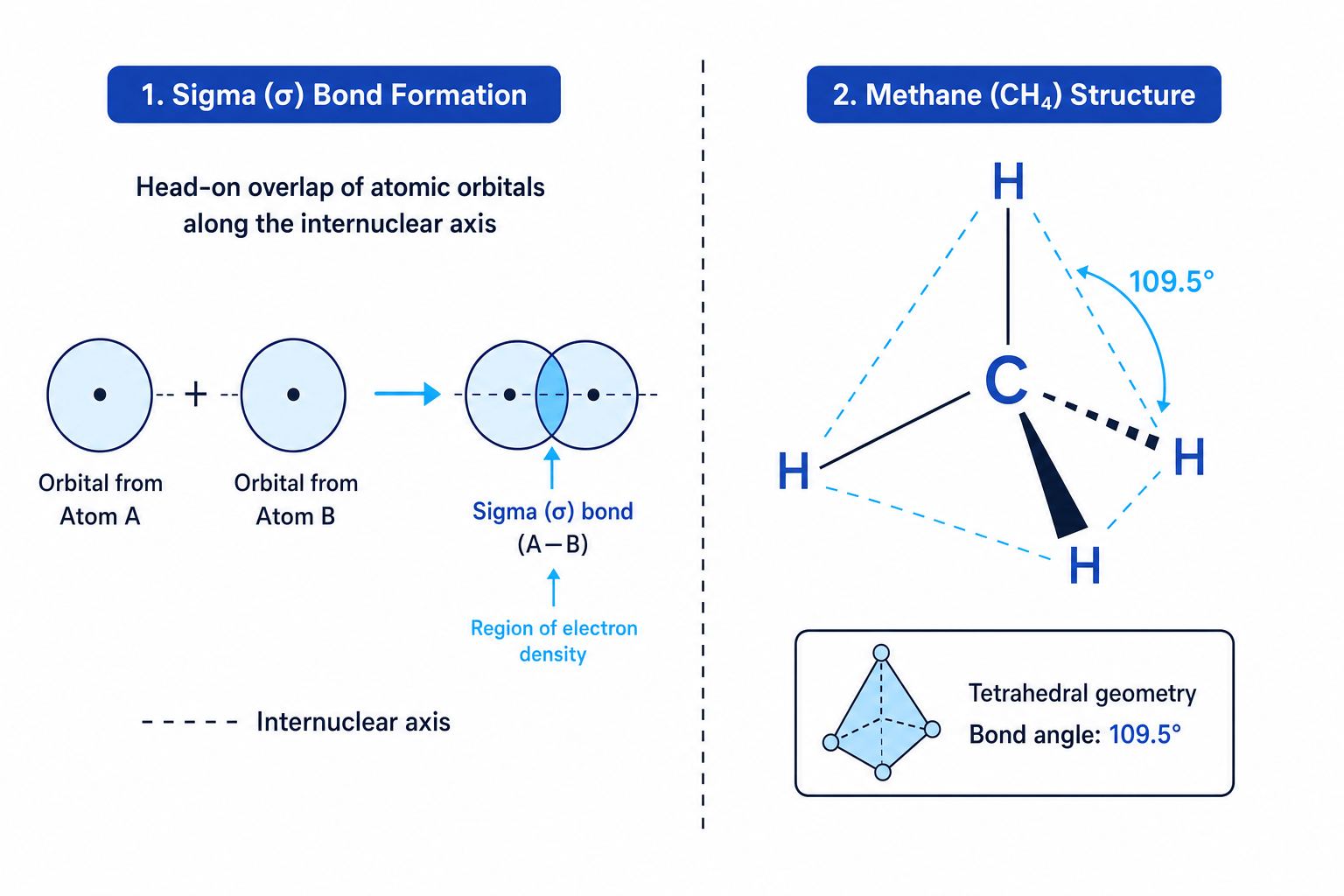
Alkanes form a homologous series with the general formula CnH2n+2C_nH_{2n+2}CnH2n+2. Every carbon atom in an alkane is joined to four other atoms by single covalent bonds called sigma (σ\sigmaσ) bonds.
The Nature of the Sigma (σ\sigmaσ) Bond
A σ\sigmaσ-bond is the strongest type of covalent bond.
Sigma (\sigma) Bond
A covalent bond formed by the direct, head-on overlap of atomic orbitals between two bonding atoms.
In an alkane:
- Each carbon atom uses its outer-shell electrons to form four σ\sigmaσ-bonds.
- These bonds can be carbon-carbon (C–C) or carbon-hydrogen (C–H) bonds.
- The shared pair of electrons is concentrated directly along the line of centers joining the nuclei of the two bonding atoms.
- Because the electron density is symmetrical about this axis, there is free rotation around a single σ\sigmaσ-bond. This allows alkane molecules to continuously change their spatial conformation (shape).
Shape and Bond Angles in Alkanes
The shape around each individual carbon atom in an alkane is determined by electron pair repulsion theory:
- Each carbon atom is surrounded by four bonding pairs of electrons and zero lone pairs.
- Electron pairs are negatively charged and repel one another as far apart as possible.
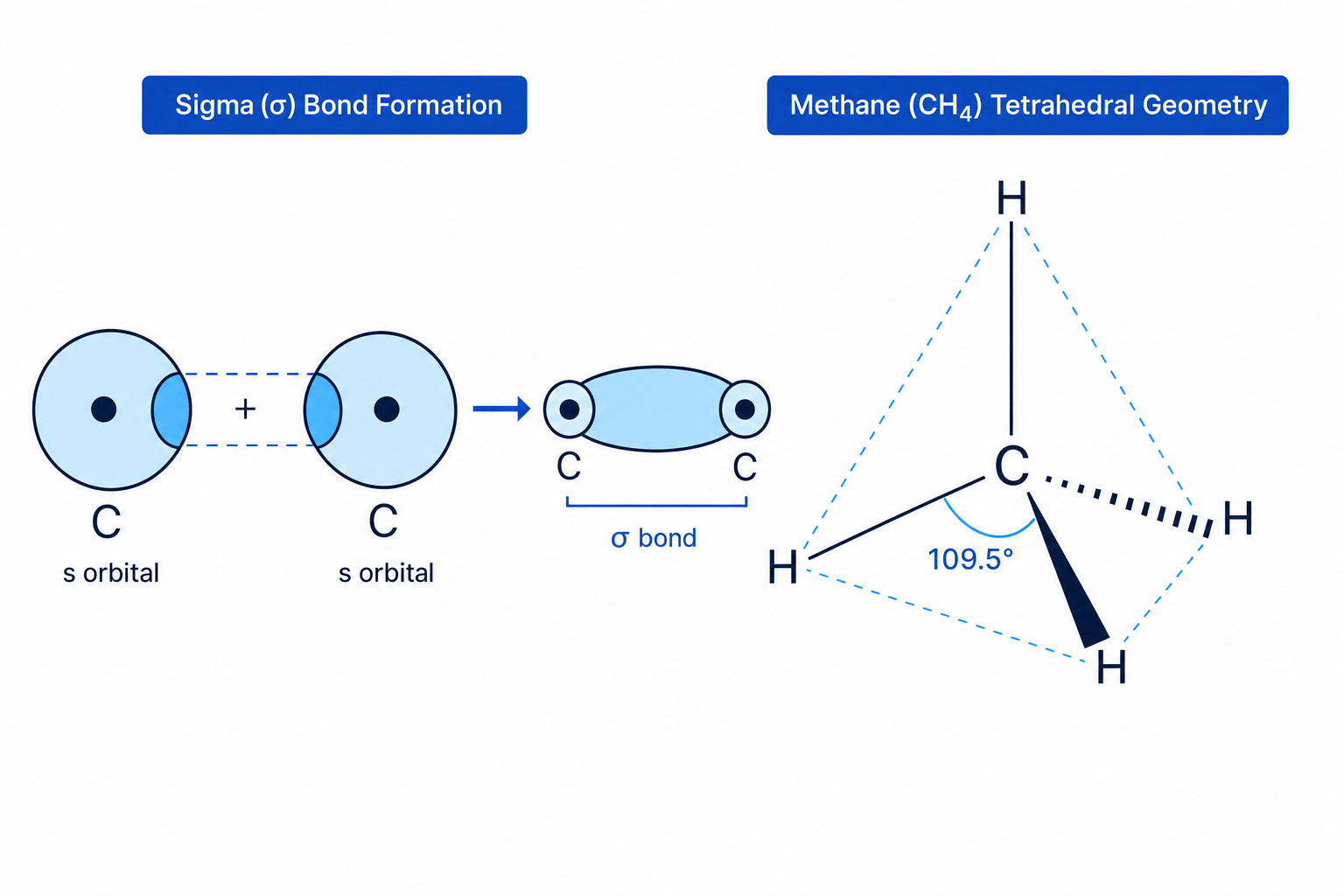
- Because all four bonding pairs repel each other equally, they adopt a tetrahedral arrangement.
- This results in a bond angle of precisely 109.5∘109.5^\circ109.5∘ around each carbon atom.
To represent this three-dimensional shape on a flat page, we use wedge-and-dash diagrams:
- Solid lines represent bonds in the plane of the paper.
- Solid wedges represent bonds pointing out of the paper towards you.
- Dashed wedges represent bonds pointing back into the paper away from you.
2. Physical Properties: Boiling Points
The boiling points of alkanes depend on the strength of the intermolecular forces holding the molecules together. Alkanes are non-polar molecules, meaning the only intermolecular forces acting between them are induced dipole–dipole interactions (London forces).
There are two main factors that affect the strength of London forces in alkanes: chain length and branching.
Effect of Carbon-Chain Length
As the carbon-chain length increases:
- The molecules have a larger molecular surface area and more electrons.
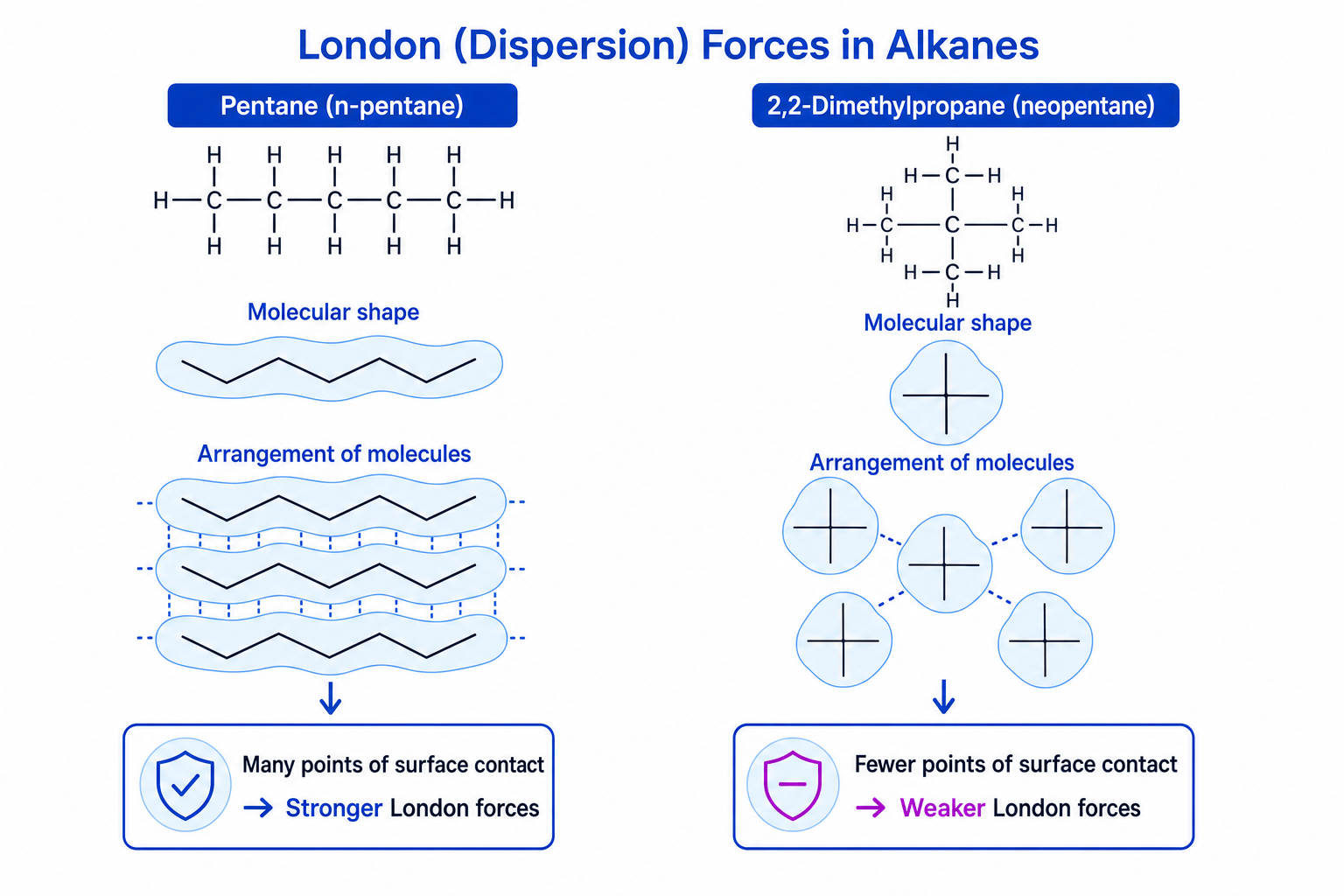
- This increases the number of points of surface contact between adjacent molecules.
- Consequently, the temporary, induced dipole-dipole interactions (London forces) become stronger.
- More thermal energy is required to overcome these stronger forces, so the boiling point increases.
Effect of Branching
For structural isomers (alkanes with the same molecular formula but different structural arrangements):
- Increased branching makes the molecule more compact and spherical.
- Spherical molecules have a smaller surface area and cannot pack as closely together.
- This minimizes the points of surface contact between adjacent molecules.
- As a result, the London forces between branched molecules are weaker.
- Less thermal energy is required to overcome these forces, so the boiling point decreases.
Comparing boiling points of isomeric alkanes
Explain the difference in the boiling points of hexane (boiling point 69 ∘C69\ ^\circ\text{C}69 ∘C) and 2,2-dimethylbutane (boiling point 50 ∘C50\ ^\circ\text{C}50 ∘C).
- Check the molecular formulae: Verify that both molecules are isomers. Hexane and 2,2-dimethylbutane both have the molecular formula C6H14C_6H_{14}C6H14, meaning they have the same total number of electrons.
- Compare their shapes and contact surface area: Hexane is a straight-chain molecule with a long, linear shape, whereas 2,2-dimethylbutane is highly branched and compact. This gives hexane a much larger molecular surface area and allows it to achieve more points of surface contact with neighbouring molecules.
- Compare the strength of their intermolecular forces: Because hexane has more points of surface contact, the induced dipole–dipole interactions (London forces) between its molecules are significantly stronger than those between the more spherical 2,2-dimethylbutane molecules.
- Relate to the energy required to boil: More thermal energy is required to break the stronger London forces in hexane, which accounts for its higher boiling point (69 ∘C69\ ^\circ\text{C}69 ∘C vs 50 ∘C50\ ^\circ\text{C}50 ∘C).
3. Chemical Reactivity of Alkanes
Alkanes are highly unreactive with common laboratory reagents (such as acids, alkalis, oxidising agents, and reducing agents). This chemical inertness is due to two main features of their σ\sigmaσ-bonds:
- Very low bond polarity: Carbon and hydrogen have very similar electronegativities (C=2.5C = 2.5C=2.5 and H=2.1H = 2.1H=2.1). Therefore, C–H bonds are essentially non-polar. C–C bonds are completely non-polar because the bonding atoms are identical. As a result, alkanes do not attract polar molecules, nucleophiles, or electrophiles.
- High bond enthalpy: Both C–C (347 kJ mol−1347\text{ kJ mol}^{-1}347 kJ mol−1) and C–H (413 kJ mol−1413\text{ kJ mol}^{-1}413 kJ mol−1) bonds are strong covalent bonds. Breaking these bonds requires a large amount of activation energy.
4. Reactions of Alkanes
While alkanes are generally unreactive, they undergo two primary types of reactions: combustion and radical substitution.
Combustion
Alkanes react readily with oxygen in exothermic reactions, making them excellent fuels.
Complete Combustion
In a plentiful supply of oxygen, alkanes burn completely to produce carbon dioxide and water:
CH4(g)+2O2(g)→CO2(g)+2H2O(l) \text{CH}_4(g) + 2\text{O}_2(g) \to \text{CO}_2(g) + 2\text{H}_2\text{O}(l) CH4(g)+2O2(g)→CO2(g)+2H2O(l)Incomplete Combustion
In a limited supply of oxygen, combustion is incomplete. Instead of carbon dioxide, toxic carbon monoxide (CO) gas or soot (carbon, C) is formed alongside water:
CH4(g)+1.5O2(g)→CO(g)+2H2O(l) \text{CH}_4(g) + 1.5\text{O}_2(g) \to \text{CO}(g) + 2\text{H}_2\text{O}(l) CH4(g)+1.5O2(g)→CO(g)+2H2O(l) CH4(g)+O2(g)→C(s)+2H2O(l) \text{CH}_4(g) + \text{O}_2(g) \to \text{C}(s) + 2\text{H}_2\text{O}(l) CH4(g)+O2(g)→C(s)+2H2O(l)The Danger of Carbon Monoxide
Carbon monoxide (CO\text{CO}CO) is a colourless, odourless, and highly toxic gas. It binds irreversibly to the haemoglobin in red blood cells, forming carboxyhaemoglobin. This prevents haemoglobin from transporting oxygen around the body, leading to oxygen starvation and death.
Balancing incomplete combustion equations
Write a balanced chemical equation for the incomplete combustion of liquid heptane (C7H16\text{C}_7\text{H}_{16}C7H16) to form carbon monoxide gas and liquid water.
- Write the unbalanced skeleton equation with state symbols:
- Balance the carbon atoms: There are 7 carbons on the left, so we need 7 molecules of CO\text{CO}CO on the right:
- Balance the hydrogen atoms: There are 16 hydrogens on the left, so we need 8 molecules of H2O\text{H}_2\text{O}H2O on the right:
- Balance the oxygen atoms: Count the oxygens on the right: 7 (from CO)+8 (from H2O)=157\text{ (from } \text{CO}) + 8\text{ (from } \text{H}_2\text{O}) = 157 (from CO)+8 (from H2O)=15 oxygen atoms. Since oxygen gas is diatomic (O2\text{O}_2O2), we require 7.57.57.5 (or 152\frac{15}{2}215) molecules of O2\text{O}_2O2:
Radical Substitution
Alkanes react with halogens (chlorine, Cl2\text{Cl}_2Cl2, or bromine, Br2\text{Br}_2Br2) in the presence of ultraviolet (UV) radiation to form haloalkanes. The UV light provides the initial energy required to break the halogen covalent bond.
This reaction occurs via a mechanism called radical substitution.
Homolytic Fission
The breaking of a covalent bond where one of the shared electrons goes to each of the bonding atoms, forming two highly reactive radicals.
Radical
A highly reactive species containing an unpaired electron, represented in chemical equations by a single dot (∙\bullet∙).
The mechanism consists of three stages: initiation, propagation, and termination.
1. Initiation
The UV light provides the energy to break the halogen-halogen bond by homolytic fission. This step generates two highly reactive halogen radicals:
Cl2→UV2Cl∙ \text{Cl}_2 \xrightarrow{\text{UV}} 2\text{Cl}^\bullet Cl2UV2Cl∙2. Propagation
A chain reaction occurs through two cyclic steps:
- Step 1: The halogen radical attacks the alkane molecule, abstracting a hydrogen atom to form a stable hydrogen halide and an alkyl radical:
- Step 2: The alkyl radical reacts with another halogen molecule to form the haloalkane product and regenerate the halogen radical:
The regenerated halogen radical (Cl∙\text{Cl}^\bulletCl∙) can feed back into Step 1, starting a continuous cycle.
3. Termination
The chain reaction stops when any two radicals collide and combine to form a stable, non-radical covalent molecule:
Cl∙+Cl∙→Cl2 \text{Cl}^\bullet + \text{Cl}^\bullet \to \text{Cl}_2 Cl∙+Cl∙→Cl2 CH3∙+Cl∙→CH3Cl \text{CH}_3^\bullet + \text{Cl}^\bullet \to \text{CH}_3\text{Cl} CH3∙+Cl∙→CH3Cl CH3∙+CH3∙→C2H6 \text{CH}_3^\bullet + \text{CH}_3^\bullet \to \text{C}_2\text{H}_6 CH3∙+CH3∙→C2H6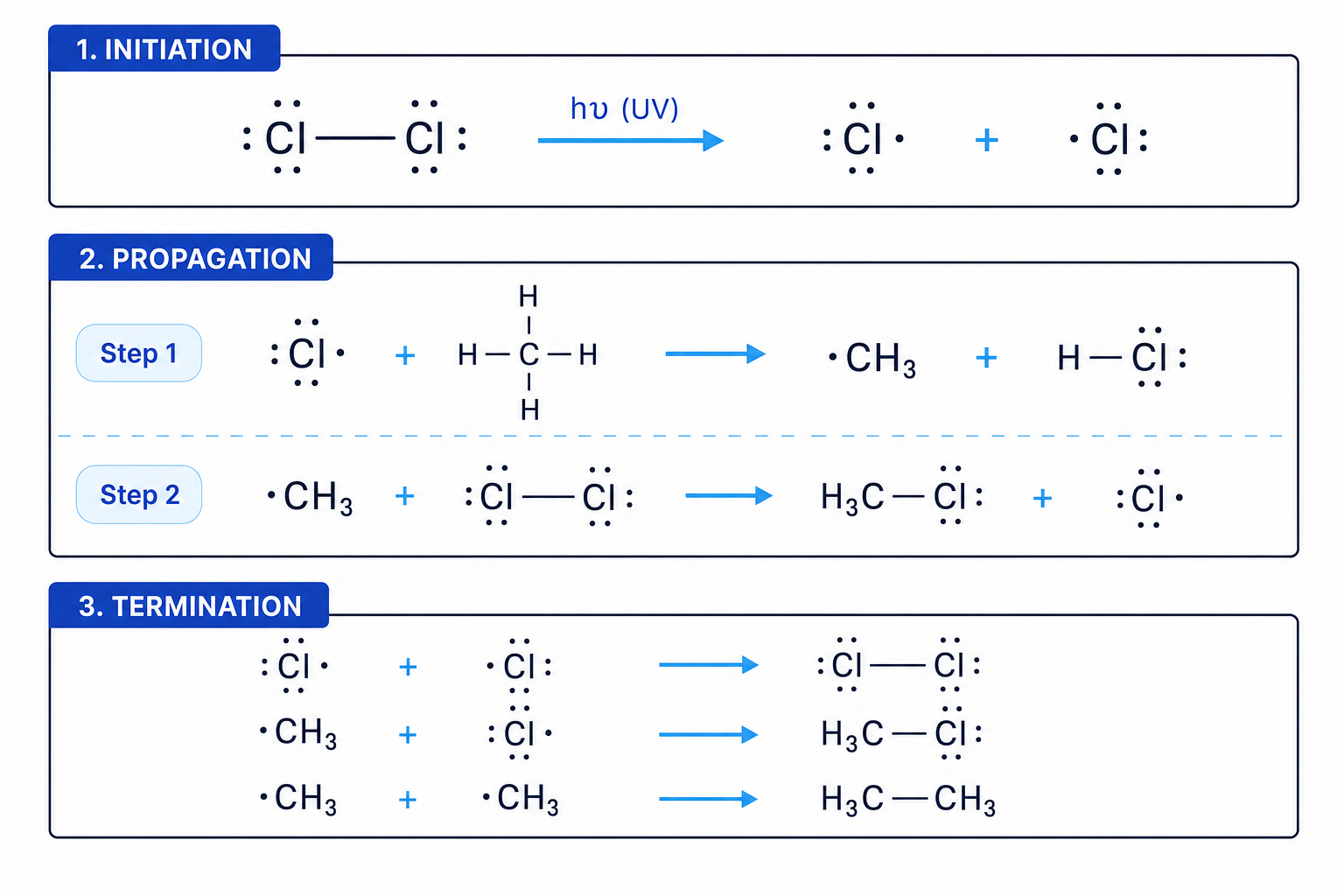
Incorrect Propagation Step
A common error is writing a propagation step that directly produces a free hydrogen radical, such as:
CH4+Cl∙→CH3Cl+H∙ \text{CH}_4 + \text{Cl}^\bullet \to \text{CH}_3\text{Cl} + \text{H}^\bullet CH4+Cl∙→CH3Cl+H∙This does not occur because hydrogen radicals (H∙\text{H}^\bulletH∙) are extremely unstable. Always form the hydrogen halide (HCl\text{HCl}HCl or HBr\text{HBr}HBr) in the first propagation step!
Writing propagation steps for propane bromination
Write the two propagation steps for the mono-bromination of propane (C3H8\text{C}_3\text{H}_8C3H8) to form 2-bromopropane.
- Identify the attacking radical and the target carbon atom: The starting radical is the bromine radical (Br∙\text{Br}^\bulletBr∙). To form 2-bromopropane, we must target carbon-2 of the propane chain to form a secondary propyl radical.
- Formulate Step 1: React propane with the bromine radical to abstract a hydrogen atom from carbon-2, producing a secondary propyl radical (CH3CH∙CH3\text{CH}_3\text{CH}^\bullet\text{CH}_3CH3CH∙CH3) and hydrogen bromide (HBr\text{HBr}HBr):
- Formulate Step 2: React the secondary propyl radical with a bromine molecule (Br2\text{Br}_2Br2) to yield the product 2-bromopropane and regenerate the bromine radical (Br∙\text{Br}^\bulletBr∙):
5. Limitations of Radical Substitution in Synthesis
Radical substitution is a highly uncontrolled reaction, making it a very poor method for preparing a pure, specific organic product in a laboratory.
There are two primary limitations:
1. Further Substitution (Multi-substitution)
Once a haloalkane product (such as chloromethane, CH3Cl\text{CH}_3\text{Cl}CH3Cl) is formed in the reaction mixture, it can be attacked by further halogen radicals because it still contains C–H bonds.
CH3Cl+Cl∙→CH2Cl∙+HCl \text{CH}_3\text{Cl} + \text{Cl}^\bullet \to \text{CH}_2\text{Cl}^\bullet + \text{HCl} CH3Cl+Cl∙→CH2Cl∙+HCl CH2Cl∙+Cl2→CH2Cl2+Cl∙ \text{CH}_2\text{Cl}^\bullet + \text{Cl}_2 \to \text{CH}_2\text{Cl}_2 + \text{Cl}^\bullet CH2Cl∙+Cl2→CH2Cl2+Cl∙This sequence of events continues, producing a mixture of di-, tri-, and tetra-substituted products (CH2Cl2\text{CH}_2\text{Cl}_2CH2Cl2, CHCl3\text{CHCl}_3CHCl3, CCl4\text{CCl}_4CCl4). These products must then be separated by fractional distillation, which is costly and inefficient.
Controlling the Product Yield
- To maximize the yield of a mono-haloalkane (like CH3Cl\text{CH}_3\text{Cl}CH3Cl), use a large excess of the alkane. This increases the probability that a halogen radical will collide with an unreacted alkane molecule rather than a product molecule.
- To maximize the yield of a fully-substituted haloalkane (like CCl4\text{CCl}_4CCl4), use a large excess of the halogen.
2. Substitution at Different Positions along the Carbon Chain
For any alkane with three or more carbon atoms, the halogen radical can abstract a hydrogen atom from different positions along the chain.
For example, the monochlorination of butane (C4H10\text{C}_4\text{H}_{10}C4H10) will yield a mixture of structural isomers:
- 1-chlorobutane (substitution at carbon-1 or carbon-4)
- 2-chlorobutane (substitution at carbon-2 or carbon-3)
In the exam
- Name the intermolecular forces correctly: When comparing boiling points, do not simply write "intermolecular forces are stronger". You must explicitly name them as London forces or induced dipole–dipole interactions.
- Position the radical dot carefully: In organic radicals, ensure the single dot (∙\bullet∙) is written directly on the atom that holds the unpaired electron. For example, write the ethyl radical as CH3CH2∙\text{CH}_3\text{CH}_2^\bulletCH3CH2∙ or ∙CH2CH3^\bullet\text{CH}_2\text{CH}_3∙CH2CH3—never put the dot on a hydrogen atom.
- Explain trace byproducts using termination: If an exam question asks why a trace of a longer-chain alkane is formed during a reaction (e.g., why ethane is formed when methane reacts with chlorine), write a termination equation showing two alkyl radicals combining:
Check yourself
- Explain why a straight-chain alkane has a higher boiling point than its branched isomer.
- Write balanced equations for the complete combustion of butane (C4H10\text{C}_4\text{H}_{10}C4H10) and its incomplete combustion to form carbon monoxide.
- Write the initiation, propagation, and termination steps for the reaction of ethane with chlorine to form monochloroethane.
- Suggest why radical substitution is rarely used in industrial organic synthesis to manufacture specific pure haloalkanes.