Chemical equilibrium
What you'll learn
- What dynamic equilibrium means, and why it only happens in a closed system.
- How changes in concentration, pressure, temperature, and catalysts affect equilibria.
- How industry chooses conditions by balancing equilibrium yield, rate, safety, and cost.
- How to write and calculate the equilibrium constant, KcK_cKc, and interpret its size.
Reversible reactions: the starting point
A reversible reaction is one that can go in both directions. The forward reaction makes products; the reverse reaction reforms reactants. We show this using the equilibrium arrow, ⇌.
For example:
N₂(g) + 3H₂(g) ⇌ 2NH₃(g)
A reaction can only reach equilibrium if the substances are kept together, so the reverse reaction can continue happening.
Closed system
A closed system is one where no substances can enter or leave. Energy, such as heat, may still be transferred.
Dynamic equilibrium
At first, if you mix reactants, the forward reaction is usually faster because reactant concentrations are high. As products build up, the reverse reaction becomes faster. Eventually the two rates become equal.

Dynamic equilibrium
A dynamic equilibrium exists in a closed system when the rate of the forward reaction equals the rate of the reverse reaction, so the concentrations of reactants and products do not change.
The word dynamic matters: the reactions have not stopped. Particles are still reacting in both directions, but the overall composition stays constant.
Equilibrium does not mean equal amounts
At equilibrium, the rates of the forward and reverse reactions are equal. The concentrations of reactants and products are usually not equal.
Recognising dynamic equilibrium
A sealed flask contains N₂O₄(g) and NO₂(g), with the equilibrium N₂O₄(g) ⇌ 2NO₂(g). After some time, the brown colour no longer changes.
- The flask is sealed, so no gas can enter or leave. This means the system is closed.
- The constant brown colour suggests the concentration of NO₂(g) is no longer changing.
- Since the system is closed and concentrations are constant, the forward and reverse reactions must be continuing at equal rates. The mixture is at dynamic equilibrium.
Position of equilibrium
The position of equilibrium describes the relative amounts of reactants and products in an equilibrium mixture.
- If equilibrium lies to the right, there is a larger proportion of products.
- If equilibrium lies to the left, there is a larger proportion of reactants.
A homogeneous equilibrium is an equilibrium where all species are in the same physical state, such as all gases or all aqueous substances.
Homogeneous equilibrium
A homogeneous equilibrium contains reactants and products all in the same physical state.
Predicting changes: Le Chatelier reasoning
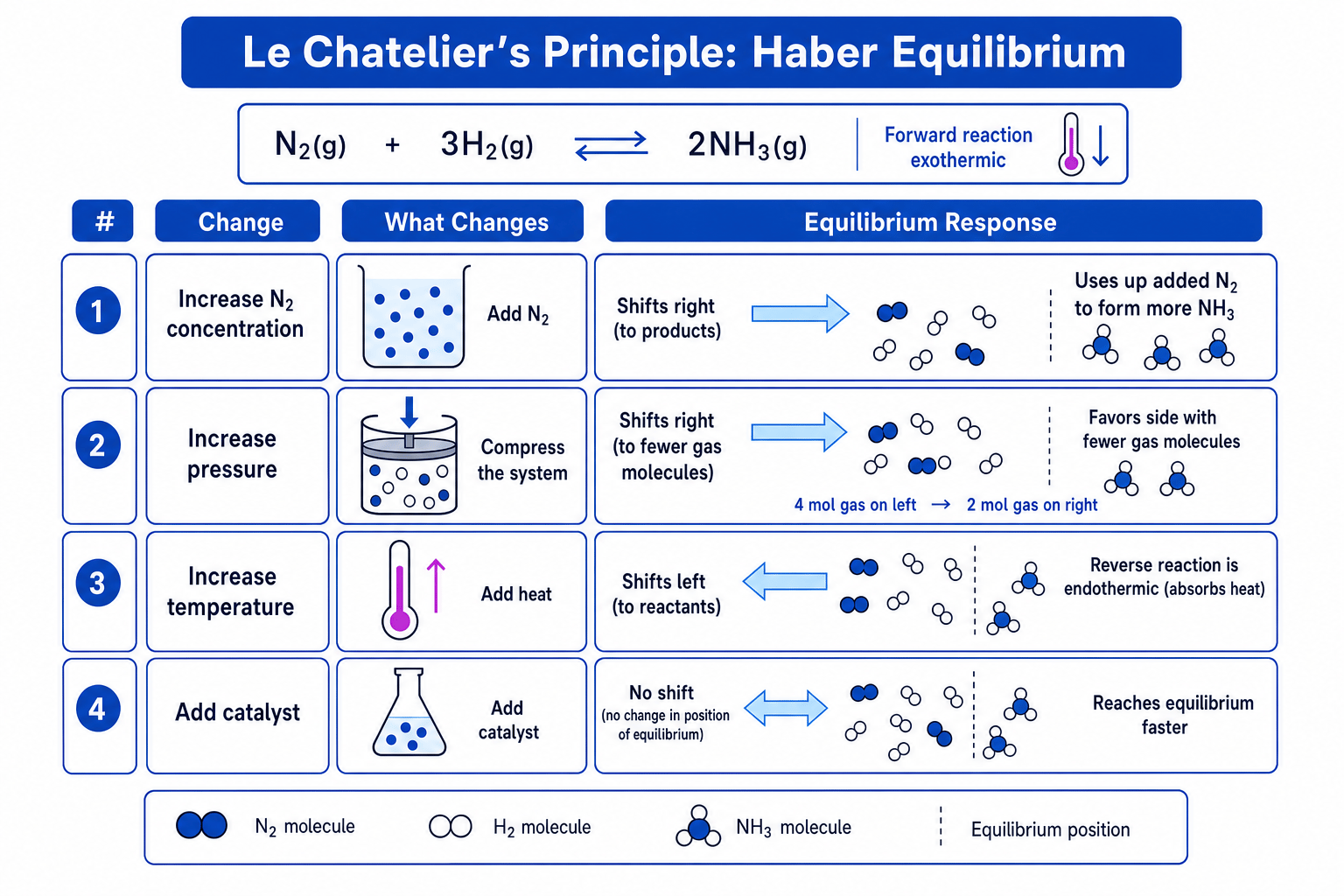
You do not need to memorise a formal definition of Le Chatelier’s principle for OCR here. You do need to use the idea correctly: when conditions change, the equilibrium mixture shifts in the direction that opposes the change.
Changing concentration
For a homogeneous equilibrium:
- Adding more reactant shifts equilibrium towards products, to use up some of the added reactant.
- Adding more product shifts equilibrium towards reactants.
- Removing a reactant shifts equilibrium towards reactants, to replace some of it.
- Removing a product shifts equilibrium towards products.
For example, in:
Fe³⁺(aq) + SCN⁻(aq) ⇌ FeSCN²⁺(aq)
the FeSCN²⁺ complex is deep red. Adding Fe³⁺(aq) or SCN⁻(aq) makes the solution darker red because equilibrium shifts right.
Changing pressure
Pressure changes mainly affect gaseous equilibria.
- Increasing pressure shifts equilibrium to the side with fewer moles of gas.
- Decreasing pressure shifts equilibrium to the side with more moles of gas.
- If both sides have the same number of gas moles, pressure has no effect on the position of equilibrium.
Changing temperature
Treat heat as if it were part of the reaction.
- Increasing temperature favours the endothermic direction, which absorbs heat.
- Decreasing temperature favours the exothermic direction, which releases heat.
Unlike concentration and pressure changes, changing temperature changes the value of KcK_cKc.
Predicting shifts in the Haber equilibrium
For the Haber equilibrium:
N₂(g) + 3H₂(g) ⇌ 2NH₃(g), forward reaction exothermic
Predict the effect of increasing pressure, increasing temperature, and removing NH₃(g).
- For pressure, compare gas moles: the left side has 4 mol of gas and the right side has 2 mol of gas. Increasing pressure favours the side with fewer gas moles, so equilibrium shifts right.
- For temperature, the forward reaction is exothermic, so the reverse reaction is endothermic. Increasing temperature favours the endothermic direction, so equilibrium shifts left.
- Removing NH₃(g) decreases the product concentration. The equilibrium shifts right to replace some NH₃(g).
Catalysts and equilibrium
A catalyst increases the rate of reaction without being used up. It provides an alternative reaction pathway with a lower activation energy.
In an equilibrium, a catalyst increases the rate of the forward reaction and the reverse reaction by the same amount. So the equilibrium is reached faster, but the position of equilibrium is unchanged.
Catalysts do not change equilibrium yield
A catalyst changes how quickly equilibrium is reached. It does not change the equilibrium composition or increase the maximum yield.
Investigating equilibrium changes
You can investigate equilibrium shifts qualitatively using colour changes. A good method uses small volumes in test tubes and a control tube for comparison.
Concentration changes: iron(III) thiocyanate
Use the equilibrium:
Fe³⁺(aq) + SCN⁻(aq) ⇌ FeSCN²⁺(aq)
The product FeSCN²⁺(aq) is deep red.
Typical procedure:
- Place the equilibrium mixture in several test tubes.
- Keep one tube unchanged as a control.
- Add a few drops of Fe³⁺(aq) to one tube and compare the colour.
- Add a few drops of SCN⁻(aq) to another tube and compare the colour.
- Remove one ion using a suitable reagent, then observe whether the red colour becomes paler.
Temperature changes: cobalt chloride equilibrium
A common temperature experiment uses:
[Co(H₂O)₆]²⁺(aq) + 4Cl⁻(aq) ⇌ [CoCl₄]²⁻(aq) + 6H₂O(l)
The hydrated cobalt complex is pink, and the chloride complex is blue. The forward reaction is endothermic.
Heating shifts equilibrium right, making the mixture bluer. Cooling shifts equilibrium left, making it pinker.
Interpreting a colour-change investigation
A red equilibrium mixture contains Fe³⁺(aq), SCN⁻(aq), and FeSCN²⁺(aq). A student adds more SCN⁻(aq), and the red colour becomes darker.
- The red colour is caused by FeSCN²⁺(aq), which is the product.
- Adding SCN⁻(aq) increases the concentration of a reactant.
- The equilibrium shifts right to use up some added SCN⁻(aq), producing more FeSCN²⁺(aq). This explains the darker red colour.
Good practical comparisons
Use a control tube, keep volumes similar, and compare colours against a white background. These experiments are qualitative: you are explaining the direction of shift, not calculating an equilibrium constant.
Industrial compromise: equilibrium versus rate
In industry, the “best” conditions are not simply the conditions that give the highest equilibrium yield. Companies also need a fast rate, safe conditions, and reasonable costs.
The Haber process is the classic example:
N₂(g) + 3H₂(g) ⇌ 2NH₃(g)
The forward reaction is exothermic and produces fewer moles of gas.
For maximum equilibrium yield of ammonia, you would want:
- low temperature, because the forward reaction is exothermic
- high pressure, because the product side has fewer gas moles
But low temperature gives a slow rate. Very high pressure is expensive and has safety risks.
So industry uses compromise conditions: about 450 °C, about 20,000 kPa, and an iron catalyst. Unreacted nitrogen and hydrogen are recycled, and ammonia is removed as it forms.
Choosing conditions for ammonia production
Explain why the Haber process does not use the lowest possible temperature.
- The forward reaction is exothermic, so lowering temperature shifts equilibrium right and increases the equilibrium yield of NH₃.
- However, a lower temperature also decreases the reaction rate because fewer particles have energy at least equal to the activation energy.
- A compromise temperature is used so the yield is acceptable and the rate is fast enough for industrial production.
The equilibrium constant, Kc
For a homogeneous equilibrium, the equilibrium constant KcK_cKc is calculated from equilibrium concentrations.
For the general reaction:
aA + bB ⇌ cC + dD
the expression is:
Kc=[C]c[D]d[A]a[B]bK_c = \frac{[\text{C}]^c[\text{D}]^d}{[\text{A}]^a[\text{B}]^b}Kc=[A]a[B]b[C]c[D]dSquare brackets mean concentration in mol dm⁻³ at equilibrium. The powers come from the balancing numbers in the chemical equation.
Kc
KcK_cKc is the equilibrium constant calculated from the equilibrium concentrations of species in a homogeneous equilibrium.
OCR does not require you to determine units for KcK_cKc in this section.
Writing and calculating Kc
For the equilibrium N₂O₄(g) ⇌ 2NO₂(g), the equilibrium concentrations are:
- NO₂(g): 0.0800 mol dm⁻³
- N₂O₄(g): 0.150 mol dm⁻³
Calculate KcK_cKc.
-
Write the expression using the balanced equation. NO₂ has coefficient 2, so its concentration is squared:
Kc=[NO2]2[N2O4]K_c = \frac{[\text{NO}_2]^2}{[\text{N}_2\text{O}_4]}Kc=[N2O4][NO2]2 -
Substitute the equilibrium concentrations:
Kc=(0.0800)20.150K_c = \frac{(0.0800)^2}{0.150}Kc=0.150(0.0800)2 -
Calculate the value:
Kc=0.0427K_c = 0.0427Kc=0.0427The value is much less than 1, so this equilibrium mixture contains a greater proportion of reactants than products.
Estimating equilibrium position from Kc
The size of KcK_cKc tells you the approximate position of equilibrium.
- If KcK_cKc is much greater than 1, products are favoured.
- If KcK_cKc is much less than 1, reactants are favoured.
- If KcK_cKc is close to 1, there are significant amounts of both reactants and products.
Kc does not tell you rate
A large KcK_cKc means products are favoured at equilibrium. It does not mean the reaction is fast.
In the exam
- For equilibrium shifts, always identify the change first: concentration, pressure, temperature, or catalyst.
- For pressure questions, count only gaseous moles on each side of the equation.
- For KcK_cKc calculations, use equilibrium concentrations, include powers from the balanced equation, and do not waste time deriving units unless the question specifically gives them.
Check yourself
- Why must a reaction be in a closed system to reach dynamic equilibrium?
- For an exothermic forward reaction, what happens to the position of equilibrium when temperature is increased?
- What does it mean if KcK_cKc is much smaller than 1?