

What you'll learn
- How to predict common ionic charges from the periodic table.
- The key compound ions OCR expects you to know.
- How to write formulae for ionic compounds using charge balance.
- How to construct balanced equations and ionic equations with state symbols.
Chemical formulae: what the symbols mean
A chemical formula tells you which elements are present in a substance and the ratio of their atoms or ions.
For example, MgCl₂ means magnesium and chlorine are present in a 1:2 ratio. The small number is called a subscript. If there is no subscript, the number is 1.
Chemical formula
A chemical formula is a symbolic way of showing the elements in a substance and the number ratio of their atoms or ions.
For ionic compounds, the formula is not usually describing a single molecule. Instead, it gives the simplest whole-number ratio of ions in the giant ionic lattice. For example, NaCl means sodium ions and chloride ions are in a 1:1 ratio.
Ions and ionic charges
An ion is a charged particle formed when an atom or group of atoms loses or gains electrons.
- A cation is a positive ion.
- An anion is a negative ion.
Metals usually form positive ions because they lose electrons. Non-metals usually form negative ions because they gain electrons.
Ion
An ion is an atom or group of atoms with an overall electric charge because it has lost or gained electrons.
Predicting charges from the periodic table
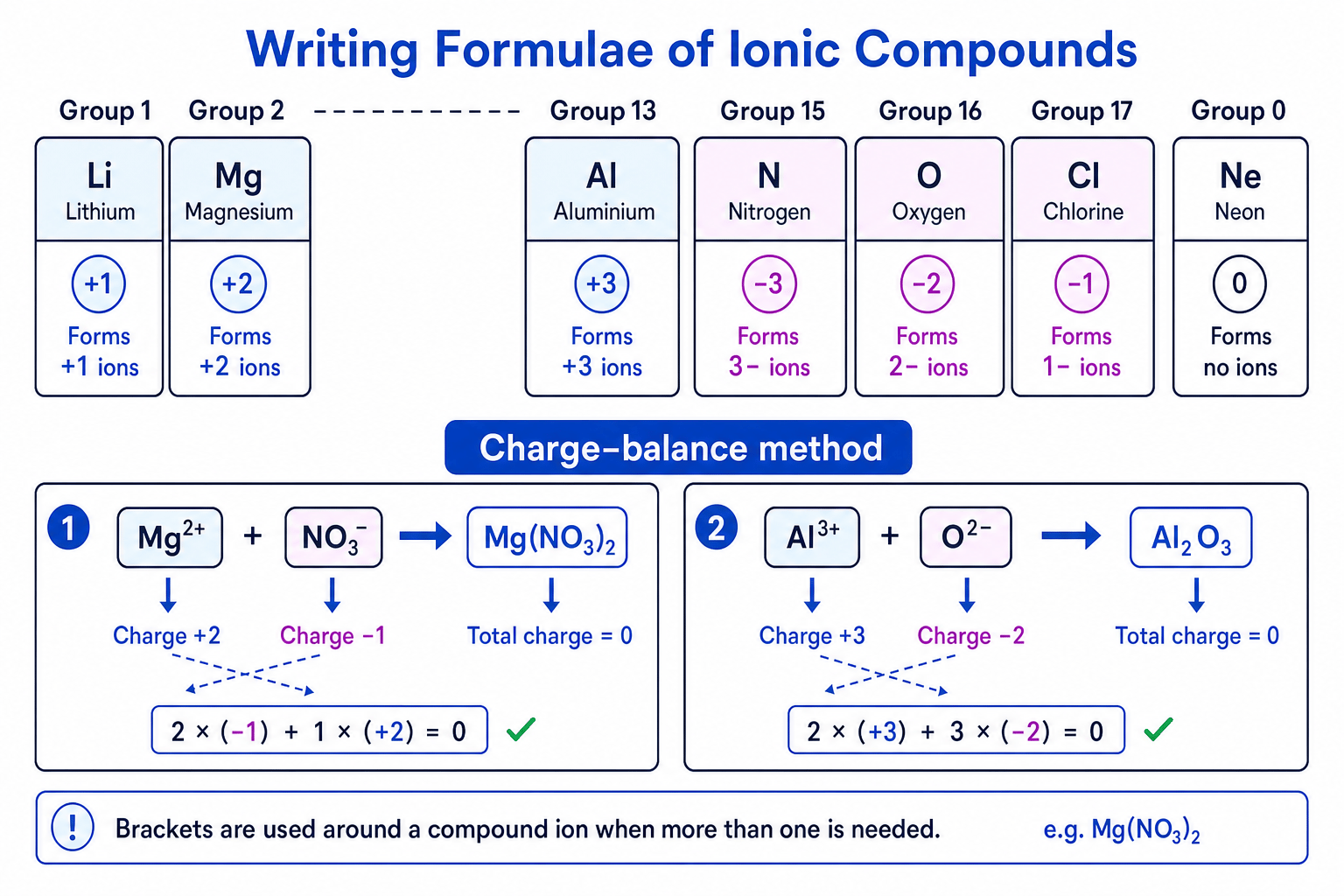
For many main-group elements, you can predict the charge of the ion from the element’s group in the periodic table.
- Group 1 metals form 1+ ions, e.g. Na⁺.
- Group 2 metals form 2+ ions, e.g. Mg²⁺.
- Aluminium commonly forms Al³⁺.
- Group 15 non-metals can form 3− ions, e.g. N³⁻.
- Group 16 non-metals form 2− ions, e.g. O²⁻.
- Group 17 halogens form 1− ions, e.g. Cl⁻.
- Group 0 elements do not normally form ions.
You are not expected to predict every possible ion charge. For ions outside these common patterns, OCR will usually provide the charge, except for the named ions you must recall below.
The diagram shows the charge-balance idea: the formula of an ionic compound must have total charge zero.
Ionic formulae are neutral overall
The total positive charge and total negative charge in an ionic compound must cancel to give zero overall charge.
Ions you must recall
Some ions are made from more than one atom. These are called compound ions or polyatomic ions.
Compound ion
A compound ion is a group of covalently bonded atoms with an overall charge, such as nitrate, NO₃⁻.
You should know these names and formulae:
| Ion name | Formula |
|---|---|
| nitrate | NO₃⁻ |
| carbonate | CO₃²⁻ |
| sulfate | SO₄²⁻ |
| hydroxide | OH⁻ |
| ammonium | NH₄⁺ |
| zinc ion | Zn²⁺ |
| silver ion | Ag⁺ |
OCR uses nitrate to mean NO₃⁻ and sulfate to mean SO₄²⁻ unless the question says otherwise.
Brackets with compound ions
Use brackets around a compound ion when you need more than one of it: Mg(NO₃)₂, Ca(OH)₂, Al₂(SO₄)₃.
Writing formulae of ionic compounds
To write the formula of an ionic compound:
- Write the positive ion and the negative ion with their charges.
- Find the smallest whole-number ratio that makes the total charge zero.
- Write the formula using subscripts.
- Use brackets if more than one compound ion is needed.
Do not change the formula of a compound ion. For example, nitrate is always NO₃⁻, not NO or NO₂.
Writing the formula of aluminium sulfate
-
Identify the ions and their charges: aluminium forms Al³⁺, and sulfate is SO₄²⁻.
-
Find the smallest numbers of ions that balance the charges. Two Al³⁺ ions give a total charge of 6+, and three SO₄²⁻ ions give a total charge of 6−.
-
Write the formula using these numbers as subscripts:
Al₂(SO₄)₃
-
Check the total charge:
2(+3)+3(−2)=02(+3) + 3(-2) = 02(+3)+3(−2)=0So Al₂(SO₄)₃ is neutral overall.
Not simplifying the ratio
If the charges are the same size, the ratio is 1:1. Calcium oxide is CaO, not Ca₂O₂, because Ca²⁺ and O²⁻ cancel in a 1:1 ratio.
Balanced chemical equations
A chemical equation shows the reactants, the products, and their relative amounts in a reaction.
The starting substances are the reactants. The substances formed are the products.
A balanced equation has the same number of atoms of each element on both sides. This follows conservation of atoms: atoms are rearranged during a chemical reaction, not created or destroyed.
Balanced chemical equation
A balanced chemical equation has equal numbers of each type of atom on the reactant side and product side.
Coefficients and subscripts
A coefficient is the large number placed in front of a formula in an equation. It tells you how many particles, formula units or moles are involved.
For example:
2H₂ + O₂ → 2H₂O
The coefficient 2 in front of H₂O means two lots of H₂O.
When balancing equations, you may change coefficients, but you must not change subscripts inside formulae. Changing H₂O to H₂O₂ would create a different substance.
Balancing sodium reacting with water
Sodium reacts with water to form sodium hydroxide and hydrogen.
-
Write the correct formulae first:
Na(s) + H₂O(l) → NaOH(aq) + H₂(g)
-
Balance sodium and hydroxide by putting 2 in front of Na and NaOH:
2Na(s) + H₂O(l) → 2NaOH(aq) + H₂(g)
-
Now balance hydrogen and oxygen by putting 2 in front of water:
2Na(s) + 2H₂O(l) → 2NaOH(aq) + H₂(g)
-
Check atoms on both sides: 2 Na, 4 H and 2 O on each side, so the equation is balanced.
State symbols
State symbols show the physical state of each substance in a reaction.
- (s) means solid.
- (l) means liquid.
- (g) means gas.
- (aq) means aqueous, meaning dissolved in water.
For example:
NaCl(aq) means sodium chloride dissolved in water.
H₂O(l) means liquid water.
Aqueous does not mean liquid
Use (aq) only for a substance dissolved in water. Pure liquid water is H₂O(l), not H₂O(aq).
In unfamiliar reactions, the question may give clues:
- “A precipitate forms” means an insoluble solid is produced, so use (s).
- “Effervescence” or “bubbles” usually means a gas is produced, so use (g).
- “Solution” means the substance is dissolved in water, so use (aq).
Ionic equations
An ionic equation shows only the ions or substances that actually change during a reaction.
Ions that appear unchanged on both sides are called spectator ions. They are present, but they do not take part in the chemical change.
Spectator ion
A spectator ion is an ion that remains unchanged during a reaction and is cancelled when writing the ionic equation.
To write an ionic equation:
- Write the balanced full equation with state symbols.
- Split aqueous ionic compounds into their ions.
- Do not split solids, liquids, gases or covalent molecules.
- Cancel spectator ions that appear unchanged on both sides.
- Check that both atoms and total charge are balanced.
Writing an ionic equation for a precipitation reaction
Aqueous silver nitrate reacts with aqueous sodium chloride to form a white precipitate of silver chloride.
-
Write the balanced full equation:
AgNO₃(aq) + NaCl(aq) → AgCl(s) + NaNO₃(aq)
-
Split the aqueous ionic substances into ions, but keep the solid precipitate together:
Ag⁺(aq) + NO₃⁻(aq) + Na⁺(aq) + Cl⁻(aq) → AgCl(s) + Na⁺(aq) + NO₃⁻(aq)
-
Cancel the spectator ions, Na⁺(aq) and NO₃⁻(aq), because they are unchanged on both sides.
-
Write the net ionic equation:
Ag⁺(aq) + Cl⁻(aq) → AgCl(s)
-
Check charge: the left-hand side has 1+ and 1−, giving zero overall, matching the neutral solid AgCl.
Ionic equations show the chemical change
A full equation shows everything mixed together; an ionic equation removes spectator ions and shows the reacting particles only.
A final link: formulae before equations
Most errors in this topic start with an incorrect formula. If the formula is wrong, balancing the equation cannot fix it.
For example, magnesium nitrate is Mg(NO₃)₂, not MgNO₃, because Mg²⁺ needs two nitrate ions, each NO₃⁻.
Then, when writing equations, keep formulae fixed and balance using coefficients only.
In the exam
- Write correct formulae first: use ion charges, simplify ratios, and add brackets around compound ions when needed.
- Balance equations using coefficients only; never alter subscripts inside formulae.
- Add state symbols after balancing, using the information given in the question.
- For ionic equations, split aqueous ionic compounds, cancel spectator ions, then check atoms and total charge.
Check yourself
- What is the formula of aluminium nitrate?
- Balance this equation with state symbols: calcium carbonate solid decomposes on heating to form calcium oxide solid and carbon dioxide gas.
- Write the ionic equation for AgNO₃(aq) reacting with KCl(aq) to form AgCl(s).
