Welcome to the study notes on Alkenes! This topic is a cornerstone of organic chemistry for OCR A-Level Chemistry (Section 4.1.3). Alkenes are highly reactive, versatile organic compounds, and understanding how they bond and react is key to mastering the synthetic routes you will encounter later in the course.
What you'll learn:
- How orbital overlap creates the carbon-to-carbon double bond and dictates molecular shape.
- How to apply the Cahn–Ingold–Prelog (CIP) rules to name stereoisomers.
- The step-by-step mechanism of electrophilic addition, including how carbocation stability explains the formation of major products.
- How addition polymers are formed and how we can manage polymer waste sustainably.
1. Structure, Bonding, and Shape in Alkenes
Alkenes are unsaturated hydrocarbons. This means they are compounds containing carbon and hydrogen atoms only, with at least one carbon-to-carbon double bond (C=C\text{C=C}C=C).
Unsaturated Hydrocarbon
An unsaturated hydrocarbon is a compound containing carbon and hydrogen atoms only, containing at least one carbon-to-carbon double (C=C\text{C=C}C=C) or triple bond.
The Nature of the Double Bond: σ\sigmaσ-bonds and π\piπ-bonds
The double bond in an alkene is not just "two single bonds." It consists of two distinct types of covalent bonds:
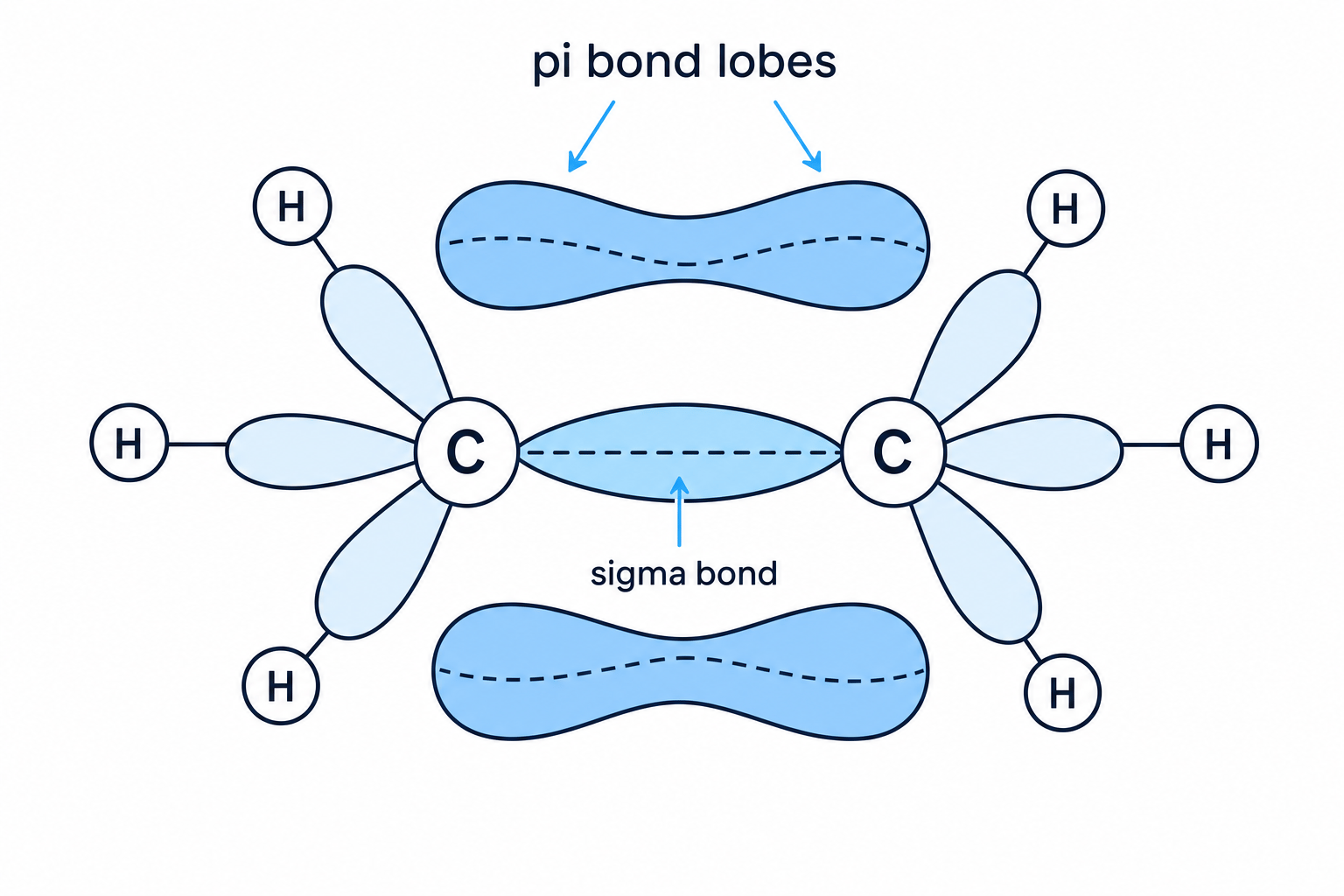
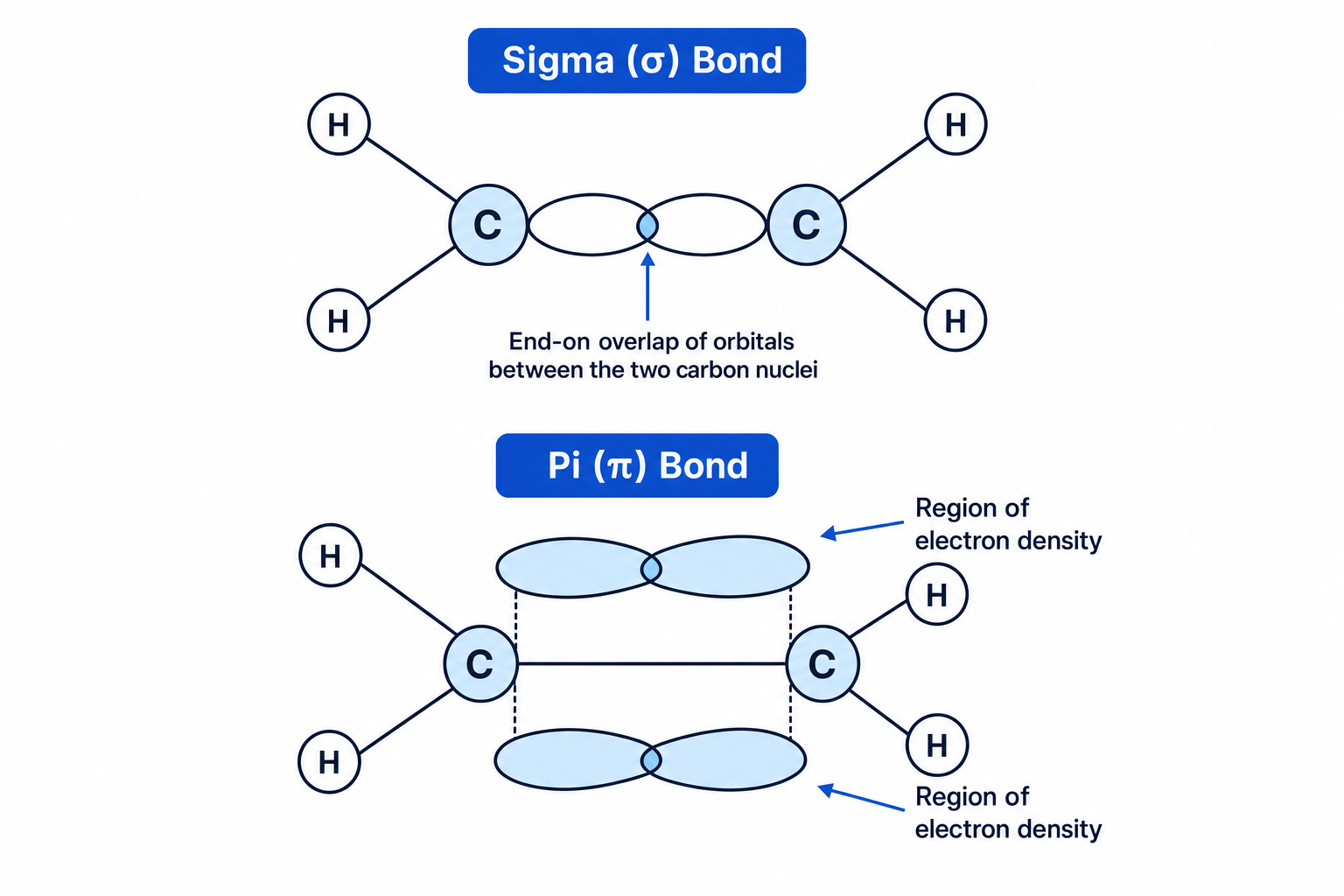
- The σ\sigmaσ-bond (sigma bond): Formed by the direct, end-on overlap of orbitals directly between the bonding carbon atoms. This is a highly localized area of electron density and forms a strong single covalent bond.
- The π\piπ-bond (pi bond): Formed by the sideways overlap of adjacent parallel p-orbitals above and below the bonding carbon atoms.
The π\piπ-electron density is concentrated in two lobes: one directly above and one directly below the line joining the nuclei of the carbon atoms.
Restricted Rotation
Because the parallel p-orbitals must remain aligned sideways to maintain the π\piπ-bond, the C=C\text{C=C}C=C double bond has restricted rotation. You cannot rotate the carbon atoms relative to each other without completely breaking the π\piπ-bond. This restricted rotation is the physical cause of stereoisomerism in alkenes.
Molecular Shape and Bond Angles
Around each carbon atom in the C=C\text{C=C}C=C bond, there are three regions of electron density (two single bonds and one double bond).
- According to Electron Pair Repulsion Theory (EPRT), these three charge centres repel each other as far apart as possible to minimize repulsion.
- This results in a trigonal planar geometry around each carbon atom.
- The bond angle around each carbon atom is approximately 120∘120^\circ120∘.
Confusing the Bond Angle
Students often write that the bond angle of the entire alkene molecule is 120∘120^\circ120∘. Remember to state that the shape and the 120∘120^\circ120∘ bond angle are around each carbon atom in the double bond. Other carbons in the chain (e.g., in propene's methyl group) will be tetrahedral with bond angles of 109.5∘109.5^\circ109.5∘.
2. Stereoisomerism in Alkenes
Alkenes can exhibit a type of isomerism called stereoisomerism.
Stereoisomers
Stereoisomers are compounds with the same structural formula but with a different arrangement of their atoms in space.
E/Z Isomerism
E/ZE/ZE/Z isomerism is a specific type of stereoisomerism. For a molecule to exhibit E/ZE/ZE/Z isomerism, it must satisfy two conditions:
- It must contain a C=C\text{C=C}C=C double bond (which restricts rotation).
- There must be two different groups attached to each carbon atom of the C=C\text{C=C}C=C group.
Cahn–Ingold–Prelog (CIP) Priority Rules
To decide whether an isomer is EEE or ZZZ, we use the Cahn–Ingold–Prelog (CIP) priority rules:
- Step 1: Look at one of the carbon atoms of the double bond. Identify the two groups attached to it.
- Step 2: Assign priority to these two groups based on the atomic number (ZZZ) of the atom directly attached to the double-bond carbon. The atom with the higher atomic number gets higher priority.
- Step 3: If the two atoms directly attached are the same (e.g., two carbon atoms in different alkyl groups like −CH3-\text{CH}_3−CH3 and −CH2CH3-\text{CH}_2\text{CH}_3−CH2CH3), compare the atomic numbers of the next atoms along the chain until a point of difference is found.
- Step 4: Repeat the process for the second carbon of the double bond.
- Step 5: Compare the positions of the two high-priority groups:
- If the high-priority groups are on the same side of the double bond, it is the ZZZ-isomer (from the German zusammen, meaning together).
- If the high-priority groups are on opposite sides of the double bond, it is the EEE-isomer (from the German entgegen, meaning opposite).
Mnemonic for E/Z
Think: "Zis Zame side" (Z-isomer = Same side).
Cis–Trans Isomerism
Cis–trans isomerism is a special, simplified case of E/ZE/ZE/Z isomerism.
- It can only be used when one of the groups attached to each carbon of the C=C\text{C=C}C=C is a hydrogen atom.
- The cis isomer has the hydrogen atoms on the same side (equivalent to ZZZ).
- The trans isomer has the hydrogen atoms on opposite sides (equivalent to EEE).
Assigning E/Z Stereoisomers
Assign the stereochemistry (EEE or ZZZ) of the following molecule:
CH3C(Br)=C(Cl)CH2CH3 \text{CH}_3\text{C(Br)=C(Cl)CH}_2\text{CH}_3 CH3C(Br)=C(Cl)CH2CH3- Analyze Carbon 1 (left carbon of the double bond): Identify the two groups attached directly to this carbon. They are a bromine atom (-Br\text{-Br}-Br) and a methyl group (-CH3\text{-CH}_3-CH3).
- Assign priority on Carbon 1: Compare the atomic numbers of the atoms directly attached. The bromine atom (Br\text{Br}Br, atomic number = 35) is compared to the carbon atom of the methyl group (C\text{C}C, atomic number = 6). Since 35>635 > 635>6, the -Br\text{-Br}-Br group has the higher priority.
- Analyze Carbon 2 (right carbon of the double bond): Identify the two attached groups. They are a chlorine atom (-Cl\text{-Cl}-Cl) and an ethyl group (-CH2CH3\text{-CH}_2\text{CH}_3-CH2CH3).
- Assign priority on Carbon 2: Compare the atomic numbers of the atoms directly attached. The chlorine atom (Cl\text{Cl}Cl, atomic number = 17) is compared to the carbon atom of the ethyl group (C\text{C}C, atomic number = 6). Since 17>617 > 617>6, the -Cl\text{-Cl}-Cl group has the higher priority.
- Determine relative positions: Look at the spatial arrangement. If the -Br\text{-Br}-Br and -Cl\text{-Cl}-Cl groups are positioned on opposite sides of the horizontal double-bond plane, the molecule is the EEE-isomer. If they are on the same side, it is the ZZZ-isomer.
3. Addition Reactions of Alkenes
Alkenes are far more reactive than alkanes because of the π\piπ-bond.
- The π\piπ-bond has a relatively low bond enthalpy compared to the σ\sigmaσ-bond. It is weaker and therefore much easier to break.
- The π\piπ-electrons are also highly exposed above and below the plane of the carbon nuclei, making them a target for attack by electron-deficient species.
Alkenes undergo addition reactions, where the weak π\piπ-bond breaks and reactant molecules add across the double bond to form saturated compounds.
Key Addition Reactions of Alkenes
1. Hydrogenation (Addition of H2\text{H}_2H2)
- Reagent: Hydrogen gas (H2\text{H}_2H2)
- Conditions: Nickel (Ni\text{Ni}Ni) catalyst, temperature of 150∘C150^\circ\text{C}150∘C
- Product: Alkane
- Equation:
2. Halogenation (Addition of X2\text{X}_2X2)
- Reagent: Halogen (e.g., Br2\text{Br}_2Br2, Cl2\text{Cl}_2Cl2) dissolved in an organic solvent, or bromine water (Br2(aq)\text{Br}_2\text{(aq)}Br2(aq))
- Conditions: Room temperature
- Product: Dihaloalkane
Test for Unsaturation
To test for the presence of a C=C\text{C=C}C=C double bond, add bromine water dropwise to the organic sample.
- If an alkene is present, the bromine adds across the double bond, and the mixture decolourises from orange to colourless.
- If no double bond is present, the solution remains orange.
3. Addition of Hydrogen Halides (Addition of HX\text{HX}HX)
- Reagent: Hydrogen halide gas (e.g., HCl\text{HCl}HCl, HBr\text{HBr}HBr) at room temperature
- Product: Haloalkane
- Equation:
4. Hydration (Addition of steam, H2O(g)\text{H}_2\text{O}\text{(g)}H2O(g))
- Reagent: Steam (H2O(g)\text{H}_2\text{O}\text{(g)}H2O(g))
- Conditions: Phosphoric acid (H3PO4\text{H}_3\text{PO}_4H3PO4) catalyst, high temperature (300∘C300^\circ\text{C}300∘C), high pressure (60 atm60\text{ atm}60 atm)
- Product: Alcohol
- Equation:
4. The Electrophilic Addition Mechanism
Alkenes react via a mechanism known as electrophilic addition.
Electrophile
An electrophile is an electron pair acceptor. Electrophiles are typically positive ions or molecules with a polar bond that contains an electron-deficient (δ+\delta^+δ+) atom.
Step-by-Step Mechanism: Propene + HBr\text{HBr}HBr
Let us walk through the mechanism of the reaction between propene (an unsymmetrical alkene) and hydrogen bromide.
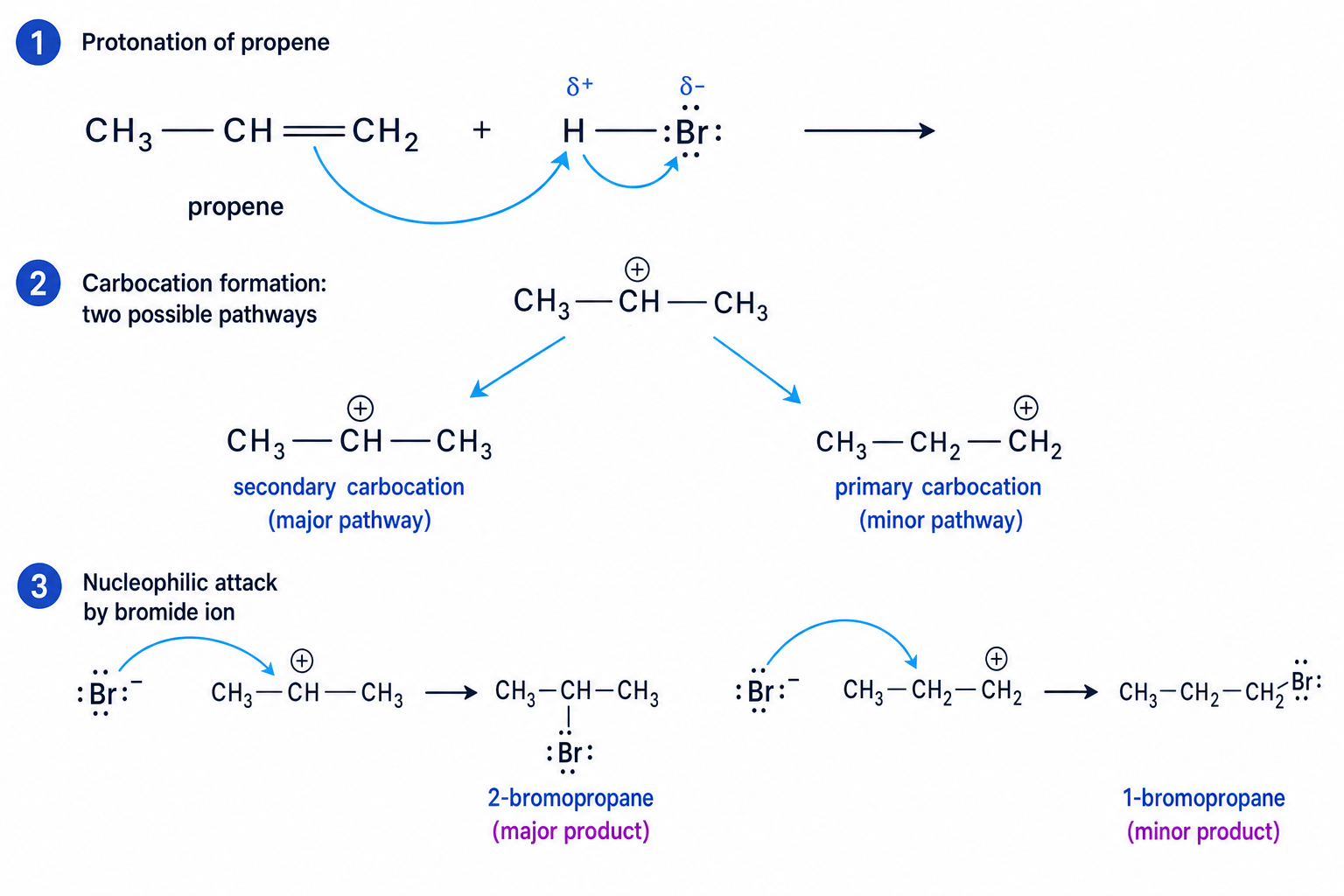
- Polarisation: The H-Br\text{H-Br}H-Br molecule is polar because bromine is more electronegative than hydrogen (Hδ+−Brδ−\text{H}^{\delta+} - \text{Br}^{\delta-}Hδ+−Brδ−).
- Attack of the double bond: The high-density π\piπ-bond of the alkene attacks the electron-deficient Hδ+\text{H}^{\delta+}Hδ+ atom. A curly arrow is drawn starting from the double bond to the H\text{H}H atom.
- Bond fission: Simultaneously, the H-Br\text{H-Br}H-Br bond breaks heterolytically. The electron pair goes entirely to the bromine atom. A curly arrow is drawn from the H-Br\text{H-Br}H-Br bond to the Br\text{Br}Br atom, forming a bromide ion (Br−\text{Br}^-Br−).
- Carbocation formation: The hydrogen atom bonds to one of the double-bonded carbons, leaving the other carbon with a positive charge. This species is called a carbocation intermediate.
- Nucleophilic attack: The bromide ion (Br−\text{Br}^-Br−) acts as a nucleophile, using its lone pair of electrons to attack the positive carbon of the carbocation. A curly arrow is drawn from the lone pair on Br−\text{Br}^-Br− to the C+\text{C}^+C+ atom, forming the final haloalkane.
Markownikoff's Rule and Carbocation Stability
When a hydrogen halide adds to an unsymmetrical alkene (like propene), two different products can form. One is the major product (formed in high yields), and the other is the minor product (formed in low yields).
We predict the major product using Markownikoff's Rule:
Markownikoff's Rule
When an unsymmetrical reagent of the form H-X\text{H-X}H-X reacts with an unsymmetrical alkene, the hydrogen atom adds to the carbon of the C=C\text{C=C}C=C double bond that already has the greater number of hydrogen atoms attached.
This is explained by the relative stability of the intermediate carbocations:
- Primary (1∘1^\circ1∘) carbocation: The carbon with the positive charge is attached to only one alkyl group.
- Secondary (2∘2^\circ2∘) carbocation: The carbon with the positive charge is attached to two alkyl groups.
- Tertiary (3∘3^\circ3∘) carbocation: The carbon with the positive charge is attached to three alkyl groups.
Alkyl groups are electron-donating; they push electron density towards the positively charged carbon atom. This helps to spread out and stabilise the positive charge.
The pathway that proceeds via the more stable carbocation intermediate has a lower activation energy and is therefore favoured, resulting in the major product.
Predicting the Major Product of Electrophilic Addition
Predict the major organic product when but-1-ene reacts with hydrogen chloride (HCl\text{HCl}HCl).
- Identify the structure of the starting alkene: But-1-ene is CH2=CH-CH2CH3\text{CH}_2\text{=CH-CH}_2\text{CH}_3CH2=CH-CH2CH3. It is an unsymmetrical alkene.
- Determine the two possible carbocation intermediates:
- If H+\text{H}^+H+ adds to Carbon-1, we form a secondary (2∘2^\circ2∘) carbocation: CH3-C+H-CH2CH3\text{CH}_3\text{-}\text{C}^+\text{H-CH}_2\text{CH}_3CH3-C+H-CH2CH3.
- If H+\text{H}^+H+ adds to Carbon-2, we form a primary (1∘1^\circ1∘) carbocation: C+H2-CH2-CH2CH3\text{C}^+\text{H}_2\text{-CH}_2\text{-CH}_2\text{CH}_3C+H2-CH2-CH2CH3.
- Compare carbocation stability: The secondary carbocation (CH3-C+H-CH2CH3\text{CH}_3\text{-}\text{C}^+\text{H-CH}_2\text{CH}_3CH3-C+H-CH2CH3) is more stable than the primary carbocation because it is stabilized by two electron-donating alkyl groups rather than one.
- Deduce the final products:
- The secondary carbocation reacts with Cl−\text{Cl}^-Cl− to form 2-chlorobutane (major product).
- The primary carbocation reacts with Cl−\text{Cl}^-Cl− to form 1-chlorobutane (minor product).
5. Addition Polymers
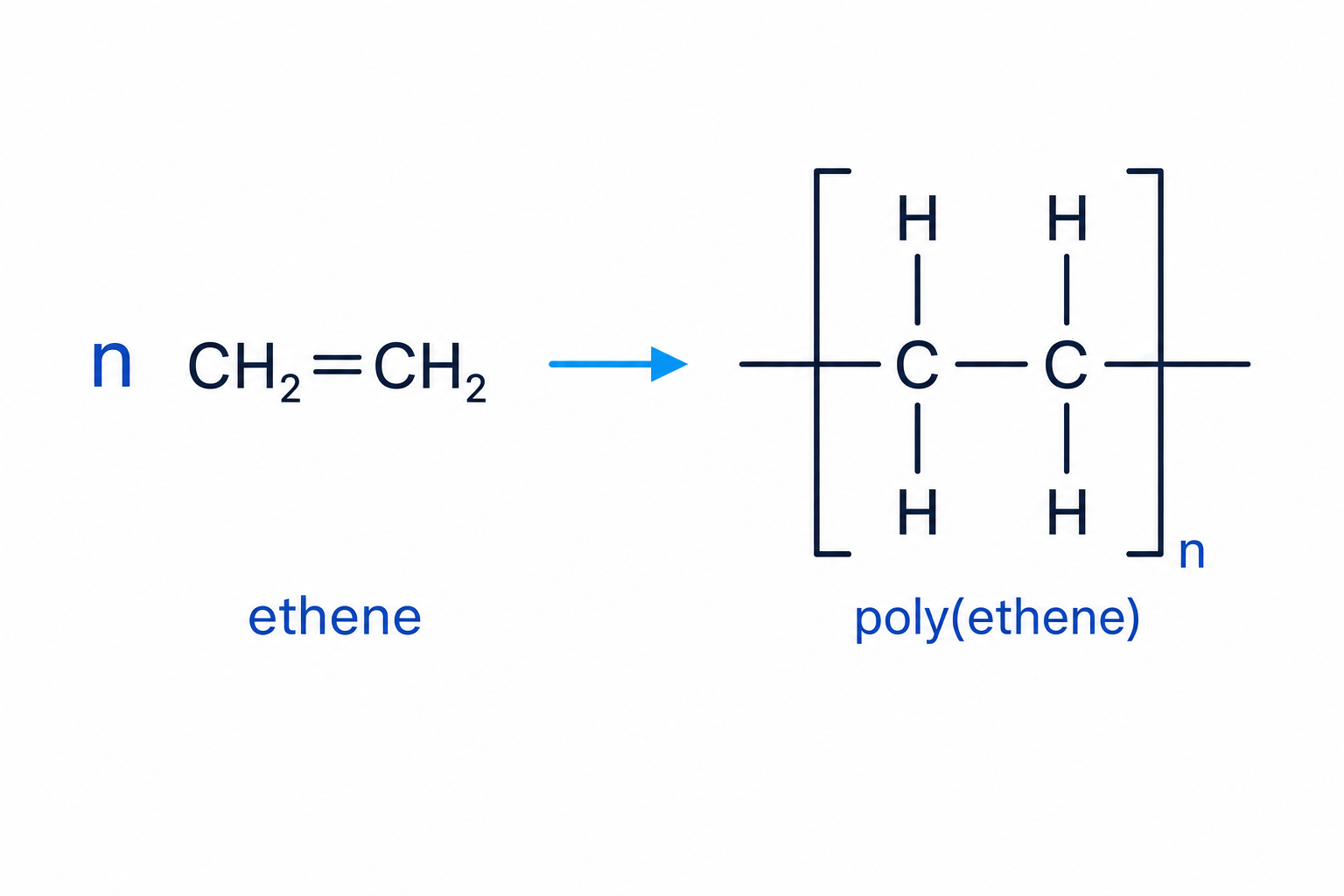
Alkenes undergo addition polymerisation to form long-chain saturated molecules called polymers. The double bonds in the monomer open up, allowing thousands of monomer units to join together.
- Monomer: The small, unsaturated alkene molecule used to start the polymerisation reaction.
- Polymer: The long-chain saturated molecule made of many repeating monomer units.
- Repeat Unit: The specific arrangement of atoms in the polymer that is repeated many times, shown in square brackets with single bonds extending out of the brackets and an 'nnn' subscript.
Drawing Repeat Units
When drawing repeat units, always ensure that:
- The double bond (C=C\text{C=C}C=C) is changed to a single bond (C-C\text{C-C}C-C).
- The open bonds extend completely through the square brackets on both sides.
- The subscript 'nnn' is written outside the bottom right-hand corner of the brackets.
- No "extra" atoms are added or removed; keep the side groups identical to those on the monomer.
6. Polymer Sustainability and Waste Management
While plastics (polymers) are highly useful due to their durability, low density, and chemical inertness, these same properties make them persistent in the environment, causing significant disposal problems.
A-Level Chemistry students must be able to discuss the advantages and disadvantages of different methods for processing polymer waste:
1. Recycling and Feedstock Recovery
- Mechanical Recycling: Sorting, washing, and melting polymers down to be reshaped into new products.
- Feedstock Recycling (Feedstock Recovery): Chemical reclamation of monomers. The polymers are heated to break them down back into their constituent hydrocarbons (monomers or chemical feedstocks). These can then be used to manufacture new plastics.
- Benefit: Conserves finite crude oil resources and reduces the volume of waste sent to landfill.
2. Combustion for Energy Production
- Non-recyclable polymers can be incinerated to release heat. This heat is used to boil water, producing steam to drive turbines and generate electricity.
- Benefit: Alleviates landfill volume and recovers valuable stored chemical energy.
3. Removal of Toxic Waste Products
- Combustion of halogenated plastics like poly(vinyl chloride) (PVC\text{PVC}PVC) releases toxic, highly acidic hydrogen chloride (HCl\text{HCl}HCl) gas.
- Mitigation: Waste incinerators use gas scrubbers where the acidic gases are sprayed and neutralized with an alkaline slurry (e.g., calcium hydroxide, Ca(OH)2\text{Ca(OH)}_2Ca(OH)2) before being released.
4. Biodegradable and Photodegradable Polymers
- Biodegradable polymers: Made from renewable plant-based starch or cellulose, or synthesized from biological monomers. They can be broken down completely by microorganisms into water, carbon dioxide, and biological compounds.
- Photodegradable polymers: Contain bonds that can be weakened and broken down by absorbing light (specifically UV light), causing the plastic to disintegrate over time.
- Benefit: Greatly reduces the longevity of litter and landfill build-up without relying on incineration.
In the exam
- Be precise with definitions: If asked to define an electrophile, write "an electron pair acceptor." Do not miss out the word pair!
- Curly arrow precision: Every single curly arrow must start precisely from a bond or from a lone pair of electrons, and point directly to the atom where the new bond is being formed. Examiners look very closely at the start and end points of your arrows.
- Justifying Markownikoff's products: When explaining why a product is major, always structure your answer in three steps: (1) state the two possible carbocations, (2) state which one is more stable (e.g., secondary vs primary), and (3) link this stability directly to the major product.
- Drawing monomers from polymers: To find the monomer from a section of a polymer chain, isolate a two-carbon segment of the main chain, change the single carbon-carbon bond back into a double bond, and remove the trailing open-ended bonds.
Check yourself
- Why does the sideways overlap of p-orbitals in a π\piπ-bond lead to stereoisomerism in alkenes?
- Draw the structural formula and state the IUPAC name for the EEE and ZZZ isomers of 1-bromo-2-chloropropene.
- Write down the reagents, conditions, and product for the reaction of cyclohexene with steam.
- Explain why the electrophilic addition of HBr\text{HBr}HBr to propene produces 2-bromopropane as the major product rather than 1-bromopropane.