What you'll learn
- What enthalpy change means, including reaction, combustion and formation enthalpies.
- How to calculate enthalpy changes from temperature-change experiments.
- How Hess’s law and energy cycles let you find enthalpy changes indirectly.
- How average bond enthalpies estimate reaction enthalpies.
1. Energy changes in chemical reactions
Chemical reactions involve bond breaking and bond making, so energy is transferred between the reacting chemicals and their surroundings.
The system is the chemicals you are focusing on. The surroundings are everything else, such as the solution, beaker, thermometer and air.
Enthalpy change
The enthalpy change, ΔH\Delta HΔH, is the heat energy change for a reaction at constant pressure. In A-Level Chemistry it is usually quoted in kJ mol⁻¹.
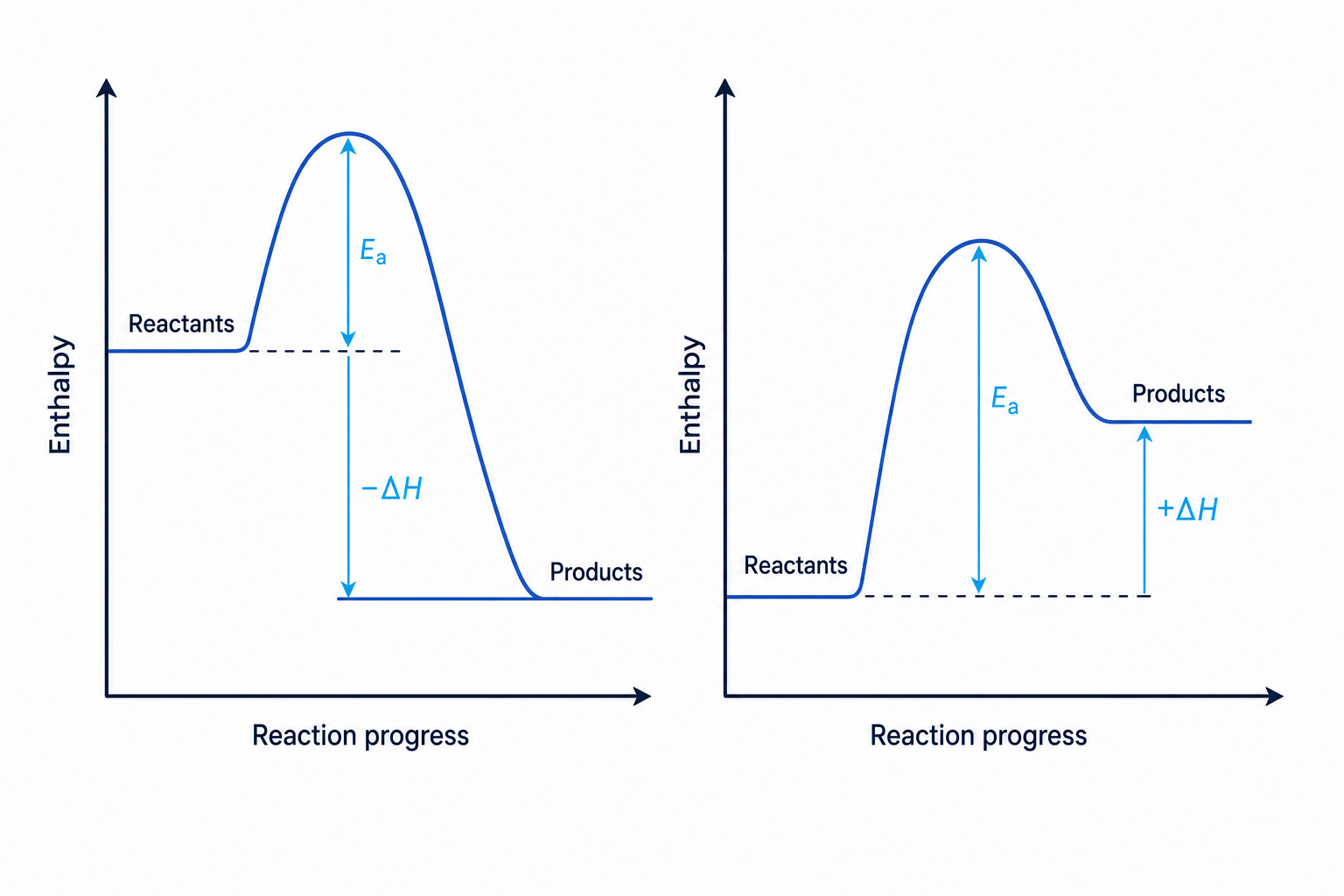
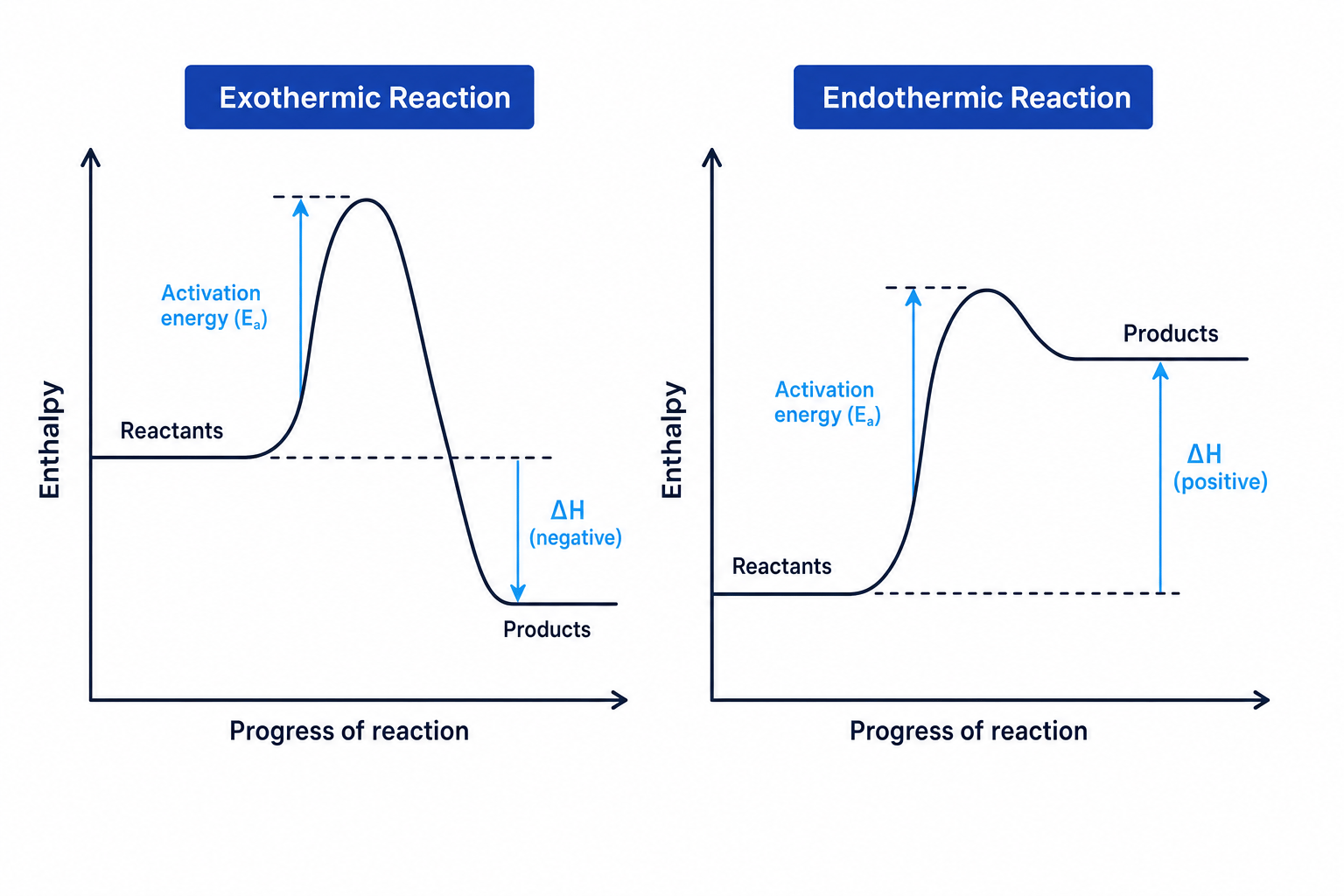
An exothermic change transfers heat energy from the system to the surroundings. The surroundings get warmer and ΔH\Delta HΔH is negative.
An endothermic change transfers heat energy from the surroundings to the system. The surroundings get cooler and ΔH\Delta HΔH is positive.
A reaction profile shows the enthalpy of reactants and products. The vertical gap between them is ΔH\Delta HΔH.
Sign of ΔH
Temperature rise in the surroundings usually means the reaction is exothermic, so ΔH<0\Delta H < 0ΔH<0. Temperature fall usually means the reaction is endothermic, so ΔH>0\Delta H > 0ΔH>0.
2. Standard enthalpy changes
To compare data fairly, enthalpy changes are often measured under standard conditions.
Standard conditions and standard states
For Eduqas A-Level Chemistry, standard enthalpy changes use substances in their standard states at 100 kPa, usually at 298 K. A standard state is the normal physical state under those conditions, for example O₂(g), H₂O(l), carbon as graphite, and Mg(s).
Enthalpy change of reaction
The enthalpy change of reaction is the enthalpy change for the reaction exactly as shown by the balanced equation.
For example, if this reaction has ΔH=−92 kJ mol−1\Delta H = -92\ \text{kJ mol}^{-1}ΔH=−92 kJ mol−1:
N₂(g) + 3H₂(g) → 2NH₃(g)
then that value applies to making 2 mol of NH₃ as written. If you halve the equation, you halve the enthalpy change.
Enthalpy change of combustion
The enthalpy change of combustion, often written ΔcH\Delta_\mathrm{c}HΔcH, is the enthalpy change when 1 mol of a substance burns completely in oxygen.
For ethanol:
C₂H₅OH(l) + 3O₂(g) → 2CO₂(g) + 3H₂O(l)
Complete combustion produces carbon dioxide and water.
Standard molar enthalpy change of formation
The standard molar enthalpy change of formation, ΔfH⊖\Delta_\mathrm{f}H^\ominusΔfH⊖, is the enthalpy change when 1 mol of a compound is formed from its elements in their standard states under standard conditions.
For magnesium carbonate:
Mg(s) + C(s, graphite) + 1.5O₂(g) → MgCO₃(s)
Formation means from elements
A formation equation must make exactly 1 mol of the compound from its elements in their standard states. It is not made from convenient compounds such as MgO or CO₂.
Writing a formation equation
Write the formation equation for calcium carbonate, CaCO₃(s).
-
Choose the product as exactly 1 mol of the compound: CaCO₃(s).
-
Use elements in their standard states: Ca(s), C(s, graphite), and O₂(g).
-
Balance the atoms while keeping 1 mol of CaCO₃ as the product:
Ca(s) + C(s, graphite) + 1.5O₂(g) → CaCO₃(s)
3. Calculating enthalpy changes from experimental data
In calorimetry, you measure a temperature change and use it to calculate heat energy transferred.
The key equation is:
q=mcΔTq = mc\Delta Tq=mcΔTwhere:
- qqq is heat energy transferred, in J
- mmm is mass heated, in g
- ccc is specific heat capacity, usually 4.18 J g⁻¹ K⁻¹ for water or dilute aqueous solutions
- ΔT\Delta TΔT is temperature change, in K or °C
For aqueous solutions, you often assume density is 1.00 g cm⁻³, so 50.0 cm³ of solution has mass 50.0 g.
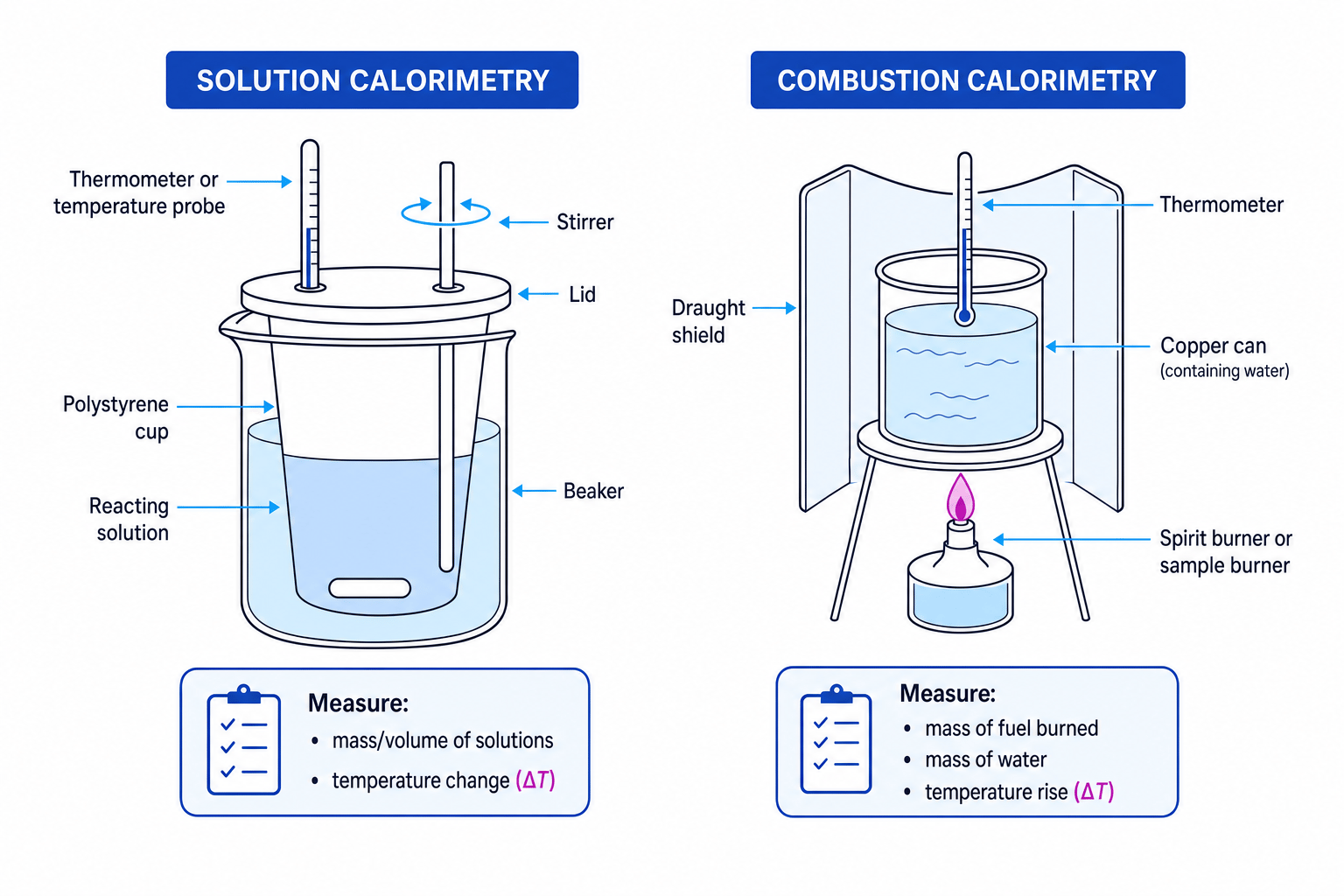
The two main practical set-ups are solution calorimetry and combustion calorimetry.
From heat energy to enthalpy change
After calculating qqq, convert J to kJ, then divide by the amount in mol:
ΔH=−qn\Delta H = -\frac{q}{n}ΔH=−nqThe negative sign is used when the solution warms up because the reaction released heat to the surroundings.
Calculating ΔH from solution calorimetry
25.0 cm³ of 1.00 mol dm⁻³ HCl is mixed with 25.0 cm³ of 1.00 mol dm⁻³ NaOH. The temperature rises from 20.5 °C to 27.2 °C. Calculate the enthalpy change per mole of water formed.
-
Find the amount reacting. For HCl, n=cV=1.00×0.0250=0.0250 moln = cV = 1.00 \times 0.0250 = 0.0250\ \text{mol}n=cV=1.00×0.0250=0.0250 mol. The NaOH amount is also 0.0250 mol, so 0.0250 mol of water forms.
-
Calculate the heat gained by the solution. Total volume is 50.0 cm³, so mass is 50.0 g. The temperature change is 27.2−20.5=6.7 K27.2 - 20.5 = 6.7\ \text{K}27.2−20.5=6.7 K.
-
Substitute into q=mcΔTq = mc\Delta Tq=mcΔT:
q=50.0×4.18×6.7=1400 J=1.40 kJq = 50.0 \times 4.18 \times 6.7 = 1400\ \text{J} = 1.40\ \text{kJ}q=50.0×4.18×6.7=1400 J=1.40 kJ
-
Convert to enthalpy change for the reaction. The solution warmed, so the reaction is exothermic:
ΔH=−1.400.0250=−56.0 kJ mol−1\Delta H = -\frac{1.40}{0.0250} = -56.0\ \text{kJ mol}^{-1}ΔH=−0.02501.40=−56.0 kJ mol−1
Calorimetry sign check
If the temperature rises, the calculated qqq for the surroundings is positive, but ΔH\Delta HΔH for the reaction is negative.
4. Simple procedures and practical evaluation
Solution calorimetry method
For reactions in solution, such as neutralisation or displacement:
- Measure known volumes or masses of reactants.
- Place the solution in a polystyrene cup with a lid.
- Record the initial temperature.
- Add the second reactant, stir, and record the maximum or minimum temperature.
- Use q=mcΔTq = mc\Delta Tq=mcΔT, then divide by moles of the limiting reactant.
A better method uses a temperature probe and plots temperature against time. You can extrapolate the cooling or warming line back to the mixing time to estimate the true temperature change before heat is lost.
Combustion calorimetry method
For a fuel:
- Add a known mass of water to a copper can.
- Weigh the burner before burning.
- Burn the fuel to heat the water, stirring gently.
- Record the temperature rise.
- Reweigh the burner to find the mass of fuel burned.
- Calculate qqq for the water and divide by moles of fuel burned.
Calculating an enthalpy change of combustion
A spirit burner containing ethanol heats 100.0 g of water. The temperature rises by 18.5 K. The mass of ethanol burned is 0.920 g. Calculate the experimental enthalpy change of combustion of ethanol. Use MrM_\mathrm{r}Mr of ethanol = 46.0.
-
Calculate the heat gained by the water:
q=100.0×4.18×18.5=7730 J=7.73 kJq = 100.0 \times 4.18 \times 18.5 = 7730\ \text{J} = 7.73\ \text{kJ}q=100.0×4.18×18.5=7730 J=7.73 kJ
-
Calculate the amount of ethanol burned:
n=mM=0.92046.0=0.0200 moln = \frac{m}{M} = \frac{0.920}{46.0} = 0.0200\ \text{mol}n=Mm=46.00.920=0.0200 mol
-
Divide by the amount burned and add the exothermic sign:
ΔcH=−7.730.0200=−387 kJ mol−1\Delta_\mathrm{c}H = -\frac{7.73}{0.0200} = -387\ \text{kJ mol}^{-1}ΔcH=−0.02007.73=−387 kJ mol−1
Why combustion values are often too low
School combustion calorimetry usually gives a value that is less exothermic than the data book value because heat is lost to the air, the copper can also absorbs heat, fuel may evaporate, and combustion may be incomplete.
5. Hess’s law and energy cycles
Hess’s law
Hess’s law states that the enthalpy change for a reaction is independent of the route taken, provided the initial and final conditions are the same.
This works because enthalpy is a state function: it depends only on the starting and finishing states, not the path taken.
Hess cycles are especially useful when the direct reaction is hard to measure. You add arrows in the direction you travel; if you reverse an equation, change the sign of its enthalpy change.
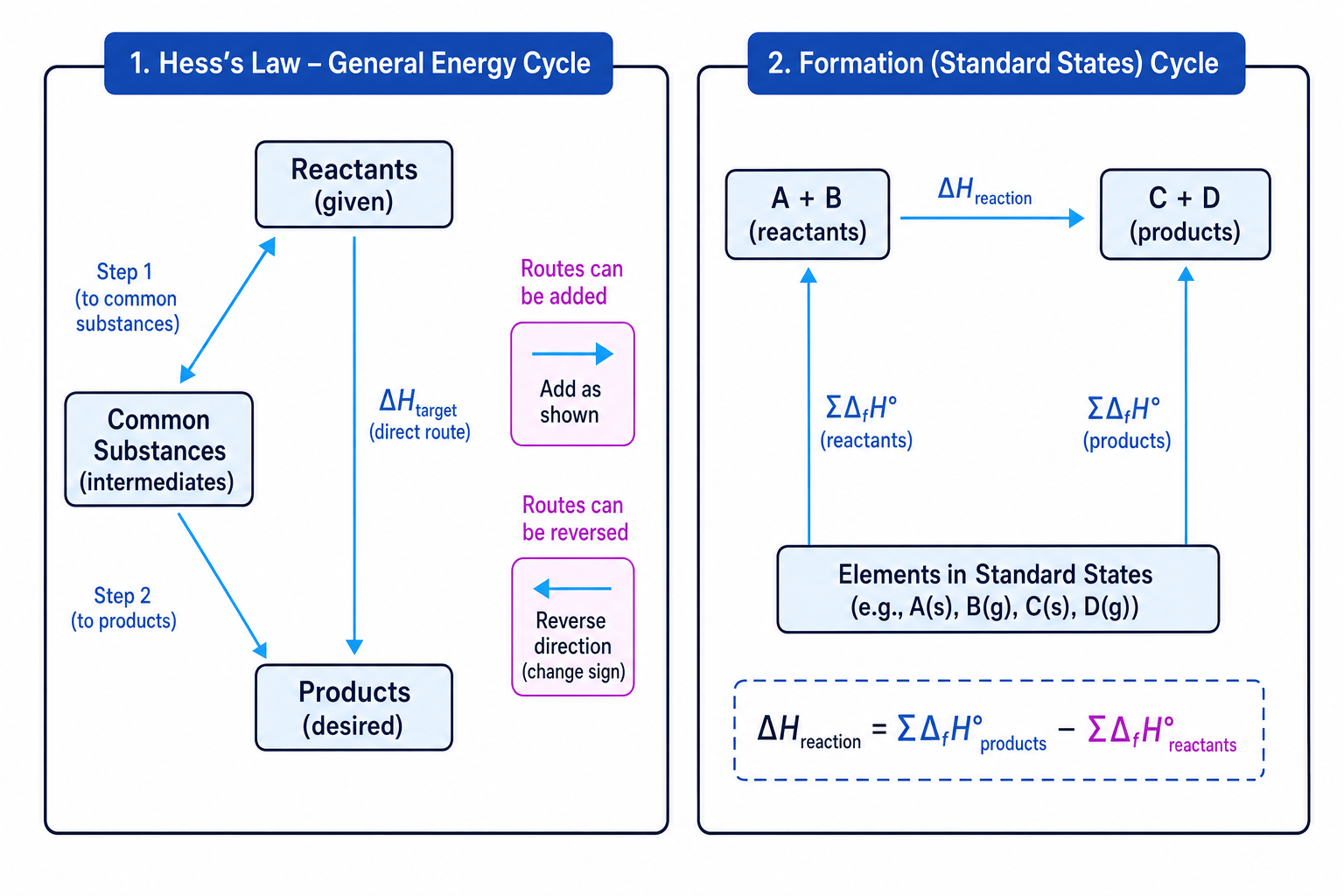
For standard formation enthalpies:
ΔHreaction⊖=∑ΔfH⊖(products)−∑ΔfH⊖(reactants)\Delta H_\mathrm{reaction}^\ominus = \sum \Delta_\mathrm{f}H^\ominus(\text{products}) - \sum \Delta_\mathrm{f}H^\ominus(\text{reactants})ΔHreaction⊖=∑ΔfH⊖(products)−∑ΔfH⊖(reactants)Elements in their standard states have ΔfH⊖=0\Delta_\mathrm{f}H^\ominus = 0ΔfH⊖=0.
Using formation enthalpies
Calculate the enthalpy change for:
CH₄(g) + 2O₂(g) → CO₂(g) + 2H₂O(l)
Use ΔfH⊖\Delta_\mathrm{f}H^\ominusΔfH⊖: CH₄(g) = −74.8 kJ mol⁻¹, CO₂(g) = −393.5 kJ mol⁻¹, H₂O(l) = −285.8 kJ mol⁻¹, O₂(g) = 0 kJ mol⁻¹.
-
Add the formation enthalpies of the products:
−393.5+2(−285.8)=−965.1 kJ mol−1-393.5 + 2(-285.8) = -965.1\ \text{kJ mol}^{-1}−393.5+2(−285.8)=−965.1 kJ mol−1
-
Add the formation enthalpies of the reactants:
−74.8+2(0)=−74.8 kJ mol−1-74.8 + 2(0) = -74.8\ \text{kJ mol}^{-1}−74.8+2(0)=−74.8 kJ mol−1
-
Apply products minus reactants:
ΔH=−965.1−(−74.8)=−890.3 kJ mol−1\Delta H = -965.1 - (-74.8) = -890.3\ \text{kJ mol}^{-1}ΔH=−965.1−(−74.8)=−890.3 kJ mol−1
Specified practical: indirect enthalpy change for MgO and CO₂
The reaction:
MgO(s) + CO₂(g) → MgCO₃(s)
is not convenient to measure directly in a school lab. Instead, you can react MgO and MgCO₃ separately with hydrochloric acid and use Hess’s law.
Measure:
MgO(s) + 2HCl(aq) → MgCl₂(aq) + H₂O(l) ΔH1\Delta H_1ΔH1
MgCO₃(s) + 2HCl(aq) → MgCl₂(aq) + CO₂(g) + H₂O(l) ΔH2\Delta H_2ΔH2
Reverse the second equation and add it to the first:
ΔHtarget=ΔH1−ΔH2\Delta H_\mathrm{target} = \Delta H_1 - \Delta H_2ΔHtarget=ΔH1−ΔH2Indirect determination using Hess’s law
In an experiment, ΔH1=−151 kJ mol−1\Delta H_1 = -151\ \text{kJ mol}^{-1}ΔH1=−151 kJ mol−1 and ΔH2=−49 kJ mol−1\Delta H_2 = -49\ \text{kJ mol}^{-1}ΔH2=−49 kJ mol−1. Find ΔH\Delta HΔH for MgO(s) + CO₂(g) → MgCO₃(s).
-
Identify the route: use reaction 1 as written, then reverse reaction 2 to end at MgCO₃(s).
-
Change the sign of the reversed reaction:
reversed ΔH2=+49 kJ mol−1\Delta H_2 = +49\ \text{kJ mol}^{-1}ΔH2=+49 kJ mol−1
-
Add the enthalpy changes:
ΔH=−151+49=−102 kJ mol−1\Delta H = -151 + 49 = -102\ \text{kJ mol}^{-1}ΔH=−151+49=−102 kJ mol−1
6. Average bond enthalpies
Average bond enthalpy
The average bond enthalpy is the energy needed to break 1 mol of a specified covalent bond in gaseous molecules, averaged over many compounds.
Bond breaking is always endothermic. Bond making is always exothermic.
For bond enthalpy calculations:
ΔH=∑bond enthalpies of bonds broken−∑bond enthalpies of bonds formed\Delta H = \sum \text{bond enthalpies of bonds broken} - \sum \text{bond enthalpies of bonds formed}ΔH=∑bond enthalpies of bonds broken−∑bond enthalpies of bonds formedUsing average bond enthalpies
Estimate ΔH\Delta HΔH for:
H₂(g) + Cl₂(g) → 2HCl(g)
Use H–H = 436 kJ mol⁻¹, Cl–Cl = 242 kJ mol⁻¹, H–Cl = 431 kJ mol⁻¹.
-
Add the bonds broken in the reactants:
H–H + Cl–Cl gives 436+242=678 kJ mol−1436 + 242 = 678\ \text{kJ mol}^{-1}436+242=678 kJ mol−1
-
Add the bonds formed in the products:
2 H–Cl bonds gives 2×431=862 kJ mol−12 \times 431 = 862\ \text{kJ mol}^{-1}2×431=862 kJ mol−1
-
Calculate bonds broken minus bonds formed:
ΔH=678−862=−184 kJ mol−1\Delta H = 678 - 862 = -184\ \text{kJ mol}^{-1}ΔH=678−862=−184 kJ mol−1
Bond enthalpy estimates
Average bond enthalpies are for gaseous covalent substances. They give estimates, so they may not match experimental values exactly, especially if liquids, solids or ionic lattices are involved.
In the exam
-
Write the balanced equation first, because the enthalpy change depends on the equation as written.
-
In calorimetry, keep J and kJ under control: calculate qqq in J, convert to kJ, then divide by moles.
-
For Hess cycles, reverse arrows by changing the sign, and multiply enthalpy values if you multiply equations.
-
For bond enthalpies, count actual bonds, not just molecules.
Check yourself
- Why is the enthalpy change of formation of O₂(g) equal to zero?
- A reaction mixture cools down during a reaction. What does that tell you about the sign of ΔH\Delta HΔH?
- How would you reduce heat loss in a simple enthalpy-change practical?