What you'll learn
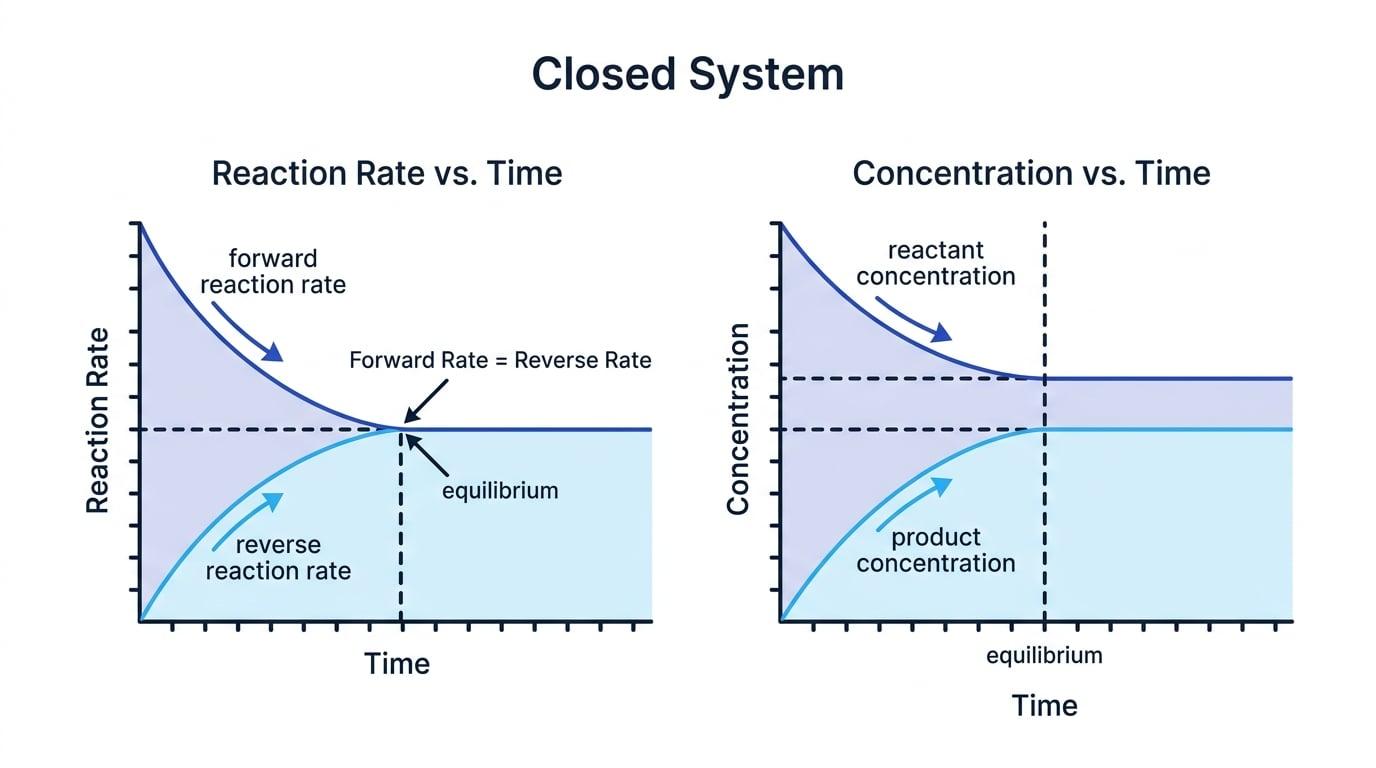
- How reversible reactions reach dynamic equilibrium in a closed system.
- How to use Le Chatelier’s principle to predict changes in equilibrium position.
- How to write and use expressions for the equilibrium constant, KcK_cKc.
- How acids, bases, pH and titration calculations fit together in practical chemistry.
Reversible reactions and dynamic equilibrium
A reversible reaction is a reaction that can go in both directions. We show this with the equilibrium arrow: ⇌.
For example, in the Haber process:
N2(g) + 3H2(g) ⇌ 2NH3(g)
The forward reaction makes ammonia. The reverse reaction breaks ammonia back down into nitrogen and hydrogen.
Dynamic equilibrium
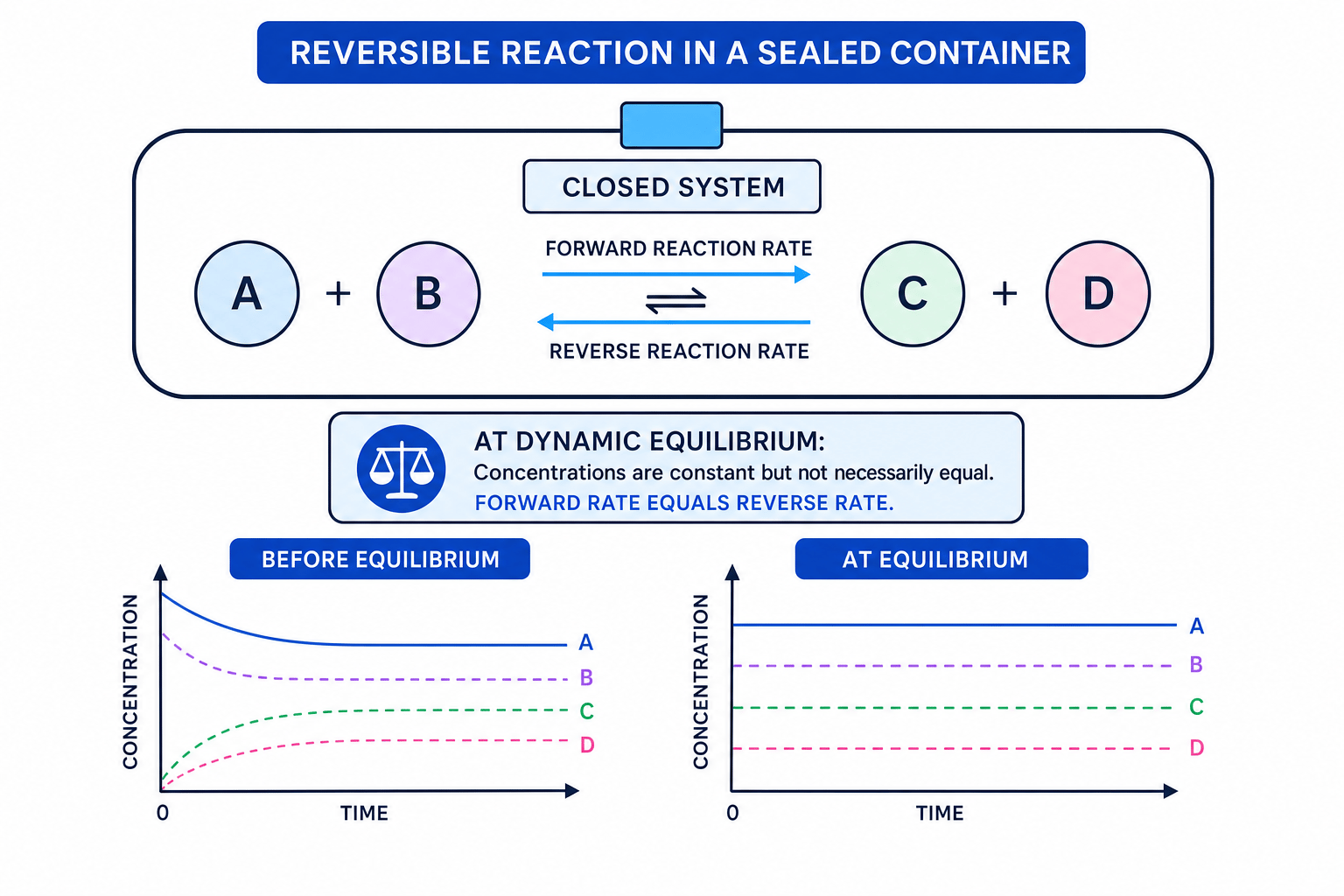
A dynamic equilibrium is reached when the rate of the forward reaction equals the rate of the reverse reaction in a closed system. The concentrations of reactants and products stay constant, but they are not necessarily equal.
A closed system means that no substances can enter or leave. This matters because equilibrium cannot be maintained if gases escape or products are removed without control.
Constant does not mean stopped
At equilibrium, reactions are still happening. “Dynamic” means particles continue to react both ways; the visible concentrations stay constant because both rates are equal.
Le Chatelier’s principle
Le Chatelier’s principle
If a system at equilibrium is disturbed, the equilibrium shifts in the direction that tends to oppose the change.
A “shift to the right” means more products are formed. A “shift to the left” means more reactants are formed.
Changing concentration
If you add more of a reactant, the equilibrium shifts to use up some of it, so it moves towards the products.
If you remove a product, the equilibrium shifts to replace it, so it also moves towards the products.
For example, in ocean acidification, extra carbon dioxide dissolves in seawater:
CO2(g) + H2O(l) ⇌ H+(aq) + HCO3−(aq)
More dissolved CO2 shifts the equilibrium to the right, increasing H+(aq), so pH decreases.
Changing pressure
Pressure only has a significant equilibrium effect when gases are involved.
- Increasing pressure shifts equilibrium to the side with fewer moles of gas.
- Decreasing pressure shifts equilibrium to the side with more moles of gas.
- If both sides have the same number of gas moles, pressure has no effect on equilibrium position.
Changing temperature
Temperature is different because it changes the value of KcK_cKc.
For an exothermic forward reaction, heat is like a product. Increasing temperature favours the reverse reaction, so KcK_cKc decreases.
For an endothermic forward reaction, heat is like a reactant. Increasing temperature favours the forward reaction, so KcK_cKc increases.
Predicting changes in the Haber equilibrium
For the equilibrium:
N2(g) + 3H2(g) ⇌ 2NH3(g), forward reaction exothermic
-
Compare gas moles for pressure.
The left side has 4 mol of gas and the right side has 2 mol of gas, so increasing pressure shifts equilibrium right, producing more NH3. -
Use the enthalpy direction for temperature.
The forward reaction is exothermic, so increasing temperature favours the endothermic reverse reaction, producing less NH3. -
Apply the effect to KcK_cKc.
Since higher temperature favours the reverse reaction, the equilibrium mixture contains relatively less product, so KcK_cKc decreases.
What changes Kc?
For a given reaction, KcK_cKc changes only when temperature changes. Changing concentration or pressure may shift the equilibrium position, but at the same temperature the value of KcK_cKc is unchanged.
The equilibrium constant, Kc
For a general homogeneous equilibrium:
aA+bB⇌cC+dDaA + bB \rightleftharpoons cC + dDaA+bB⇌cC+dDthe equilibrium constant in terms of concentration is:
Kc=[C]c[D]d[A]a[B]bK_c = \frac{[C]^c[D]^d}{[A]^a[B]^b}Kc=[A]a[B]b[C]c[D]dSquare brackets mean equilibrium concentration, usually in mol dm−3. The powers come from the balancing numbers in the equation.
Kc
KcK_cKc is the equilibrium constant calculated from the concentrations of products and reactants at equilibrium, each raised to the power of its stoichiometric coefficient.
Calculating Kc from equilibrium concentrations
For:
H2(g) + I2(g) ⇌ 2HI(g)
At equilibrium: [H2] = 0.0200 mol dm−3, [I2] = 0.0150 mol dm−3, [HI] = 0.120 mol dm−3.
- Write the expression using the balanced equation.
- Substitute the equilibrium concentrations.
- Evaluate and consider units.
The concentration units cancel here, so KcK_cKc has no units for this reaction.
Using starting concentrations
Only use equilibrium concentrations in a KcK_cKc expression. Initial concentrations are not valid unless the question tells you they are unchanged, which is unusual.
Acids and bases
In this topic, acids and bases are described using the Brønsted–Lowry idea.
Acid and base
An acid is a donor of H+(aq) ions. A base is an acceptor of H+(aq) ions.
For example:
HCl(aq) → H+(aq) + Cl−(aq)
HCl acts as an acid because it donates H+(aq).
Ammonia acts as a base:
NH3(aq) + H+(aq) → NH4+(aq)
because it accepts H+(aq).
You are expected to recall common acid reactions:
- acid + base → salt + water
- acid + alkali → salt + water
- acid + carbonate → salt + water + carbon dioxide
For example:
2HCl(aq) + CaCO3(s) → CaCl2(aq) + H2O(l) + CO2(g)
Strong and weak acids
A strong acid dissociates almost completely in water. A weak acid only partially dissociates, setting up an equilibrium.
Strong acid example:
HCl(aq) → H+(aq) + Cl−(aq)
Weak acid example:
CH3COOH(aq) ⇌ H+(aq) + CH3COO−(aq)
Strong is not the same as concentrated
Strong/weak describes the extent of dissociation. Concentrated/dilute describes how much acid is dissolved per dm3. A dilute strong acid is still strong.
pH and hydrogen ion concentration
pH measures the concentration of H+(aq) ions:
pH=−log[H+(aq)]\text{pH} = -\log[\text{H}^+(\text{aq})]pH=−log[H+(aq)]You can rearrange this to:
[H+(aq)]=10−pH[\text{H}^+(\text{aq})] = 10^{-\text{pH}}[H+(aq)]=10−pHUsing pH and hydrogen ion concentration
A hydrochloric acid solution has concentration 0.0250 mol dm−3. Calculate its pH.
-
Use the fact that HCl is a strong acid.
HCl dissociates completely, so [H+(aq)] = 0.0250 mol dm−3. -
Substitute into the pH equation.
- Calculate and round sensibly.
Acid-base titrations
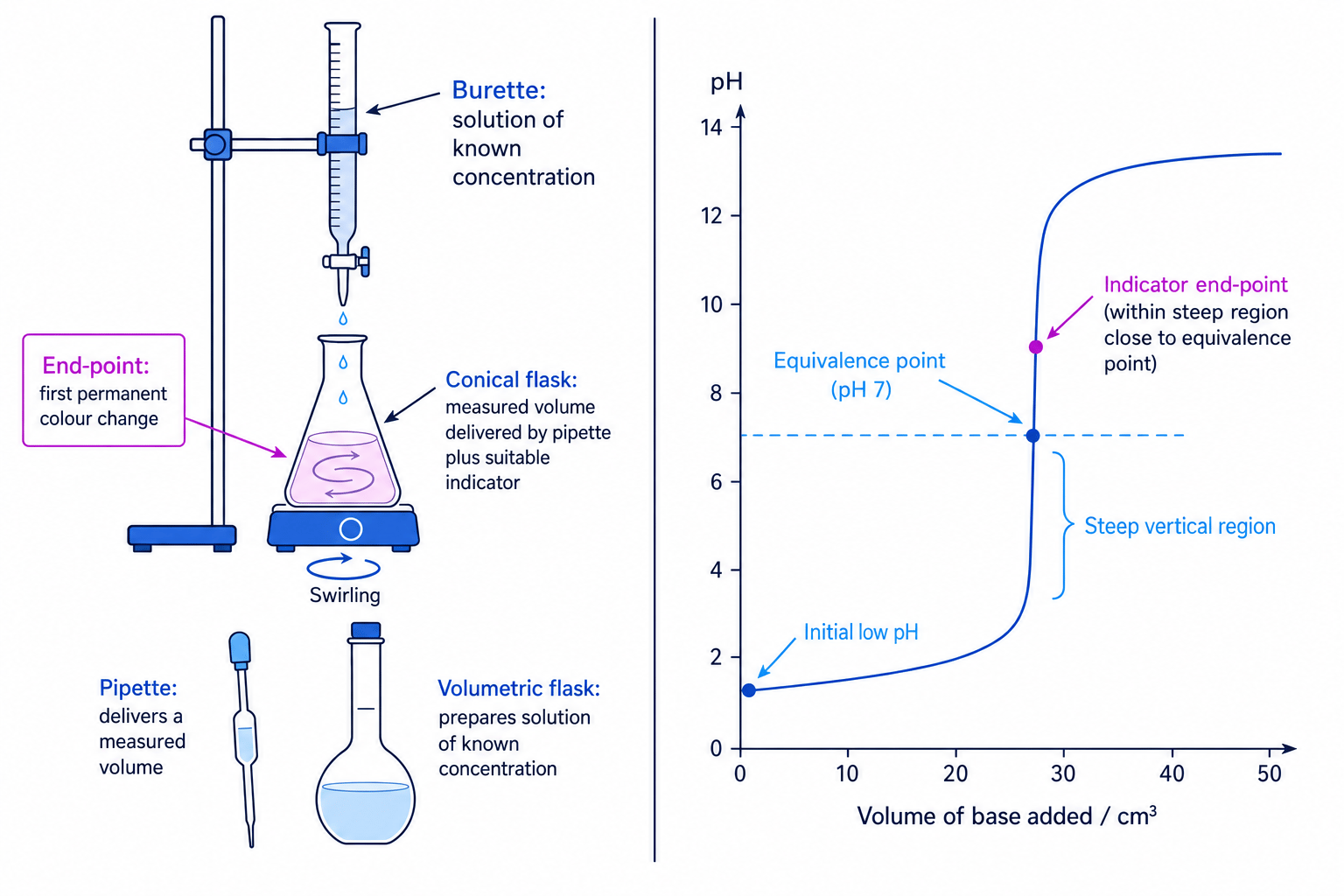
A titration is a practical method used to find the concentration of a solution by reacting it with another solution of known concentration.
The key equation is:
n=cVn = cVn=cVwhere nnn is amount in mol, ccc is concentration in mol dm−3, and VVV is volume in dm3.
Core titration method
- Use a pipette to transfer a measured volume into a conical flask.
- Add a few drops of a suitable indicator.
- Fill the burette with the other solution.
- Do a rough titration to estimate the end-point.
- Repeat until you obtain concordant titres.
- Use only concordant accurate titres to calculate the mean.
Titre uncertainty
A burette reading is usually recorded to the nearest 0.05 cm3. A titre uses two readings, so the approximate uncertainty in one titre is ±0.10 cm3. Percentage uncertainty is calculated using absolute uncertainty divided by the titre, then multiplied by 100.
Standardising an acid solution
25.0 cm3 of 0.0500 mol dm−3 Na2CO3(aq) is titrated with HCl(aq). The mean titre of HCl is 23.40 cm3.
Na2CO3(aq) + 2HCl(aq) → 2NaCl(aq) + H2O(l) + CO2(g)
- Calculate moles of sodium carbonate.
- Use the 1:2 reacting ratio.
- Calculate the HCl concentration.
So the acid concentration is 0.107 mol dm−3.
Preparing a soluble salt by titration
Titration is used when both reactants are soluble, for example making sodium chloride from hydrochloric acid and sodium hydroxide.
Preparing a soluble salt by titration
To prepare a pure soluble salt such as NaCl(aq) from HCl(aq) and NaOH(aq):
-
Find the neutralising volumes.
Titrate HCl(aq) against NaOH(aq) using an indicator to find the exact volume needed for neutralisation. -
Repeat without indicator.
Mix the same measured volumes again, but without indicator, so the salt solution is not contaminated by indicator dye. -
Crystallise the salt.
Warm the solution to evaporate some water, then allow it to cool and crystallise. Filter and dry the crystals.
Back titration
A back titration is used when the substance being analysed reacts slowly, is insoluble, or has an unclear end-point. You add a known excess of acid, allow it to react, then titrate the leftover acid.
Calculating percentage calcium carbonate by back titration
0.600 g of limestone is reacted with 25.0 cm3 of 0.500 mol dm−3 HCl. The excess HCl requires 16.40 cm3 of 0.100 mol dm−3 NaOH for neutralisation. Calculate the percentage of CaCO3 in the limestone.
- Calculate moles of HCl added initially.
- Calculate moles of HCl left over.
HCl and NaOH react 1:1, so:
- Find moles of HCl that reacted with CaCO3.
- Use the equation CaCO3 + 2HCl → CaCl2 + H2O + CO2.
- Convert to mass and percentage.
Double titration
A double titration can analyse a mixture where two substances react differently with acid. A common example is a mixture of NaOH and Na2CO3.
With HCl:
- NaOH uses 1 mol HCl per 1 mol NaOH.
- Na2CO3 uses 1 mol HCl to reach the phenolphthalein end-point.
- Na2CO3 uses 2 mol HCl in total to reach the methyl orange end-point.
Analysing sodium hydroxide and sodium carbonate by double titration
25.0 cm3 of a mixture is titrated with 0.100 mol dm−3 HCl. The phenolphthalein end-point is 18.30 cm3. The methyl orange total end-point is 27.60 cm3.
- Let carbonate moles be found from the extra acid after phenolphthalein.
- Use the first end-point to find hydroxide moles.
At phenolphthalein: acid moles = NaOH moles + Na2CO3 moles.
- Convert moles in 25.0 cm3 to concentration.
Practical safety and validity
Wear eye protection when handling acids and alkalis. In titrations, rinse apparatus with the solutions they will contain, remove the funnel before taking burette readings, and read the meniscus at eye level to reduce systematic error.
In the exam
- Always write the balanced equation before doing titration calculations; the mole ratio usually carries the marks.
- Convert cm3 to dm3 before using n=cVn = cVn=cV.
- For equilibria, state both the direction of shift and the reason, such as “fewer gas moles” or “opposes added reactant”.
Check yourself
- Why are concentrations constant, but not necessarily equal, at dynamic equilibrium?
- What happens to KcK_cKc for an exothermic forward reaction when temperature is increased?
- How would you distinguish a weak acid from a dilute strong acid?