What you'll learn
- How chemical synthesis and energy production affect society, the economy and the environment.
- How to evaluate benefits and risks using evidence rather than one-sided arguments.
- What green chemistry means, and how it improves sustainability.
- How to write balanced exam answers about issues such as shale gas, fuels, polymers and new manufacturing routes.
Why this topic matters
Chemistry gives us medicines, fertilisers, fuels, polymers, batteries, cleaning products and construction materials. That is hugely beneficial — but chemical processes can also use finite resources, produce waste, release greenhouse gases, or create hazards for workers and ecosystems.
In C2.4, you are not just learning facts. You are learning how chemists make judgements: what evidence matters, what trade-offs exist, and how society decides whether a technology should be used.
Sustainability
Sustainability means meeting present needs without preventing future generations from meeting their own needs. In chemistry, this includes conserving resources, reducing pollution, protecting health, and maintaining useful products and energy supplies.
The three main types of impact
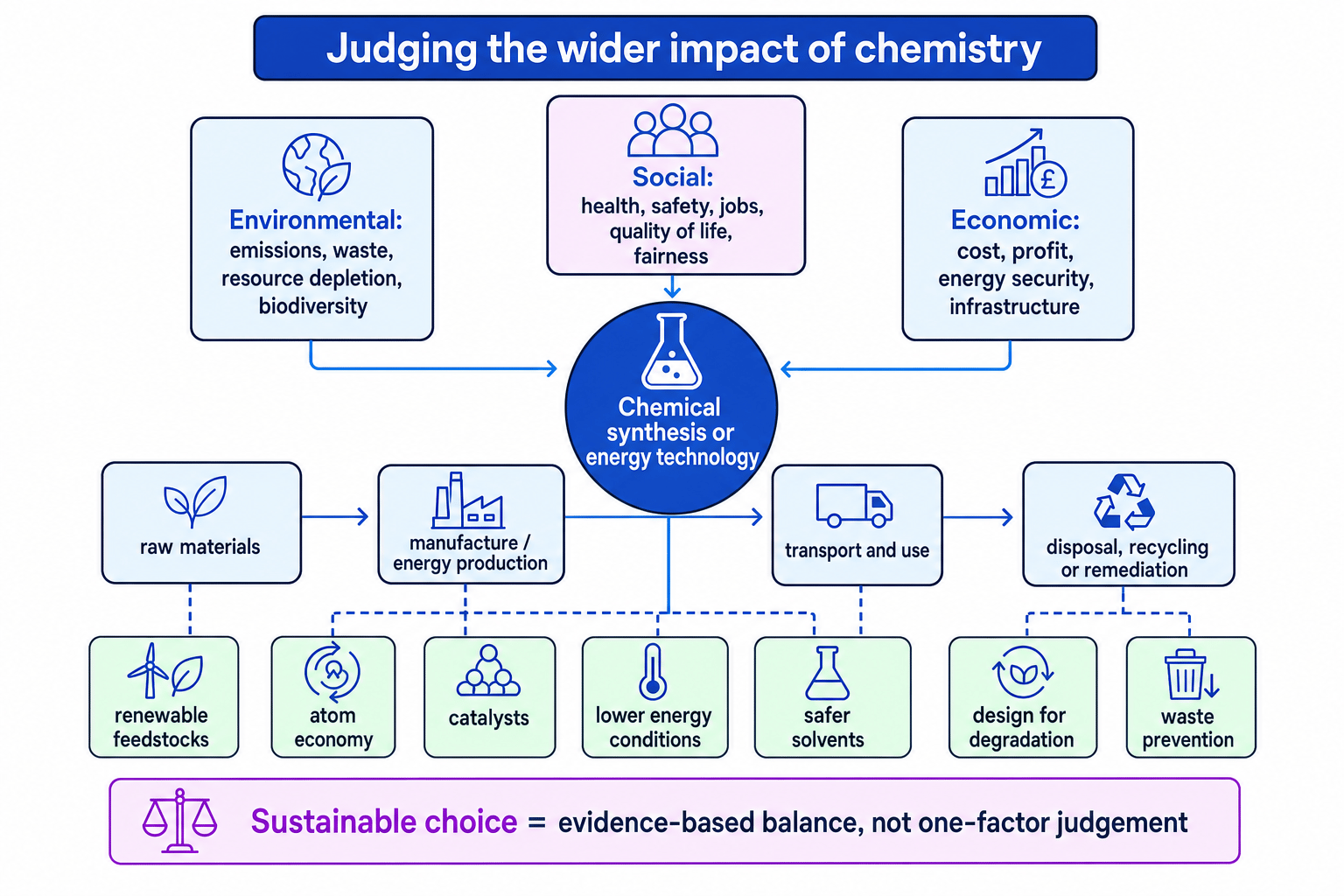
When you evaluate a chemical process or energy technology, group your points into three broad areas: social, economic and environmental.
Social impact
The social impact is the effect on people and communities.
This can include:
- improved health, such as new medicines or clean water treatment
- risks to workers, local residents or consumers
- job creation or job losses
- access to energy, food, transport and materials
- fairness: who receives the benefits, and who carries the risks?
For example, fertiliser production supports food supply by increasing crop yields. However, fertiliser run-off can contribute to eutrophication in rivers and lakes, affecting people who rely on those ecosystems.
Economic impact
The economic impact is the effect on costs, profits, employment, infrastructure and national energy security.
A process may be attractive if it:
- uses cheap raw materials
- has a high yield
- uses low temperatures and pressures
- needs little separation or purification
- creates valuable products
- reduces imports of fuels or chemicals
But economic benefits must be weighed against costs such as waste treatment, pollution control, safety systems, decommissioning and long-term environmental damage.
Environmental impact
The environmental impact is the effect on air, water, land, climate and living organisms.
Important environmental questions include:
- Are the raw materials renewable or finite?
- Does the process release carbon dioxide, methane, nitrogen oxides or sulfur dioxide?
- Are toxic substances used or formed?
- How much waste is produced?
- Can the product be reused, recycled or biodegraded?
- What happens at the end of the product’s life?
A balanced judgement
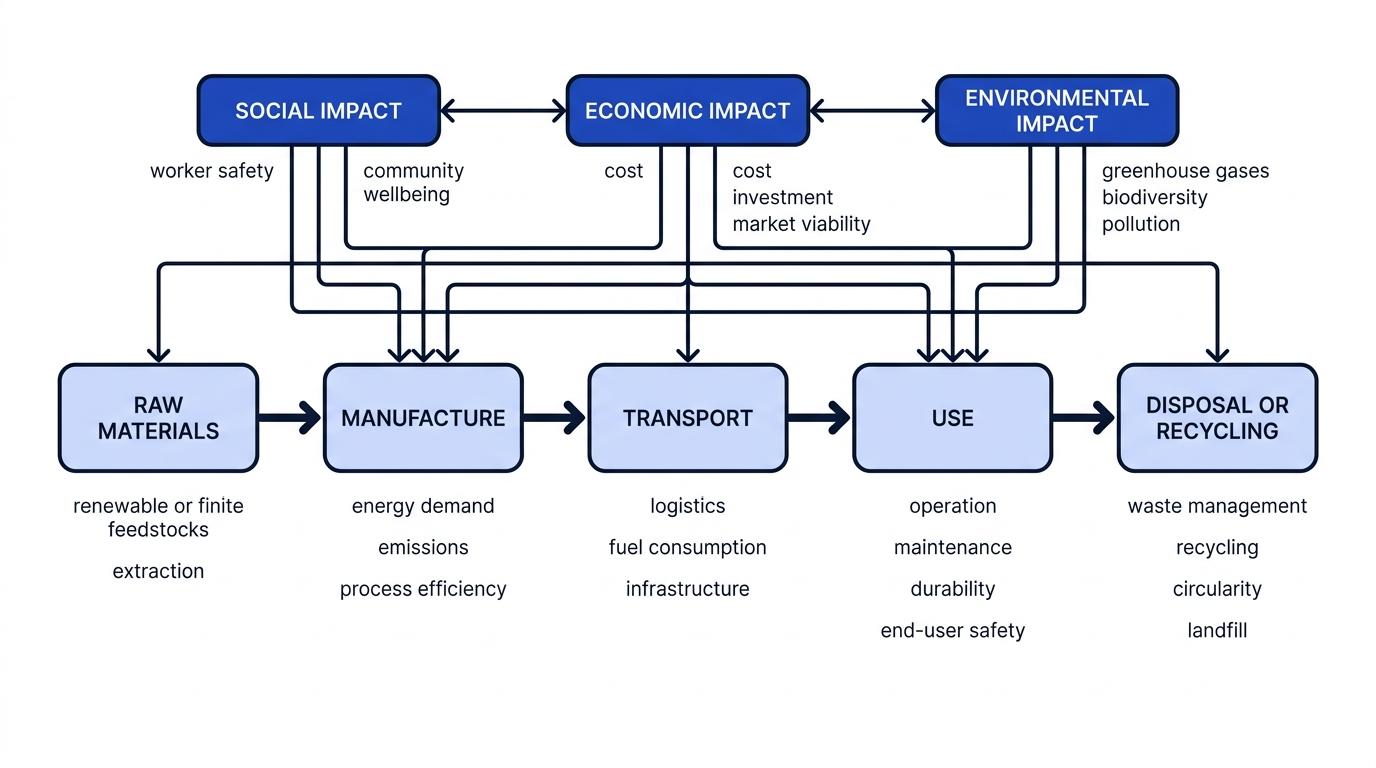
A strong chemistry judgement considers benefits and risks across the full lifecycle: raw materials, manufacture, transport, use, disposal and possible recycling.
Chemical synthesis: benefits and concerns
Chemical synthesis means making useful substances from simpler starting materials by chemical reactions.
Synthesis has transformed society. Medicines treat disease, polymers make lightweight materials, fertilisers increase food production, and detergents improve hygiene. These are real benefits.
However, synthesis can also involve:
- non-renewable feedstocks, especially crude oil and natural gas
- high energy demand
- hazardous reagents or solvents
- unwanted by-products
- difficult product disposal
- pollution from poor waste management
Example: making ethanol by different routes
Ethanol can be made by several routes. Two simplified routes are:
Hydration of ethene:
C2H4(g)+H2O(g)→C2H5OH(g)\text{C}_2\text{H}_4(g) + \text{H}_2\text{O}(g) \to \text{C}_2\text{H}_5\text{OH}(g)C2H4(g)+H2O(g)→C2H5OH(g)Reaction of chloroethane with sodium hydroxide:
C2H5Cl(l)+NaOH(aq)→C2H5OH(l)+NaCl(aq)\text{C}_2\text{H}_5\text{Cl}(l) + \text{NaOH}(aq) \to \text{C}_2\text{H}_5\text{OH}(l) + \text{NaCl}(aq)C2H5Cl(l)+NaOH(aq)→C2H5OH(l)+NaCl(aq)One useful green chemistry measure is atom economy.
Atom economy
Atom economy is the percentage of the atoms in the reactants that end up in the desired product.
atom economy=Mr of desired productsum of Mr of all reactants×100\text{atom economy} = \frac{M_r \text{ of desired product}}{\text{sum of } M_r \text{ of all reactants}} \times 100atom economy=sum of Mr of all reactantsMr of desired product×100Comparing atom economy for ethanol synthesis
-
For hydration of ethene, the only product is ethanol. All atoms from ethene and water become part of ethanol, so the atom economy is 100%.
-
For the chloroethane route, calculate the relative formula masses:
- C2H5OH\text{C}_2\text{H}_5\text{OH}C2H5OH: 2(12.0)+6(1.0)+16.0=46.02(12.0) + 6(1.0) + 16.0 = 46.02(12.0)+6(1.0)+16.0=46.0
- C2H5Cl\text{C}_2\text{H}_5\text{Cl}C2H5Cl: 2(12.0)+5(1.0)+35.5=64.52(12.0) + 5(1.0) + 35.5 = 64.52(12.0)+5(1.0)+35.5=64.5
- NaOH\text{NaOH}NaOH: 23.0+16.0+1.0=40.023.0 + 16.0 + 1.0 = 40.023.0+16.0+1.0=40.0
-
Substitute into the atom economy expression:
atom economy=46.064.5+40.0×100=44.0%\text{atom economy} = \frac{46.0}{64.5 + 40.0} \times 100 = 44.0\%atom economy=64.5+40.046.0×100=44.0% -
Compare the routes. The hydration route is more atom-efficient because it produces no stoichiometric waste product, whereas the chloroethane route also forms sodium chloride.
Atom economy is not the whole answer
A high atom economy is good, but it does not prove a process is fully sustainable. You should also consider yield, energy demand, catalyst use, solvent hazards, feedstock renewability and waste treatment.
Energy production: fossil fuels, shale gas and low-carbon options
Energy production is a major chemical issue because fuels store energy in chemical bonds. Combustion releases energy, but often produces carbon dioxide and other pollutants.
A typical complete combustion reaction for methane is:
CH4(g)+2O2(g)→CO2(g)+2H2O(l)\text{CH}_4(g) + 2\text{O}_2(g) \to \text{CO}_2(g) + 2\text{H}_2\text{O}(l)CH4(g)+2O2(g)→CO2(g)+2H2O(l)Methane is the main component of natural gas and shale gas. It releases less carbon dioxide per unit of energy than coal, but it is still a fossil fuel.
Shale gas and fracking
Shale gas is natural gas trapped in shale rock. It can be extracted by hydraulic fracturing, often called fracking, where high-pressure fluid is used to create cracks in the rock so gas can flow out.
Potential benefits include:
- increased domestic energy supply
- reduced dependence on imported fuels
- jobs and tax revenue
- gas-fired power stations that can respond quickly to demand
Potential risks include:
- carbon dioxide emissions from combustion
- methane leakage during extraction and transport
- water use and wastewater treatment
- possible induced seismic activity
- public concern about land use and groundwater contamination
Low-carbon energy
Low-carbon energy refers to energy sources or technologies with much lower lifecycle greenhouse gas emissions than fossil fuels. Examples include wind, solar, hydroelectric power, nuclear power and some bioenergy routes.
Making evidence-based comparisons
You may be asked to compare technologies using data. Look for what is being measured and whether the comparison covers the same boundary, such as “emissions during use” or “emissions over the full lifecycle”.
Comparing two energy options using emissions data
A region needs to generate 1.0×1091.0 \times 10^91.0×10⁹ kWh of electricity. A shale gas option emits 490 g CO₂ equivalent per kWh over its lifecycle. A wind-plus-storage option emits 25 g CO₂ equivalent per kWh over its lifecycle.
-
Calculate the lifecycle emissions for shale gas:
1.0×109 kWh×490 g kWh−1=4.90×10¹¹ g1.0 \times 10^9 \text{ kWh} \times 490 \text{ g kWh}^{-1} = 4.90 \times 10^{11} \text{ g}1.0×109 kWh×490 g kWh−1=4.90×10¹¹ gThis is 4.90×1054.90 \times 10^54.90×10⁵ tonnes, because one tonne is 10610^6106 g.
-
Calculate the lifecycle emissions for wind plus storage:
1.0×109 kWh×25 g kWh−1=2.5×10¹⁰ g1.0 \times 10^9 \text{ kWh} \times 25 \text{ g kWh}^{-1} = 2.5 \times 10^{10} \text{ g}1.0×109 kWh×25 g kWh−1=2.5×10¹⁰ gThis is 2.5×1042.5 \times 10^42.5×10⁴ tonnes.
-
Compare the environmental evidence. The wind-plus-storage option has much lower greenhouse gas emissions for the same electricity output.
-
Add non-emissions factors before making a final judgement. Shale gas may be dispatchable and use existing infrastructure, while wind may require storage, grid upgrades and careful site selection. A balanced conclusion should weigh these alongside the emissions data.
Check the comparison boundary
“Low emissions during use” is not always the same as “low emissions overall”. A fair comparison should consider construction, extraction, transport, operation and disposal where possible.
Green chemistry
Green chemistry is about designing chemical products and processes to reduce harm from the start, rather than cleaning up pollution afterwards.
Green chemistry
Green chemistry is the design of chemical products and processes that reduce or eliminate the use and generation of hazardous substances, while improving sustainability.
Green chemistry can involve:
- preventing waste rather than treating it later
- using renewable feedstocks where possible
- improving atom economy
- using catalysts instead of stoichiometric reagents
- using safer solvents, or avoiding solvents
- reducing temperature and pressure requirements
- designing products that degrade safely after use
- making processes safer for workers and surrounding communities
Catalysts and lower energy demand
A catalyst increases the rate of reaction without being used up overall. Catalysts can improve sustainability because they allow reactions to happen under milder conditions or with fewer by-products.
For example, if a catalyst allows a process to run at a lower temperature, less fuel may be needed. That can reduce carbon dioxide emissions and operating costs.
Safer solvents
A solvent is a liquid used to dissolve reactants or allow them to mix. Many traditional organic solvents are volatile, flammable or toxic. Greener alternatives may include water, ethanol, supercritical carbon dioxide, or solvent-free conditions.
Designing for the end of life
A product can be useful during its lifetime but problematic after disposal. Green chemistry considers whether a material can be:
- reused
- recycled
- chemically broken back into useful monomers
- biodegraded into harmless products
- safely incinerated with energy recovery
Use the lifecycle checklist
For evaluation questions, move through: raw materials → manufacture → use → disposal. This helps you avoid writing only about one stage.
Correlation, causation and evidence quality
In this topic, exam questions may give you data about pollution, health, emissions or costs. You need to decide what the data can and cannot prove.
Correlation and causation
A correlation is a relationship between two variables. Causation means that one variable directly causes a change in another. A correlation alone does not prove causation.
For example, if illness rates are higher near a chemical plant, that is important evidence, but it does not automatically prove the plant caused the illness. Scientists would need more evidence, such as measured emissions, exposure levels, comparison with control areas, plausible chemical mechanisms, and repeated studies.
The scientific community helps validate claims by using:
- peer review
- independent replication
- transparent data and methods
- risk assessment
- monitoring over time
- open discussion of uncertainty and conflicts of interest
Ethical issues in chemical decisions
Chemistry decisions can affect people unequally. A process may provide cheap products for many people while creating pollution for a smaller local community. This raises ethical questions.
Useful ethical questions include:
- Who benefits?
- Who is exposed to risk?
- Are affected communities properly consulted?
- Are future generations being left with waste or climate impacts?
- Are animals, ecosystems and biodiversity being protected?
- Is the evidence being presented honestly?
Sustainable chemistry is a judgement
The most sustainable option is rarely chosen from one number alone. It is an evidence-based balance of chemical efficiency, safety, cost, resource use, emissions, social benefit and long-term responsibility.
Writing balanced conclusions
A good answer does not simply say “this is good” or “this is bad”. Instead, it weighs evidence.
A strong structure is:
- State a benefit, linked to chemistry or data.
- State a risk or limitation, linked to chemistry or data.
- Compare the importance of the points.
- Give a justified conclusion, including any conditions needed.
For example: “Shale gas could improve short-term energy security and provide flexible electricity generation, but it still produces carbon dioxide on combustion and methane leakage would significantly reduce its climate advantage. Therefore, it may be useful only as a short-term transition fuel if leakage is tightly controlled and investment in low-carbon energy continues.”
Writing a one-sided answer
In evaluation questions, a list of only advantages or only disadvantages usually cannot access the highest marks. Show that you can balance competing evidence.
In the exam
-
Use the words social, economic and environmental to organise evaluation answers clearly.
-
Quote or process data where it is provided, then explain what it means chemically.
-
Avoid absolute claims such as “completely green” or “no pollution” unless the evidence really supports them.
-
For green chemistry, mention specific improvements such as higher atom economy, catalysts, safer solvents, renewable feedstocks or reduced energy demand.
Check yourself
- Why might a process with 100% atom economy still not be the most sustainable option?
- What are two environmental risks and two economic benefits associated with shale gas extraction?
- How would you distinguish correlation from causation in data about pollution and human health?