What you'll learn
- How to represent organic compounds using displayed, shortened and skeletal formulae.
- How to name alkanes, alkenes, halogenoalkanes, alcohols and carboxylic acids.
- How chain length and functional groups affect melting temperature, boiling temperature and solubility.
- How to describe structural isomers, electrophiles, nucleophiles, radicals and bond fission.
The basic idea: carbon compounds
Organic chemistry is the chemistry of carbon-containing compounds, especially molecules with carbon–carbon and carbon–hydrogen bonds. Carbon is very good at forming chains and rings because each carbon atom usually forms four covalent bonds.
A hydrocarbon is a compound containing carbon and hydrogen only. For example, methane, ethane and ethene are hydrocarbons.
A functional group is an atom or group of atoms that gives an organic molecule its characteristic chemical reactions. For example, the –OH group makes a molecule an alcohol.
Functional group
A functional group is the reactive atom or group of atoms in an organic molecule that determines many of its chemical properties.
Representing organic molecules
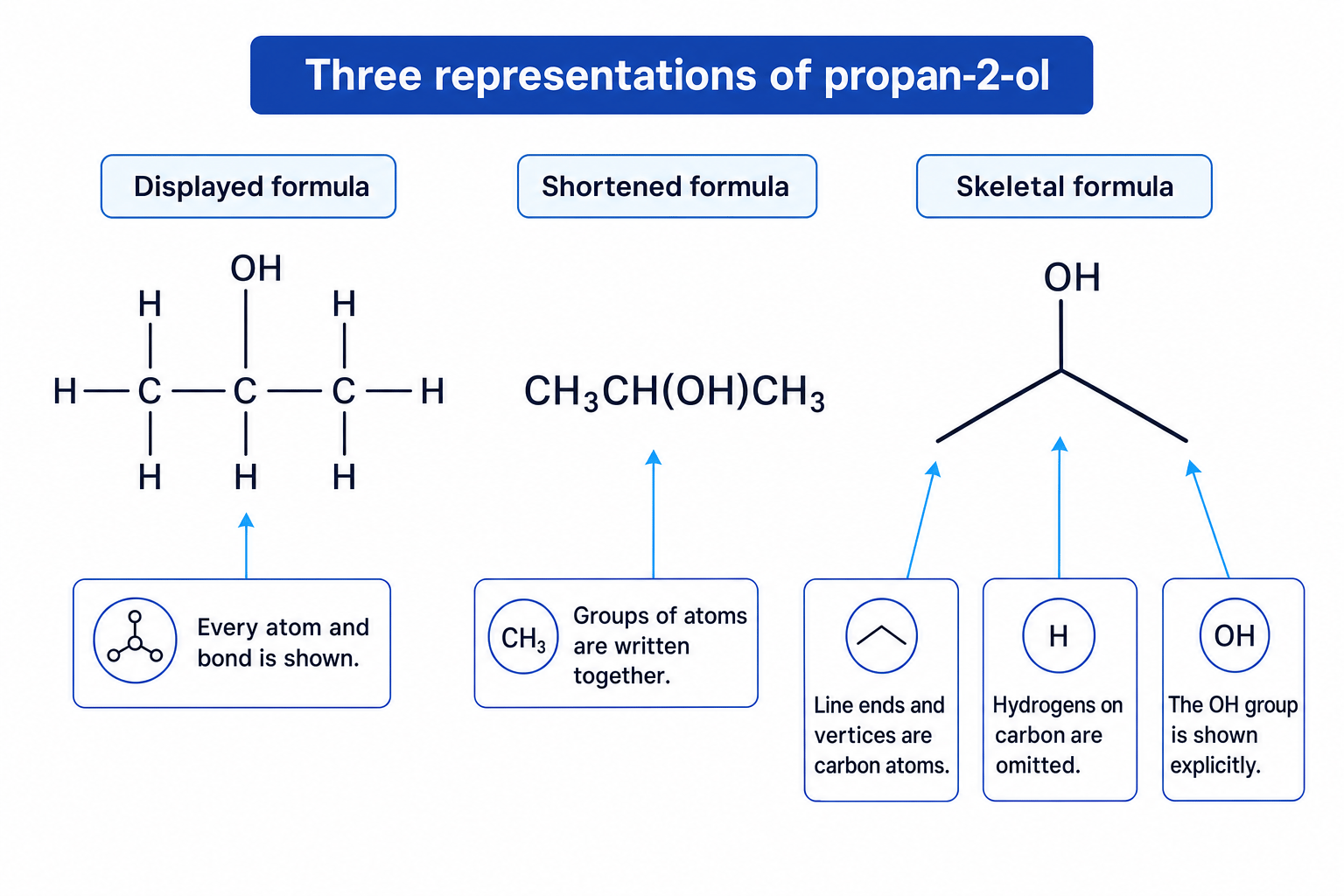
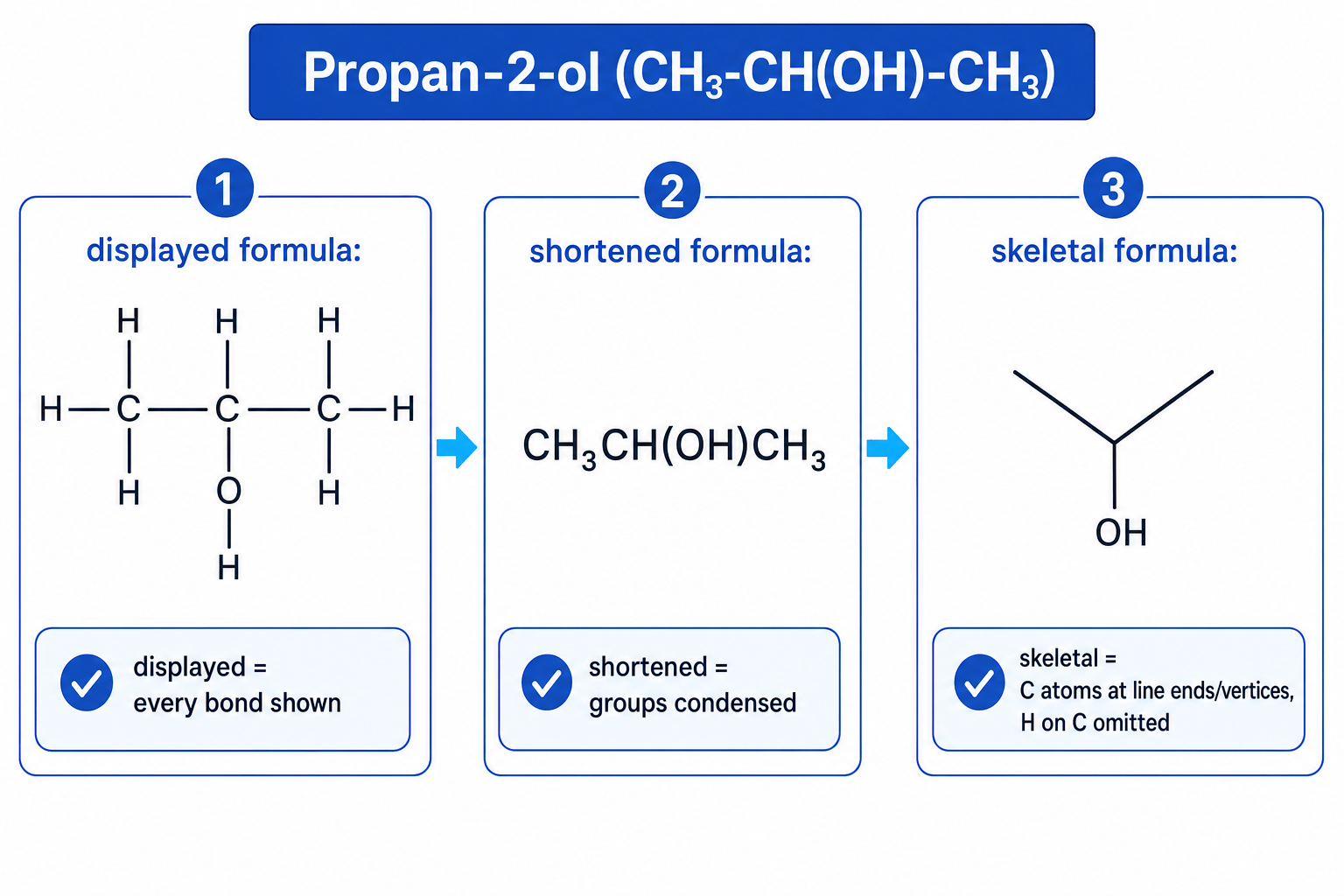
You need to move confidently between different formula types. They all show the same molecule, but with different amounts of detail.
Displayed formula
A displayed formula shows every atom and every covalent bond. This is useful when you are first learning bonding and mechanisms.
Shortened formula
A shortened formula groups atoms together to make the structure quicker to write. For example, propan-2-ol can be written as CH3CH(OH)CH3.
Skeletal formula
A skeletal formula is the fastest representation used in organic chemistry.
In skeletal formulae:
- each line represents a covalent bond between carbon atoms
- each line end or vertex represents a carbon atom
- hydrogen atoms attached to carbon are not shown
- atoms other than carbon, such as O, N, Cl or Br, are shown
- hydrogen atoms attached to non-carbon atoms, such as the H in
–OH, are shown
Forgetting hidden hydrogens
In skeletal formulae, carbon still has four bonds overall. If a carbon appears to have only two or three bonds drawn, the missing bonds are usually to hydrogen atoms.
Families of organic compounds
Organic compounds are often grouped into homologous series. A homologous series is a family of compounds with the same functional group and similar chemical properties, where neighbouring members differ by CH2.
Homologous series
A homologous series is a family of organic compounds with the same functional group, similar chemical reactions and a gradual change in physical properties.
Key functional groups for C3.1
| Family | Key feature | Example name | Example formula |
|---|---|---|---|
| Alkane | C–C single bonds only | propane | CH3CH2CH3 |
| Alkene | C=C double bond | propene | CH2CHCH3 |
| Halogenoalkane | C–halogen bond | 1-bromopropane | CH3CH2CH2Br |
| Alcohol | –OH group | propan-1-ol | CH3CH2CH2OH |
| Carboxylic acid | –COOH group | propanoic acid | CH3CH2COOH |
Naming organic compounds
Organic names are systematic: the name tells you the structure.
Chain length prefixes
You should know these common prefixes:
| Number of carbons | Prefix |
|---|---|
| 1 | meth- |
| 2 | eth- |
| 3 | prop- |
| 4 | but- |
| 5 | pent- |
| 6 | hex- |
Main naming rules
- Find the longest carbon chain containing the main functional group.
- Number the chain to give the main functional group the lowest possible number.
- Identify side groups or halogens as prefixes, such as methyl-, chloro- or bromo-.
- Use the correct ending:
- alkanes end in -ane
- alkenes end in -ene
- alcohols end in -ol
- carboxylic acids end in -oic acid
- Use numbers, called locants, to show positions when needed.
Names are instructions
A good organic name is like a set of building instructions: it tells you the chain length, functional group, and where any branches or substituents are.
Naming alkanes
Alkanes are saturated hydrocarbons. Saturated means they contain only carbon–carbon single bonds.
Examples:
- CH4 is methane
- CH3CH3 is ethane
- CH3CH2CH3 is propane
Naming alkenes
Alkenes contain a carbon–carbon double bond, C=C. Use the ending -ene and number the chain to show where the double bond starts.
For example:
- CH2CHCH3 is propene
- CH3CHCHCH3 is but-2-ene
Naming halogenoalkanes
Halogenoalkanes contain a halogen atom: F, Cl, Br or I. The halogen is named as a prefix:
- fluoro-
- chloro-
- bromo-
- iodo-
For example, CH3CHBrCH3 is 2-bromopropane.
Naming alcohols
Alcohols contain the –OH functional group. Use the ending -ol.
For example:
- CH3CH2OH is ethanol
- CH3CH(OH)CH3 is propan-2-ol
Naming carboxylic acids
Carboxylic acids contain the –COOH functional group. Use the ending -oic acid.
The carbon in the –COOH group is always carbon 1, so simple carboxylic acids usually do not need a number for the acid group.
For example:
- HCOOH is methanoic acid
- CH3COOH is ethanoic acid
- CH3CH2COOH is propanoic acid
Naming a substituted alcohol
Name CH3CH(CH3)CH(OH)CH3.
-
Choose the longest chain containing the
–OHgroup. The longest suitable chain has four carbon atoms, so the parent name is based on butan-. -
Number the chain to give the
–OHgroup the lowest number. Numbering from the right gives the–OHon carbon 2, so the parent alcohol is butan-2-ol. -
Identify the branch. There is a CH3 branch on carbon 3, so add the prefix 3-methyl-.
-
Combine the parts with correct punctuation: 3-methylbutan-2-ol.
Punctuation in names
Use commas between numbers, and hyphens between numbers and words: for example, 2,3-dibromobutane, not 2-3 dibromobutane.
Physical properties of organic compounds
Physical properties include melting temperature, boiling temperature and solubility. These depend strongly on intermolecular forces — the attractions between molecules.
Effect of increasing chain length
As the carbon chain gets longer:
- molecules have more electrons
- the surface area increases
- London forces between molecules become stronger
- boiling temperature generally increases
- melting temperature generally increases, although less smoothly
- solubility in water usually decreases for compounds with long hydrocarbon chains
London forces
London forces are weak intermolecular attractions caused by temporary dipoles. They are present between all molecules and become stronger as molecular size and electron number increase.
Effect of functional groups
Functional groups can make molecules more polar and can introduce stronger intermolecular forces.
- Alkanes and alkenes are mostly non-polar, so they are insoluble in water and have relatively low boiling temperatures.
- Halogenoalkanes have polar C–halogen bonds, so their boiling temperatures are often higher than similar alkanes, but they do not hydrogen-bond well with water.
- Alcohols can form hydrogen bonds because they contain
–OH, so short-chain alcohols are quite soluble in water and have higher boiling temperatures than similar alkanes. - Carboxylic acids can form strong hydrogen bonds and often have high boiling temperatures. Short-chain carboxylic acids are soluble in water.
Two competing effects
A polar functional group increases attraction to water, but a longer non-polar hydrocarbon chain reduces water solubility.
Comparing boiling temperature and solubility
Compare ethane, ethanol and hexan-1-ol.
-
Ethane is a small non-polar molecule, so it has only weak London forces. It has a low boiling temperature and is not soluble in water.
-
Ethanol has an
–OHgroup, so ethanol molecules form hydrogen bonds with each other and with water. Its boiling temperature is much higher than ethane’s, and it is soluble in water. -
Hexan-1-ol also has an
–OHgroup, but it has a much longer non-polar hydrocarbon chain. It has stronger London forces than ethanol, so its boiling temperature is higher, but it is less soluble in water.
Melting temperatures are less predictable
Boiling temperature usually shows a clearer trend with chain length. Melting temperature also depends on how well molecules pack in the solid, so branching and symmetry can disrupt the pattern.
Structural isomerism
Two molecules can have the same molecular formula but different structures. These are called isomers.
Structural isomerism
Structural isomers are compounds with the same molecular formula but different structural formulae, meaning their atoms are connected in different ways.
Common types of structural isomerism
You should be able to recognise simple examples.
Chain isomerism
The carbon skeleton is arranged differently.
Example: C4H10 can be:
- butane, CH3CH2CH2CH3
- 2-methylpropane, CH3CH(CH3)CH3
Position isomerism
The same functional group is in a different position.
Example: C3H8O can be:
- propan-1-ol
- propan-2-ol
Functional group isomerism
The atoms are connected to form different functional groups. For this introductory topic, you mainly need the concept: same molecular formula, different connectivity.
Rotating is not isomerism
If two drawings only differ because a single bond has been rotated, they are not structural isomers. Structural isomers must have different atom-to-atom connectivity.
Finding structural isomers of C4H10
Find the structural isomers with molecular formula C4H10.
-
Start with the longest possible straight carbon chain using all four carbons. This gives butane: CH3CH2CH2CH3.
-
Try making a shorter main chain and using the remaining carbon as a branch. A three-carbon chain with one methyl branch gives CH3CH(CH3)CH3.
-
Check for duplicates. Putting the methyl branch on carbon 1 would simply recreate a four-carbon straight chain, so it is not a new isomer.
-
Therefore C4H10 has two structural isomers: butane and 2-methylpropane.
Reactive species and bond fission
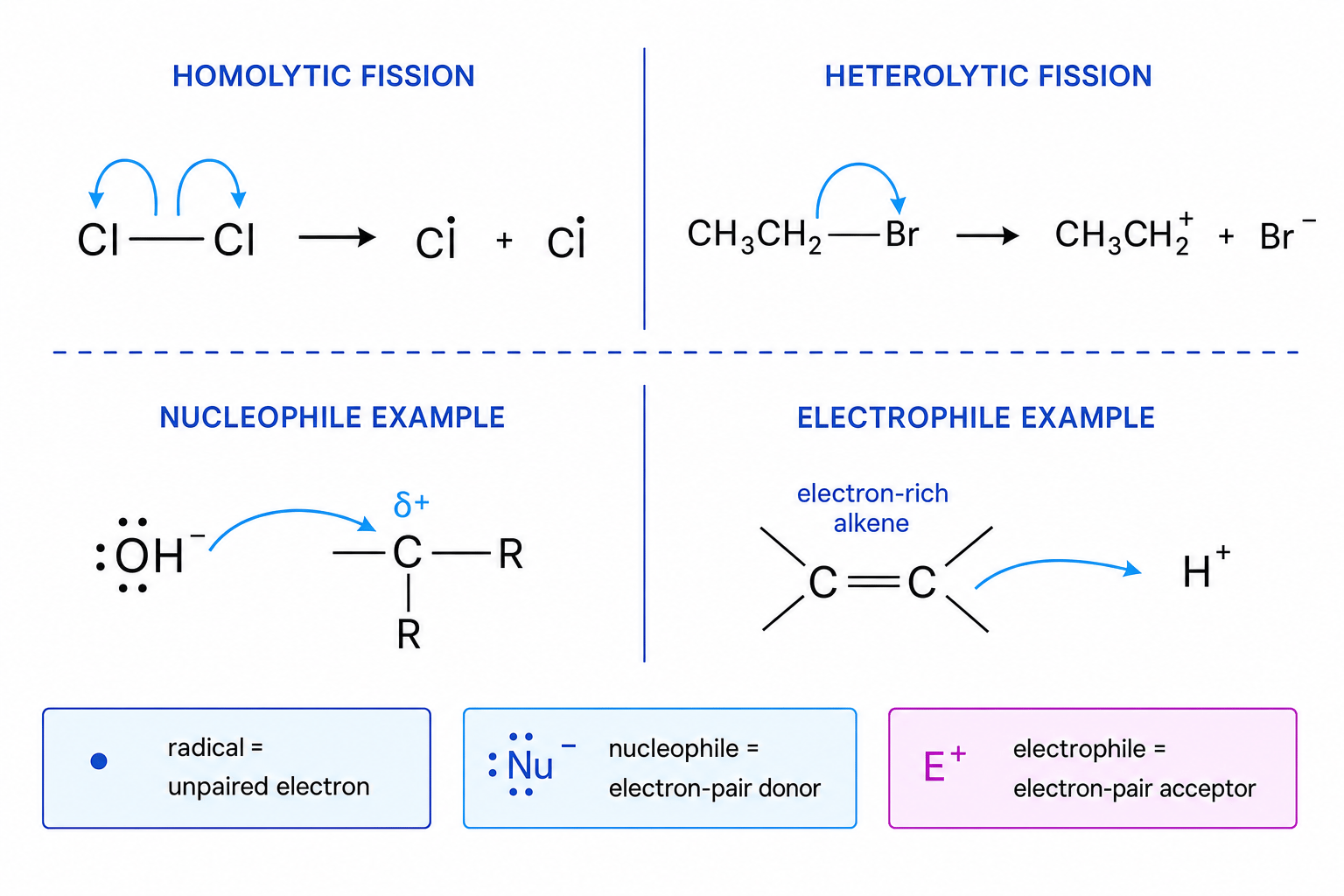
Organic mechanisms describe how bonds break and form. The arrows show movement of electrons, not movement of atoms.
Bond fission
Bond fission means breaking a covalent bond.
There are two important types:
- homolytic fission
- heterolytic fission
Homolytic and heterolytic fission
In homolytic fission, each atom takes one electron from the covalent bond, forming radicals. In heterolytic fission, one atom takes both electrons from the covalent bond, forming ions.
Radicals
A radical is a species with an unpaired electron. Radicals are often shown using a dot, for example Cl•.
Homolytic fission is usually shown with single-headed curly arrows, sometimes called fish-hook arrows. For example, chlorine molecules can undergo homolytic fission under ultraviolet light:
Cl2 → 2Cl•
Nucleophiles
A nucleophile is an electron-pair donor. Nucleophiles are attracted to electron-deficient atoms, such as a carbon atom with a partial positive charge.
Common nucleophiles include:
- OH−
- CN−
- NH3
- H2O
Electrophiles
An electrophile is an electron-pair acceptor. Electrophiles are attracted to electron-rich regions, such as a C=C double bond or a lone pair.
Common electrophiles include:
- H+
- NO2+
- polarised Br2
Starting curly arrows in the wrong place
A full curly arrow must start at an electron source, such as a lone pair, a negative charge or a covalent bond. It should not start at a positive charge.
Classifying species and bond breaking
Classify OH−, H+ and Cl•, and state the type of bond fission that forms Cl• from Cl2.
-
OH− has a negative charge and lone pairs on oxygen, so it can donate an electron pair. It is a nucleophile.
-
H+ has no electrons and can accept an electron pair to form a bond. It is an electrophile.
-
Cl• has an unpaired electron, shown by the dot. It is a radical.
-
Cl2 forming two Cl• radicals means the bonding pair is split equally, with one electron going to each chlorine atom. This is homolytic fission.
In the exam
-
When naming, first identify the longest chain and the main functional group before worrying about branches.
-
For skeletal formulae, count every line end and vertex as a carbon unless another atom is written there.
-
For isomer questions, check the molecular formula is unchanged and that the connectivity is genuinely different.
-
For mechanisms, remember: full curly arrows move electron pairs; fish-hook arrows move single electrons.
Check yourself
- What is the difference between a displayed formula and a skeletal formula?
- Name CH3CHBrCH2CH3.
- Why is ethanol more soluble in water than hexane?