

What you'll learn
- How stereoisomerism is different from structural isomerism.
- Why restricted rotation around a C=C bond gives E–Z isomers.
- How an asymmetric carbon atom leads to optical isomerism.
- How enantiomers affect plane-polarised light and why this matters in biochemistry.
Starting point: what is an isomer?
An isomer is one of two or more compounds with the same molecular formula but a different arrangement of atoms. The key question is: are the atoms connected differently, or are they connected the same way but arranged differently in space?
Isomers and the two big classes
- Structural isomers have the same molecular formula but different connectivity: the atoms are joined in a different order.
- Stereoisomers have the same molecular formula and the same connectivity, but the atoms are arranged differently in 3D space.
- In this topic, stereoisomerism includes E–Z isomerism and optical isomerism.
A quick way to separate them is to check the bonding pattern first. If a bond is to a different atom, you are dealing with structural isomerism. If the bonding pattern is identical and only the 3D arrangement differs, it is stereoisomerism.
Classifying isomers
-
Compare CH₃CH₂CH₂OH and CH₃CH(OH)CH₃. Both have the molecular formula C₃H₈O, so they are possible isomers.
-
In CH₃CH₂CH₂OH, the OH group is on carbon 1. In CH₃CH(OH)CH₃, the OH group is on carbon 2, so the atoms are connected differently.
-
They are structural isomers, not stereoisomers, because the difference is connectivity rather than 3D arrangement.
Why stereoisomerism happens
Stereoisomerism appears when a molecule’s 3D arrangement is “locked” in some way.
For alkenes, the C=C double bond is rigid because the pi bond prevents free rotation. For optical isomerism, a tetrahedral carbon can have four different groups arranged in two mirror-image ways.
Same connections, different space
Stereoisomers have the same atoms joined in the same order, but the molecule’s 3D shape is different enough to make a distinct isomer.
E–Z isomerism
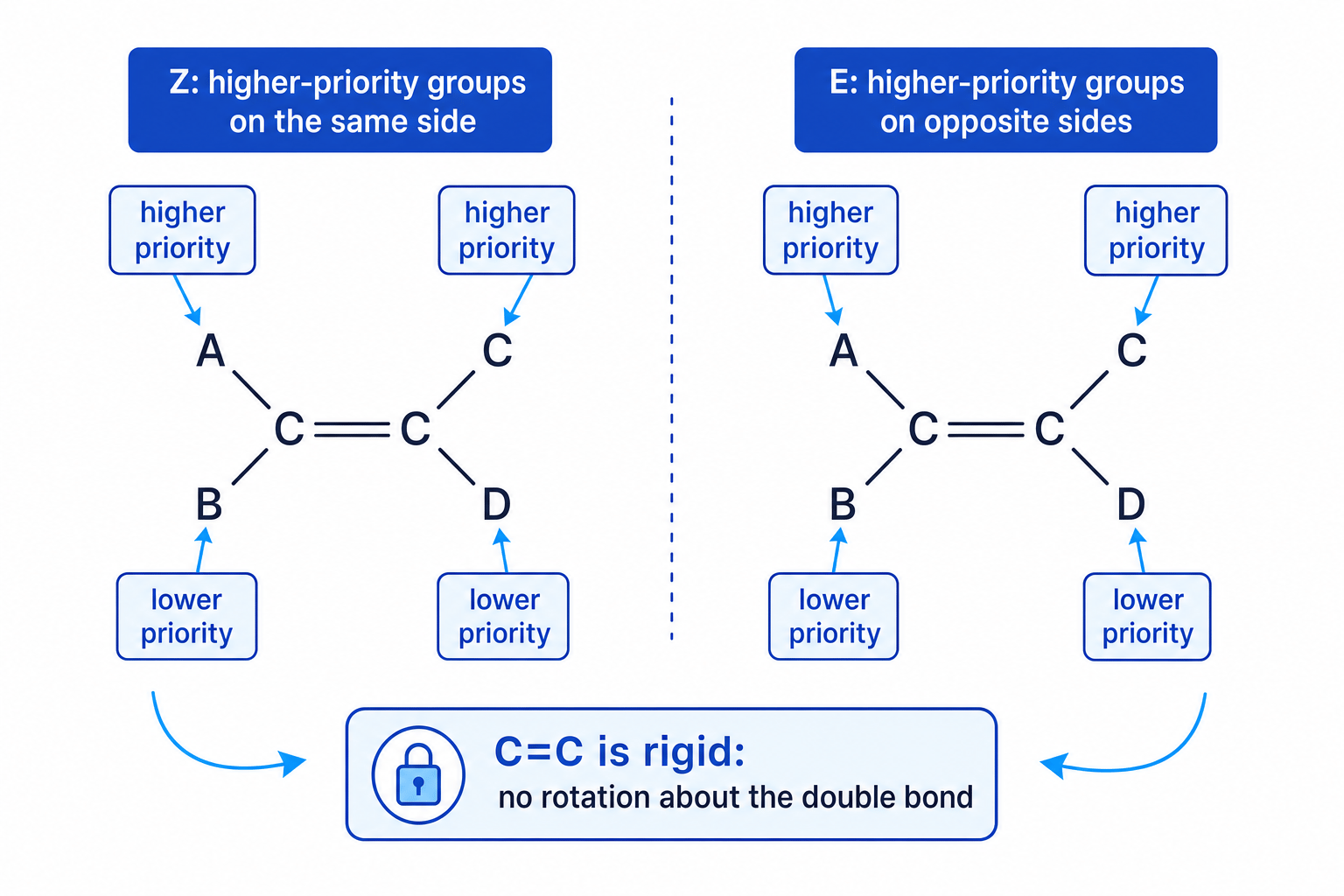
E–Z isomerism occurs in some alkenes because rotation about the C=C double bond is restricted.
For E–Z isomerism to be possible, each carbon atom in the C=C bond must be attached to two different groups. If one of the double-bonded carbons has two identical groups, there is no E–Z isomerism.
E and Z
- Z means the higher-priority groups are on the same side of the C=C bond.
- E means the higher-priority groups are on opposite sides of the C=C bond.
- Priority is usually decided using atomic number: the atom with the higher atomic number has higher priority.
The letters come from German: Z from zusammen meaning “together”, and E from entgegen meaning “opposite”.
Assigning priorities
On each carbon of the C=C bond:
- Look at the two atoms directly attached to that carbon.
- The atom with the higher atomic number has higher priority.
- If the directly attached atoms are the same, compare the atoms further along the chains until a difference is found.
Choosing priority by size
Do not choose the “largest-looking” group first. For E–Z priority, compare the atoms directly attached to the C=C carbon by atomic number; only move further along the group if there is a tie.
Assigning E or Z
Consider an alkene drawn so that Br and Cl are above the C=C bond, while H and CH₃ are below it.
-
On the left-hand carbon of the C=C bond, compare Br and H. Bromine has a higher atomic number than hydrogen, so Br is the higher-priority group.
-
On the right-hand carbon of the C=C bond, compare Cl and CH₃. The directly attached atoms are Cl and C; chlorine has the higher atomic number, so Cl is the higher-priority group.
-
The higher-priority groups, Br and Cl, are on the same side of the C=C bond, so the isomer is the Z isomer.
When E–Z isomerism is not possible
Propene, CH₃CH=CH₂, does not show E–Z isomerism because the terminal carbon in the C=C bond is attached to two identical hydrogen atoms.
But-2-ene, CH₃CH=CHCH₃, does show E–Z isomerism because each carbon in the C=C bond is attached to H and CH₃.
Optical isomerism: mirror-image molecules
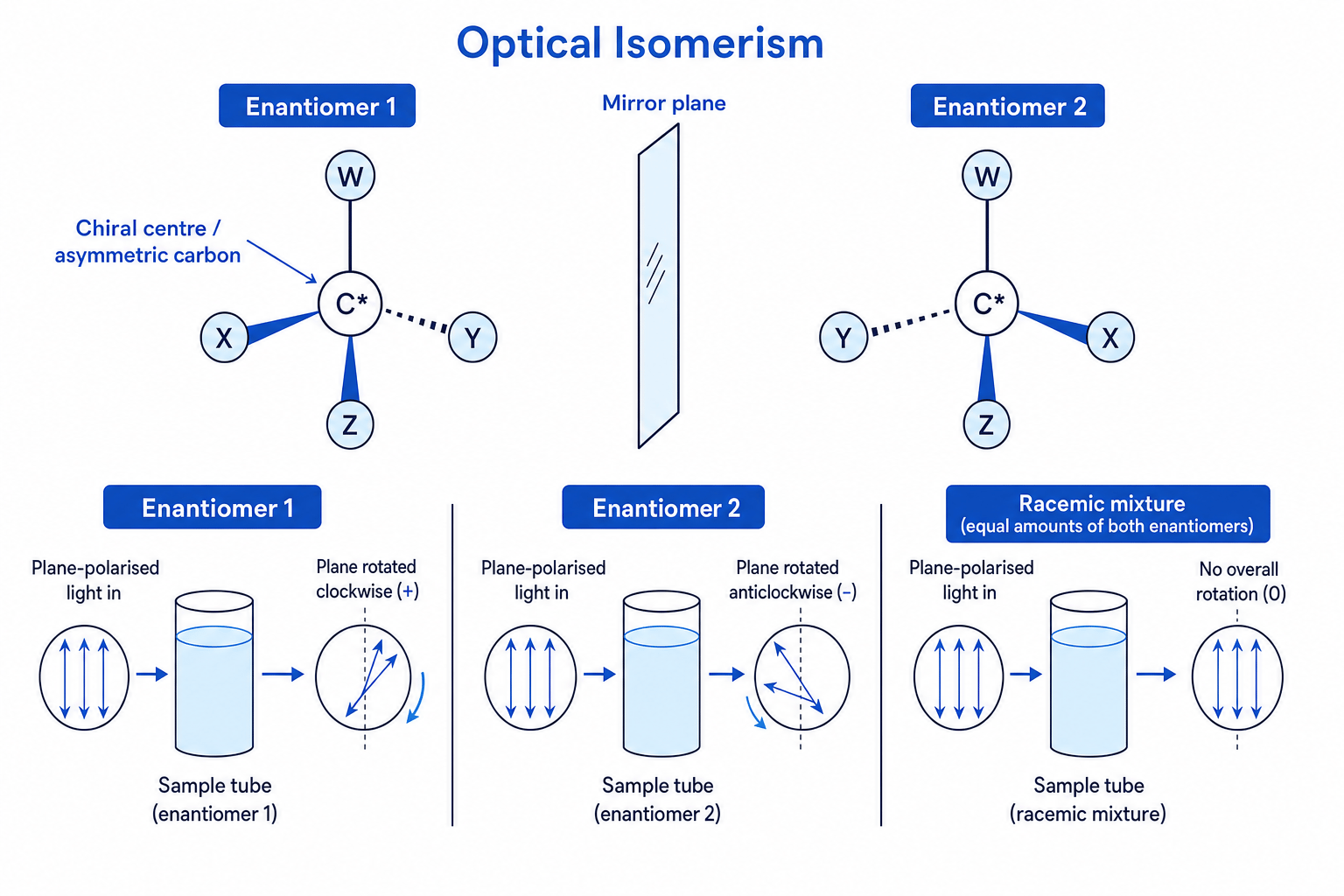
Optical isomerism is a type of stereoisomerism involving molecules that are non-superimposable mirror images. “Non-superimposable” means you cannot rotate one structure in 3D and make every atom line up with the other.
A familiar comparison is your left and right hands: they are mirror images, but they are not identical when placed on top of each other.
Key optical-isomerism terms
- A chiral molecule is one that is not superimposable on its mirror image.
- A chiral centre is an atom that causes chirality; at A-Level this is usually a tetrahedral carbon attached to four different groups.
- An asymmetric carbon atom is a carbon atom bonded to four different atoms or groups.
- Enantiomers are a pair of optical isomers that are non-superimposable mirror images.
- Optical activity is the ability of a substance to rotate the plane of plane-polarised light.
- A racemic mixture contains equal amounts of the two enantiomers.
Drawing 3D structures
Organic molecules are often drawn using wedge-and-dash notation:
- A solid wedge shows a bond coming out of the page towards you.
- A dashed wedge shows a bond going behind the page.
- A normal straight line shows a bond roughly in the plane of the page.
This notation is especially useful around an asymmetric carbon atom, because the arrangement of the four groups determines which enantiomer you have.
Testing for a chiral centre
For a simple A-Level molecule, look for a tetrahedral carbon bonded to four different groups. If two of the groups are identical, that carbon is not asymmetric.
Identifying chiral centres in alcohols
-
In butan-2-ol, CH₃CH(OH)CH₂CH₃, carbon 2 is tetrahedral and bonded to H, OH, CH₃ and CH₂CH₃.
-
Those four groups are all different, so carbon 2 is an asymmetric carbon atom. Butan-2-ol can exist as a pair of enantiomers.
-
In propan-2-ol, CH₃CH(OH)CH₃, carbon 2 is bonded to H, OH and two identical CH₃ groups. Because two groups are the same, carbon 2 is not asymmetric, so propan-2-ol does not show optical isomerism.
Plane-polarised light and optical activity
Ordinary light vibrates in many planes. Plane-polarised light vibrates in one plane only.
A single enantiomer rotates the plane of plane-polarised light. One enantiomer rotates it clockwise, often labelled plus, and the other rotates it anticlockwise, often labelled minus. Under the same conditions, the rotations are equal in size but opposite in direction.
A racemic mixture has no overall optical activity because the two enantiomers cancel each other’s rotations.
Predicting optical rotation
A pure sample of one enantiomer rotates plane-polarised light by +8.4° under fixed conditions.
-
The other enantiomer must rotate the plane by the same amount in the opposite direction, so its rotation is −8.4° under the same conditions.
-
A racemic mixture contains equal amounts of both enantiomers, so the rotations cancel: +8.4∘+(−8.4∘)=0.0∘+8.4^\circ + (-8.4^\circ) = 0.0^\circ+8.4∘+(−8.4∘)=0.0∘.
-
The racemic mixture is therefore optically inactive overall, even though it contains chiral molecules.
Calling a racemate achiral
A racemic mixture is optically inactive overall, but the individual molecules in it are still chiral. The observed rotation is zero because equal and opposite rotations cancel.
Why optical isomerism matters in biochemistry
Many biological molecules are chiral, including amino acids, sugars, enzymes and receptors. Enzymes and receptors have 3D active sites, so they can interact very differently with two enantiomers of the same compound.
This is important in medicines. One enantiomer may give the desired therapeutic effect, while the other may be less active or may cause unwanted side effects. That is why the production, testing and regulation of single-enantiomer drugs is scientifically and ethically important.
Biochemical specificity
In a chiral biological environment, enantiomers can have very different effects because their 3D shapes fit differently into enzyme active sites and receptor binding sites.
Comparing the two types
| Feature | E–Z isomerism | Optical isomerism |
|---|---|---|
| Main cause | Restricted rotation around C=C | Non-superimposable mirror-image molecules |
| Typical requirement | Each C in C=C has two different groups | Usually a carbon bonded to four different groups |
| Relationship between isomers | Same connectivity, different arrangement around C=C | Enantiomers: mirror images |
| Key property | Different spatial arrangement about a double bond | Rotates plane-polarised light |
| Racemic mixture involved? | No | Yes, equal amounts of two enantiomers |
In the exam
-
First compare molecular formula and connectivity: different connectivity means structural isomerism, not stereoisomerism.
-
For a C=C bond, check that each double-bonded carbon has two different groups, then assign priorities and decide Z for same side or E for opposite sides.
-
For optical isomerism, look for a tetrahedral carbon with four different groups and describe the two forms as non-superimposable mirror images.
-
When asked about optical activity, state that enantiomers rotate plane-polarised light by equal amounts in opposite directions, while a racemic mixture has no overall rotation.
Check yourself
- Why does CH₃CH=CH₂ not show E–Z isomerism, but CH₃CH=CHCH₃ does?
- In CH₃CH(OH)COOH, which carbon is asymmetric, and what four groups is it bonded to?
- If one enantiomer rotates plane-polarised light by +13°, what would you expect for the other enantiomer and for a racemic mixture?
