Aromaticity
What you'll learn
- How benzene is bonded: planar, sp² carbons and a delocalised π system.
- Why benzene is more stable than a “three double bond” structure suggests.
- Why arenes usually undergo substitution rather than addition.
- How nitration, halogenation and Friedel-Crafts alkylation fit the same electrophilic substitution mechanism.
The orbital idea behind aromaticity
“Aromatic” in chemistry does not just mean “has a smell”. It describes a special type of bonding and stability.
Aromaticity
Aromaticity is the extra stability shown by a cyclic, planar, fully conjugated π system. Conjugated means adjacent p orbitals can overlap continuously, allowing π electrons to be delocalised over several atoms.
A σ bond is a covalent bond formed by end-on orbital overlap along the line between two nuclei. A π bond is formed by side-on overlap of p orbitals, with electron density above and below the σ bond framework.
An arene is an aromatic hydrocarbon based on a benzene ring. Examples include benzene, methylbenzene and ethylbenzene. The group C₆H₅– is called the phenyl group.
Benzene: structure and bonding
Benzene has molecular formula C₆H₆. Each carbon atom is sp² hybridised, meaning it forms three σ bonds in a trigonal planar arrangement with bond angles of 120°. Each carbon has one unhybridised p orbital perpendicular to the plane of the ring.
The six p orbitals overlap side-on around the ring. This forms a delocalised π electron cloud above and below the ring, containing six π electrons.
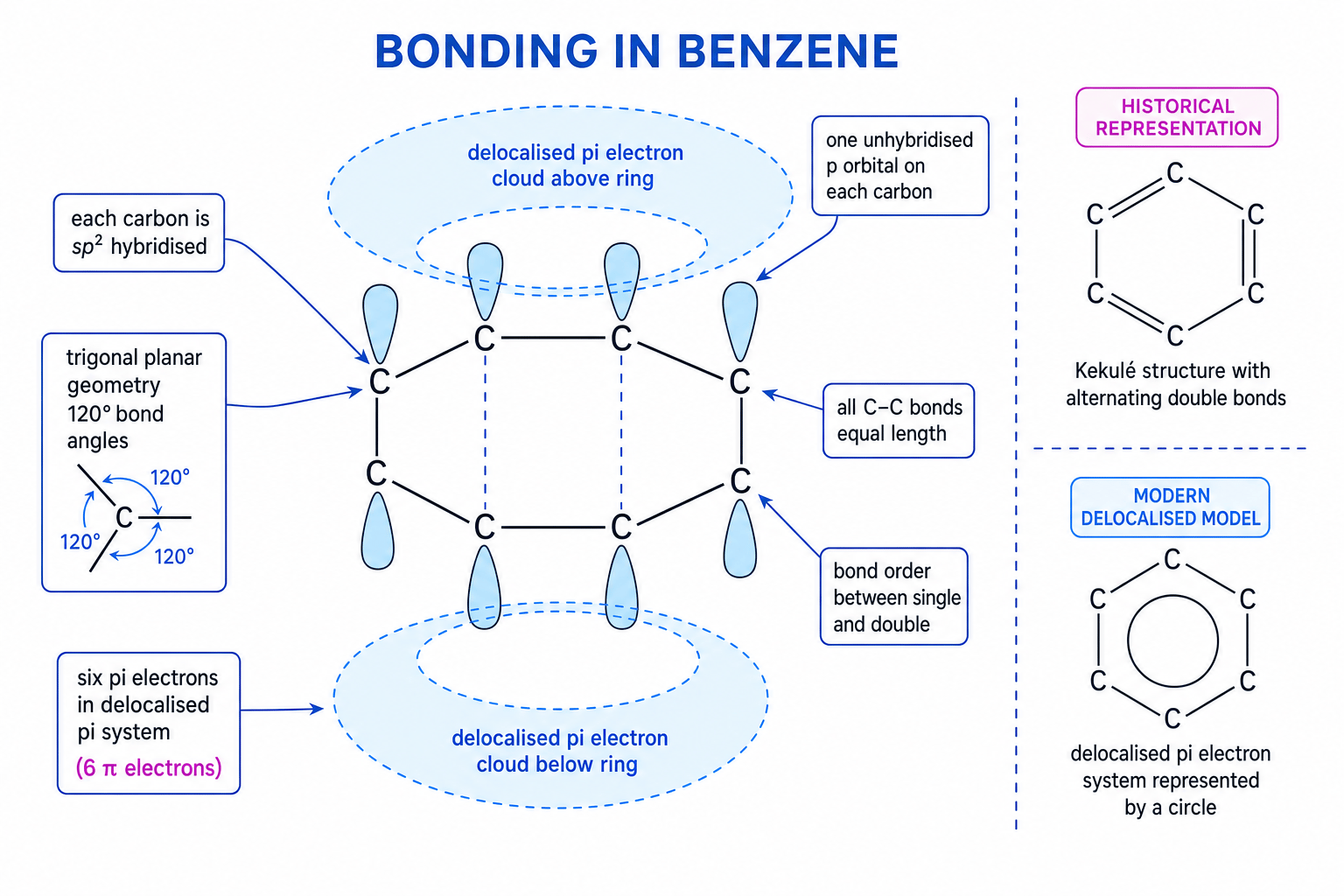
Because the π electrons are spread over the whole ring, all six C—C bonds in benzene are identical. Their length is about 0.139 nm, between a typical C—C single bond and a C=C double bond.
Benzene is not cyclohexa-1,3,5-triene
Do not explain benzene as “three normal double bonds”. The Kekulé structure is a useful historical representation, but the real molecule has one delocalised π system and equal C—C bonds.
Evidence for aromatic stability
The delocalised model explains experimental evidence better than the Kekulé model.
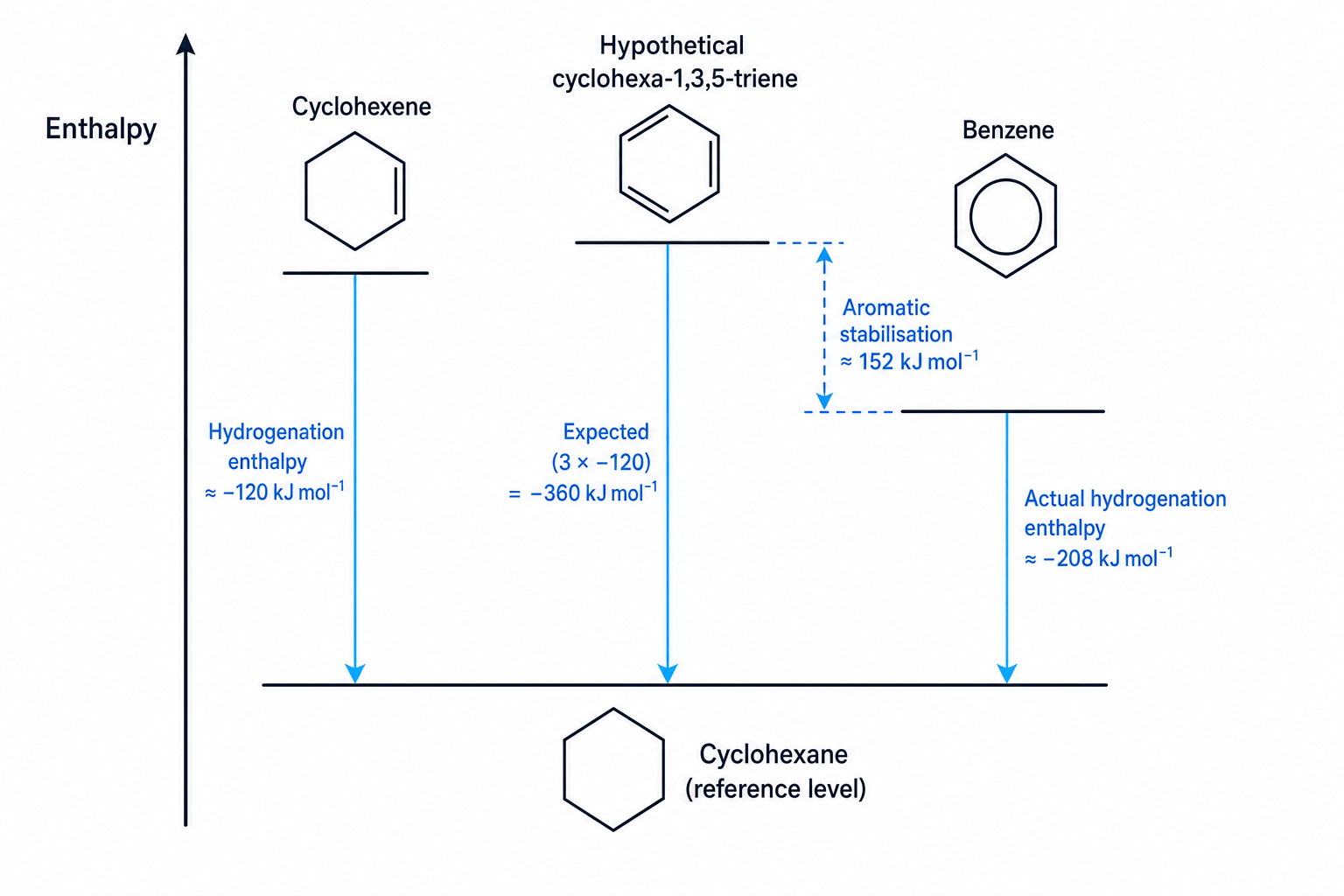
One key piece of evidence is enthalpy of hydrogenation. If benzene behaved like cyclohexa-1,3,5-triene with three separate C=C bonds, hydrogenating it to cyclohexane should release about three times as much energy as hydrogenating cyclohexene.
In reality, benzene releases much less energy than expected, so it must start from a lower enthalpy level: it is extra stable.
Estimating aromatic stabilisation from hydrogenation data
-
Use cyclohexene as the model for one isolated C=C bond. If hydrogenation of cyclohexene is about −120 kJ mol⁻¹, a hypothetical molecule with three isolated C=C bonds would be expected to have ΔHexpected=3×(−120)=−360 kJ mol−1\Delta H_{\text{expected}} = 3 \times (-120) = -360\ \text{kJ mol}^{-1}ΔHexpected=3×(−120)=−360 kJ mol−1.
-
Compare this with the actual hydrogenation of benzene: ΔHactual≈−208 kJ mol−1\Delta H_{\text{actual}} \approx -208\ \text{kJ mol}^{-1}ΔHactual≈−208 kJ mol−1 for C₆H₆(l) + 3H₂(g) → C₆H₁₂(l).
-
The actual value is less exothermic by about (−208)−(−360)=+152 kJ mol−1(-208)-(-360)=+152\ \text{kJ mol}^{-1}(−208)−(−360)=+152 kJ mol−1. This is the approximate aromatic stabilisation energy of benzene.
Why benzene is unusually stable
Delocalisation lowers the energy of benzene. Reactions that destroy aromaticity are energetically unfavourable unless conditions are forcing.
Why benzene resists addition reactions
Alkenes readily undergo addition reactions because the π bond is localised and relatively exposed. Benzene is different: addition to benzene would break the continuous delocalised π system and remove aromatic stabilisation.
So benzene does not rapidly decolourise bromine water at room temperature in the way an alkene does. Benzene can undergo addition under forcing conditions, such as hydrogenation with H₂ and a nickel catalyst at high temperature and pressure, but this is not its characteristic reaction.
Predicting benzene's reaction with bromine
-
Compare the bonding. Cyclohexene has a localised C=C π bond, so Br₂ can add across it and the orange colour is lost.
-
For benzene, direct addition of Br₂ would produce a non-aromatic product and lose the delocalised π stabilisation, so no rapid addition reaction occurs without a catalyst.
-
With a suitable halogen carrier such as FeBr₃, benzene undergoes substitution instead: C₆H₆(l) + Br₂(l) → C₆H₅Br(l) + HBr(g).
Electrophilic substitution: the characteristic reaction of arenes
Electrophile and electrophilic substitution
An electrophile is an electron-pair acceptor. Electrophilic substitution is a reaction where an electrophile replaces a hydrogen atom on an arene, while the aromatic π system is restored in the final product.
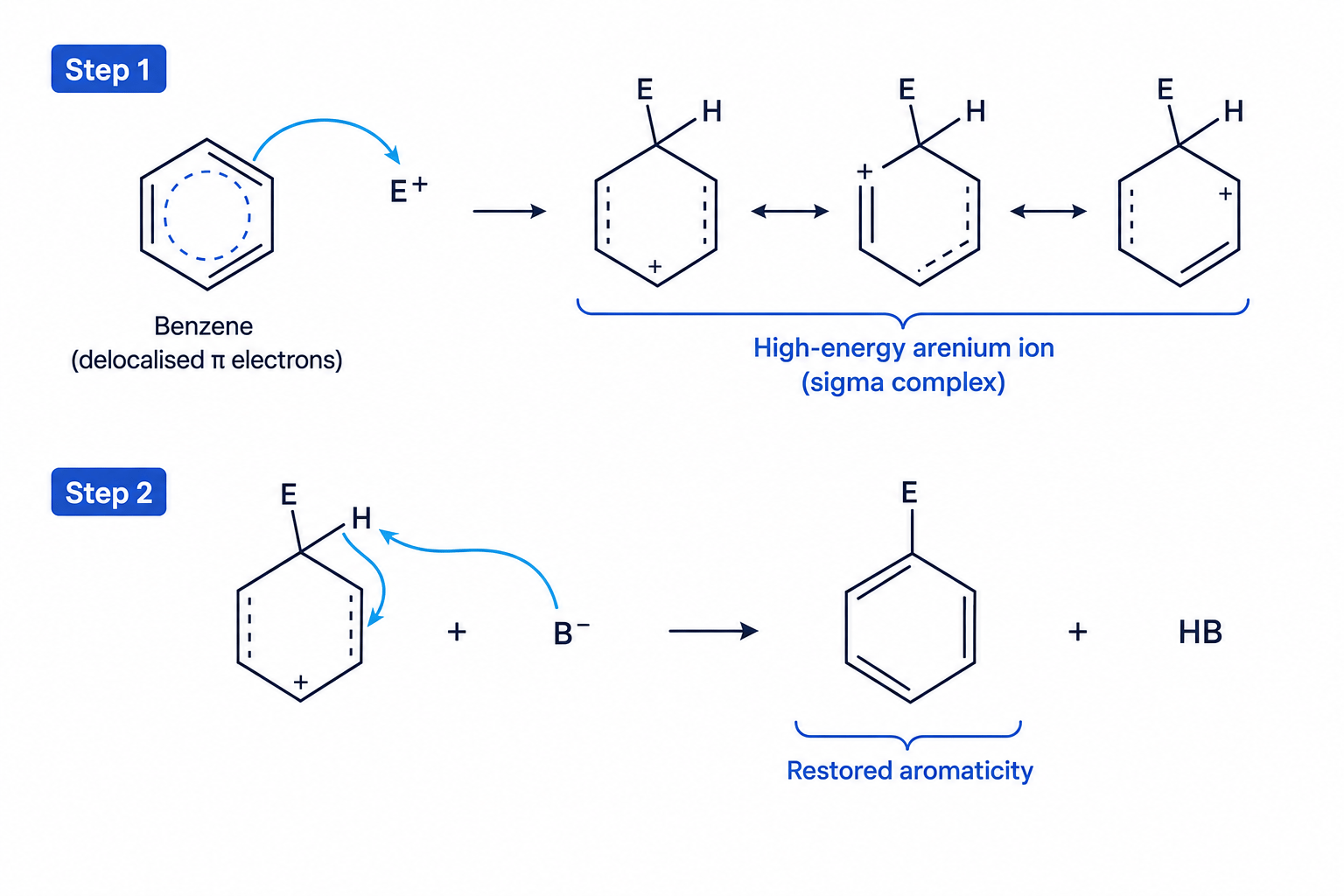
The benzene ring has electron density in its delocalised π system, so it can attack a strong electrophile. The first step temporarily disrupts aromaticity and forms an arenium ion, also called a sigma complex. A base then removes H⁺, and the C—H bond electrons restore the aromatic ring.
The diagram below shows the full curly-arrow pattern. For each named reaction, replace E⁺ and B⁻ with the correct electrophile and base.
Nitration of benzene
Reagents and conditions: concentrated HNO₃ and concentrated H₂SO₄, warmed to about 323 K (50 °C) for mononitration.
Overall reaction: C₆H₆(l) + HNO₃(l) → C₆H₅NO₂(l) + H₂O(l), with H₂SO₄ acting as an acid catalyst.
The electrophile is the nitronium ion, NO₂⁺:
HNO₃ + H₂SO₄ → NO₂⁺ + HSO₄⁻ + H₂O
Mechanism using the general scheme:
- E⁺ is NO₂⁺.
- The benzene π system attacks NO₂⁺ to form the arenium ion.
- HSO₄⁻ removes H⁺; the C—H bond electrons return to the ring, forming nitrobenzene and regenerating H₂SO₄.
In practical contexts, remember the risk assessment: benzene is carcinogenic, nitrobenzene is toxic, and concentrated acids are corrosive, so work is controlled carefully, often on a small scale and in a fume cupboard.
Halogenation of benzene
Benzene reacts with chlorine or bromine only when a strong electrophile is generated.
For bromination:
- Reagents and conditions: Br₂ with FeBr₃ catalyst, dry conditions.
- Electrophile generation: Br₂ + FeBr₃ → Br⁺ + FeBr₄⁻, written as a simplified A-Level model.
- Overall reaction: C₆H₆(l) + Br₂(l) → C₆H₅Br(l) + HBr(g).
For chlorination, use Cl₂ with AlCl₃ or FeCl₃.
Bromination of benzene
-
Generate the electrophile by polarising bromine with FeBr₃. In the simplified mechanism, Br⁺ is the electrophile and FeBr₄⁻ is the base later in the reaction.
-
Draw a curly arrow from the benzene π system to Br⁺. This forms an arenium ion where Br and H are both attached to the same carbon, and the positive charge is delocalised around the ring.
-
Draw FeBr₄⁻ removing H⁺, with a curly arrow from the C—H bond back into the ring. This restores aromaticity and forms bromobenzene, HBr and FeBr₃.
Friedel-Crafts alkylation
Friedel-Crafts alkylation introduces an alkyl group onto a benzene ring.
For methylation:
- Reagents and conditions: CH₃Cl with anhydrous AlCl₃.
- Electrophile generation: CH₃Cl + AlCl₃ → CH₃⁺ + AlCl₄⁻, simplified.
- Overall reaction: C₆H₆(l) + CH₃Cl(g) → C₆H₅CH₃(l) + HCl(g).
AlCl₃ is a Lewis acid, meaning it accepts an electron pair. In the mechanism, the benzene ring attacks CH₃⁺, then AlCl₄⁻ removes H⁺ to restore aromaticity and regenerate AlCl₃.
Friedel-Crafts limitations
- AlCl₃ must be kept anhydrous because it reacts with water.
- Alkylbenzene products can be more reactive than benzene, so further alkylation may occur.
Interaction between benzene and substituent groups
A substituent is an atom or group that replaces a hydrogen atom on benzene. Substituents can interact electronically with the delocalised π system.
Chlorobenzene, C₆H₅Cl, is a key example. Chlorine has lone pairs that can overlap with the p orbitals of the benzene ring. This delocalisation gives the C—Cl bond some partial double-bond character.
As a result, the C—Cl bond in chlorobenzene is shorter and stronger than the C—Cl bond in a chloroalkane such as chloroethane. Chlorobenzene therefore resists nucleophilic substitution much more strongly.
Comparing chlorobenzene with a chloroalkane
-
In chloroethane, the C—Cl bond is a normal polar σ bond to an sp³ carbon, so a nucleophile such as OH⁻ can attack and break the C—Cl bond under suitable conditions.
-
In chlorobenzene, chlorine is attached to an sp² carbon in the aromatic ring, and a chlorine lone pair can overlap with the benzene π system.
-
This gives the C—Cl bond partial double-bond character, making it stronger and harder to break; chlorobenzene does not hydrolyse under the mild conditions used for many chloroalkanes.
In the exam
-
When describing benzene, always include planar ring, sp² carbons, delocalised π electrons and equal C—C bond lengths.
-
For electrophilic substitution mechanisms, show the electrophile being generated, a curly arrow from the ring to E⁺, the arenium ion, then loss of H⁺ to restore aromaticity.
-
Learn the reagent packages: nitration uses conc HNO₃/conc H₂SO₄, halogenation uses Br₂/FeBr₃ or Cl₂/AlCl₃, and Friedel-Crafts alkylation uses a halogenoalkane with anhydrous AlCl₃.
Check yourself
- Why is benzene less exothermic to hydrogenate than a hypothetical cyclohexa-1,3,5-triene?
- In nitration, what is the electrophile and how is it generated?
- Why is the C—Cl bond in chlorobenzene stronger than the C—Cl bond in chloroethane?