

What you'll learn
- How Lowry–Brønsted theory explains acids, bases and conjugate pairs.
- How to use KaK_aKa, pKapK_apKa, KwK_wKw and pH in quantitative calculations.
- How titration curves, indicators, buffers and salt hydrolysis are linked.
- How a pH-probe titration is carried out and evaluated.
1. The starting point: proton transfer
Acid–base equilibria are all about the movement of protons, meaning hydrogen ions, H+\mathrm{H^+}H+. In water, H+\mathrm{H^+}H+ is usually attached to a water molecule as H3O+\mathrm{H_3O^+}H3O+, but A-Level calculations often write simply H+\mathrm{H^+}H+.
Lowry–Brønsted acids and bases
A Lowry–Brønsted acid is a proton donor. A Lowry–Brønsted base is a proton acceptor.
For example:
NH3(aq)+H2O(l)⇌NH4+(aq)+OH−(aq)\mathrm{NH_3(aq) + H_2O(l) \rightleftharpoons NH_4^+(aq) + OH^-(aq)}NH3(aq)+H2O(l)⇌NH4+(aq)+OH−(aq)
Ammonia accepts a proton, so it acts as a base. Water donates a proton, so it acts as an acid.
A conjugate acid–base pair contains two species that differ by one proton.
Identifying conjugate pairs
For the equilibrium NH3+H2O⇌NH4++OH−\mathrm{NH_3 + H_2O \rightleftharpoons NH_4^+ + OH^-}NH3+H2O⇌NH4++OH−:
- Track the proton transfer: water loses H+\mathrm{H^+}H+ to form OH−\mathrm{OH^-}OH−, while ammonia gains H+\mathrm{H^+}H+ to form NH4+\mathrm{NH_4^+}NH4+.
- The acid is H2O\mathrm{H_2O}H2O and its conjugate base is OH−\mathrm{OH^-}OH−.
- The base is NH3\mathrm{NH_3}NH3 and its conjugate acid is NH4+\mathrm{NH_4^+}NH4+.
2. Strong and weak are not the same as concentrated and dilute
A strong acid fully dissociates in water. A weak acid only partially dissociates, setting up an equilibrium.
Examples:
- Strong acid: HCl(aq)→H+(aq)+Cl−(aq)\mathrm{HCl(aq) \to H^+(aq) + Cl^-(aq)}HCl(aq)→H+(aq)+Cl−(aq)
- Weak acid: CH3COOH(aq)⇌H+(aq)+CH3COO−(aq)\mathrm{CH_3COOH(aq) \rightleftharpoons H^+(aq) + CH_3COO^-(aq)}CH3COOH(aq)⇌H+(aq)+CH3COO−(aq)
A strong base fully releases hydroxide ions in water, such as sodium hydroxide:
NaOH(aq)→Na+(aq)+OH−(aq)\mathrm{NaOH(aq) \to Na^+(aq) + OH^-(aq)}NaOH(aq)→Na+(aq)+OH−(aq)
A weak base only partially reacts with water, such as ammonia:
NH3(aq)+H2O(l)⇌NH4+(aq)+OH−(aq)\mathrm{NH_3(aq) + H_2O(l) \rightleftharpoons NH_4^+(aq) + OH^-(aq)}NH3(aq)+H2O(l)⇌NH4+(aq)+OH−(aq)
Strength is about dissociation
Strong/weak describes the extent of ionisation or proton transfer. Concentrated/dilute describes how much solute is dissolved per dm³ of solution.
Calling dilute acids weak
A dilute hydrochloric acid solution is still a strong acid because each HCl molecule dissociates fully. It is dilute because the concentration is low.
3. pH and strong acid calculations
pH measures hydrogen ion concentration:
pH=−log[H+]\text{pH} = -\log[\mathrm{H^+}]pH=−log[H+]You can reverse this using:
[H+]=10−pH[\mathrm{H^+}] = 10^{-\text{pH}}[H+]=10−pHFor a strong monoprotic acid such as HCl or HNO₃, the acid fully dissociates, so the hydrogen ion concentration equals the acid concentration.
Finding the pH of a strong acid
Find the pH of 0.0250 mol dm⁻³ hydrochloric acid.
-
HCl is a strong monoprotic acid, so one mole of HCl gives one mole of H+\mathrm{H^+}H+. Therefore [H+]=0.0250 mol dm−3[\mathrm{H^+}] = 0.0250\ \mathrm{mol\ dm^{-3}}[H+]=0.0250 mol dm−3.
-
Substitute into the pH equation:
pH=−log(0.0250)=1.60\text{pH} = -\log(0.0250) = 1.60pH=−log(0.0250)=1.60 -
Check the size: 0.0100 mol dm⁻³ acid has pH 2.00, so a more concentrated acid having pH 1.60 is sensible.
4. The acid dissociation constant, KaK_aKa
For a weak acid, HA:
HA(aq)⇌H+(aq)+A−(aq)\mathrm{HA(aq) \rightleftharpoons H^+(aq) + A^-(aq)}HA(aq)⇌H+(aq)+A−(aq)
The equilibrium constant is called the acid dissociation constant, KaK_aKa.
Acid dissociation constant
For HA⇌H++A−\mathrm{HA \rightleftharpoons H^+ + A^-}HA⇌H++A−:
Ka=[H+][A−][HA]K_a = \frac{[\mathrm{H^+}][\mathrm{A^-}]}{[\mathrm{HA}]}Ka=[HA][H+][A−]For this simple equilibrium, KaK_aKa has units of mol dm⁻³ at A-Level.
A larger KaK_aKa means the acid dissociates more, so it is a stronger acid. Chemists often use pKapK_apKa:
pKa=−logKapK_a = -\log K_apKa=−logKaSo:
- lower pKapK_apKa means stronger acid
- higher pKapK_apKa means weaker acid
For many weak acid calculations, if the initial acid concentration is ccc, then:
[H+]≈Kac[\mathrm{H^+}] \approx \sqrt{K_a c}[H+]≈KacThis works when the acid is only slightly dissociated.
Calculating the pH of a weak acid
Ethanoic acid has Ka=1.74×10⁻⁵ mol dm−3K_a = 1.74 \times 10^{-5}\ \mathrm{mol\ dm^{-3}}Ka=1.74×10⁻⁵ mol dm−3. Calculate the pH of 0.100 mol dm⁻³ ethanoic acid.
-
Write the weak acid approximation:
[H+]≈Kac[\mathrm{H^+}] \approx \sqrt{K_a c}[H+]≈Kac -
Substitute the values:
[H+]=(1.74×10⁻⁵)(0.100)=1.32×10⁻³ mol dm−3[\mathrm{H^+}] = \sqrt{(1.74 \times 10^{-5})(0.100)} = 1.32 \times 10^{-3}\ \mathrm{mol\ dm^{-3}}[H+]=(1.74×10⁻⁵)(0.100)=1.32×10⁻³ mol dm−3 -
Calculate pH:
pH=−log(1.32×10⁻³)=2.88\text{pH} = -\log(1.32 \times 10^{-3}) = 2.88pH=−log(1.32×10⁻³)=2.88 -
Check the approximation: the fraction dissociated is about 1.32%, so treating the undissociated acid concentration as approximately 0.100 mol dm⁻³ is reasonable.
When the weak acid shortcut can fail
The approximation [H+]≈Kac[\mathrm{H^+}] \approx \sqrt{K_a c}[H+]≈Kac becomes less reliable if the acid is very dilute or if the acid is not very weak. In those cases, you may need to solve the full quadratic expression.
5. The ionic product of water, KwK_wKw
Water very slightly ionises:
H2O(l)⇌H+(aq)+OH−(aq)\mathrm{H_2O(l) \rightleftharpoons H^+(aq) + OH^-(aq)}H2O(l)⇌H+(aq)+OH−(aq)
The equilibrium expression is:
Kw=[H+][OH−]K_w = [\mathrm{H^+}][\mathrm{OH^-}]Kw=[H+][OH−]At 298 K:
Kw=1.00×10⁻¹⁴ mol2 dm−6K_w = 1.00 \times 10^{-14}\ \mathrm{mol^2\ dm^{-6}}Kw=1.00×10⁻¹⁴ mol2 dm−6In pure water at 298 K, [H+]=[OH−][\mathrm{H^+}] = [\mathrm{OH^-}][H+]=[OH−], so pH is 7.00.
Neutral does not always mean pH 7
KwK_wKw changes with temperature. Neutral means [H+]=[OH−][\mathrm{H^+}] = [\mathrm{OH^-}][H+]=[OH−], but the pH of neutrality is only exactly 7.00 at 298 K.
Strong base calculations use KwK_wKw because a strong base directly gives OH−\mathrm{OH^-}OH−, then KwK_wKw gives H+\mathrm{H^+}H+.
Finding the pH of a strong base
Calculate the pH of 0.0200 mol dm⁻³ NaOH at 298 K.
-
NaOH is a strong base, so [OH−]=0.0200 mol dm−3[\mathrm{OH^-}] = 0.0200\ \mathrm{mol\ dm^{-3}}[OH−]=0.0200 mol dm−3.
-
Use Kw=[H+][OH−]K_w = [\mathrm{H^+}][\mathrm{OH^-}]Kw=[H+][OH−]:
[H+]=1.00×10−140.0200=5.00×10⁻¹³ mol dm−3[\mathrm{H^+}] = \frac{1.00 \times 10^{-14}}{0.0200} = 5.00 \times 10^{-13}\ \mathrm{mol\ dm^{-3}}[H+]=0.02001.00×10−14=5.00×10⁻¹³ mol dm−3 -
Calculate pH:
pH=−log(5.00×10⁻¹³)=12.30\text{pH} = -\log(5.00 \times 10^{-13}) = 12.30pH=−log(5.00×10⁻¹³)=12.30
6. Titration curves and equivalence points
A titration curve shows how pH changes as one solution is added to another. The equivalence point is where the acid and base have reacted in the exact stoichiometric ratio. It is not always pH 7.
The curves below show base being added to acid.
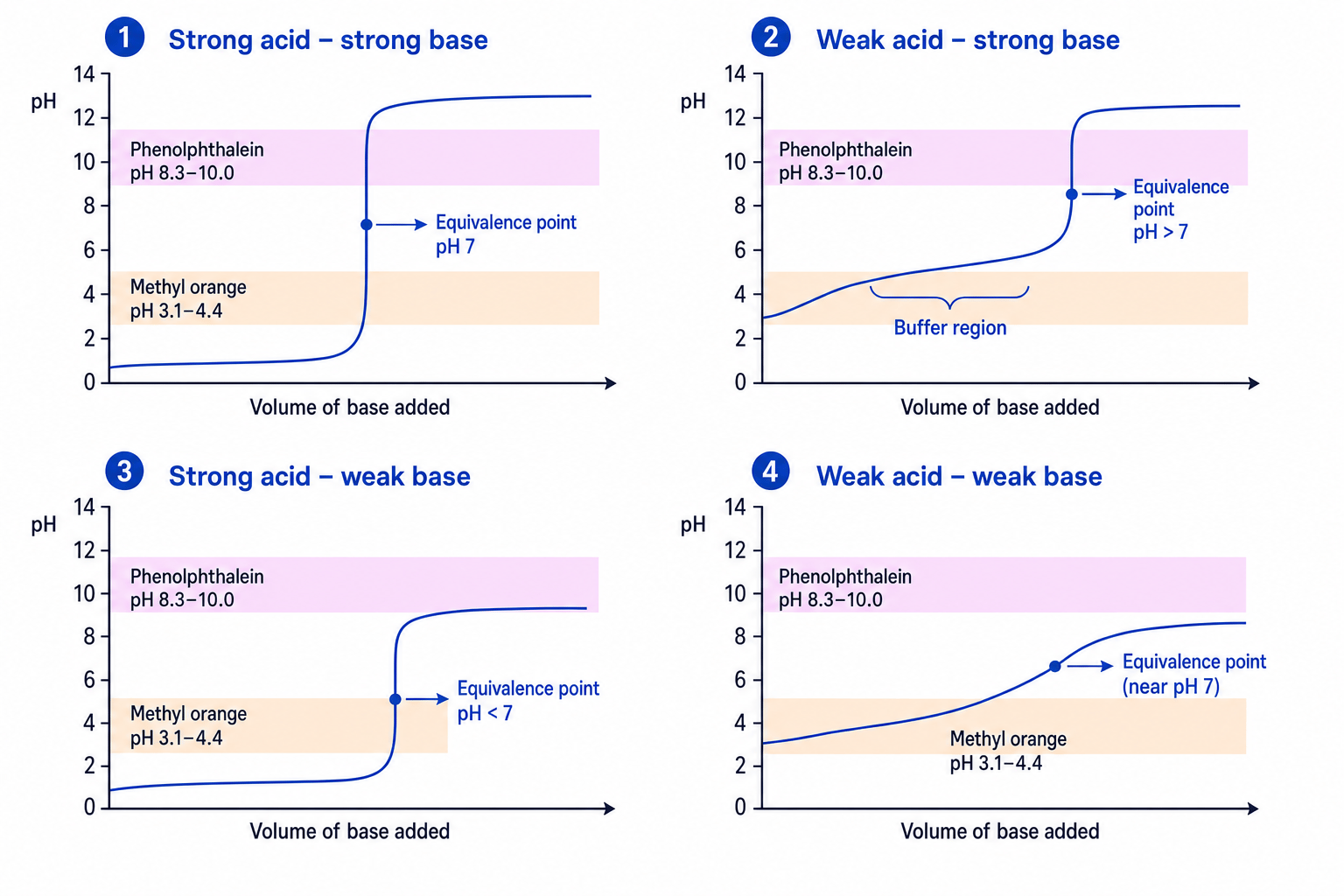
Key shapes:
- Strong acid + strong base: steep vertical section centred around pH 7.
- Weak acid + strong base: starts at a higher pH; has a buffer region; equivalence point is above pH 7 because the conjugate base hydrolyses.
- Strong acid + weak base: equivalence point is below pH 7 because the conjugate acid hydrolyses.
- Weak acid + weak base: no sharp vertical section, so visual indicators are unreliable.
Practical: titration using a pH probe
A typical method:
- Calibrate the pH probe using standard buffer solutions, usually pH 4, 7 and/or 10.
- Use a pipette to place a known volume of acid or base into a conical flask.
- Add the other solution from a burette in measured portions, stirring after each addition.
- Record the pH once the reading is stable.
- Add smaller volumes near the rapid pH change.
- Plot pH against volume added and find the equivalence point from the steepest part of the curve.
Main sources of error include poor probe calibration, not waiting for a stable pH reading, temperature changes affecting KwK_wKw, and overshooting near the equivalence point.
7. Choosing indicators
An acid–base indicator is a weak acid or weak base with different colours in its acid and base forms. It changes colour over a narrow pH range.
A suitable indicator must change colour within the steep vertical section of the titration curve.
Choosing an indicator
Choose an indicator for titrating a weak acid with a strong base.
- A weak acid–strong base titration has an equivalence point above pH 7.
- Phenolphthalein changes around pH 8.3–10.0, which usually lies within the steep section for this titration.
- Methyl orange changes around pH 3.1–4.4, which is too early, before the equivalence point.
- Therefore phenolphthalein is suitable; for weak acid–weak base titrations, a pH probe is preferred because there is no sharp vertical section.
8. Buffer solutions
A buffer solution resists changes in pH when small amounts of acid or alkali are added.
An acidic buffer contains:
- a weak acid, HA
- its conjugate base, A⁻, often from a soluble salt such as sodium ethanoate
The buffer works because both acid and base components are present:
- Added acid is removed by A−+H+→HA\mathrm{A^- + H^+ \to HA}A−+H+→HA.
- Added alkali is removed by HA+OH−→A−+H2O\mathrm{HA + OH^- \to A^- + H_2O}HA+OH−→A−+H2O.
For an acidic buffer:
Ka=[H+][A−][HA]K_a = \frac{[\mathrm{H^+}][\mathrm{A^-}]}{[\mathrm{HA}]}Ka=[HA][H+][A−]Rearranging:
[H+]=Ka[HA][A−][\mathrm{H^+}] = K_a \frac{[\mathrm{HA}]}{[\mathrm{A^-}]}[H+]=Ka[A−][HA]Or in pH form:
pH=pKa+log([A−][HA])\text{pH} = pK_a + \log\left(\frac{[\mathrm{A^-}]}{[\mathrm{HA}]}\right)pH=pKa+log([HA][A−])Use moles in buffer mixtures
If HA and A⁻ are in the same final solution volume, the volume cancels in the ratio, so you can use moles instead of concentrations.
Calculating the pH of a buffer after neutralisation
25.0 cm³ of 0.100 mol dm⁻³ ethanoic acid is mixed with 10.0 cm³ of 0.100 mol dm⁻³ NaOH. For ethanoic acid, Ka=1.74×10⁻⁵ mol dm−3K_a = 1.74 \times 10^{-5}\ \mathrm{mol\ dm^{-3}}Ka=1.74×10⁻⁵ mol dm−3. Calculate the buffer pH.
-
Calculate initial amounts:
n(CH3COOH)=0.100×25.01000=2.50×10⁻³ moln(\mathrm{CH_3COOH}) = 0.100 \times \frac{25.0}{1000} = 2.50 \times 10^{-3}\ \mathrm{mol}n(CH3COOH)=0.100×100025.0=2.50×10⁻³ mol n(OH−)=0.100×10.01000=1.00×10⁻³ moln(\mathrm{OH^-}) = 0.100 \times \frac{10.0}{1000} = 1.00 \times 10^{-3}\ \mathrm{mol}n(OH−)=0.100×100010.0=1.00×10⁻³ mol -
Neutralisation converts acid into conjugate base:
CH3COOH+OH−→CH3COO−+H2O\mathrm{CH_3COOH + OH^- \to CH_3COO^- + H_2O}CH3COOH+OH−→CH3COO−+H2O
So remaining HA is 1.50×10⁻³ mol1.50 \times 10^{-3}\ \mathrm{mol}1.50×10⁻³ mol and formed A⁻ is 1.00×10⁻³ mol1.00 \times 10^{-3}\ \mathrm{mol}1.00×10⁻³ mol.
-
Calculate pKapK_apKa:
pKa=−log(1.74×10⁻⁵)=4.76pK_a = -\log(1.74 \times 10^{-5}) = 4.76pKa=−log(1.74×10⁻⁵)=4.76 -
Substitute into the buffer equation using the mole ratio:
pH=4.76+log(1.00×10−31.50×10−3)=4.58\text{pH} = 4.76 + \log\left(\frac{1.00 \times 10^{-3}}{1.50 \times 10^{-3}}\right) = 4.58pH=4.76+log(1.50×10−31.00×10−3)=4.58
Buffers are vital in living systems because enzyme activity is pH dependent. Blood is buffered mainly by the carbonic acid/hydrogencarbonate system, helping maintain pH close to 7.4. Industrially, buffers are used in fermentation, medicines, food production, dyeing and analytical calibration.
9. Hydrolysis of salts
Salt hydrolysis means ions from a salt react with water to produce H+\mathrm{H^+}H+ or OH−\mathrm{OH^-}OH−, changing the pH.
-
A salt from a strong acid and strong base, such as NaCl, gives a roughly neutral solution. The ions do not hydrolyse significantly.
-
A salt from a strong acid and weak base, such as NH₄Cl, gives an acidic solution:
NH4+(aq)+H2O(l)⇌NH3(aq)+H3O+(aq)\mathrm{NH_4^+(aq) + H_2O(l) \rightleftharpoons NH_3(aq) + H_3O^+(aq)}NH4+(aq)+H2O(l)⇌NH3(aq)+H3O+(aq)
-
A salt from a weak acid and strong base, such as sodium ethanoate, gives an alkaline solution:
CH3COO−(aq)+H2O(l)⇌CH3COOH(aq)+OH−(aq)\mathrm{CH_3COO^-(aq) + H_2O(l) \rightleftharpoons CH_3COOH(aq) + OH^-(aq)}CH3COO−(aq)+H2O(l)⇌CH3COOH(aq)+OH−(aq)
Predicting salt solution pH
Predict whether sodium ethanoate solution is acidic, neutral or alkaline.
- Identify the parent acid and base: sodium ethanoate comes from ethanoic acid, a weak acid, and sodium hydroxide, a strong base.
- Sodium ions do not hydrolyse significantly, but ethanoate ions can accept protons from water.
- Hydrolysis forms OH−\mathrm{OH^-}OH−, so the solution is alkaline.
In the exam
- Decide first whether the acid/base is strong or weak; this tells you whether to use stoichiometry, KaK_aKa, KwK_wKw or a buffer equation.
- For weak acid and buffer calculations, keep track of equilibrium concentrations or mole ratios carefully before substituting into equations.
- In titration questions, use the curve shape and equivalence-point pH to choose the indicator, not just the names of the reactants.
- Always check whether pH 7 is actually justified; equivalence point and neutrality are different ideas.
Check yourself
- Why does a weak acid–strong base titration have an equivalence point above pH 7?
- How would you calculate the pH of a strong base using KwK_wKw?
- What two components must an acidic buffer contain, and how does each component respond to added acid or alkali?
