

What you'll learn
- Why alkanes are useful fuels, but can produce harmful combustion products.
- How the bonding in alkanes and alkenes explains their very different reactions.
- How to draw and explain radical substitution and electrophilic addition mechanisms.
- How E–Z isomerism, hydrogenation and addition polymerisation arise from the C=C bond.
Hydrocarbons: the basics
Crude oil and natural gas contain many hydrocarbons. They are separated and processed by the petroleum industry to provide fuels and chemical feedstocks, including alkenes used to make polymers.
Hydrocarbon, alkane and alkene
A hydrocarbon is a compound containing only carbon and hydrogen. An alkane is a saturated hydrocarbon containing only C–C single bonds. An alkene is an unsaturated hydrocarbon containing at least one C=C double bond.
For open-chain compounds, alkanes have general formula CnH2n+2C_nH_{2n+2}CnH2n+2. Alkenes with one C=C double bond have general formula CnH2nC_nH_{2n}CnH2n.
Alkanes as fuels
Complete and incomplete combustion
Combustion is reaction with oxygen. In complete combustion, an alkane burns in plentiful oxygen to form carbon dioxide and water.
For methane:
CH4(g) + 2O2(g) → CO2(g) + 2H2O(l)
In limited oxygen, incomplete combustion can produce carbon monoxide, carbon, and water. Carbon monoxide is especially dangerous because it is a toxic gas that binds strongly to haemoglobin in the blood.
Balancing complete combustion
-
Butane is C4H10, so four carbon atoms require 4CO2, and ten hydrogen atoms require 5H2O.
-
Count oxygen atoms needed in the products: 4CO2 contains eight oxygen atoms and 5H2O contains five, so 13 oxygen atoms are needed altogether. That is 132\frac{13}{2}213O2.
-
Multiply through by two to avoid a fraction:
2C4H10(g) + 13O2(g) → 8CO2(g) + 10H2O(l)
Benefits and drawbacks of fossil fuels
A fossil fuel is a carbon-containing fuel formed over millions of years from ancient biological material. Alkanes are valuable fossil fuels because they have high energy density, are easy to transport, and existing engines and power stations are designed around them.
The drawbacks are significant:
- CO2 is a greenhouse gas, so large-scale fossil fuel use contributes to climate change.
- Sulfur impurities can form SO2, and high-temperature engines form nitrogen oxides, NO and NO2. These are acidic gases and contribute to acid rain.
- Incomplete combustion produces carbon monoxide and particulates.
- Fossil fuels are finite resources.
Fuels are a trade-off
Alkanes release useful energy when burned, but their large-scale use has environmental and health costs, especially through CO2, acidic gases and CO.
Why alkanes are relatively unreactive
A covalent bond is a shared pair of electrons. In alkanes, the C–C and C–H bonds are all σ\sigmaσ-bonds.
Sigma bond
A σ\sigmaσ-bond is a covalent bond formed by end-on overlap of orbitals, with electron density concentrated along the line between the two nuclei.
C–C and C–H σ\sigmaσ-bonds are quite strong and are not very polar, so alkanes do not usually react with acids, bases or electrophiles. Their important reaction, apart from combustion, is radical substitution with halogens.
Radical substitution: photochlorination
A radical is a species with an unpaired electron, shown using a dot, such as Cl•. Homolytic fission is bond breaking where each atom takes one electron from the bond, forming radicals.
In photochlorination, chlorine reacts with an alkane under ultraviolet light. With methane, one substitution product is chloromethane:
CH4(g) + Cl2(g) → CH3Cl(g) + HCl(g)
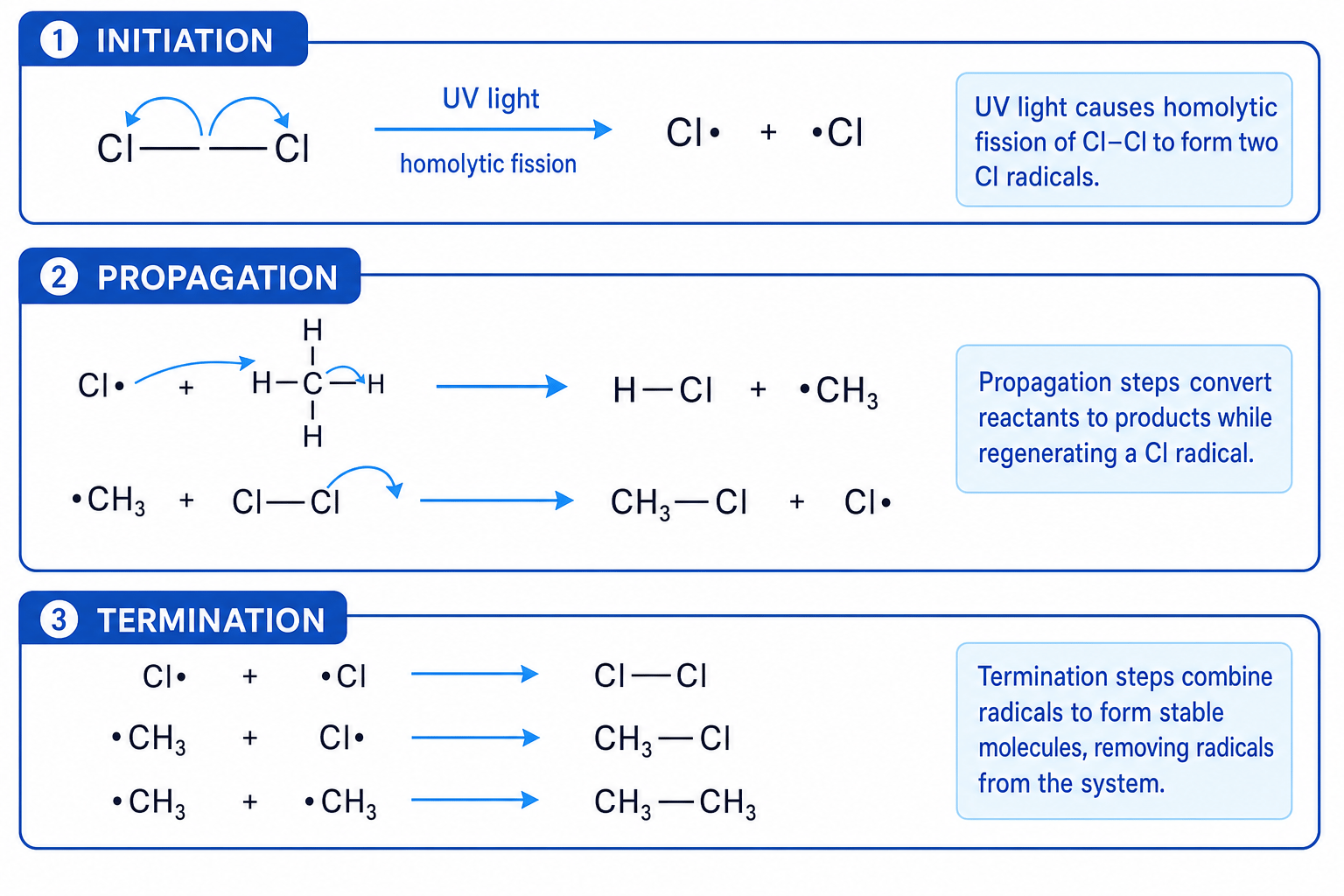
The radical-substitution chain mechanism is summarised below.
The three stages
Initiation creates radicals:
Cl2(g) → 2Cl•(g)
Condition: ultraviolet light.
Propagation uses radicals and regenerates radicals:
Cl•(g) + CH4(g) → HCl(g) + •CH3(g)
•CH3(g) + Cl2(g) → CH3Cl(g) + Cl•(g)
Termination removes radicals by combining them:
Cl• + Cl• → Cl2
•CH3 + Cl• → CH3Cl
•CH3 + •CH3 → C2H6
Forgetting the chain part
A propagation step must produce a radical as well as a product. If no radical is regenerated, the chain reaction would stop.
Writing propagation steps for chlorination of ethane
- A chlorine radical abstracts a hydrogen atom from ethane, forming HCl and an ethyl radical:
Cl• + C2H6 → HCl + C2H5•
- The ethyl radical reacts with chlorine, forming chloroethane and regenerating a chlorine radical:
C2H5• + Cl2 → C2H5Cl + Cl•
- Adding the two propagation equations gives the overall substitution:
C2H6 + Cl2 → C2H5Cl + HCl
Alkenes: the reactive C=C bond
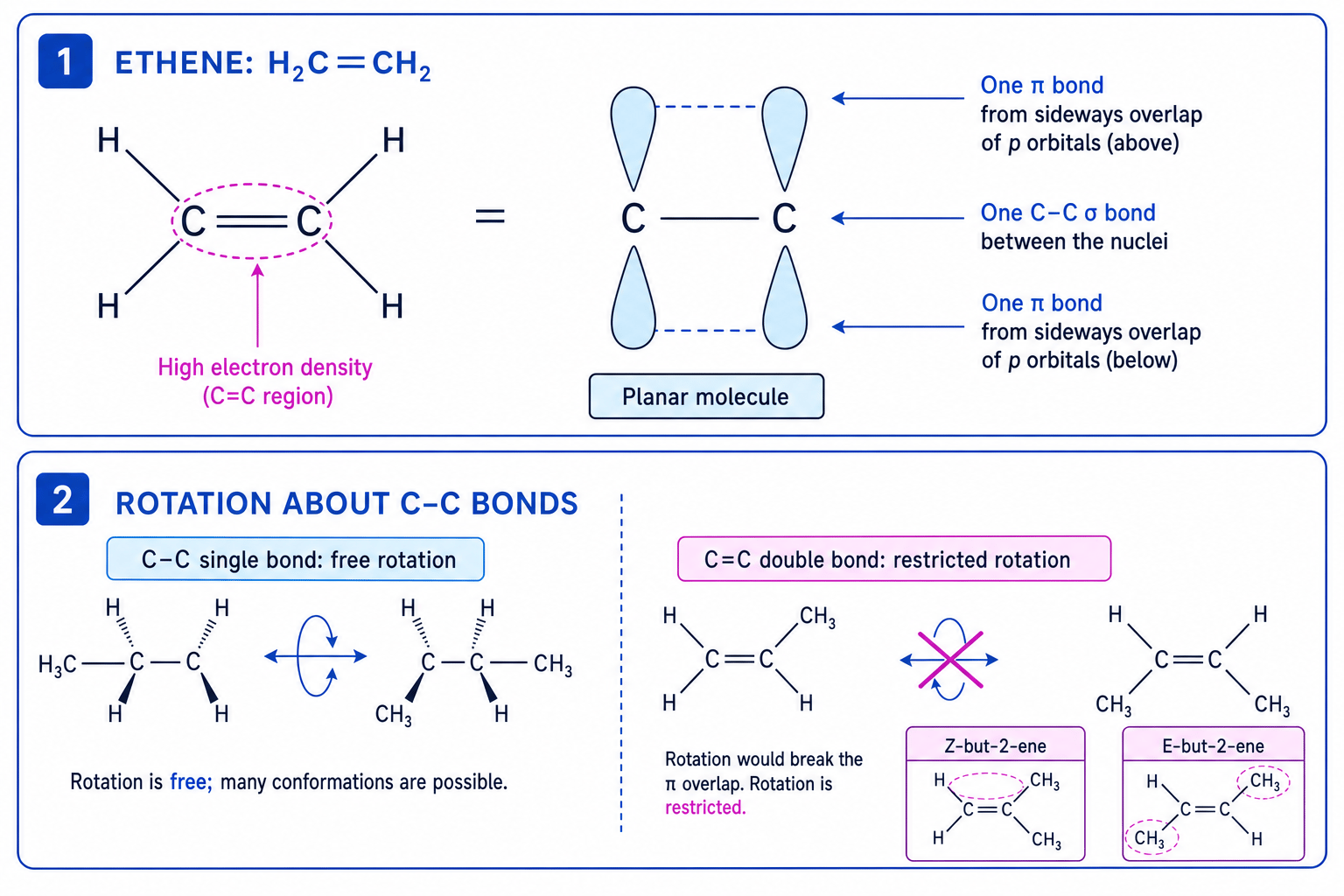
Alkenes are more reactive than alkanes because the C=C double bond is a region of high electron density. A C=C double bond consists of one σ\sigmaσ-bond and one π\piπ-bond.
Pi bond
A π\piπ-bond is formed by sideways overlap of p orbitals, with electron density above and below the plane of the bonded atoms.
The π\piπ-bond is exposed and electron-rich, so it attracts electrophiles. It also prevents free rotation about the C=C bond.
E–Z isomerism
Stereoisomers have the same structural formula but a different arrangement of atoms in space. E–Z isomerism occurs because rotation about a C=C double bond is restricted.
E–Z isomerism
E–Z isomerism occurs when each carbon atom of a C=C bond is attached to two different groups. The higher-priority groups are compared: Z means they are on the same side, and E means they are on opposite sides.
Priority is usually decided by atomic number: the atom with the higher atomic number has higher priority.
Remembering E and Z
Z comes from zusammen, meaning together. So Z isomers have the higher-priority groups on the same side.
Assigning E–Z configuration
-
Check that each carbon of the C=C bond has two different groups. If either carbon has two identical groups, E–Z isomerism is not possible.
-
Compare priorities on each carbon. For example, Cl has higher priority than H, and CH3 has higher priority than H because carbon has a higher atomic number than hydrogen.
-
Compare the higher-priority groups. If Cl and CH3 are on opposite sides of the C=C bond, the isomer is E. If they are on the same side, it is Z.
Electrophilic addition
An electrophile is an electron-pair acceptor. Alkenes undergo electrophilic addition, where an electrophile attacks the electron-rich C=C bond and atoms add across the double bond.
A carbocation is an organic ion containing a positively charged carbon atom.
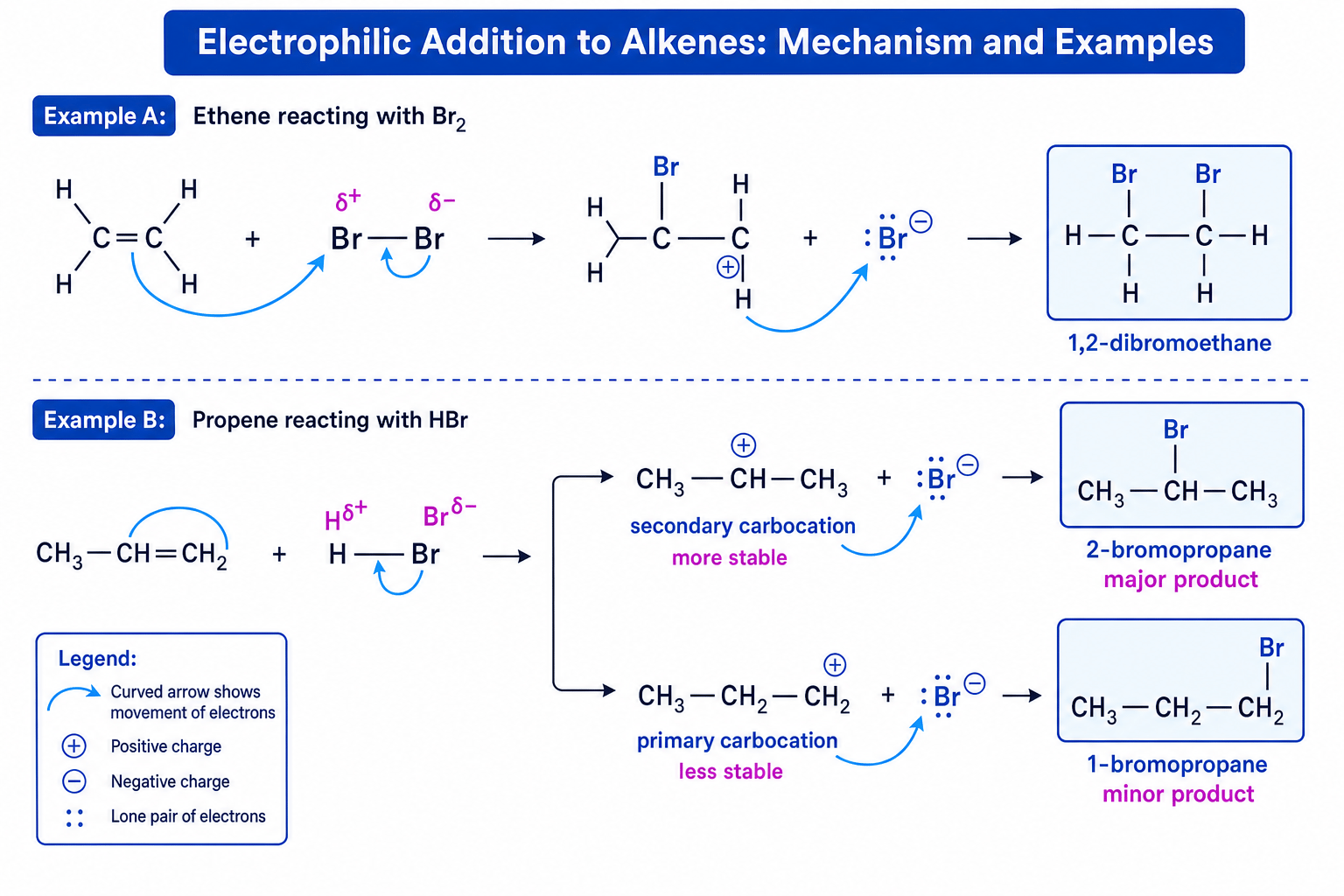
The key electron-pair movements for bromine addition and HBr addition are shown below.
Addition of bromine to ethene
Overall reaction:
CH2=CH2(g) + Br2(aq) → CH2BrCH2Br(l)
The mechanism is:
- The C=C π\piπ-bond induces a dipole in Br2, making the nearer bromine Brδ+.
- A curly arrow goes from the alkene π\piπ-bond to Brδ+.
- A curly arrow goes from the Br–Br bond to the other bromine atom, forming Br−.
- Br− attacks the carbocation to form 1,2-dibromoethane.
Curly arrows start at electrons
In electrophilic addition, curly arrows must start from an electron pair: the C=C bond, a lone pair, or a bond. Do not start a curly arrow from a positive charge.
Tests for alkenes
Bromine water is orange or brown. With an alkene, it is decolourised because bromine adds across the C=C bond. An alkane gives no rapid change in the dark.
Potassium manganate(VII), KMnO4, is purple. Cold, dilute potassium manganate(VII) is decolourised by alkenes because the C=C bond is oxidised. In alkaline conditions, a brown MnO2 precipitate may be seen.
Best quick test for C=C
For a simple alkene test, bromine water is usually the cleanest observation: orange or brown to colourless, without needing UV light.
Addition of HBr to propene: orientation
When HBr adds to propene, two products are possible, but one is major.
CH3CH=CH2 + HBr → mainly CH3CHBrCH3
The major product is 2-bromopropane.
This happens because the reaction goes through the more stable carbocation. A secondary carbocation is more stable than a primary carbocation because alkyl groups donate electron density towards the positive carbon.
Predicting the major product from HBr and propene
-
Protonation at the terminal carbon gives CH3CH+CH3, a secondary carbocation. Protonation at the middle carbon gives CH3CH2CH2+, a primary carbocation.
-
Compare stability: the secondary carbocation is more stable because it is supported by two alkyl groups, while the primary carbocation is supported by only one.
-
Br− attacks the more stable carbocation, so the major product is CH3CHBrCH3, 2-bromopropane.
Normal addition of HBr
Here, “normal addition” means the polar electrophilic addition mechanism without peroxides. Radical conditions can change the orientation for HBr, but that is not the route in this topic.
Catalytic hydrogenation
Hydrogenation is addition of hydrogen across a C=C double bond to form an alkane.
CH2=CH2(g) + H2(g) → CH3CH3(g)
Conditions: hydrogen gas with a nickel catalyst at about 150 °C.
This reaction is important because it converts unsaturated compounds into saturated ones. Industrially, related hydrogenation reactions are used in processing vegetable oils and in making useful saturated feedstocks.
Addition polymerisation
Addition polymerisation happens when many alkene monomers join together. The C=C double bond opens up and new C–C single bonds form between monomers. No small molecule is eliminated.
For propene:
n CH2=CHCH3→[-CH2-CH(CH3)-]nn\,\text{CH}_2=\text{CHCH}_3 \to \left[\text{-CH}_2\text{-CH}(\text{CH}_3)\text{-}\right]_nnCH2=CHCH3→[-CH2-CH(CH3)-]nDrawing a repeat unit from chloroethene
-
Identify the monomer double bond in chloroethene, CH2=CHCl. The two carbon atoms of the C=C will become the polymer backbone.
-
Change the C=C double bond into a C–C single bond and keep the substituents attached to the same carbons: H atoms stay on one carbon, and Cl stays on the other.
-
Put brackets around the repeat unit with bonds extending through the brackets:
This polymer is poly(chloroethene), also called PVC.
Polymers from alkenes and substituted alkenes are economically important because they are cheap, light, strong, waterproof and chemically resistant. Examples include poly(ethene) for bags and bottles, poly(propene) for packaging and fibres, and PVC for pipes and insulation.
The drawbacks are also important: many polymers are made from fossil-fuel feedstocks, are non-biodegradable, and can form persistent waste or microplastics. Recycling, reuse and careful disposal are therefore part of the chemistry story, not an afterthought.
In the exam
-
Link reactivity to bonding: alkanes have strong, relatively non-polar σ\sigmaσ-bonds, while alkenes have an exposed, electron-rich π\piπ-bond.
-
For mechanisms, show the correct arrow type: half-headed arrows for radicals, curly arrows for electron pairs in electrophilic addition.
-
For major products in HBr addition, compare carbocation stability before naming the product.
Check yourself
- Why does bromine water decolourise with ethene but not rapidly with ethane in the dark?
- What are the initiation, propagation and termination stages in photochlorination?
- How would you draw the repeat unit for poly(propene) from propene?
