

What you'll learn
- How the polar carbon–halogen bond controls halogenoalkane reactions.
- How to draw nucleophilic substitution and elimination mechanisms.
- How bond enthalpy affects the rate of hydrolysis and the silver nitrate test.
- Why many halogenoalkanes are useful but tightly regulated.
Starting point: what is a halogenoalkane?
Halogenoalkane
A halogenoalkane is an organic compound in which one or more hydrogen atoms in an alkane have been replaced by halogen atoms: fluorine, chlorine, bromine or iodine. The carbon–halogen bond is often written as C–X, where X is F, Cl, Br or I.
Examples include chloromethane, bromoethane and 1-bromobutane. In a primary halogenoalkane, the carbon attached to the halogen is bonded to only one other carbon atom, such as in 1-bromobutane.
Halogens are more electronegative than carbon, so the C–X bond is polar: carbon is δ+ and the halogen is δ−. That δ+ carbon is the key reactive site.
Nucleophile and leaving group
- A nucleophile is an electron-pair donor attracted to an electron-deficient atom. Hydroxide, OH−\text{OH}^-OH−, is a nucleophile because it has lone pairs and a negative charge.
- A leaving group is an atom or ion that takes the bonding electron pair when a bond breaks. In bromoalkanes, Br−\text{Br}^-Br− is the leaving group.
Nucleophilic substitution: forming alcohols
In nucleophilic substitution, a nucleophile replaces another atom or group in a molecule. With aqueous sodium hydroxide, a halogenoalkane forms an alcohol.
For 1-bromobutane:
CH3CH2CH2CH2Br(l)+OH−(aq)→CH3CH2CH2CH2OH(l)+Br−(aq)\text{CH}_3\text{CH}_2\text{CH}_2\text{CH}_2\text{Br(l)} + \text{OH}^-\text{(aq)} \to \text{CH}_3\text{CH}_2\text{CH}_2\text{CH}_2\text{OH(l)} + \text{Br}^-\text{(aq)}CH3CH2CH2CH2Br(l)+OH−(aq)→CH3CH2CH2CH2OH(l)+Br−(aq)Conditions: aqueous NaOH, heat under reflux.
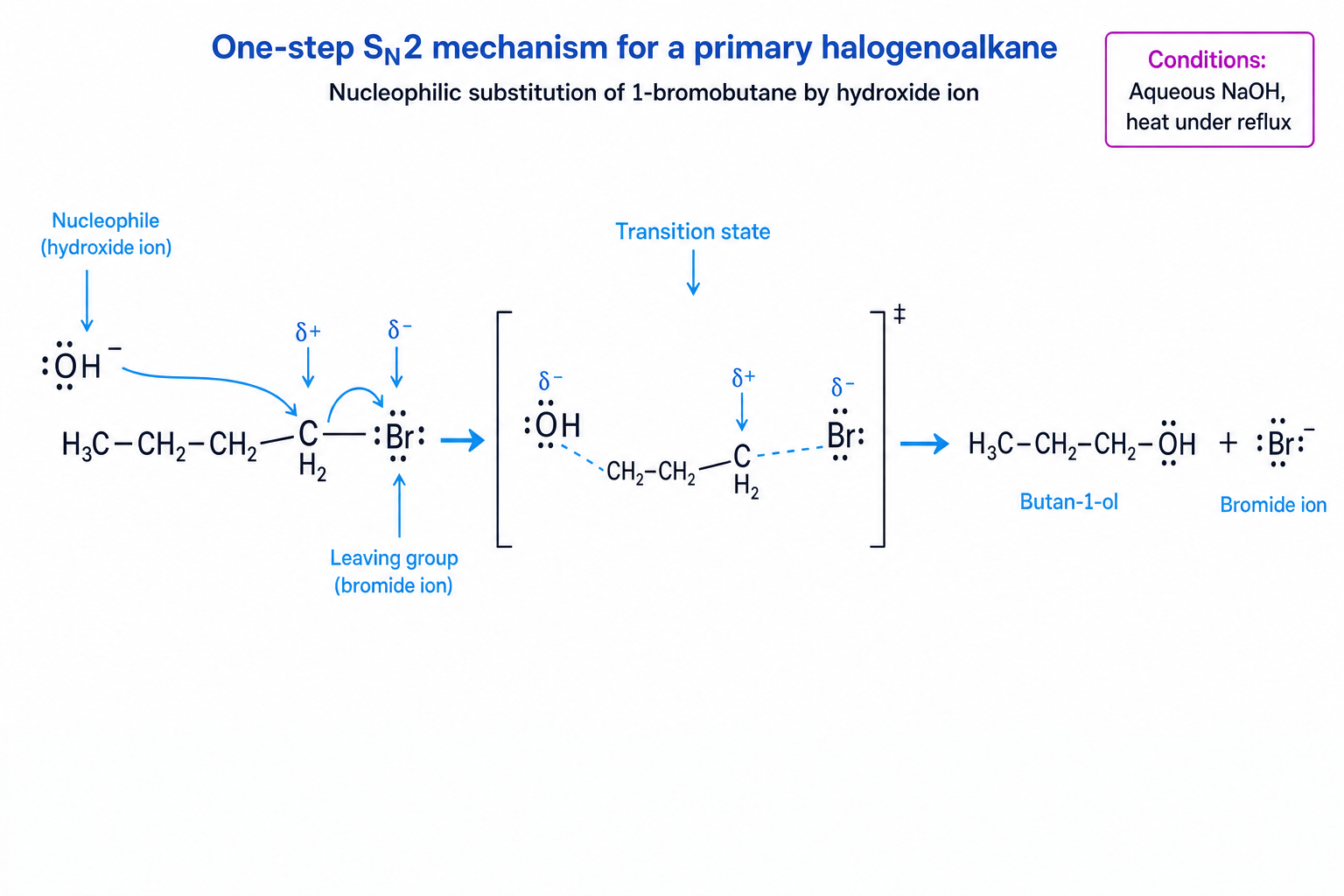
For primary halogenoalkanes, this is usually shown as a one-step SN2S_\text{N}2SN2 mechanism. The C–Br bond breaks heterolytically, meaning both bonding electrons go to bromine.
The image below shows the key curly arrows: one from the hydroxide lone pair to the δ+ carbon, and one from the C–Br bond to bromine.
Drawing the substitution mechanism
-
Identify the δ+ carbon: it is the carbon directly bonded to Br in 1-bromobutane, because Br withdraws electron density.
-
Draw a curly arrow from a lone pair on the oxygen of OH−\text{OH}^-OH− to that δ+ carbon. This shows formation of the new C–O bond.
-
Draw a curly arrow from the C–Br bond to Br. This shows heterolytic bond breaking and formation of Br−\text{Br}^-Br−.
-
Replace Br with OH in the organic product, giving butan-1-ol, plus the bromide ion.
Elimination: forming alkenes
In an elimination reaction, a small molecule is removed from an organic molecule, often forming a C=C double bond.
For halogenoalkanes, heating with ethanolic KOH or NaOH favours elimination. A hydrogen atom is removed from a carbon next to the C–X carbon, and the halogen leaves. Overall, HBr is eliminated from 1-bromopropane to form propene:
CH3CH2CH2Br(l)+KOH(ethanol)→CH3CH=CH2(g)+KBr+H2O(l)\text{CH}_3\text{CH}_2\text{CH}_2\text{Br(l)} + \text{KOH(ethanol)} \to \text{CH}_3\text{CH}=\text{CH}_2\text{(g)} + \text{KBr} + \text{H}_2\text{O(l)}CH3CH2CH2Br(l)+KOH(ethanol)→CH3CH=CH2(g)+KBr+H2O(l)Aqueous versus ethanolic hydroxide
Aqueous hydroxide favours substitution to form an alcohol. Ethanolic hydroxide with heat favours elimination to form an alkene.
Drawing the elimination mechanism
-
Find a hydrogen on the carbon next to the C–Br carbon. This is the hydrogen removed during elimination.
-
Draw a curly arrow from a lone pair on OH−\text{OH}^-OH− to that hydrogen. Here hydroxide is acting as a base.
-
Draw a curly arrow from the C–H bond to the C–C bond, forming the C=C double bond.
-
Draw a curly arrow from the C–Br bond to Br, forming Br−\text{Br}^-Br−. The organic product is propene, and the other products are water and bromide.
Mixing up conditions
Do not just write “NaOH” on its own. For substitution, say aqueous NaOH, heat under reflux. For elimination, say ethanolic NaOH/KOH, heat.
Why some halogenoalkanes substitute faster than others
Two ideas matter: bond polarity and bond enthalpy.
Bond enthalpy
Bond enthalpy is the energy needed to break one mole of a specified covalent bond in gaseous molecules, measured in kJ mol⁻¹.
C–F is the most polar C–X bond because fluorine is very electronegative. However, C–F is also very strong. In hydrolysis and nucleophilic substitution, the C–X bond must be broken, so bond enthalpy is usually more important than polarity.
Approximate C–X bond enthalpies decrease like this:
- C–F: very strong, about 467 kJ mol⁻¹
- C–Cl: weaker
- C–Br: weaker still
- C–I: weakest, about 228 kJ mol⁻¹
So the usual ease of substitution is:
iodoalkanes>bromoalkanes>chloroalkanes≫fluoroalkanes\text{iodoalkanes} > \text{bromoalkanes} > \text{chloroalkanes} \gg \text{fluoroalkanes}iodoalkanes>bromoalkanes>chloroalkanes≫fluoroalkanesRanking hydrolysis rates
-
Compare 1-chlorobutane, 1-bromobutane and 1-iodobutane. The carbon chain is the same, so focus on the C–X bond.
-
Use bond enthalpy: C–I is weaker than C–Br, and C–Br is weaker than C–Cl.
-
The weakest bond breaks most easily during substitution, so the fastest hydrolysis is 1-iodobutane, then 1-bromobutane, then 1-chlorobutane.
Choosing polarity alone
Do not say fluoroalkanes react fastest because C–F is most polar. The C–F bond is so strong that fluoroalkanes are usually very resistant to substitution.
Hydrolysis and the silver nitrate test
A halogenoalkane does not contain free halide ions at the start. The C–X bond must first be hydrolysed to release X−\text{X}^-X− ions. These then react with aqueous silver ions.
Ag+(aq)+X−(aq)→AgX(s)\text{Ag}^+\text{(aq)} + \text{X}^-\text{(aq)} \to \text{AgX(s)}Ag+(aq)+X−(aq)→AgX(s)The precipitate identifies the halide:
- AgCl(s)\text{AgCl(s)}AgCl(s): white precipitate
- AgBr(s)\text{AgBr(s)}AgBr(s): cream precipitate
- AgI(s)\text{AgI(s)}AgI(s): yellow precipitate
A typical test uses ethanol to help dissolve the halogenoalkane, then aqueous silver nitrate, and gentle warming in a water bath. Faster precipitate formation means faster hydrolysis.
If you hydrolyse first using aqueous sodium hydroxide, acidify with dilute nitric acid before adding silver nitrate. This removes excess hydroxide ions, which could otherwise form misleading silver precipitates.
Interpreting silver nitrate observations
-
Suppose three halogenoalkanes give these precipitates under identical conditions: A gives yellow quickly, B gives cream more slowly, and C gives white very slowly.
-
Use the precipitate colours: yellow is iodide, cream is bromide, and white is chloride.
-
Therefore A is an iodoalkane, B is a bromoalkane, and C is a chloroalkane. The rate order also matches C–I being the weakest C–X bond.
Specified practical: refluxing 1-bromobutane with aqueous sodium hydroxide
Reflux
Reflux means heating a reaction mixture while a condenser cools vapours and returns them to the flask. This lets you heat volatile substances for longer without losing reactants or products.
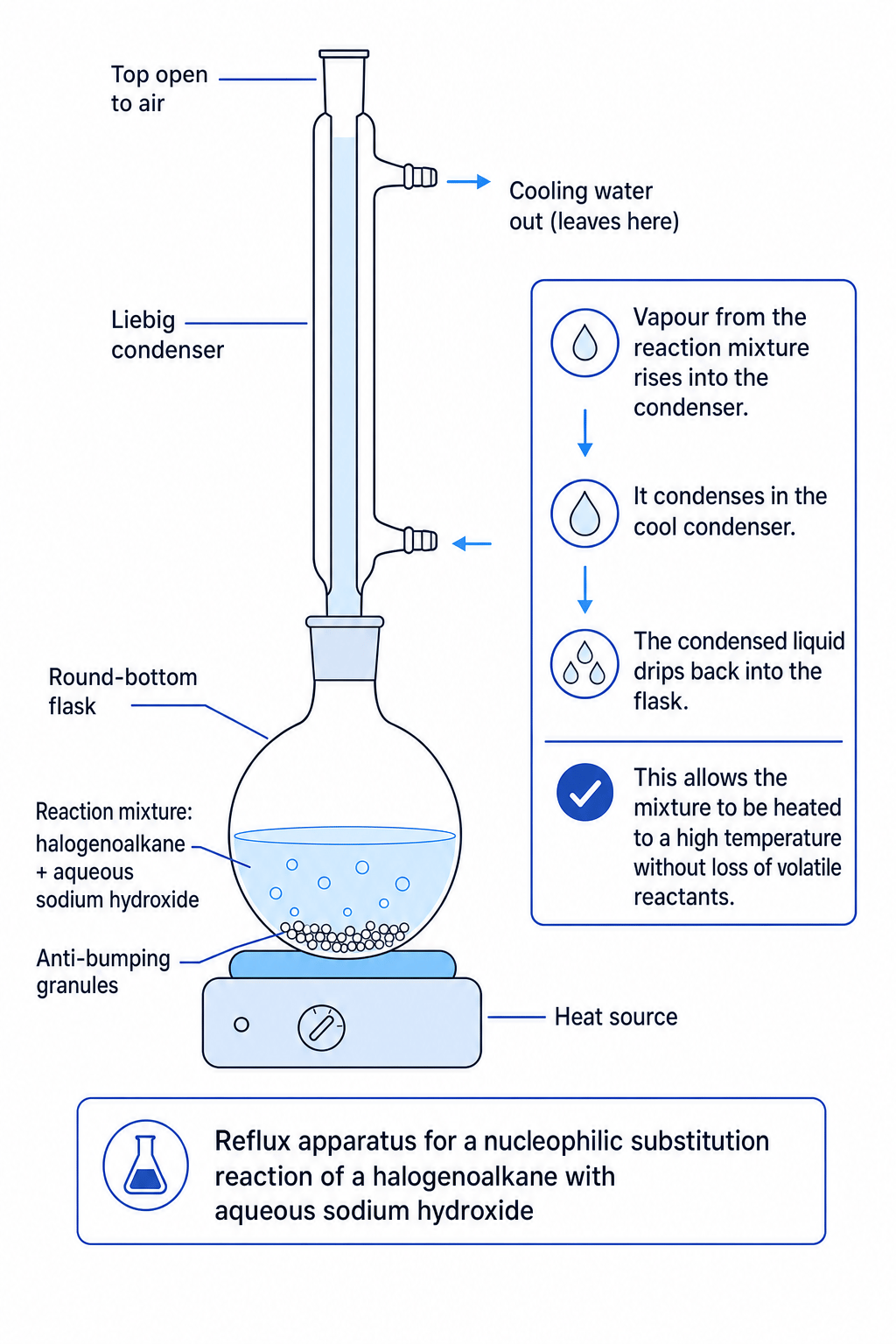
A practical method for nucleophilic substitution:
- Add measured amounts of 1-bromobutane and aqueous sodium hydroxide to a round-bottom flask. A little ethanol may be used to help the organic halogenoalkane mix with the aqueous reagent.
- Add anti-bumping granules.
- Fit a vertical Liebig condenser. Cooling water goes in at the bottom and out at the top. Do not seal the top.
- Heat under reflux using an electric heater or water bath.
- After heating, the organic product is butan-1-ol and bromide ions are present in the mixture.
Safety and evaluation points matter here. Sodium hydroxide is corrosive, many halogenoalkanes are volatile and harmful, and ethanol is flammable, so avoid naked flames and use eye protection. Main sources of error include poor mixing of organic and aqueous layers, temperature variation, loss of vapour if the condenser is not working, and subjective judgement of precipitate formation in rate tests.
Uses, risks and regulation
Halogenoalkanes have been used as:
- Solvents, for example in cleaning, degreasing or extraction.
- Anaesthetics, because some are volatile and biologically active.
- Refrigerants, especially chlorofluorocarbons, CFCs.
They are tightly regulated because some are toxic, persistent, ozone-depleting or powerful greenhouse gases. This is a good example of society balancing benefits, such as safe surgery or refrigeration, against risks to people and the environment.
CFCs contain C–Cl and C–F bonds but no C–H bonds. This matters because compounds with C–H bonds are often broken down more readily in the lower atmosphere. CFCs are very unreactive in the lower atmosphere, so they can reach the stratosphere.
In the upper atmosphere, high-energy UV light can break the weaker C–Cl bond. The C–F bond is stronger and is much less likely to break under the same conditions.
CF2Cl2→CF2Cl⋅+Cl⋅\text{CF}_2\text{Cl}_2 \to \text{CF}_2\text{Cl}\cdot + \text{Cl}\cdotCF2Cl2→CF2Cl⋅+Cl⋅The chlorine radical then catalyses ozone destruction:
Cl⋅+O3→ClO⋅+O2ClO⋅+O→Cl⋅+O2overall: O3+O→2O2\begin{aligned} \text{Cl}\cdot + \text{O}_3 &\to \text{ClO}\cdot + \text{O}_2 \\ \text{ClO}\cdot + \text{O} &\to \text{Cl}\cdot + \text{O}_2 \\ \text{overall: }\text{O}_3 + \text{O} &\to 2\text{O}_2 \end{aligned}Cl⋅+O3ClO⋅+Ooverall: O3+O→ClO⋅+O2→Cl⋅+O2→2O2Why CFCs are damaging
A chlorine radical is regenerated, so one radical can destroy many ozone molecules. This catalytic effect is why CFCs had to be internationally restricted.
In the exam
-
State conditions precisely: aqueous hydroxide + reflux for substitution; ethanolic hydroxide + heat for elimination.
-
For mechanisms, curly arrows must start at an electron pair: a lone pair on OH−\text{OH}^-OH−, a C–H bond, or a C–X bond.
-
For hydrolysis rates and CFCs, compare bond enthalpies, not just electronegativity or polarity.
Check yourself
- Why does 1-iodobutane hydrolyse faster than 1-chlorobutane?
- What would you observe when a bromoalkane releases halide ions in the silver nitrate test?
- Can you draw the curly arrows for both substitution and elimination of 1-bromopropane?
