What you'll learn
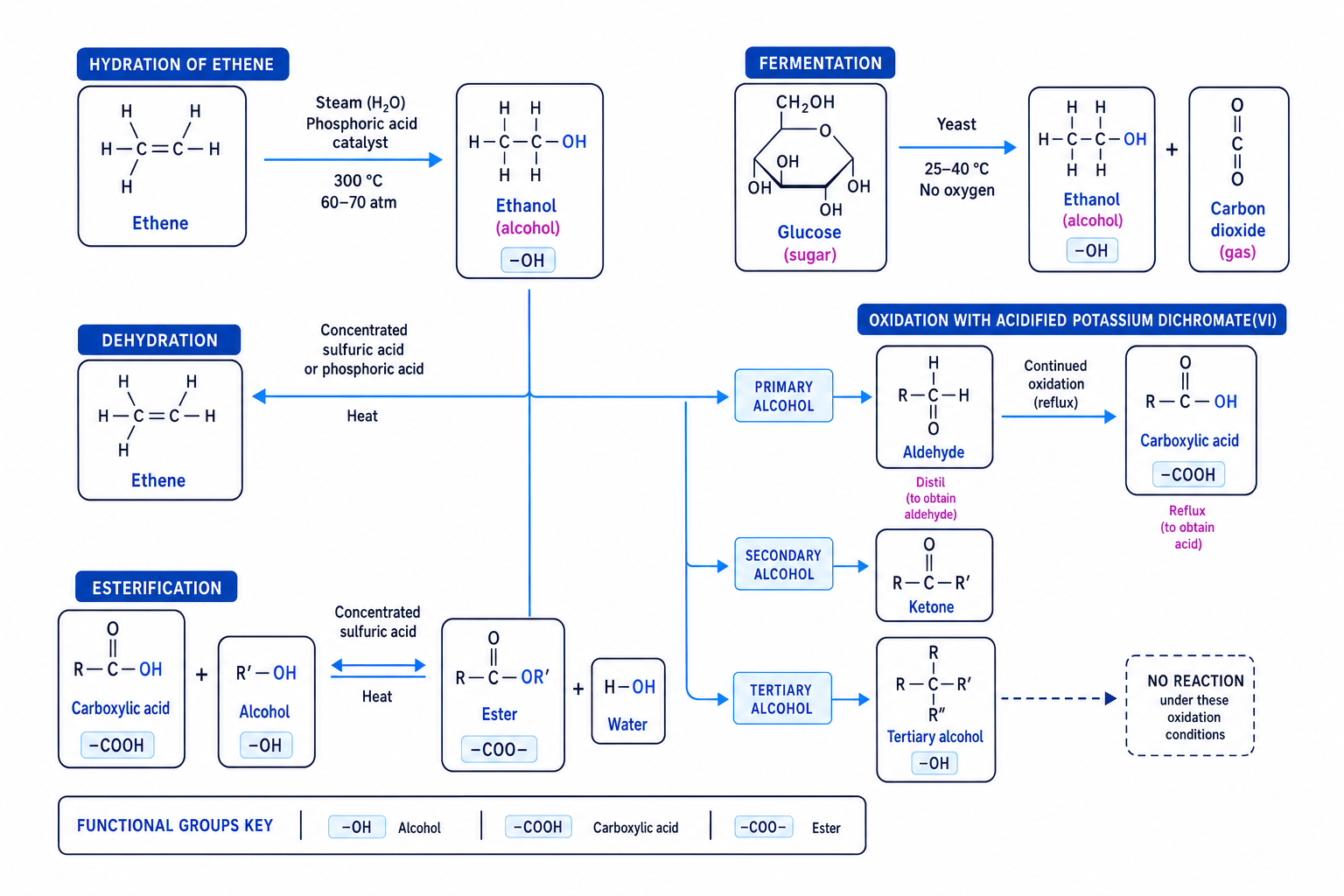
- How ethanol is made industrially from ethene, and by fermentation.
- How alcohols are classified, dehydrated and oxidised.
- How to test for alcohols and carboxylic acids.
- How carboxylic acids form salts and esters, and how esters can be separated by distillation.
1. The key functional groups
Organic chemistry is much easier when you focus on the functional group: the part of a molecule that controls its typical reactions.
Functional group
A functional group is an atom or group of atoms in an organic molecule that gives the molecule its characteristic chemical reactions.
For this section:
- Alcohols contain the hydroxyl group, –OH. Example: ethanol, CH3CH2OH.
- Carboxylic acids contain the carboxyl group, –COOH. Example: ethanoic acid, CH3COOH.
- Esters contain the ester link, –COO–. Example: ethyl ethanoate, CH3COOCH2CH3.
The symbol R
In organic chemistry, R means an alkyl group: a carbon chain such as CH3– or CH3CH2–. So R–OH represents a general alcohol.
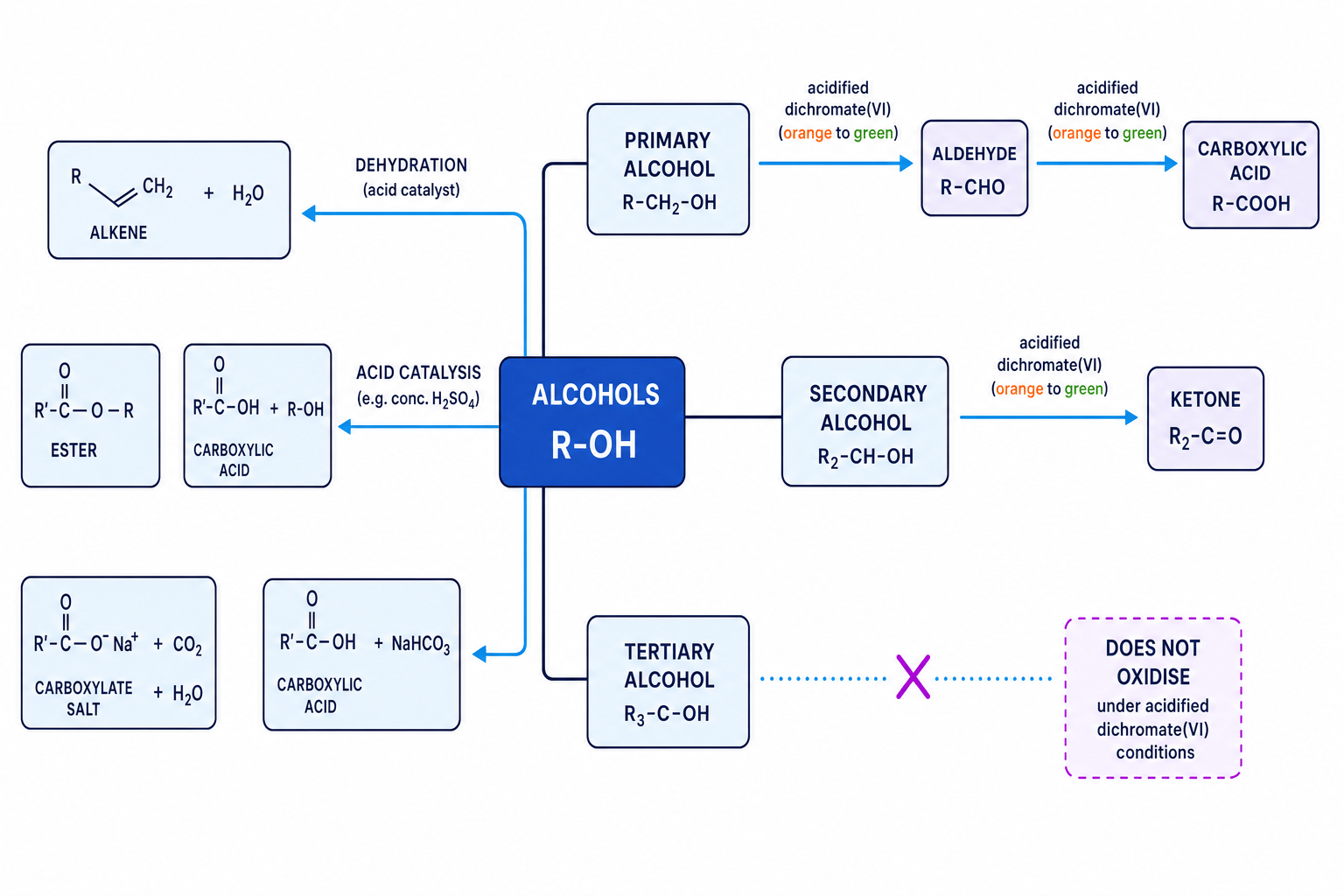
The main reactions in C3.4 fit together like this.
2. Making ethanol
Industrial preparation from ethene
Ethanol can be made by hydration of ethene. Hydration means adding water across a carbon-carbon double bond.
Ethene reacts with steam:
C2H4(g) + H2O(g) ⇌ C2H5OH(g)
Typical conditions:
- phosphoric(V) acid catalyst, H3PO4, on a solid support
- about 300 °C
- high pressure, around 60–70 atm
- unreacted ethene and steam are recycled
This is a fast, continuous industrial process and gives relatively pure ethanol. Its main disadvantage is that ethene usually comes from crude oil, so it is not renewable.
Curly-arrow mechanism: acid-catalysed hydration of ethene
In mechanism terms, this is electrophilic addition.
- A curly arrow goes from the alkene π bond to H+, forming a carbocation.
- A curly arrow goes from a lone pair on the oxygen of water to the positively charged carbon, forming protonated ethanol.
- A base removes H+; the O–H bond electrons return to oxygen, producing ethanol and regenerating the acid catalyst.
Fermentation
Ethanol can also be made by fermentation, where enzymes in yeast convert glucose into ethanol and carbon dioxide under anaerobic conditions.
C6H12O6(aq) → 2CH3CH2OH(aq) + 2CO2(g)
Conditions are mild: warm, around 25–40 °C, and no oxygen. The ethanol solution is dilute because ethanol eventually kills the yeast, so distillation is needed to concentrate it.
Other alcohols, such as propan-1-ol or butan-1-ol, can be produced by fermentation using different microorganisms or feedstocks. The mixture is then separated by distillation or fractional distillation.
Biofuels
Fermentation uses renewable biomass, but biofuels are not automatically “carbon neutral”: energy is used in growing, harvesting, transporting and distilling, and land use may compete with food production.
3. Classifying alcohols
Alcohols are classified by looking at the carbon atom directly bonded to the –OH group.
- A primary alcohol has that carbon attached to one other carbon, or none in methanol. General form: RCH2OH.
- A secondary alcohol has that carbon attached to two other carbons. General form: R2CHOH.
- A tertiary alcohol has that carbon attached to three other carbons. General form: R3COH.
Counting the wrong carbons
Primary, secondary and tertiary refer to the carbon attached to the –OH group, not the total number of carbons in the molecule.
Classifying and oxidising an alcohol
Classify CH3CH(OH)CH3 and predict its oxidation product.
- Identify the carbon bonded to –OH: it is the middle carbon in CH3CH(OH)CH3.
- Count how many carbon groups are attached to that carbon: it is attached to two CH3 groups.
- Therefore the alcohol is secondary, so acidified dichromate(VI) oxidises it to a ketone.
- The product is propanone, CH3COCH3.
4. Dehydration of alcohols
Dehydration means removal of water from a molecule. Alcohols can be dehydrated to form alkenes.
For ethanol:
CH3CH2OH(l) → CH2=CH2(g) + H2O(l)
Typical conditions:
- concentrated sulfuric acid or phosphoric acid catalyst
- heat
Curly-arrow mechanism: acid-catalysed dehydration
A simplified mechanism is:
- A lone pair on the alcohol oxygen attacks H+, forming a protonated alcohol, R–OH2+. This turns –OH into water, a better leaving group.
- The C–O bond electrons move onto oxygen as water leaves.
- A base removes H+ from an adjacent carbon; the C–H bond electrons form the C=C double bond, giving the alkene and regenerating the acid catalyst.
Spotting dehydration
If an alcohol loses H2O and the product contains C=C, the reaction is dehydration and the organic product is an alkene.
5. Oxidation of alcohols
Alcohols are oxidised using acidified potassium dichromate(VI), K2Cr2O7/H2SO4. The observation is orange to green because Cr2O72− is reduced to Cr3+.
Primary alcohols can be oxidised in two stages:
- primary alcohol → aldehyde
- aldehyde → carboxylic acid
For ethanol:
CH3CH2OH + [O] → CH3CHO + H2O
CH3CH2OH + 2[O] → CH3COOH + H2O
To get the aldehyde, distil it off as it forms. To get the carboxylic acid, heat under reflux with excess oxidising agent.
Secondary alcohols oxidise to ketones:
CH3CHOHCH3 + [O] → CH3COCH3 + H2O
Tertiary alcohols are not oxidised under these conditions because the carbon bonded to –OH has no hydrogen atom to remove.
Dichromate test limitation
Acidified dichromate(VI) tells you that an alcohol is primary or secondary if it turns orange to green. By itself, it does not distinguish primary from secondary.
6. Tests for alcohols and carboxylic acids
Dichromate(VI) test for alcohols
Warm the compound with acidified potassium dichromate(VI).
- Primary alcohol: orange to green.
- Secondary alcohol: orange to green.
- Tertiary alcohol: remains orange.
Sodium hydrogencarbonate test for carboxylic acids
Carboxylic acids react with sodium hydrogencarbonate to produce carbon dioxide gas.
CH3COOH(aq) + NaHCO3(aq) → CH3COONa(aq) + CO2(g) + H2O(l)
The observation is effervescence. If the gas is bubbled through limewater, it turns milky.
7. Reactions of carboxylic acids with bases, carbonates and hydrogencarbonates
Carboxylic acids are weak acids, but they still neutralise bases to form salts.
With sodium hydroxide:
CH3COOH(aq) + NaOH(aq) → CH3COONa(aq) + H2O(l)
With sodium carbonate:
2CH3COOH(aq) + Na2CO3(aq) → 2CH3COONa(aq) + CO2(g) + H2O(l)
With sodium hydrogencarbonate:
CH3COOH(aq) + NaHCO3(aq) → CH3COONa(aq) + CO2(g) + H2O(l)
Predicting a carboxylate salt
Predict the salt formed when propanoic acid reacts with magnesium oxide.
- Propanoic acid forms the propanoate ion, CH3CH2COO−.
- Magnesium forms Mg2+, so two propanoate ions are needed to balance the charge.
- The salt is magnesium propanoate, (CH3CH2COO)2Mg.
- The balanced equation is: 2CH3CH2COOH + MgO → (CH3CH2COO)2Mg + H2O.
8. Esterification
An esterification reaction occurs when a carboxylic acid reacts with an alcohol to form an ester and water.
General equation:
carboxylic acid + alcohol ⇌ ester + water
Example:
CH3COOH(l) + CH3CH2OH(l) ⇌ CH3COOCH2CH3(l) + H2O(l)
Conditions:
- concentrated sulfuric acid catalyst
- heat, often under reflux
The reaction is reversible, so the yield may be improved by using an excess of one reactant or removing water.
Curly-arrow mechanism: acid-catalysed esterification
- A lone pair on the carbonyl oxygen of the carboxylic acid attacks H+, making the carbonyl carbon more electrophilic.
- A lone pair on the alcohol oxygen attacks the carbonyl carbon; the C=O π electrons move onto oxygen.
- Proton transfers occur so that an –OH group becomes –OH2+, a good leaving group.
- Water leaves, and a lone pair reforms the C=O bond.
- Loss of H+ gives the ester and regenerates the acid catalyst.
Naming an ester
Name the ester formed from butanoic acid and methanol.
- The alcohol gives the first part of the ester name: methanol gives methyl.
- The carboxylic acid gives the second part: butanoic acid gives butanoate.
- Therefore the ester is methyl butanoate.
9. Separation by distillation
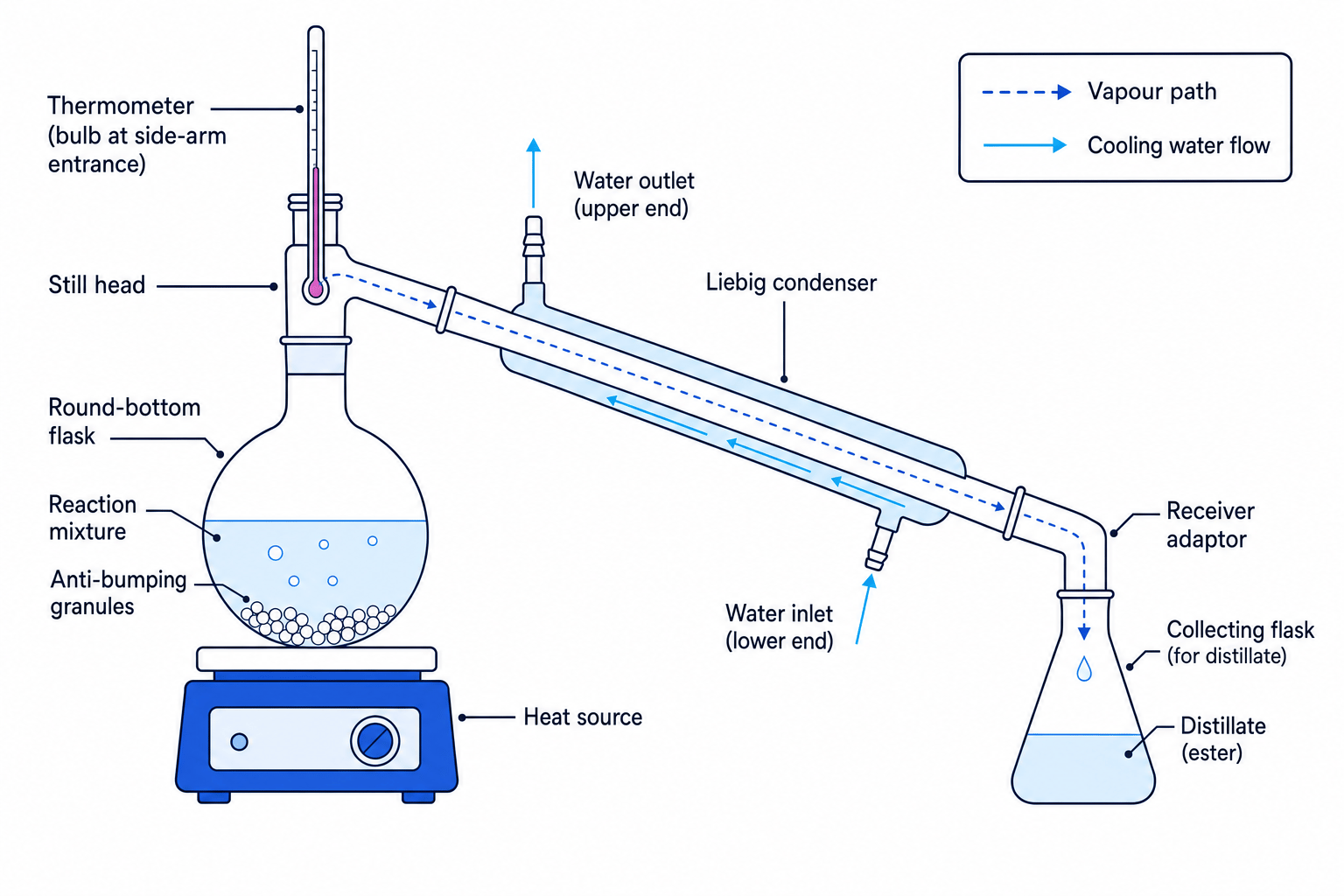
Distillation separates liquids using differences in boiling point. In this topic, it is used to collect an ester product from a reaction mixture.
The core apparatus includes a heated round-bottom flask, thermometer, Liebig condenser and collecting flask. Cooling water enters at the lower end of the condenser and leaves at the upper end so the condenser jacket stays full.
Specified practical: preparation of an ester and separation by distillation
A typical method is:
- Add the carboxylic acid and alcohol to a flask.
- Add a few drops of concentrated sulfuric acid catalyst and anti-bumping granules.
- Heat gently using an electric heater or water bath.
- Distil the volatile ester product and collect the fraction boiling near its boiling point.
- Further purification may involve washing, drying with an anhydrous salt, and redistilling.
Safety points matter: alcohols and esters are flammable, concentrated sulfuric acid is corrosive, and volatile organic vapours should not be inhaled.
Choosing the distillation fraction
A reaction mixture contains methyl ethanoate, methanol, water and ethanoic acid. Their boiling points are approximately 57 °C, 65 °C, 100 °C and 118 °C. Which fraction should contain most ester?
- Identify the ester: methyl ethanoate.
- Compare boiling points: methyl ethanoate has the lowest boiling point, 57 °C.
- The ester should distil first, so collect the fraction close to 57 °C.
Purity in distillation
Simple distillation works best when boiling points are well separated. If boiling points are close, the distillate may contain impurities and fractional distillation or further purification may be needed.
In the exam
- For alcohol oxidation, always state both the reagent and the conditions: acidified potassium dichromate(VI), heat; distil for aldehyde, reflux for carboxylic acid.
- For ester questions, name the ester as alkyl alkanoate: alcohol part first, acid part second.
- For practical questions, mention key measurements and errors: thermometer position, boiling range collected, anti-bumping granules, no naked flame, and loss of volatile product.
Check yourself
- Why does a tertiary alcohol not turn acidified dichromate(VI) from orange to green?
- What is the product when propan-1-ol is oxidised under reflux with excess dichromate(VI)?
- How would you test an unknown liquid to show it contains a carboxylic acid group?