

What you'll learn
- How to write and use expressions for KcK_cKc and KpK_pKp.
- How to calculate equilibrium constants and unknown equilibrium quantities.
- What the size of an equilibrium constant tells you about equilibrium position.
- How temperature affects KcK_cKc and KpK_pKp, and how an esterification practical can determine KcK_cKc.
1. Starting point: dynamic equilibrium
A reversible reaction is a reaction that can proceed in both directions, shown using ⇌. In a closed system, the forward and reverse reactions can reach dynamic equilibrium.
Dynamic equilibrium
A dynamic equilibrium is reached when the forward and reverse reactions are still happening, but at equal rates, so the concentrations of reactants and products stay constant.
The diagram summarises the key ideas: equilibrium is dynamic, the equilibrium constant has products over reactants, and the size of KKK shows which side is favoured.
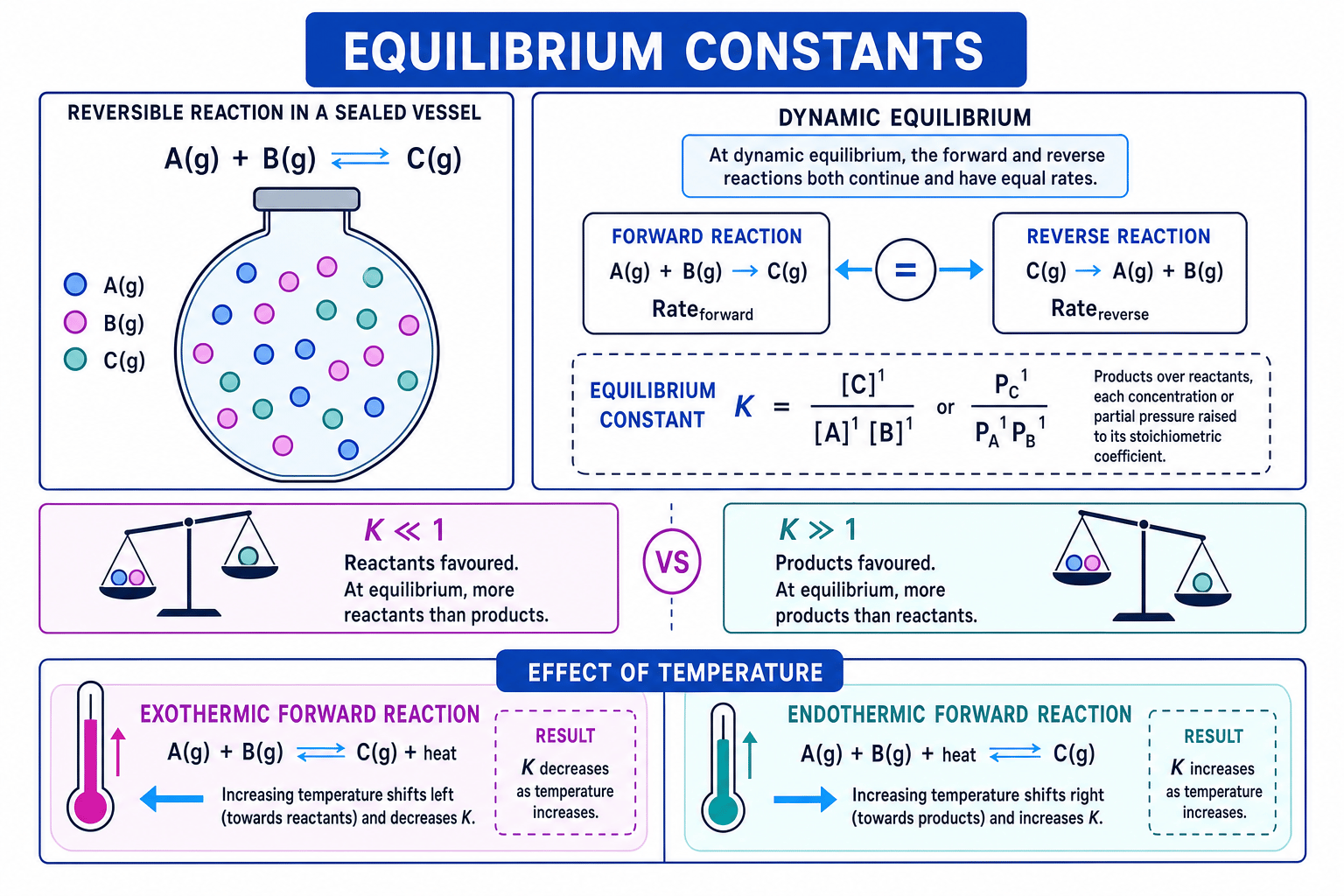
Equal rates, not equal amounts
At equilibrium, the rates of the forward and reverse reactions are equal. The concentrations of reactants and products are usually not equal.
2. KcK_cKc: using equilibrium concentrations
KcK_cKc is the equilibrium constant written using equilibrium concentrations, usually in mol dm⁻³.
For a general homogeneous reaction:
aA+bB⇌cC+dDaA + bB \rightleftharpoons cC + dDaA+bB⇌cC+dDthe expression is:
Kc=[C]c[D]d[A]a[B]bK_c = \frac{[C]^c[D]^d}{[A]^a[B]^b}Kc=[A]a[B]b[C]c[D]dSquare brackets mean equilibrium concentration, not initial concentration.
Equilibrium constant Kc
KcK_cKc is the value of the products’ equilibrium concentrations divided by the reactants’ equilibrium concentrations, each raised to the power of its balancing number.
Pure solids are not included in equilibrium expressions. Pure liquids are usually omitted in heterogeneous equilibria, but in the esterification practical, the reacting liquid substances are treated as variable concentrations and are included.
Writing a Kc expression
For the Haber equilibrium:
N₂(g) + 3H₂(g) ⇌ 2NH₃(g)
-
Identify the products and reactants from the balanced equation: NH₃ is the product; N₂ and H₂ are reactants.
-
Put products over reactants, using square brackets for equilibrium concentrations:
Kc=[NH3]2[N2][H2]3K_c = \frac{[\text{NH}_3]^2}{[\text{N}_2][\text{H}_2]^3}Kc=[N2][H2]3[NH3]2 -
Work out the units from the powers: top power is 2, bottom total power is 4, so the overall unit is (mol dm−3)−2\left(\text{mol dm}^{-3}\right)^{-2}(mol dm−3)−2, often written as dm⁶ mol⁻².
Using initial concentrations
Equilibrium constants must be calculated from equilibrium concentrations or partial pressures. Initial amounts are only a starting point for working out the equilibrium amounts.
3. Calculating KcK_cKc from equilibrium data
You often use the amount–concentration relationship:
n=cVn = cVn=cVso:
c=nVc = \frac{n}{V}c=Vnwhere volume must be in dm³ if concentration is in mol dm⁻³.
Calculating Kc from equilibrium amounts
At a fixed temperature, hydrogen and iodine reach equilibrium:
H₂(g) + I₂(g) ⇌ 2HI(g)
In a 1.00 dm³ vessel at equilibrium, there are 0.100 mol H₂, 0.100 mol I₂ and 0.780 mol HI.
-
Convert each amount into concentration using c=nVc = \frac{n}{V}c=Vn:
[H2]=0.100,[I2]=0.100,[HI]=0.780[\text{H}_2] = 0.100,\quad [\text{I}_2] = 0.100,\quad [\text{HI}] = 0.780[H2]=0.100,[I2]=0.100,[HI]=0.780all in mol dm⁻³.
-
Write the expression:
Kc=[HI]2[H2][I2]K_c = \frac{[\text{HI}]^2}{[\text{H}_2][\text{I}_2]}Kc=[H2][I2][HI]2 -
Substitute the equilibrium concentrations:
Kc=0.78020.100×0.100=60.8K_c = \frac{0.780^2}{0.100 \times 0.100} = 60.8Kc=0.100×0.1000.7802=60.8 -
Check the units: the total concentration power on top and bottom is 2, so the units cancel. Here, Kc=60.8K_c = 60.8Kc=60.8 with no units.
4. Finding equilibrium quantities
When the equilibrium amount is unknown, use a change variable such as xxx. This is sometimes called an ICE method: initial, change, equilibrium.
Finding equilibrium concentrations from Kc
For H₂(g) + I₂(g) ⇌ 2HI(g), Kc=49.0K_c = 49.0Kc=49.0 at a particular temperature. Initially, [H2]=0.500[\text{H}_2] = 0.500[H2]=0.500 mol dm⁻³ and [I2]=0.500[\text{I}_2] = 0.500[I2]=0.500 mol dm⁻³, with no HI present.
-
Let xxx be the concentration of H₂ and I₂ that reacts. The equilibrium concentrations are:
[H2]=0.500−x,[I2]=0.500−x,[HI]=2x[\text{H}_2] = 0.500 - x,\quad [\text{I}_2] = 0.500 - x,\quad [\text{HI}] = 2x[H2]=0.500−x,[I2]=0.500−x,[HI]=2x -
Substitute into the KcK_cKc expression:
49.0=(2x)2(0.500−x)(0.500−x)49.0 = \frac{(2x)^2}{(0.500 - x)(0.500 - x)}49.0=(0.500−x)(0.500−x)(2x)2 -
Take the square root to simplify:
7.00=2x0.500−x7.00 = \frac{2x}{0.500 - x}7.00=0.500−x2x -
Solve for xxx:
7.00(0.500−x)=2x3.50−7.00x=2x3.50=9.00xx=0.389\begin{aligned} 7.00(0.500 - x) &= 2x \\ 3.50 - 7.00x &= 2x \\ 3.50 &= 9.00x \\ x &= 0.389 \end{aligned}7.00(0.500−x)3.50−7.00x3.50x=2x=2x=9.00x=0.389 -
Calculate the equilibrium concentrations:
[H2]=[I2]=0.111 mol dm−3,[HI]=0.778 mol dm−3[\text{H}_2] = [\text{I}_2] = 0.111\ \text{mol dm}^{-3},\quad [\text{HI}] = 0.778\ \text{mol dm}^{-3}[H2]=[I2]=0.111 mol dm−3,[HI]=0.778 mol dm−3
Sanity check
Your value of xxx cannot be larger than the starting concentration of a limiting reactant. If it is, something has gone wrong in the algebra.
5. KpK_pKp: using partial pressures
For gaseous equilibria, you may use KpK_pKp, which is written using partial pressures.
Partial pressure
The partial pressure of a gas is the pressure it would exert if it alone occupied the container. In a gas mixture, pi=χiptotalp_i = \chi_i p_{\text{total}}pi=χiptotal, where χi\chi_iχi is the mole fraction of gas iii.
For:
aA(g)+bB(g)⇌cC(g)+dD(g)aA(g) + bB(g) \rightleftharpoons cC(g) + dD(g)aA(g)+bB(g)⇌cC(g)+dD(g)the expression is:
Kp=(pC)c(pD)d(pA)a(pB)bK_p = \frac{(p_C)^c(p_D)^d}{(p_A)^a(p_B)^b}Kp=(pA)a(pB)b(pC)c(pD)dOnly gaseous species appear in a KpK_pKp expression.
Calculating Kp from mole fractions
For N₂O₄(g) ⇌ 2NO₂(g), an equilibrium mixture contains 0.400 mol N₂O₄ and 0.600 mol NO₂. The total pressure is 200 kPa.
-
Calculate the total number of moles and mole fractions:
ntotal=0.400+0.600=1.000n_{\text{total}} = 0.400 + 0.600 = 1.000ntotal=0.400+0.600=1.000 χN2O4=0.400,χNO2=0.600\chi_{\text{N}_2\text{O}_4} = 0.400,\quad \chi_{\text{NO}_2} = 0.600χN2O4=0.400,χNO2=0.600 -
Calculate partial pressures using pi=χiptotalp_i = \chi_i p_{\text{total}}pi=χiptotal:
pN2O4=0.400×200=80.0 kPap_{\text{N}_2\text{O}_4} = 0.400 \times 200 = 80.0\ \text{kPa}pN2O4=0.400×200=80.0 kPa pNO2=0.600×200=120 kPap_{\text{NO}_2} = 0.600 \times 200 = 120\ \text{kPa}pNO2=0.600×200=120 kPa -
Substitute into the expression:
Kp=(pNO2)2pN2O4=120280.0=180 kPaK_p = \frac{(p_{\text{NO}_2})^2}{p_{\text{N}_2\text{O}_4}} = \frac{120^2}{80.0} = 180\ \text{kPa}Kp=pN2O4(pNO2)2=80.01202=180 kPa
Using total pressure in Kp
KpK_pKp uses partial pressures, not the total pressure directly. Use mole fractions first if the mixture composition is given.
6. What the size of KKK means
The position of equilibrium describes whether the equilibrium mixture contains mostly reactants or mostly products.
Magnitude of K
If K≫1K \gg 1K≫1, products are favoured and equilibrium lies to the right. If K≪1K \ll 1K≪1, reactants are favoured and equilibrium lies to the left. If KKK is close to 1, appreciable amounts of both reactants and products are present.
A large KKK does not mean the reaction is fast. Rate and equilibrium position are different ideas.
Interpreting the size of K
Two reversible reactions have these equilibrium constants at the same temperature: reaction A has Kc=2.0×10⁻⁴K_c = 2.0 \times 10^{-4}Kc=2.0×10⁻⁴ and reaction B has Kc=1.5×10³K_c = 1.5 \times 10^3Kc=1.5×10³.
- Compare each value with 1: reaction A has Kc≪1K_c \ll 1Kc≪1, while reaction B has Kc≫1K_c \gg 1Kc≫1.
- For reaction A, the denominator of the KcK_cKc expression is relatively large, so reactants are favoured.
- For reaction B, the numerator is relatively large, so products are favoured.
7. Temperature changes KcK_cKc and KpK_pKp
At a fixed temperature, KcK_cKc and KpK_pKp are constant for a given balanced equation. Changing concentration or pressure can change the equilibrium composition, but it does not change the value of KKK if temperature stays the same.
Temperature is different because it changes the relative favourability of the forward and reverse reactions.
- For an exothermic forward reaction, increasing temperature decreases KKK.
- For an endothermic forward reaction, increasing temperature increases KKK.
Predicting the temperature effect on Kp
For the Haber process:
N₂(g) + 3H₂(g) ⇌ 2NH₃(g), ΔH=−92 kJ mol−1\Delta H = -92\ \text{kJ mol}^{-1}ΔH=−92 kJ mol−1
- The forward reaction is exothermic because ΔH\Delta HΔH is negative.
- Increasing temperature favours the endothermic direction, which is the reverse reaction.
- The equilibrium mixture contains a smaller proportion of NH₃, so the numerator of the KpK_pKp expression becomes smaller relative to the denominator.
- Therefore KpK_pKp decreases when temperature increases.
Catalysts and K
A catalyst helps equilibrium be reached faster, but it increases the rates of the forward and reverse reactions equally. It does not change KcK_cKc, KpK_pKp or the equilibrium position.
8. Practical: determining KcK_cKc for esterification
A common practical is the equilibrium between ethanol and ethanoic acid:
CH₃COOH(l) + C₂H₅OH(l) ⇌ CH₃COOC₂H₅(l) + H₂O(l)
This is catalysed by acid, often concentrated sulfuric acid.
A typical method:
- Measure known initial amounts of ethanoic acid and ethanol into a stoppered flask.
- Add a small amount of acid catalyst and keep the mixture at constant temperature until equilibrium is reached.
- Take a measured sample and titrate the remaining ethanoic acid with standard sodium hydroxide.
- Correct for any acid catalyst that is also neutralised.
- Use the remaining ethanoic acid to calculate the equilibrium amounts of all species, then calculate KcK_cKc.
Calculating Kc from esterification titration data
An equilibrium mixture was prepared from 0.100 mol ethanoic acid and 0.100 mol ethanol, with no ester or water initially. After equilibrium, the mixture was analysed. A corrected titration showed that 0.0330 mol ethanoic acid remained in the whole mixture.
-
Calculate the amount of ethanoic acid that reacted:
nreacted=0.100−0.0330=0.0670 moln_{\text{reacted}} = 0.100 - 0.0330 = 0.0670\ \text{mol}nreacted=0.100−0.0330=0.0670 mol -
Use the 1:1:1:1 stoichiometry to find equilibrium amounts:
nCH3COOH=0.0330,nC2H5OH=0.0330n_{\text{CH}_3\text{COOH}} = 0.0330,\quad n_{\text{C}_2\text{H}_5\text{OH}} = 0.0330nCH3COOH=0.0330,nC2H5OH=0.0330 nester=0.0670,nwater=0.0670n_{\text{ester}} = 0.0670,\quad n_{\text{water}} = 0.0670nester=0.0670,nwater=0.0670 -
Write the expression:
Kc=[CH3COOC2H5][H2O][CH3COOH][C2H5OH]K_c = \frac{[\text{CH}_3\text{COOC}_2\text{H}_5][\text{H}_2\text{O}]}{[\text{CH}_3\text{COOH}][\text{C}_2\text{H}_5\text{OH}]}Kc=[CH3COOH][C2H5OH][CH3COOC2H5][H2O] -
Because the powers on top and bottom are equal, the same volume factor cancels, so moles can be used directly:
Kc=0.0670×0.06700.0330×0.0330=4.12K_c = \frac{0.0670 \times 0.0670}{0.0330 \times 0.0330} = 4.12Kc=0.0330×0.03300.0670×0.0670=4.12
Practical accuracy
The mixture must be at constant temperature and genuinely at equilibrium. Ethanol and ethyl ethanoate are flammable, and concentrated sulfuric acid is corrosive, so use eye protection, avoid naked flames and handle acids carefully.
In the exam
- Start with the balanced equation, then write the equilibrium expression with products over reactants.
- Use equilibrium concentrations for KcK_cKc and partial pressures for KpK_pKp; convert cm³ to dm³ where needed.
- If an equilibrium amount is unknown, define xxx and build the equilibrium quantities from the stoichiometry.
- For temperature questions, identify whether the forward reaction is exothermic or endothermic, then link the shift to how KKK changes.
- Remember: pressure, concentration and catalysts do not change KKK at constant temperature.
Check yourself
- For N₂(g) + 3H₂(g) ⇌ 2NH₃(g), what is the expression for KcK_cKc and what are its units?
- How do you calculate partial pressures from mole amounts and total pressure?
- For an exothermic forward reaction, what happens to KKK when temperature is increased?

