

What you'll learn
- What entropy means in terms of particle freedom.
- How to predict and calculate entropy changes using absolute entropy data.
- How to use ΔG=ΔH−TΔS\Delta G = \Delta H - T\Delta SΔG=ΔH−TΔS to decide whether a reaction is feasible.
- Why some endothermic processes can still happen spontaneously.
Why enthalpy is not enough
From earlier work on energetics, you know that an enthalpy change, ΔH\Delta HΔH, is the heat energy change at constant pressure.
- ΔH<0\Delta H < 0ΔH<0: exothermic, heat released.
- ΔH>0\Delta H > 0ΔH>0: endothermic, heat absorbed.
It is tempting to think “exothermic means it happens” and “endothermic means it does not happen”. That is not reliable. To predict feasibility, we also need entropy.
Entropy: a measure of particle freedom
Entropy
Entropy, SSS, is a measure of the freedom possessed by particles in a system. More freedom means more possible ways for particles and energy to be arranged.
A system is the chemical reaction or physical process being studied. The surroundings are everything outside the system.
Entropy is often described loosely as “disorder”, but for A-Level Chemistry it is better to think in terms of particle freedom and the number of possible arrangements.
Entropy and states of matter
Particles in a solid are held in fixed positions and mainly vibrate. Particles in a liquid can move past each other. Particles in a gas are far apart and move freely. So, other factors being equal:
S(gas)>S(liquid)>S(solid)S(\text{gas}) > S(\text{liquid}) > S(\text{solid})S(gas)>S(liquid)>S(solid)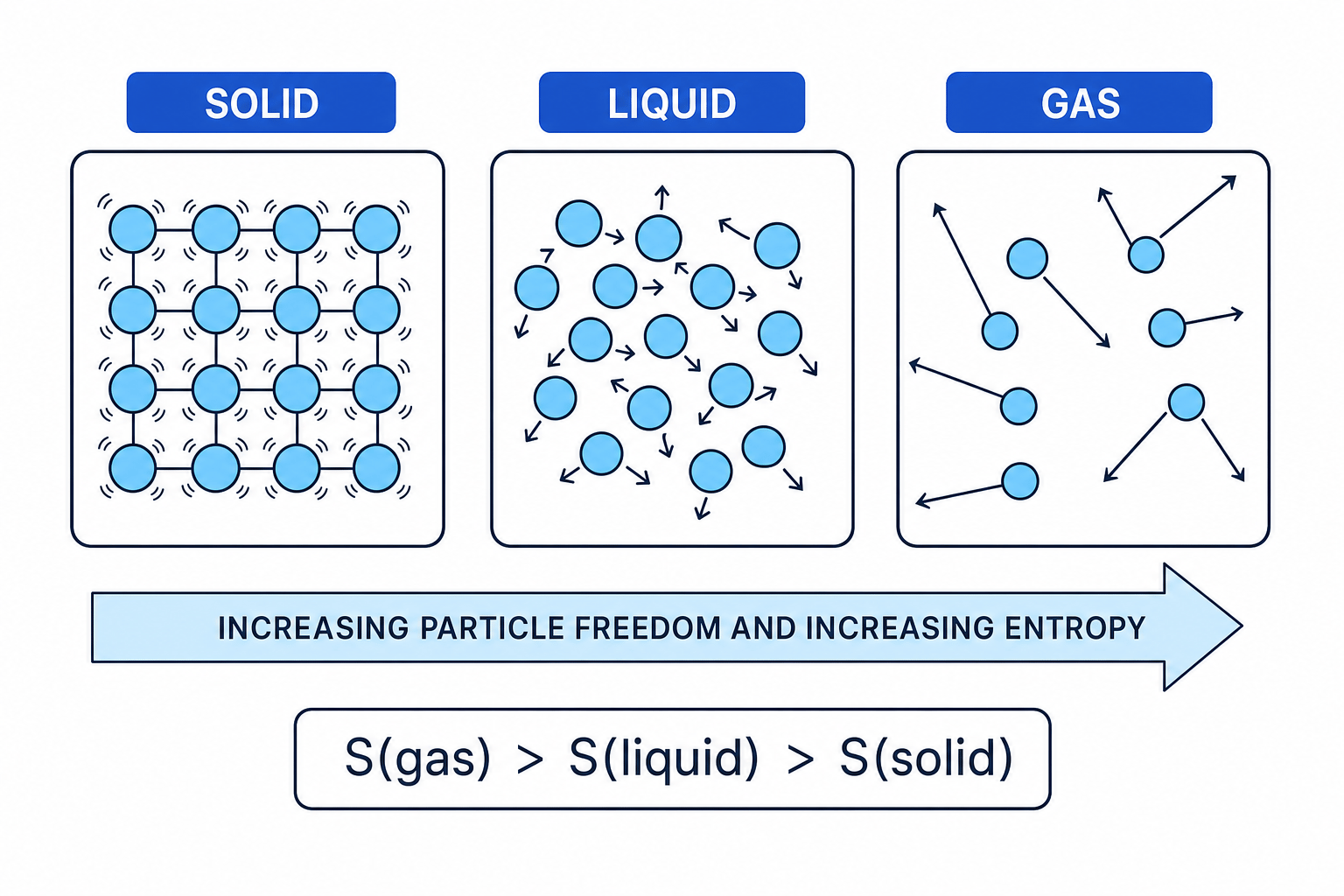
State and entropy
Changing from solid → liquid → gas increases entropy because particle freedom increases.
Natural changes and maximum entropy
A natural change is one that occurs without continuous external forcing once suitable conditions are provided. For an isolated system, natural changes occur in the direction that increases total entropy towards a maximum.
At equilibrium, entropy has reached a maximum for the conditions, so there is no further net change.
The direction of natural change
Natural changes are associated with an increase in total entropy, but the entropy of the chemical system alone can decrease if the surroundings compensate.
Predicting the sign of an entropy change
For reactions, a useful first check is to look at the number and state of particles.
Entropy usually increases when:
- a gas is formed from a solid or liquid
- the number of moles of gas increases
- a solid dissolves into many mobile ions or molecules
Entropy usually decreases when:
- gas particles are removed
- fewer gas molecules are produced
- a precipitate forms from aqueous ions
Predicting the sign of an entropy change
Consider the thermal decomposition:
CaCO₃(s) → CaO(s) + CO₂(g)
- Compare the initial and final states. Initially there is one solid reactant; finally there is one solid product and one gaseous product.
- Focus on the gas because gas particles have much more freedom than solid particles. CO₂(g) has far more freedom than particles locked in a solid lattice.
- The products have greater particle freedom overall, so the entropy change is positive: ΔS>0\Delta S > 0ΔS>0.
Quick gas check
When gases are involved, the change in the number of moles of gas often dominates the sign of ΔS\Delta SΔS.
Calculating entropy change from absolute entropy values
Absolute entropy
An absolute entropy, usually written as S∘S^\circS∘, is the entropy of one mole of a substance under standard conditions, commonly quoted in J K⁻¹ mol⁻¹.
Unlike standard enthalpies of formation, standard entropy values for elements are not zero. Even pure elements have particles with energy and possible arrangements.
For a reaction:
ΔS∘=Sfinal−Sinitial\Delta S^\circ = S_{\text{final}} - S_{\text{initial}}ΔS∘=Sfinal−SinitialFor chemical equations, this means:
ΔS∘=∑S∘(products)−∑S∘(reactants)\Delta S^\circ = \sum S^\circ(\text{products}) - \sum S^\circ(\text{reactants})ΔS∘=∑S∘(products)−∑S∘(reactants)Remember to multiply each entropy value by the balancing coefficient in the equation.
Forgetting the coefficients
If the equation has 3H₂(g), you must use three times the entropy of H₂(g), not just one value.
Calculating an entropy change from entropy data
For the reaction:
N₂(g) + 3H₂(g) → 2NH₃(g)
Use these standard entropy values:
- N₂(g): 191.5 J K⁻¹ mol⁻¹
- H₂(g): 130.7 J K⁻¹ mol⁻¹
- NH₃(g): 192.5 J K⁻¹ mol⁻¹
- Calculate the total entropy of the products: 2×192.5=385.0 J K−1 mol−12 \times 192.5 = 385.0 \ \text{J K}^{-1}\text{ mol}^{-1}2×192.5=385.0 J K−1 mol−1.
- Calculate the total entropy of the reactants: 191.5+(3×130.7)=583.6 J K−1 mol−1191.5 + (3 \times 130.7) = 583.6 \ \text{J K}^{-1}\text{ mol}^{-1}191.5+(3×130.7)=583.6 J K−1 mol−1.
- Apply products minus reactants: ΔS∘=385.0−583.6=−198.6 J K−1 mol−1\Delta S^\circ = 385.0 - 583.6 = -198.6 \ \text{J K}^{-1}\text{ mol}^{-1}ΔS∘=385.0−583.6=−198.6 J K−1 mol−1.
- Interpret the sign. Four moles of gas become two moles of gas, so particle freedom decreases; the negative value makes chemical sense.
Gibbs free energy change
Gibbs free energy change
The Gibbs free energy change, ΔG\Delta GΔG, combines enthalpy and entropy to predict whether a reaction is thermodynamically feasible at a particular temperature.
The Eduqas relationship is:
ΔG=ΔH−TΔS\Delta G = \Delta H - T\Delta SΔG=ΔH−TΔSwhere:
- ΔG\Delta GΔG is usually in kJ mol⁻¹
- ΔH\Delta HΔH is usually in kJ mol⁻¹
- TTT is temperature in K
- ΔS\Delta SΔS must be in kJ K⁻¹ mol⁻¹ if ΔH\Delta HΔH is in kJ mol⁻¹
Unit check for Gibbs calculations
Entropy data are usually given in J K⁻¹ mol⁻¹, but enthalpy is usually in kJ mol⁻¹. Convert entropy by dividing by 1000 before using ΔG=ΔH−TΔS\Delta G = \Delta H - T\Delta SΔG=ΔH−TΔS.
What the sign of Gibbs energy means
At a stated temperature:
- ΔG<0\Delta G < 0ΔG<0: reaction is thermodynamically feasible, or spontaneous.
- ΔG=0\Delta G = 0ΔG=0: system is at equilibrium.
- ΔG>0\Delta G > 0ΔG>0: forward reaction is not thermodynamically feasible under those conditions.
Feasible does not mean fast
A reaction with ΔG<0\Delta G < 0ΔG<0 may still be very slow if it has a high activation energy. Gibbs energy tells you about thermodynamic feasibility, not rate.
Calculating Gibbs free energy
Calcium carbonate decomposes as follows:
CaCO₃(s) → CaO(s) + CO₂(g)
For this reaction, ΔH=+178 kJ mol−1\Delta H = +178 \ \text{kJ mol}^{-1}ΔH=+178 kJ mol−1 and ΔS=+161 J K−1 mol−1\Delta S = +161 \ \text{J K}^{-1}\text{ mol}^{-1}ΔS=+161 J K−1 mol−1. Calculate ΔG\Delta GΔG at 1200 K.
- Convert entropy into kJ K⁻¹ mol⁻¹: 161÷1000=0.161 kJ K−1 mol−1161 \div 1000 = 0.161 \ \text{kJ K}^{-1}\text{ mol}^{-1}161÷1000=0.161 kJ K−1 mol−1.
- Substitute into the Gibbs equation: ΔG=178−(1200×0.161)\Delta G = 178 - (1200 \times 0.161)ΔG=178−(1200×0.161).
- Calculate the entropy term: 1200×0.161=193.2 kJ mol−11200 \times 0.161 = 193.2 \ \text{kJ mol}^{-1}1200×0.161=193.2 kJ mol−1.
- Find ΔG\Delta GΔG: ΔG=178−193.2=−15.2 kJ mol−1\Delta G = 178 - 193.2 = -15.2 \ \text{kJ mol}^{-1}ΔG=178−193.2=−15.2 kJ mol−1.
- Interpret the result. Since ΔG<0\Delta G < 0ΔG<0, the decomposition is thermodynamically feasible at 1200 K.
How temperature affects feasibility
The equation ΔG=ΔH−TΔS\Delta G = \Delta H - T\Delta SΔG=ΔH−TΔS shows that temperature controls the size of the entropy term, TΔST\Delta STΔS.
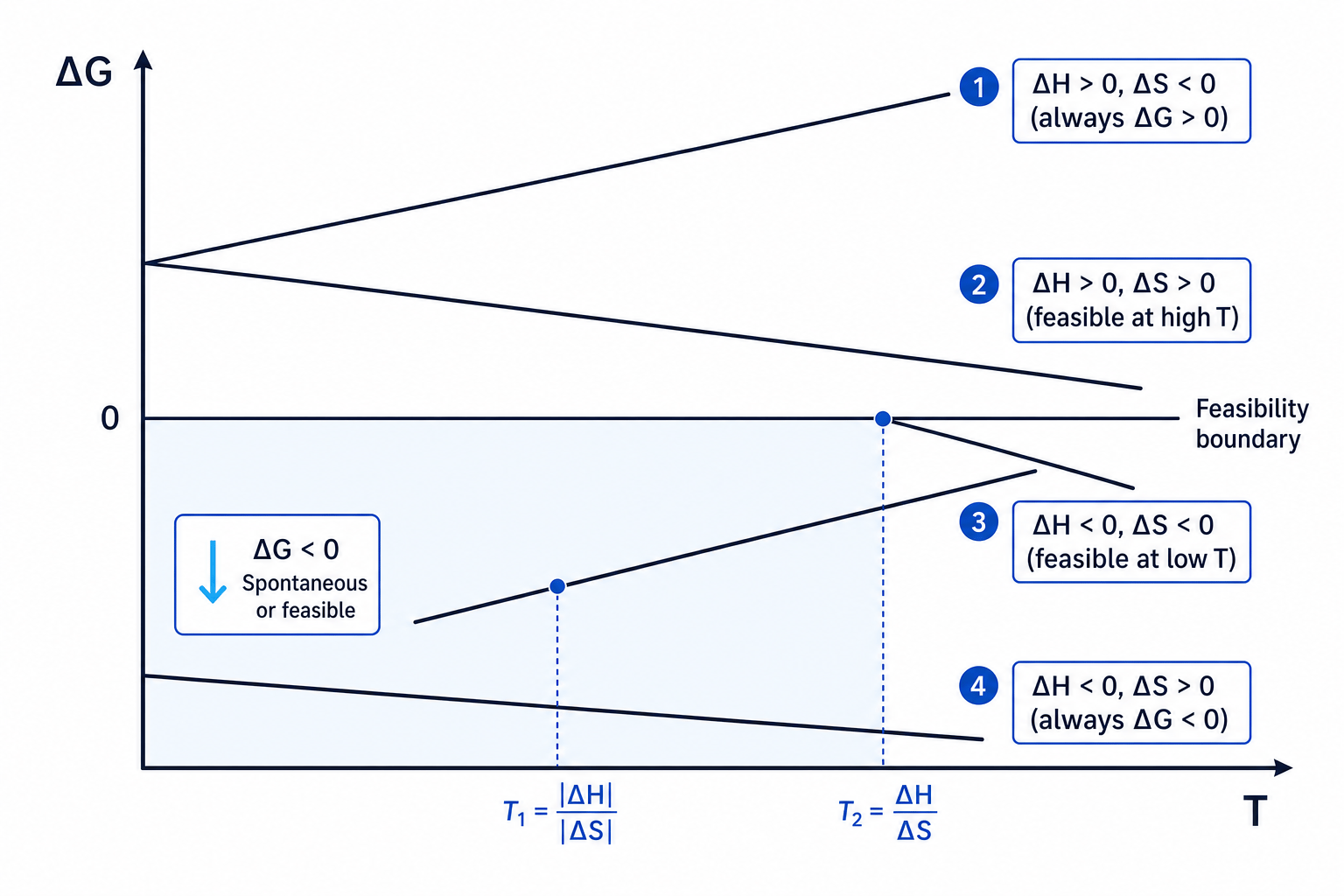
- If ΔH<0\Delta H < 0ΔH<0 and ΔS>0\Delta S > 0ΔS>0, then ΔG\Delta GΔG is always negative.
- If ΔH>0\Delta H > 0ΔH>0 and ΔS<0\Delta S < 0ΔS<0, then ΔG\Delta GΔG is always positive.
- If ΔH<0\Delta H < 0ΔH<0 and ΔS<0\Delta S < 0ΔS<0, the reaction is more feasible at low temperature.
- If ΔH>0\Delta H > 0ΔH>0 and ΔS>0\Delta S > 0ΔS>0, the reaction is more feasible at high temperature.
The graph below summarises how different signs of ΔH\Delta HΔH and ΔS\Delta SΔS affect ΔG\Delta GΔG as temperature changes.
Finding the temperature where feasibility changes
The boundary between feasible and not feasible occurs when ΔG=0\Delta G = 0ΔG=0.
Starting from:
ΔG=ΔH−TΔS\Delta G = \Delta H - T\Delta SΔG=ΔH−TΔSAt the boundary:
0=ΔH−TΔS0 = \Delta H - T\Delta S0=ΔH−TΔSSo:
T=ΔHΔST = \frac{\Delta H}{\Delta S}T=ΔSΔHThis only works if ΔH\Delta HΔH and ΔS\Delta SΔS are in compatible units.
Finding the feasibility temperature
For CaCO₃(s) → CaO(s) + CO₂(g), use ΔH=+178 kJ mol−1\Delta H = +178 \ \text{kJ mol}^{-1}ΔH=+178 kJ mol−1 and ΔS=+161 J K−1 mol−1\Delta S = +161 \ \text{J K}^{-1}\text{ mol}^{-1}ΔS=+161 J K−1 mol−1.
- Set the boundary condition: at the changeover point, ΔG=0\Delta G = 0ΔG=0, so T=ΔHΔST = \frac{\Delta H}{\Delta S}T=ΔSΔH.
- Convert entropy into kJ K⁻¹ mol⁻¹: 161 J K−1 mol−1=0.161 kJ K−1 mol−1161 \ \text{J K}^{-1}\text{ mol}^{-1} = 0.161 \ \text{kJ K}^{-1}\text{ mol}^{-1}161 J K−1 mol−1=0.161 kJ K−1 mol−1.
- Substitute values: T=1780.161=1106 KT = \frac{178}{0.161} = 1106 \ \text{K}T=0.161178=1106 K.
- Interpret the result. Since this reaction has ΔH>0\Delta H > 0ΔH>0 and ΔS>0\Delta S > 0ΔS>0, it becomes feasible above about 1100 K.
Why endothermic processes can be spontaneous
An endothermic process has ΔH>0\Delta H > 0ΔH>0, which seems unfavourable. But if entropy increases enough, then TΔST\Delta STΔS can be larger than ΔH\Delta HΔH.
That makes:
ΔG=ΔH−TΔS<0\Delta G = \Delta H - T\Delta S < 0ΔG=ΔH−TΔS<0So an endothermic process can be spontaneous when it has a sufficiently positive entropy change, especially at high temperature. This explains processes such as some thermal decompositions and some dissolving processes.
Endothermic does not mean impossible
Endothermic means heat is absorbed. It does not automatically mean the process is not feasible; entropy and temperature must also be considered.
In the exam
- For entropy calculations, do products minus reactants and multiply each S∘S^\circS∘ value by its balancing coefficient.
- In Gibbs calculations, convert ΔS\Delta SΔS from J K⁻¹ mol⁻¹ to kJ K⁻¹ mol⁻¹ if ΔH\Delta HΔH is in kJ mol⁻¹, and always use temperature in K.
- Interpret the sign clearly: ΔG<0\Delta G < 0ΔG<0 means feasible, ΔG=0\Delta G = 0ΔG=0 means equilibrium, and ΔG>0\Delta G > 0ΔG>0 means not feasible in the forward direction.
Check yourself
- Why does forming a gas usually increase entropy?
- In ΔG=ΔH−TΔS\Delta G = \Delta H - T\Delta SΔG=ΔH−TΔS, why must temperature be measured in K?
- How can an endothermic reaction become feasible at high temperature?
