Enthalpy changes for solids and solutions
What you'll learn
- What atomisation, lattice, hydration and solution enthalpy changes mean.
- How to combine lattice breaking and hydration enthalpies to explain solubility.
- How Born–Haber cycles model the formation of simple ionic compounds.
- How ΔfH⊖\Delta_\text{f}H^\ominusΔfH⊖ gives a qualitative clue about compound stability.
Before we start: enthalpy and standard conditions
Enthalpy change is the heat energy change for a process at constant pressure. In A-Level Chemistry, enthalpy changes are usually quoted in kJ mol⁻¹, meaning “per mole of the process as written”.
A standard enthalpy change uses standard conditions: pressure of 100 kPa, a stated temperature usually 298 K, and substances in their standard states.
Standard enthalpy of formation
The standard enthalpy change of formation, ΔfH⊖\Delta_\text{f}H^\ominusΔfH⊖, is the enthalpy change when one mole of a compound is formed from its elements in their standard states under standard conditions.
For example:
Na(s) + ½Cl₂(g) → NaCl(s)
This equation forms one mole of NaCl(s), so its enthalpy change is ΔfH⊖\Delta_\text{f}H^\ominusΔfH⊖ for sodium chloride.
Key enthalpy changes for ionic solids
Ionic compounds involve strong electrostatic attractions between oppositely charged ions. To understand their formation and dissolving, you need a few named enthalpy changes.
Enthalpy change of atomisation
Enthalpy change of atomisation
The enthalpy change of atomisation, ΔatH⊖\Delta_\text{at}H^\ominusΔatH⊖, is the enthalpy change when one mole of gaseous atoms is formed from an element in its standard state.
Examples:
- Na(s) → Na(g)
- ½Cl₂(g) → Cl(g)
Atomisation is usually endothermic because bonds or metallic attractions must be overcome.
Lattice formation and lattice breaking
Lattice enthalpy
The enthalpy change of lattice formation, ΔlattH⊖\Delta_\text{latt}H^\ominusΔlattH⊖, is the enthalpy change when one mole of an ionic solid is formed from its gaseous ions.
For sodium chloride:
Na+(g) + Cl−(g) → NaCl(s)
Lattice formation is exothermic, so its value is negative.
The reverse process is lattice breaking or lattice dissociation:
NaCl(s) → Na+(g) + Cl−(g)
This is endothermic, so its value is positive and equal in magnitude to the lattice formation enthalpy.
Mixing up lattice signs
Check whether the question gives lattice formation or lattice breaking enthalpy. Formation is usually negative; breaking is positive. Using the wrong sign changes the whole answer.
Enthalpy change of hydration
Enthalpy change of hydration
The enthalpy change of hydration, ΔhydH⊖\Delta_\text{hyd}H^\ominusΔhydH⊖, is the enthalpy change when one mole of gaseous ions dissolves in water to form aqueous ions under standard conditions.
Examples:
Na+(g) → Na+(aq)
Cl−(g) → Cl−(aq)
Hydration enthalpies are normally exothermic because attractions form between ions and polar water molecules. Smaller ions and more highly charged ions usually have more exothermic hydration enthalpies.
Enthalpy change of solution
Enthalpy change of solution
The enthalpy change of solution, ΔsolH⊖\Delta_\text{sol}H^\ominusΔsolH⊖, is the enthalpy change when one mole of solute dissolves in sufficient water to form an infinitely dilute solution.
For NaCl:
NaCl(s) → Na+(aq) + Cl−(aq)
Dissolving an ionic solid: two energy stages
When an ionic solid dissolves, you can imagine two stages:
- Break the lattice into gaseous ions — this requires energy.
- Hydrate the ions — this releases energy.
So:
ΔsolH⊖=Δlatt,breakH⊖+∑ΔhydH⊖\Delta_\text{sol}H^\ominus = \Delta_\text{latt,break}H^\ominus + \sum \Delta_\text{hyd}H^\ominusΔsolH⊖=Δlatt,breakH⊖+∑ΔhydH⊖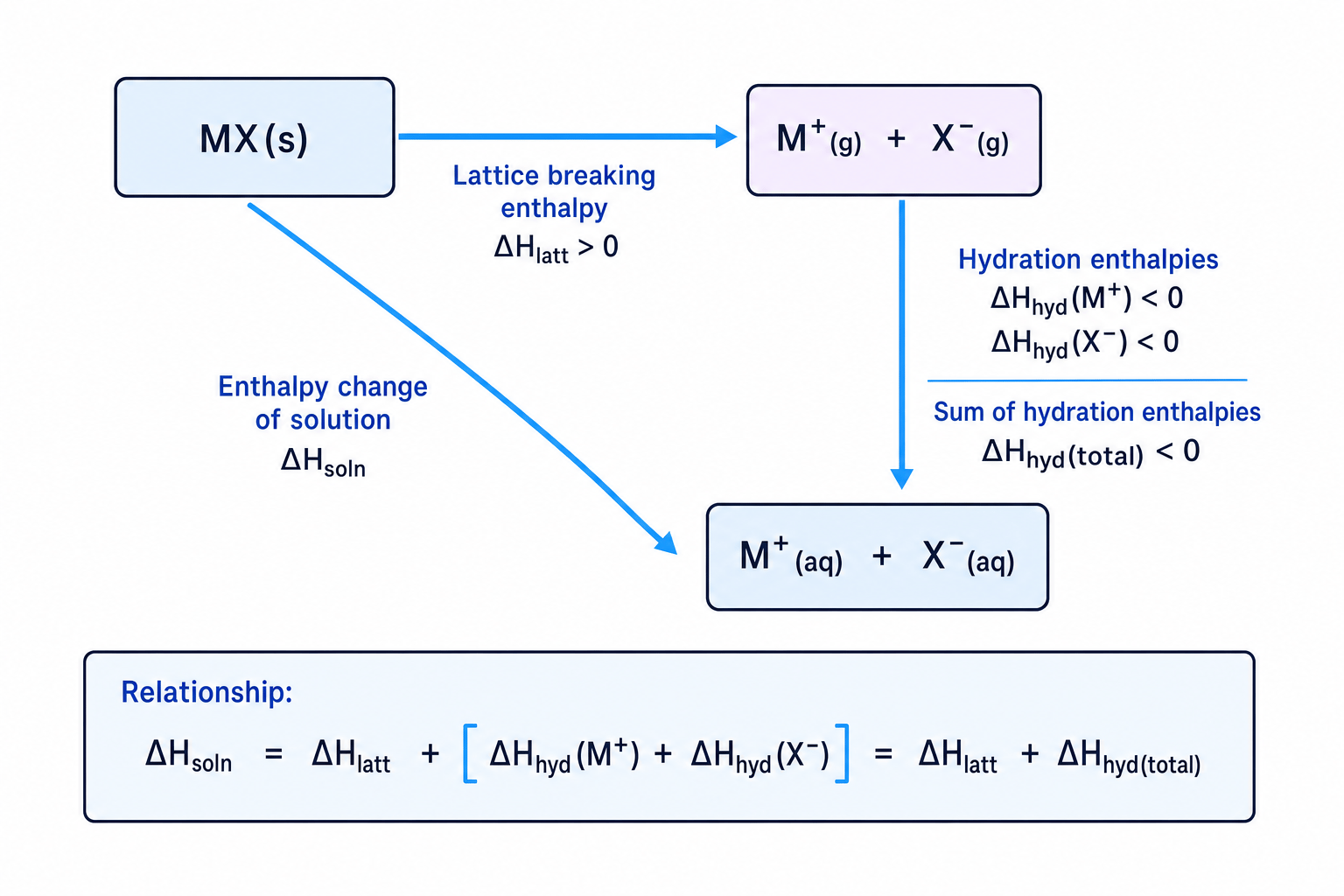
Why some salts dissolve
Solubility depends strongly on the balance between the energy needed to break the ionic lattice and the energy released when ions become hydrated.
If hydration releases more energy than lattice breaking requires, ΔsolH⊖\Delta_\text{sol}H^\ominusΔsolH⊖ is negative. If lattice breaking requires slightly more energy than hydration releases, ΔsolH⊖\Delta_\text{sol}H^\ominusΔsolH⊖ is positive.
That does not automatically mean the salt is insoluble. Some endothermic dissolving processes, such as ammonium chloride dissolving in water, still occur because the particles become more spread out. Later, this is explained using entropy and Gibbs energy: ΔG=ΔH−TΔS\Delta G = \Delta H - T\Delta SΔG=ΔH−TΔS.
Calculating enthalpy change of solution from lattice and hydration data
Calculate ΔsolH⊖\Delta_\text{sol}H^\ominusΔsolH⊖ for NaCl(s), using:
- lattice breaking enthalpy of NaCl = +787 kJ mol⁻¹
- hydration enthalpy of Na+ = −406 kJ mol⁻¹
- hydration enthalpy of Cl− = −364 kJ mol⁻¹
-
Write the cycle relationship. For one mole of NaCl, one mole of Na+ and one mole of Cl− are hydrated:
ΔsolH⊖=Δlatt,breakH⊖+ΔhydH⊖(Na+)+ΔhydH⊖(Cl−)\Delta_\text{sol}H^\ominus = \Delta_\text{latt,break}H^\ominus + \Delta_\text{hyd}H^\ominus(\text{Na}^+) + \Delta_\text{hyd}H^\ominus(\text{Cl}^-)ΔsolH⊖=Δlatt,breakH⊖+ΔhydH⊖(Na+)+ΔhydH⊖(Cl−) -
Substitute the values with their signs.
ΔsolH⊖=787+(−406)+(−364)\Delta_\text{sol}H^\ominus = 787 + (-406) + (-364)ΔsolH⊖=787+(−406)+(−364) -
Calculate the result and interpret it.
ΔsolH⊖=+17 kJ mol−1\Delta_\text{sol}H^\ominus = +17\ \text{kJ mol}^{-1}ΔsolH⊖=+17 kJ mol−1The dissolving is slightly endothermic, but NaCl is still soluble because enthalpy is not the only factor controlling spontaneity.
Count every ion
For MgCl₂, you must include hydration of one Mg2+ ion and two Cl− ions. Stoichiometry matters in enthalpy cycles.
Measuring enthalpy change of solution by calorimetry
In the lab, you can estimate ΔsolH\Delta_\text{sol}HΔsolH using a simple insulated cup calorimeter.
A typical method:
- Measure a known mass or volume of water.
- Record its initial temperature.
- Add a known mass of solid.
- Stir until the solid dissolves.
- Record the maximum or minimum temperature reached.
- Calculate heat transferred using q=mcΔTq = mc\Delta Tq=mcΔT.
Here, qqq is energy in J, mmm is mass in g, ccc is specific heat capacity in J g⁻¹ K⁻¹, and ΔT\Delta TΔT is temperature change in K or °C.
Calculating enthalpy change of solution from temperature change
5.35 g of NH₄Cl is dissolved in water. The final solution has mass 105.35 g. The temperature falls by 3.2 °C. Use c=4.18 J g−1K−1c = 4.18\ \text{J g}^{-1}\text{K}^{-1}c=4.18 J g−1K−1 and MrM_\text{r}Mr of NH₄Cl = 53.5.
-
Find the amount of NH₄Cl dissolved.
n=mM=5.3553.5=0.100 moln = \frac{m}{M} = \frac{5.35}{53.5} = 0.100\ \text{mol}n=Mm=53.55.35=0.100 mol -
Calculate the heat change of the solution surroundings. The temperature falls, so ΔT=−3.2 K\Delta T = -3.2\ \text{K}ΔT=−3.2 K.
q=mcΔT=105.35×4.18×(−3.2)=−1409 Jq = mc\Delta T = 105.35 \times 4.18 \times (-3.2) = -1409\ \text{J}q=mcΔT=105.35×4.18×(−3.2)=−1409 J -
Switch sign for the dissolving process. The solution surroundings lost heat, so dissolving absorbed heat:
qreaction=+1409 J=+1.409 kJq_\text{reaction} = +1409\ \text{J} = +1.409\ \text{kJ}qreaction=+1409 J=+1.409 kJ -
Calculate enthalpy change per mole.
ΔsolH=1.4090.100=+14.1 kJ mol−1\Delta_\text{sol}H = \frac{1.409}{0.100} = +14.1\ \text{kJ mol}^{-1}ΔsolH=0.1001.409=+14.1 kJ mol−1The positive sign shows that dissolving NH₄Cl is endothermic.
Forgetting the sign change in calorimetry
q=mcΔTq = mc\Delta Tq=mcΔT gives the heat change of the solution surroundings. The reaction has the opposite sign.
Born–Haber cycles
A Born–Haber cycle is a Hess cycle used to analyse the enthalpy changes involved in forming an ionic solid from its elements.
Born–Haber cycle
A Born–Haber cycle breaks the formation of an ionic compound into theoretical steps involving atomisation, ionisation, electron affinity and lattice formation.
It is based on Hess’s law: the overall enthalpy change is independent of the route taken, as long as the starting and finishing states are the same.
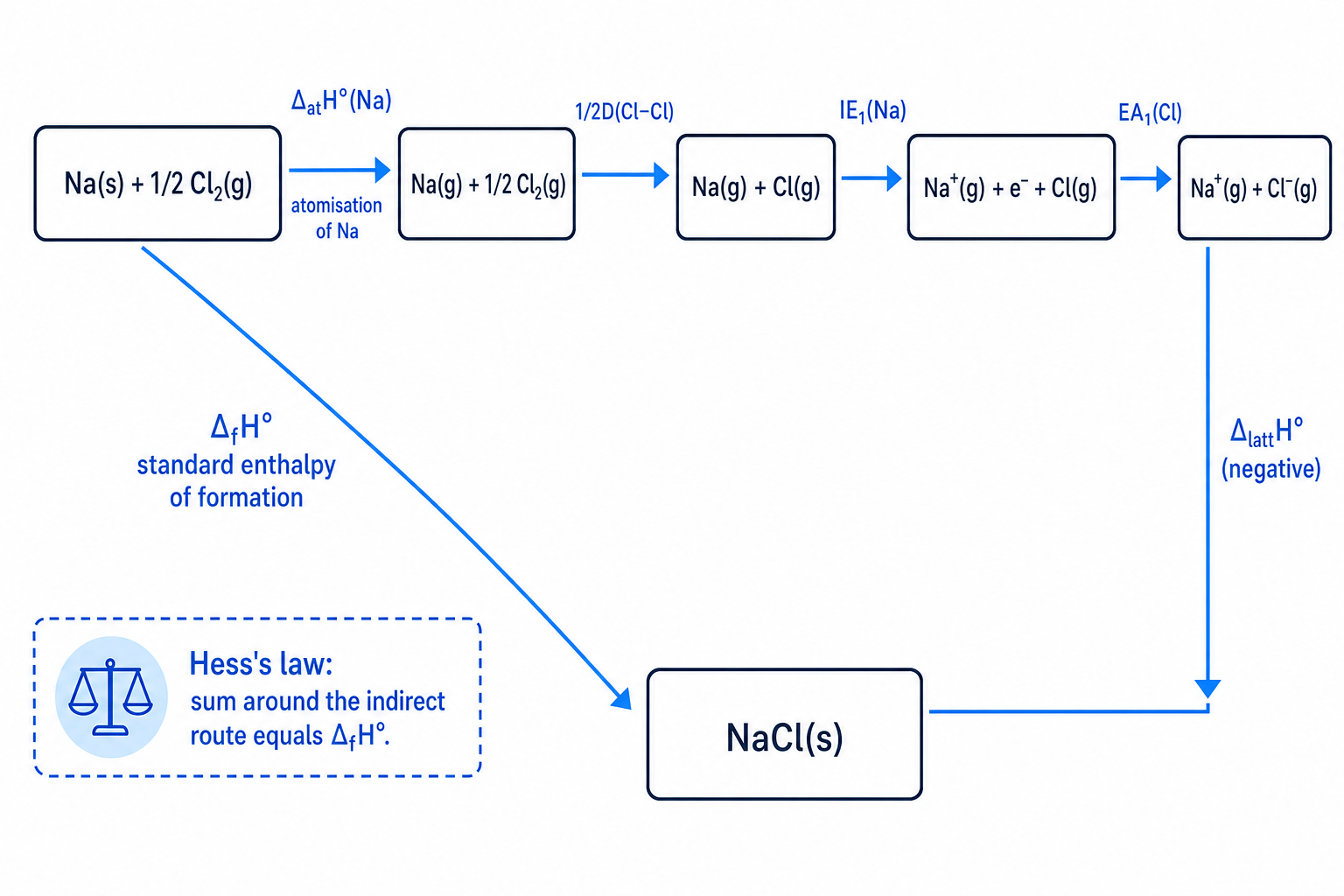
For NaCl(s), the indirect route is:
- Atomise sodium: Na(s) → Na(g)
- Atomise chlorine: ½Cl₂(g) → Cl(g)
- Ionise sodium: Na(g) → Na+(g) + e−
- Add an electron to chlorine: Cl(g) + e− → Cl−(g)
- Form the lattice: Na+(g) + Cl−(g) → NaCl(s)
Electron affinity signs
First electron affinity is often exothermic and negative. Second electron affinity, such as O−(g) + e− → O2−(g), is endothermic and positive because an electron is being forced onto an already negative ion.
Calculating lattice formation enthalpy using a Born–Haber cycle
Calculate the lattice formation enthalpy of NaCl(s), using:
- ΔfH⊖\Delta_\text{f}H^\ominusΔfH⊖ of NaCl(s) = −411 kJ mol⁻¹
- atomisation of Na = +108 kJ mol⁻¹
- ½ bond dissociation enthalpy of Cl₂ = +121 kJ mol⁻¹
- first ionisation energy of Na = +496 kJ mol⁻¹
- first electron affinity of Cl = −349 kJ mol⁻¹
-
Set up the Hess relationship.
ΔfH⊖=ΔatH⊖(Na)+12D(Cl-Cl)+IE1(Na)+EA1(Cl)+ΔlattH⊖\Delta_\text{f}H^\ominus = \Delta_\text{at}H^\ominus(\text{Na}) + \frac{1}{2}D(\text{Cl-Cl}) + \text{IE}_1(\text{Na}) + \text{EA}_1(\text{Cl}) + \Delta_\text{latt}H^\ominusΔfH⊖=ΔatH⊖(Na)+21D(Cl-Cl)+IE1(Na)+EA1(Cl)+ΔlattH⊖ -
Substitute the data with signs included.
−411=108+121+496+(−349)+ΔlattH⊖-411 = 108 + 121 + 496 + (-349) + \Delta_\text{latt}H^\ominus−411=108+121+496+(−349)+ΔlattH⊖ -
Simplify the known terms.
108+121+496−349=376108 + 121 + 496 - 349 = 376108+121+496−349=376 -
Rearrange for the lattice formation enthalpy.
ΔlattH⊖=−411−376=−787 kJ mol−1\Delta_\text{latt}H^\ominus = -411 - 376 = -787\ \text{kJ mol}^{-1}ΔlattH⊖=−411−376=−787 kJ mol−1The negative value is sensible because forming an ionic lattice releases energy.
Formation enthalpy and stability
A compound with a negative ΔfH⊖\Delta_\text{f}H^\ominusΔfH⊖ is lower in enthalpy than its elements. That usually suggests it is thermodynamically stable with respect to decomposition into those elements.
A more exothermic formation enthalpy often suggests a more stable compound, but it is only a qualitative indicator. Entropy and reaction kinetics can also matter.
Judging stability from formation enthalpy
Two ionic compounds have these standard enthalpy changes of formation:
- Compound A: −620 kJ mol⁻¹
- Compound B: +85 kJ mol⁻¹
-
Compare each compound with its elements. A has a negative formation enthalpy, so forming A from its elements releases energy. B has a positive formation enthalpy, so forming B absorbs energy.
-
Use enthalpy as a stability indicator. A is lower in enthalpy than its elements, so it is likely to be more stable with respect to decomposition into its elements.
-
Avoid overclaiming. B is less stable by this enthalpy argument, but a positive ΔfH⊖\Delta_\text{f}H^\ominusΔfH⊖ does not prove it cannot exist.
In the exam
- Always write the relevant process with state symbols before using an enthalpy value; this helps you choose the correct sign.
- In solution cycles, add lattice breaking to all hydration enthalpies, remembering ion ratios such as two Cl− ions in MgCl₂.
- In Born–Haber calculations, build the route in order: atomisation, ionisation, electron affinity, lattice formation, then apply Hess’s law algebraically.
Check yourself
- Why is lattice breaking endothermic but lattice formation exothermic?
- How would the solution enthalpy expression change for CaCl₂ instead of NaCl?
- In a Born–Haber cycle for MgO, which ionisation energies and electron affinities would you need?