What you'll learn
- How the acidity of carboxylic acids, phenols, water and alcohols compares.
- How carboxylic acids are made, reduced, decarboxylated and converted into derivatives.
- The key reagents, conditions and mechanisms for esters, acyl chlorides, amides, nitriles and hydroxynitriles.
- How to plan short synthetic routes and interpret practical observations safely.
The carboxyl group
Carboxylic acid
A carboxylic acid contains the carboxyl group, written as -COOH\text{-COOH}-COOH or RCOOH\text{RCOOH}RCOOH. It has a carbonyl group, C=O\text{C=O}C=O, and a hydroxyl group, -OH\text{-OH}-OH, attached to the same carbon.
The part RCO-\text{RCO-}RCO- is called an acyl group. Many derivatives are made by replacing the -OH\text{-OH}-OH of a carboxylic acid with another group, for example -Cl\text{-Cl}-Cl in an acyl chloride or -OR’\text{-OR'}-OR’ in an ester.
Relative acidity
A Brønsted–Lowry acid is a proton donor. The easier it is for a compound to lose H+\text{H}^+H+, the stronger the acid.
The acidity order you need is:
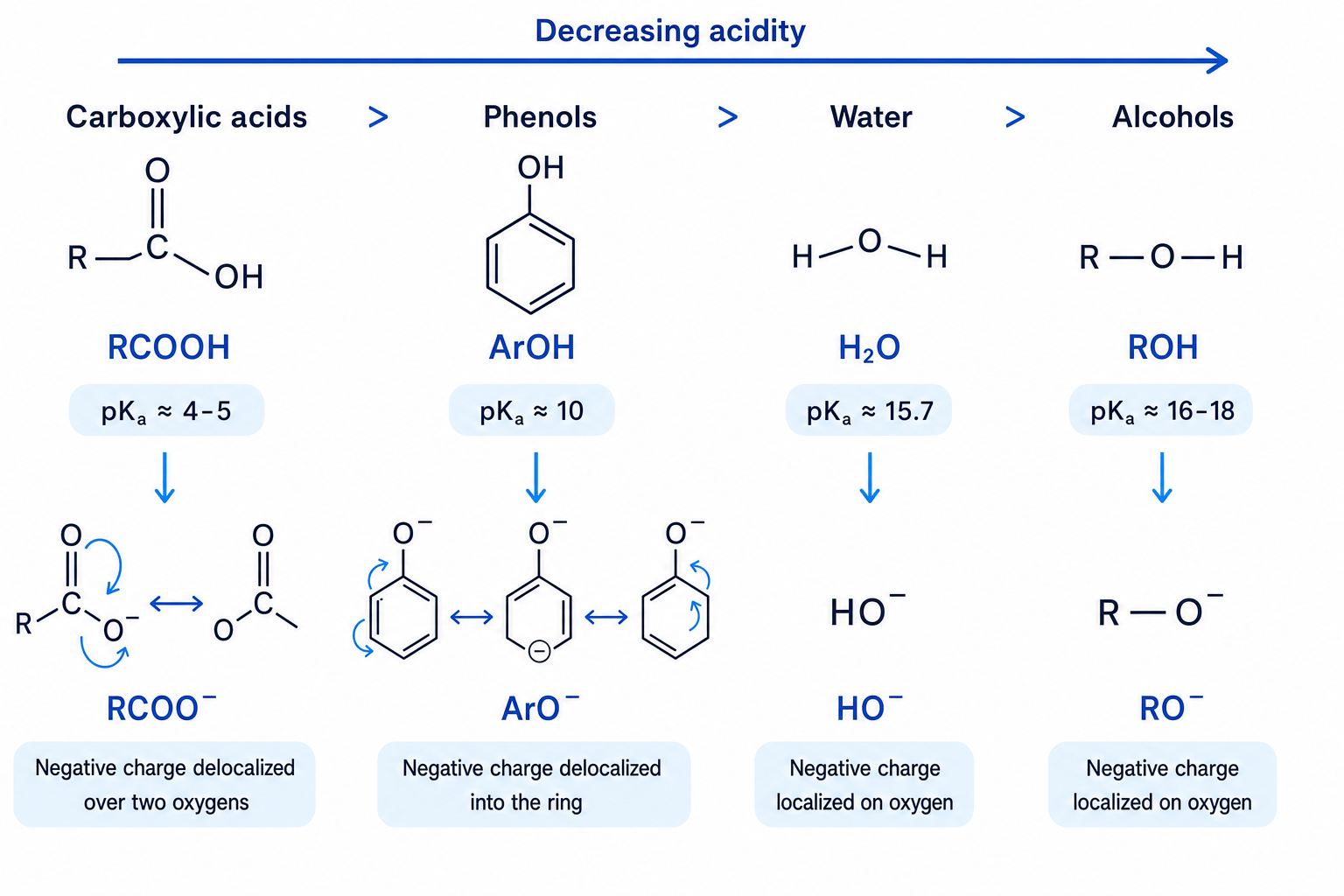
carboxylic acids > phenols > water > alcohols
Typical pKapK_apKa values support this: carboxylic acids are about 4–5, phenol is about 10, water is 15.7, and many alcohols are about 16–18. A lower pKapK_apKa means a stronger acid.
Why carboxylic acids are strongest
Carboxylic acids are relatively acidic because their conjugate base, the carboxylate ion RCOO−\text{RCOO}^-RCOO−, is stabilised by delocalisation of the negative charge over two oxygen atoms.
Phenoxide ions are also resonance-stabilised, but less effectively. Alkoxide ions from alcohols have a localised negative charge on one oxygen, and alkyl groups tend to push electron density towards it, making them less stable.
Carboxylic acids show typical acid reactions:
RCOOH+NaOH→RCOONa+H2O2RCOOH+Na2CO3→2RCOONa+CO2+H2O2RCOOH+2Na→2RCOONa+H2\begin{aligned} \text{RCOOH} + \text{NaOH} &\to \text{RCOONa} + \text{H}_2\text{O} \\ 2\text{RCOOH} + \text{Na}_2\text{CO}_3 &\to 2\text{RCOONa} + \text{CO}_2 + \text{H}_2\text{O} \\ 2\text{RCOOH} + 2\text{Na} &\to 2\text{RCOONa} + \text{H}_2 \end{aligned}RCOOH+NaOH2RCOOH+Na2CO32RCOOH+2Na→RCOONa+H2O→2RCOONa+CO2+H2O→2RCOONa+H2Demonstrating the order
- Carbonates / hydrogencarbonates: carboxylic acids fizz, giving CO2\text{CO}_2CO2. Phenols, water and alcohols do not.
- Aqueous sodium hydroxide: carboxylic acids and phenols form salts; alcohols do not react appreciably.
- Sodium metal: carboxylic acids, water and alcohols can give hydrogen, so this is less selective.
Using acidity tests to identify compounds
Three liquids are ethanoic acid, phenol and ethanol. One fizzes with sodium carbonate. One reacts with sodium hydroxide but not sodium carbonate. One does neither.
-
The liquid that fizzes with sodium carbonate must be ethanoic acid, because only the carboxylic acid is acidic enough to release CO2\text{CO}_2CO2 from carbonate.
-
The liquid that reacts with sodium hydroxide but not carbonate must be phenol, because phenol is acidic enough to form phenoxide with strong base, but not acidic enough to react with carbonate.
-
The remaining liquid is ethanol, because alcohols are weaker acids than water and do not react appreciably with sodium hydroxide or carbonate.
Carbonate test
Do not say “any compound with an -OH\text{-OH}-OH group reacts with carbonate”. Alcohols and phenols contain -OH\text{-OH}-OH, but only carboxylic acids give effervescence with carbonates.
Making carboxylic acids
Oxidation of alcohols and aldehydes
Primary alcohols are oxidised to aldehydes and then to carboxylic acids using acidified potassium dichromate(VI), K2Cr2O7/H+\text{K}_2\text{Cr}_2\text{O}_7/\text{H}^+K2Cr2O7/H+, under reflux. The colour changes from orange to green.
RCH2OH+2[O]→RCOOH+H2ORCHO+[O]→RCOOH\begin{aligned} \text{RCH}_2\text{OH} + 2[\text{O}] &\to \text{RCOOH} + \text{H}_2\text{O} \\ \text{RCHO} + [\text{O}] &\to \text{RCOOH} \end{aligned}RCH2OH+2[O]RCHO+[O]→RCOOH+H2O→RCOOHUse reflux when you want complete oxidation, because it allows heating without losing volatile reactants or products.
Oxidation of methyl side-chains on benzene rings
A methylbenzene side-chain can be oxidised to an aromatic carboxylic acid using hot alkaline potassium manganate(VII), then acidification.
C6H5CH3+3[O]→C6H5COOH+H2O\text{C}_6\text{H}_5\text{CH}_3 + 3[\text{O}] \to \text{C}_6\text{H}_5\text{COOH} + \text{H}_2\text{O}C6H5CH3+3[O]→C6H5COOH+H2OSo methylbenzene forms benzoic acid. The benzene ring is not oxidised under these conditions.
Reduction of carboxylic acids
Carboxylic acids are reduced to primary alcohols using lithium aluminium hydride, LiAlH4\text{LiAlH}_4LiAlH4, in dry ether, followed by acidified water.
RCOOH+4[H]→RCH2OH+H2O\text{RCOOH} + 4[\text{H}] \to \text{RCH}_2\text{OH} + \text{H}_2\text{O}RCOOH+4[H]→RCH2OH+H2OReducing agent choice
NaBH4\text{NaBH}_4NaBH4 reduces aldehydes and ketones, but it is usually not strong enough for carboxylic acids. Use LiAlH4\text{LiAlH}_4LiAlH4 for carboxylic acids and nitriles.
Decarboxylation
Decarboxylation means removal of carbon dioxide. Heating a sodium carboxylate with soda lime, a mixture of NaOH\text{NaOH}NaOH and CaO\text{CaO}CaO, gives an alkane with one fewer carbon.
RCOONa+NaOH→RH+Na2CO3\text{RCOONa} + \text{NaOH} \to \text{RH} + \text{Na}_2\text{CO}_3RCOONa+NaOH→RH+Na2CO3For example, sodium ethanoate forms methane.
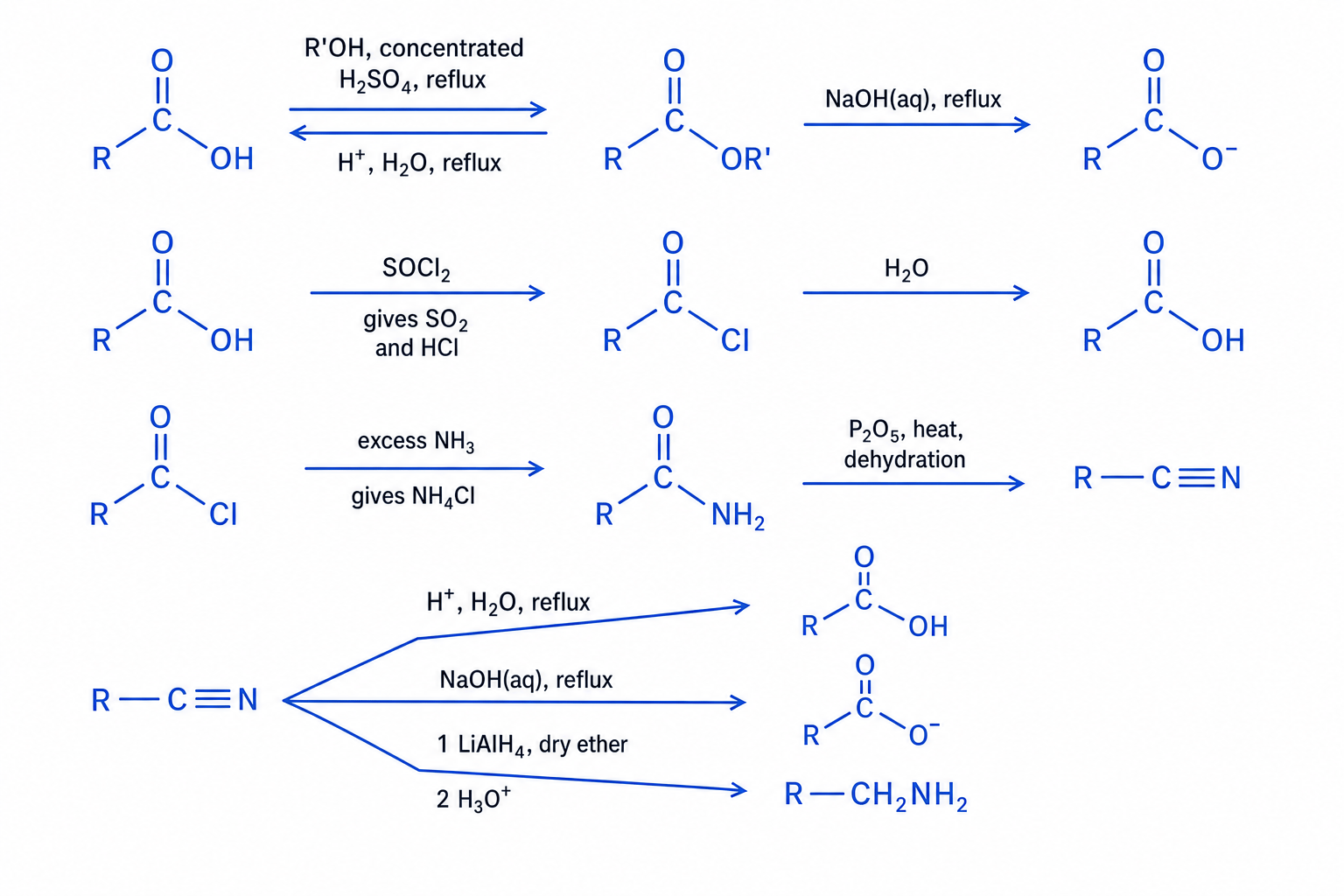
Derivatives route map
A route map is useful because many questions ask you to choose reagents and conditions to move between families.
Esters
Ester
An ester has the functional group -COOR’\text{-COOR'}-COOR’. Esters are formed from a carboxylic acid and an alcohol.
Carboxylic acid + alcohol ⇌ ester + water. The conditions are concentrated sulfuric acid catalyst and reflux.
RCOOH+R’OH⇌RCOOR’+H2O\text{RCOOH} + \text{R'OH} \rightleftharpoons \text{RCOOR'} + \text{H}_2\text{O}RCOOH+R’OH⇌RCOOR’+H2OTo draw the acid-catalysed esterification mechanism:
- Protonate the carbonyl oxygen using H+\text{H}^+H+, making the carbonyl carbon more electron deficient.
- Draw a curly arrow from the alcohol oxygen lone pair to the carbonyl carbon; move the π\piπ electrons of C=O\text{C=O}C=O onto oxygen.
- Use proton transfers to turn an -OH\text{-OH}-OH group into a good leaving group, H2O\text{H}_2\text{O}H2O.
- Reform the carbonyl, eliminate water, then deprotonate to regenerate the acid catalyst.
Esters are hydrolysed in two main ways:
- Acid hydrolysis: dilute acid, water, reflux; reversible, giving carboxylic acid and alcohol.
- Alkaline hydrolysis: aqueous sodium hydroxide, reflux; gives carboxylate salt and alcohol. Acidification afterwards gives the carboxylic acid.
Acyl chlorides and amides
Acyl chloride
An acyl chloride, also called an acid chloride, has the functional group -COCl\text{-COCl}-COCl.
Carboxylic acids are converted to acyl chlorides using sulfur dichloride oxide, SOCl2\text{SOCl}_2SOCl2.
RCOOH+SOCl2→RCOCl+SO2+HCl\text{RCOOH} + \text{SOCl}_2 \to \text{RCOCl} + \text{SO}_2 + \text{HCl}RCOOH+SOCl2→RCOCl+SO2+HClAcyl chlorides react rapidly because the carbonyl carbon is very electron deficient and chloride is a good leaving group.
For hydrolysis:
RCOCl+H2O→RCOOH+HCl\text{RCOCl} + \text{H}_2\text{O} \to \text{RCOOH} + \text{HCl}RCOCl+H2O→RCOOH+HClFor amide formation:
RCOCl+2NH3→RCONH2+NH4Cl\text{RCOCl} + 2\text{NH}_3 \to \text{RCONH}_2 + \text{NH}_4\text{Cl}RCOCl+2NH3→RCONH2+NH4ClThe curly-arrow mechanism is nucleophilic addition–elimination:
- A nucleophile, such as water or ammonia, attacks the carbonyl carbon; the C=O\text{C=O}C=O π\piπ electrons move onto oxygen.
- The oxygen lone pair reforms the carbonyl; the C-Cl\text{C-Cl}C-Cl bond breaks to release Cl−\text{Cl}^-Cl−.
- A proton is removed. With ammonia, a second ammonia molecule accepts the proton to form NH4+\text{NH}_4^+NH4+.
Amides can also be made by reacting a carboxylic acid with ammonia to form an ammonium carboxylate salt, then heating to dehydrate it.
RCOOH+NH3→RCOO−NH4+\text{RCOOH} + \text{NH}_3 \to \text{RCOO}^- \text{NH}_4^+RCOOH+NH3→RCOO−NH4+ RCOO−NH4+→RCONH2+H2O\text{RCOO}^- \text{NH}_4^+ \to \text{RCONH}_2 + \text{H}_2\text{O}RCOO−NH4+→RCONH2+H2OAmides can be dehydrated to nitriles using phosphorus(V) oxide, P2O5\text{P}_2\text{O}_5P2O5, with heat.
RCONH2→RCN+H2O\text{RCONH}_2 \to \text{RCN} + \text{H}_2\text{O}RCONH2→RCN+H2ONitriles and hydroxynitriles
Nitrile
A nitrile contains the -C≡N\text{-C}\equiv\text{N}-C≡N group. In RCN\text{RCN}RCN, the nitrile carbon becomes part of the carbon chain.
From halogenoalkanes
Halogenoalkanes form nitriles by nucleophilic substitution with ethanolic potassium cyanide, KCN\text{KCN}KCN, under reflux.
R-X+CN−→R-CN+X−\text{R-X} + \text{CN}^- \to \text{R-CN} + \text{X}^-R-X+CN−→R-CN+X−For the curly-arrow mechanism, draw the arrow from the carbon lone pair of CN−\text{CN}^-CN− to the carbon bonded to the halogen, and another arrow from the C-X\text{C-X}C-X bond to the halogen. This is an SN2\text{S}_\text{N}2SN2 reaction for primary halogenoalkanes.
One-carbon extension
Turning a halogenoalkane into a nitrile increases the carbon chain length by one, because the carbon in CN−\text{CN}^-CN− becomes part of the product.
From aldehydes and ketones
Aldehydes and ketones react with hydrogen cyanide, usually with KCN\text{KCN}KCN as a catalyst, to form hydroxynitriles.
To draw the mechanism:
- CN−\text{CN}^-CN− attacks the carbonyl carbon; the C=O\text{C=O}C=O π\piπ electrons move onto oxygen.
- The alkoxide ion formed is protonated by HCN\text{HCN}HCN.
- CN−\text{CN}^-CN− is regenerated, so only a small amount is needed as catalyst.
Hydrogen cyanide
HCN\text{HCN}HCN and cyanide salts are highly toxic. Practical work involving cyanide chemistry requires strict risk assessment and appropriate control measures such as a fume cupboard.
Hydrolysis and reduction
Nitriles and amides are hydrolysed under acidic or alkaline reflux.
RCN+2H2O+H+→RCOOH+NH4+RCN+H2O+OH−→RCOO−+NH3RCONH2+H2O+H+→RCOOH+NH4+RCONH2+OH−→RCOO−+NH3\begin{aligned} \text{RCN} + 2\text{H}_2\text{O} + \text{H}^+ &\to \text{RCOOH} + \text{NH}_4^+ \\ \text{RCN} + \text{H}_2\text{O} + \text{OH}^- &\to \text{RCOO}^- + \text{NH}_3 \\ \text{RCONH}_2 + \text{H}_2\text{O} + \text{H}^+ &\to \text{RCOOH} + \text{NH}_4^+ \\ \text{RCONH}_2 + \text{OH}^- &\to \text{RCOO}^- + \text{NH}_3 \end{aligned}RCN+2H2O+H+RCN+H2O+OH−RCONH2+H2O+H+RCONH2+OH−→RCOOH+NH4+→RCOO−+NH3→RCOOH+NH4+→RCOO−+NH3Nitriles are reduced to primary amines using LiAlH4\text{LiAlH}_4LiAlH4 in dry ether, followed by acidified water.
RCN+4[H]→RCH2NH2\text{RCN} + 4[\text{H}] \to \text{RCH}_2\text{NH}_2RCN+4[H]→RCH2NH2Planning a one-carbon extension
Convert 1-bromopropane into butanoic acid.
-
Use ethanolic KCN\text{KCN}KCN under reflux so CN−\text{CN}^-CN− replaces bromide by nucleophilic substitution, forming butanenitrile: the chain grows from three carbons to four.
-
Hydrolyse the nitrile using dilute acid and water under reflux, converting -CN\text{-CN}-CN into -COOH\text{-COOH}-COOH.
-
The final product is butanoic acid, CH3CH2CH2COOH\text{CH}_3\text{CH}_2\text{CH}_2\text{COOH}CH3CH2CH2COOH.
Practical data: yields and evidence
In organic preparations, you often reflux to complete a reaction, then purify by separation, drying and distillation or recrystallisation. IR spectroscopy can support identification: carboxylic acids show a broad O–H absorption around 2500–3300 cm⁻¹ and a strong C=O absorption near 1700 cm⁻¹; nitriles show a sharp C≡N absorption around 2220–2260 cm⁻¹.
Calculating an ester percentage yield
2.40 g of ethanoic acid reacts with excess ethanol. The mass of ethyl ethanoate collected is 2.05 g. Calculate the percentage yield.
-
Work out the amount of ethanoic acid, using n=mMn = \frac{m}{M}n=Mm:
n=2.4060.0=0.0400 moln = \frac{2.40}{60.0} = 0.0400\ \text{mol}n=60.02.40=0.0400 mol. -
Use the 1:1 mole ratio between ethanoic acid and ethyl ethanoate, so the theoretical amount of ester is 0.0400 mol.
-
Calculate the theoretical mass of ethyl ethanoate:
m=nM=0.0400×88.0=3.52 gm = nM = 0.0400 \times 88.0 = 3.52\ \text{g}m=nM=0.0400×88.0=3.52 g. -
Calculate percentage yield:
2.053.52×100=58.2%\frac{2.05}{3.52} \times 100 = 58.2\%3.522.05×100=58.2%.
In the exam
-
Always give both reagent and conditions: for example, KCN\text{KCN}KCN in ethanol under reflux is more precise than just “cyanide”.
-
Track the carbon count carefully: nitrile formation from a halogenoalkane adds one carbon, but decarboxylation removes one carbon.
-
For mechanisms, curly arrows must start from an electron pair: a lone pair, a negative charge, or a bond.
Check yourself
- Why is a carboxylate ion more stable than an alkoxide ion?
- What reagents would convert propanoic acid into propanoyl chloride, then propanamide?
- How would you make a four-carbon carboxylic acid starting from a three-carbon halogenoalkane?