

What you'll learn
- How to make primary aliphatic amines from halogenoalkanes and nitriles.
- How aromatic amines are formed from nitrobenzenes.
- Why amines are basic, and why phenylamine is less basic than ammonia.
- How primary amines react to form amides, diazonium salts, and azo dyes.
1. What is an amine?
Amine
An amine is an organic compound related to ammonia, NH₃, in which one or more hydrogen atoms have been replaced by carbon-containing groups. A primary amine has the general formula RNH₂, where R is an alkyl or aryl group.
Amines contain a nitrogen atom with a lone pair of electrons. This lone pair controls much of their chemistry: it makes amines nucleophiles and bases.
Important wording:
- Aliphatic amine: the nitrogen is attached to an alkyl chain, for example CH₃CH₂NH₂.
- Aromatic amine: the nitrogen is attached directly to a benzene ring, for example phenylamine, C₆H₅NH₂.
- Phenylamine is also commonly called aniline.
2. Making primary aliphatic amines
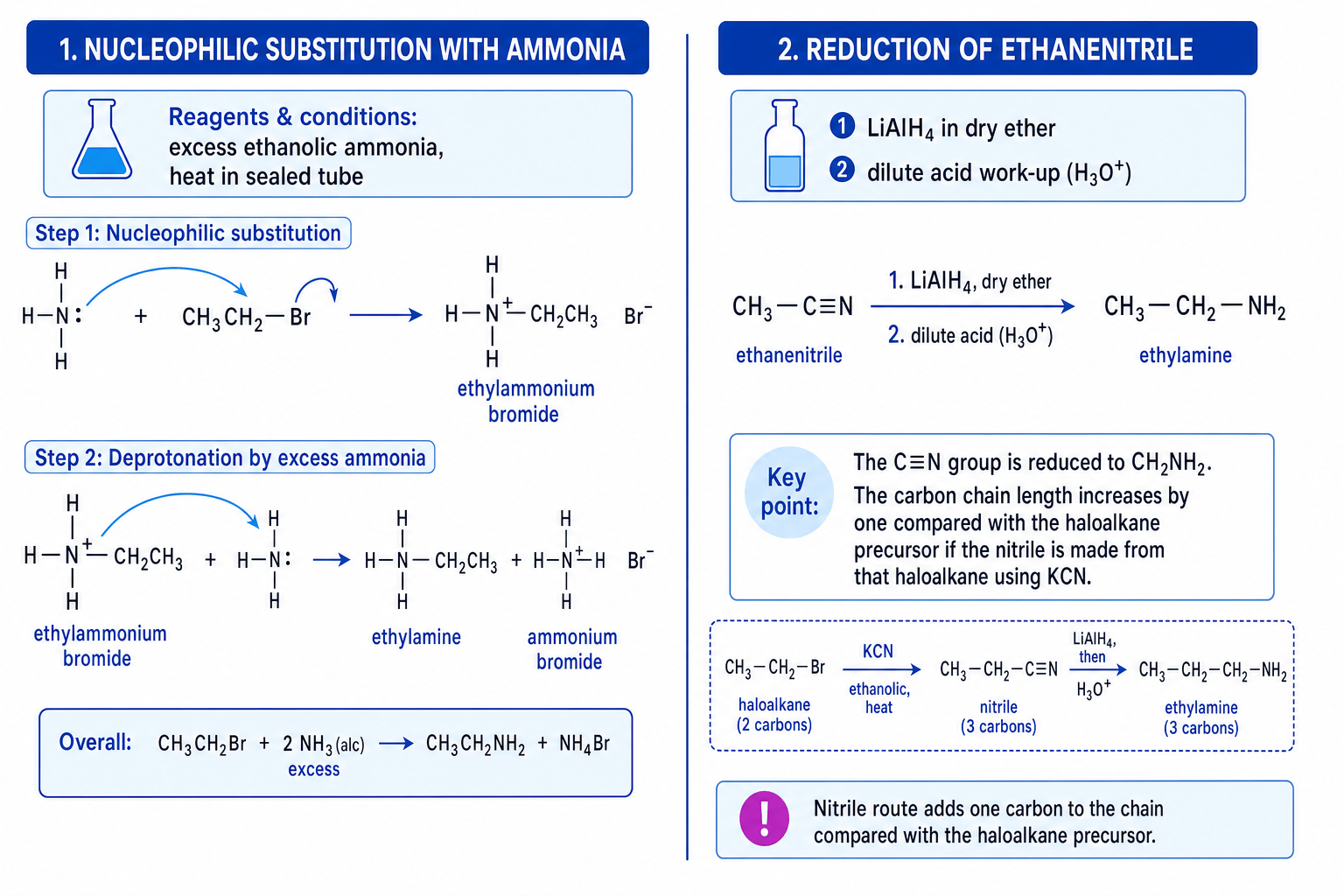
From halogenoalkanes: substitution with ammonia
A halogenoalkane contains a polar carbon–halogen bond, such as C–Br. The carbon bonded to the halogen is electron-deficient, so ammonia can attack it as a nucleophile.
For bromoethane:
CH₃CH₂Br + 2NH₃(alc) → CH₃CH₂NH₂ + NH₄Br
Conditions:
- Excess ethanolic ammonia
- Heat in a sealed tube
The first product is an alkylammonium salt, which is then deprotonated by another ammonia molecule to form the primary amine.
The main aliphatic amine routes are summarised below.
Forgetting excess ammonia
The primary amine product is also a nucleophile, so it can react further with the halogenoalkane to form secondary and tertiary amines. Using excess ammonia makes ammonia much more likely to react first, favouring the primary amine.
From nitriles: reduction
A nitrile contains the functional group –C≡N. Nitriles can be reduced to primary amines:
RCN + 4[H] → RCH₂NH₂
Typical reagents:
- LiAlH₄ in dry ether
- Then dilute acid work-up
A useful synthetic point: if the nitrile was made from a halogenoalkane using CN⁻, the carbon chain becomes one carbon longer.
Halogenoalkane to nitrile:
CH₃CH₂Br + KCN → CH₃CH₂CN + KBr
Then reduction:
CH₃CH₂CN + 4[H] → CH₃CH₂CH₂NH₂
Choosing a synthesis route
You need to make propylamine, CH₃CH₂CH₂NH₂, starting from bromoethane, CH₃CH₂Br.
-
Count the carbon atoms: bromoethane has 2 carbons, but propylamine has 3 carbons, so the route must add one carbon.
-
Use cyanide ions to substitute the bromine and extend the chain:
CH₃CH₂Br + KCN → CH₃CH₂CN + KBr -
Reduce the nitrile to a primary amine:
CH₃CH₂CN + 4[H] → CH₃CH₂CH₂NH₂
3. Making aromatic amines from nitrobenzenes
Aromatic amines are made by reducing nitroarenes. For example, nitrobenzene is reduced to phenylamine.
Overall equation:
C₆H₅NO₂ + 6[H] → C₆H₅NH₂ + 2H₂O
Typical reagents and conditions:
- Tin and concentrated hydrochloric acid
- Heat under reflux
- Then add NaOH(aq)
Reflux means heating a reaction mixture with a condenser, so volatile substances condense and return to the flask rather than escaping.
In acid, phenylamine is initially converted into the phenylammonium salt, C₆H₅NH₃⁺Cl⁻. Adding NaOH(aq) releases the free amine, C₆H₅NH₂.
4. Basicity of amines
A Brønsted–Lowry base is a proton acceptor. Amines are bases because the lone pair on nitrogen can accept H⁺.
In water:
RNH₂ + H₂O ⇌ RNH₃⁺ + OH⁻
With hydrochloric acid:
RNH₂ + HCl → RNH₃⁺Cl⁻
This forms an ammonium salt.
Basicity depends on lone-pair availability
The more available the nitrogen lone pair is for bonding to H⁺, the stronger the amine is as a base.
Comparing ammonia, aliphatic amines and phenylamine
Aliphatic amines are usually stronger bases than ammonia. Alkyl groups have a positive inductive effect: they push electron density towards nitrogen, making the lone pair more available.
Phenylamine is weaker than ammonia. The nitrogen lone pair is partly delocalised into the benzene ring, so it is less available to accept H⁺.
Typical basicity order:
ethylamine > ammonia > phenylamine
Comparing basicity
Put ethylamine, ammonia and phenylamine in order of decreasing basicity.
-
Ethylamine has an ethyl group that pushes electron density towards nitrogen, so its lone pair is more available than in ammonia.
-
In phenylamine, the nitrogen lone pair overlaps with the benzene ring and becomes partly delocalised, so it is less available for bonding to H⁺.
-
Therefore the order is:
ethylamine > ammonia > phenylamine
5. Ethanoylation using ethanoyl chloride
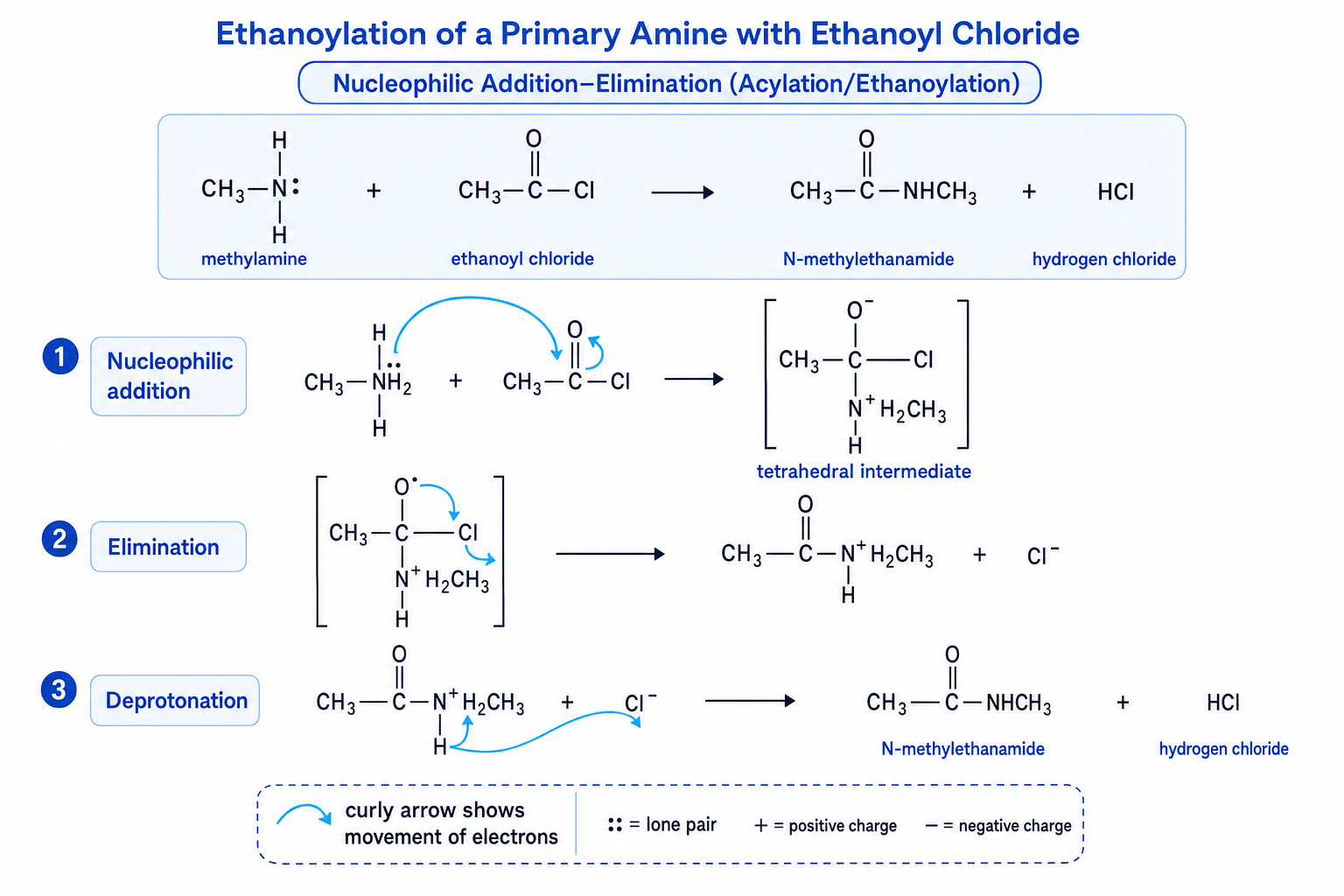
Ethanoylation is the introduction of the ethanoyl group, CH₃CO–, into a molecule. When a primary amine reacts with ethanoyl chloride, an amide is formed.
General equation:
RNH₂ + CH₃COCl → CH₃CONHR + HCl
Example with methylamine:
CH₃NH₂ + CH₃COCl → CH₃CONHCH₃ + HCl
The product is N-methylethanamide.
This reaction is a nucleophilic addition–elimination reaction. The amine attacks the carbonyl carbon, chloride leaves, and a proton is lost to give the amide.
Practical safety
Ethanoyl chloride releases steamy acidic HCl fumes and reacts vigorously with water, so reactions are carried out carefully in a fume cupboard using dry apparatus where appropriate.
6. Reaction with cold nitric(III) acid
Nitric(III) acid, HNO₂, is also called nitrous acid. It is unstable, so it is generated in the reaction mixture using sodium nitrite and hydrochloric acid:
NaNO₂ + HCl → HNO₂ + NaCl
The reaction with primary amines depends strongly on whether the amine is aliphatic or aromatic.
Primary aliphatic amines
Primary aliphatic amines react with cold HNO₂ to form an alcohol, nitrogen gas and water:
RNH₂ + HNO₂ → ROH + N₂ + H₂O
Example:
CH₃CH₂NH₂ + HNO₂ → CH₃CH₂OH + N₂ + H₂O
You would observe effervescence because nitrogen gas is produced.
Primary aromatic amines
Primary aromatic amines form diazonium salts at 0–10 °C.
For phenylamine:
C₆H₅NH₂ + HNO₂ + HCl → C₆H₅N₂⁺Cl⁻ + 2H₂O
The product is benzenediazonium chloride.
Predicting products with cold nitric(III) acid
Predict the products when butylamine and phenylamine react separately with cold HNO₂.
-
Butylamine is a primary aliphatic amine, so it forms the corresponding alcohol and nitrogen gas:
CH₃CH₂CH₂CH₂NH₂ → CH₃CH₂CH₂CH₂OH + N₂ -
Phenylamine is a primary aromatic amine, so it forms a diazonium salt at 0–10 °C:
C₆H₅NH₂ → C₆H₅N₂⁺Cl⁻ -
The key distinction is aliphatic versus aromatic: aliphatic diazonium ions are too unstable, while aromatic diazonium salts are stable enough in cold solution.
Diazonium salts must be kept cold
Benzenediazonium salts decompose if warmed, releasing nitrogen gas and often forming phenol. They should be kept cold and in solution; dry diazonium salts can be hazardous.
7. Coupling reactions and azo dyes
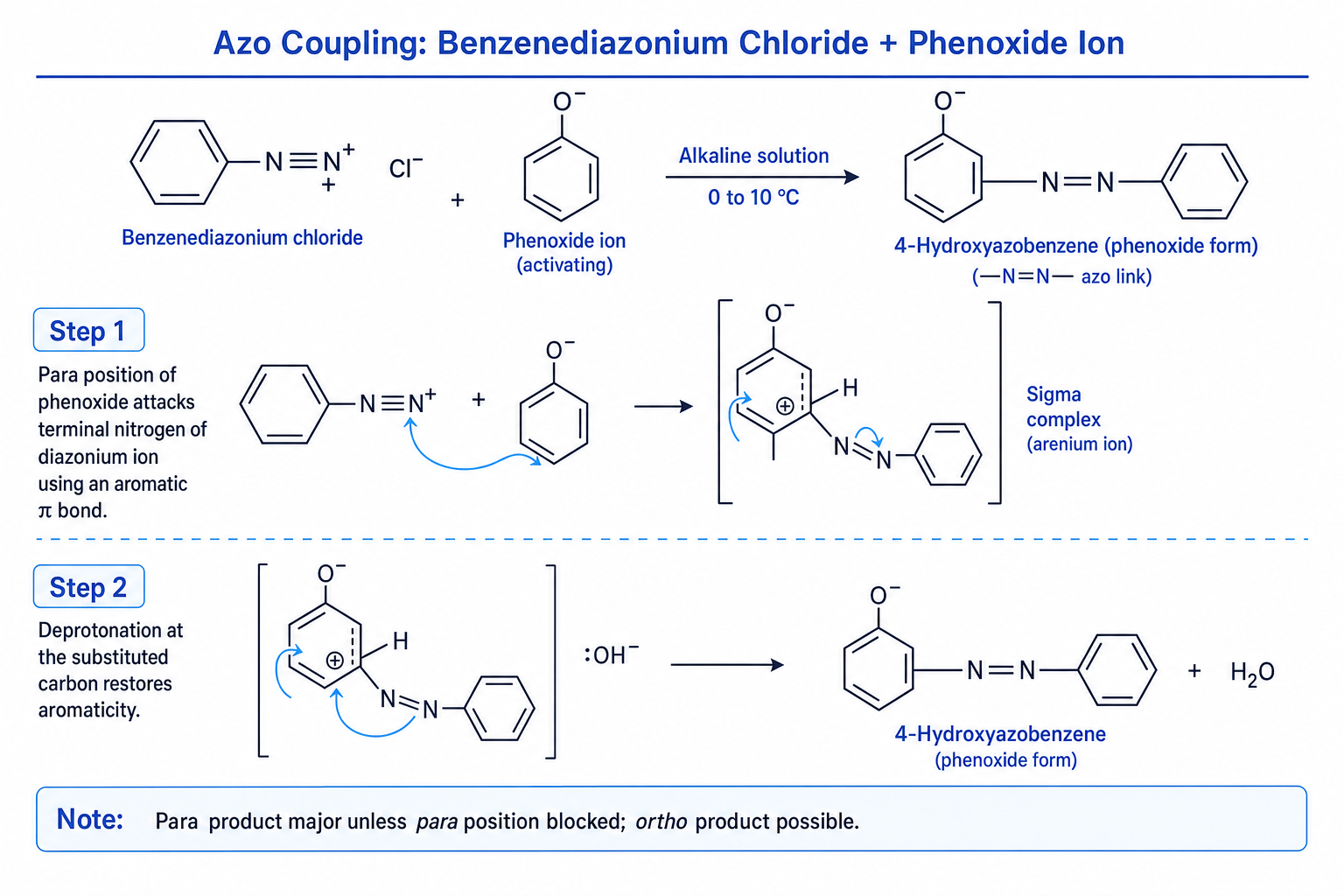
Benzenediazonium salts react with activated aromatic compounds such as phenols and aromatic amines. This is called a coupling reaction.
With phenol in alkaline solution:
C₆H₅N₂⁺Cl⁻ + C₆H₅OH → C₆H₅N=NC₆H₄OH + HCl
With phenylamine:
C₆H₅N₂⁺Cl⁻ + C₆H₅NH₂ → C₆H₅N=NC₆H₄NH₂ + HCl
The product usually forms at the para position if it is available. If the para position is blocked, an ortho product may form.
For phenols, alkaline conditions form the phenoxide ion, which is more strongly activating. For aromatic amines, conditions must not be too acidic, because protonating the –NH₂ group would deactivate the ring.
The coupling mechanism is an electrophilic substitution reaction: the diazonium ion behaves as the electrophile, and the activated aromatic ring attacks it.
Practical outline for making an azo dye
A typical preparation uses cold solutions:
- Dissolve phenylamine in dilute HCl and cool in an ice bath.
- Add cold NaNO₂(aq) to form the diazonium salt at 0–10 °C.
- Add this slowly to cold alkaline phenol solution, with stirring.
- A brightly coloured azo dye forms, often as a precipitate.
8. Chromophores and the origin of colour
Chromophore
A chromophore is the part of a molecule responsible for absorbing visible light. In azo dyes, the —N=N— group is the azo chromophore, especially when joined to aromatic rings.
Azo dyes are coloured because they contain an extended delocalised π-electron system. Electrons can absorb visible light and move to a higher energy level.
The energy of absorbed light is linked to wavelength by:
E=hcλE = \frac{hc}{\lambda}E=λhcSo a smaller energy gap means absorption at a longer wavelength.
The colour you see is the colour of light not absorbed. If a dye absorbs blue light strongly, it may appear orange or yellow, which is the complementary colour.
Predicting the observed colour of a dye
An azo dye absorbs light strongly at about 480 nm, in the blue region of the visible spectrum. Predict the colour seen and explain the effect of increased conjugation.
-
A wavelength of about 480 nm corresponds to blue light being absorbed.
-
The dye appears the complementary colour of the absorbed light, so it is likely to look orange or yellow.
-
Increasing conjugation lowers the energy gap between electronic levels. Since E=hcλE = \frac{hc}{\lambda}E=λhc, a lower energy absorption corresponds to a longer wavelength.
In the exam
-
For synthesis questions, count carbons carefully: the nitrile route adds one carbon if CN⁻ is introduced first.
-
For basicity questions, always discuss the availability of the nitrogen lone pair, not just the presence of nitrogen.
-
For diazonium and azo dye questions, state the cold conditions, 0–10 °C, and link colour to visible wavelengths absorbed.
Check yourself
- Why is ethylamine more basic than ammonia, but phenylamine less basic than ammonia?
- What products form when a primary aliphatic amine reacts with cold nitric(III) acid?
- Why does the —N=N— group help azo dyes absorb visible light?
