What you'll learn
- How aldehydes and ketones are formed by oxidising alcohols.
- How to distinguish aldehydes from ketones using Tollens’ and Fehling’s reagents.
- How carbonyl compounds react with sodium borohydride, hydrogen cyanide, 2,4-DNPH and iodine/alkali.
- How practical tests can identify an unknown aldehyde or ketone.
The carbonyl group
Carbonyl compounds
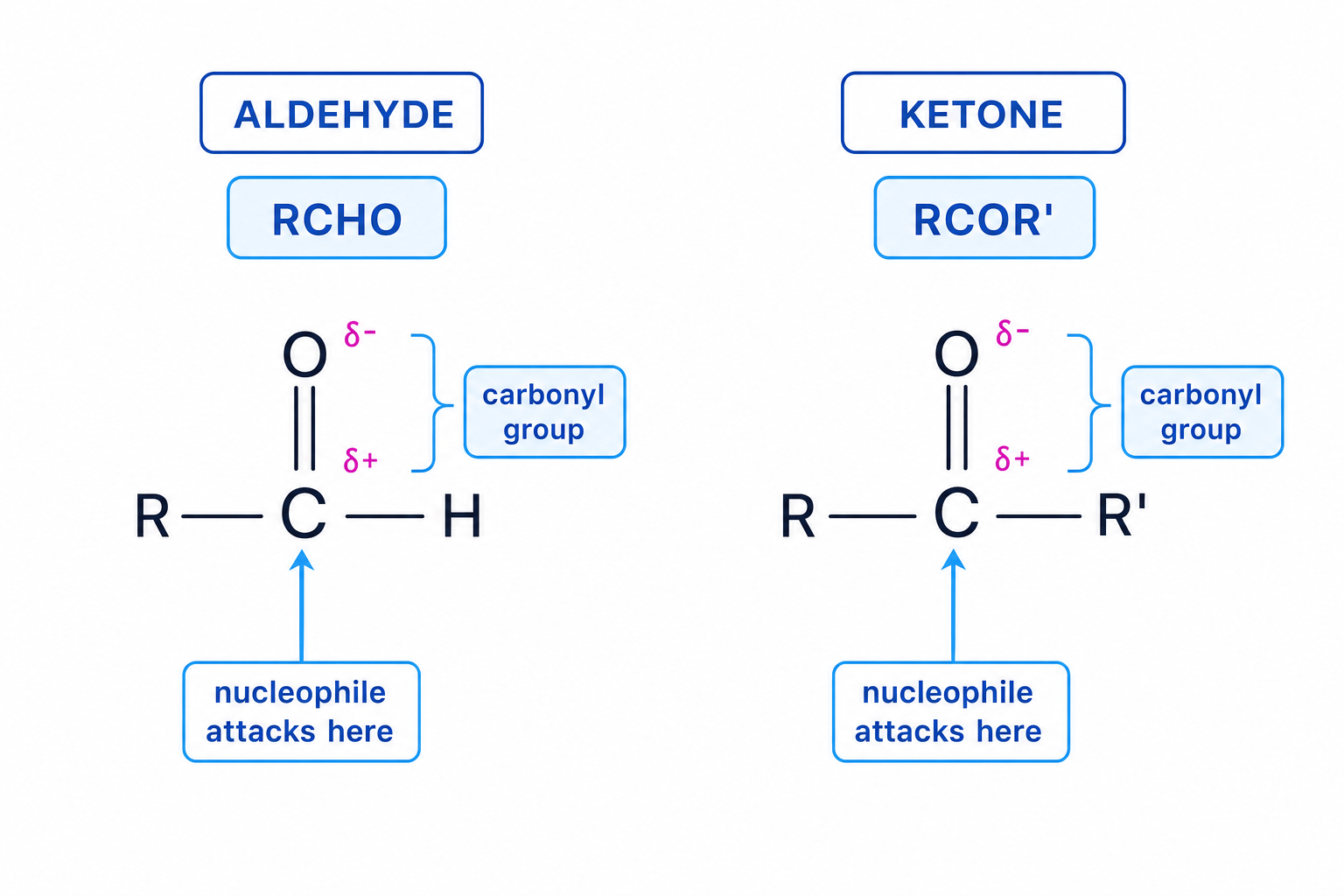
A carbonyl group is a carbon-oxygen double bond, C=O. An aldehyde has the carbonyl group at the end of a carbon chain, with the general form RCHO. A ketone has the carbonyl group within a carbon chain, with the general form RCOR′.
In aldehydes and ketones, oxygen is more electronegative than carbon. The C=O bond is therefore polar: the carbonyl carbon is δ+\delta^+δ+ and the oxygen is δ−\delta^-δ−. This makes the carbonyl carbon attractive to nucleophiles, which are electron-pair donors.
Why carbonyls react
Most aldehyde and ketone reactions begin because a nucleophile attacks the electron-deficient carbonyl carbon.
Classifying carbonyl compounds
Classify CH3CH2CHO\text{CH}_3\text{CH}_2\text{CHO}CH3CH2CHO and CH3COCH3\text{CH}_3\text{COCH}_3CH3COCH3.
- In CH3CH2CHO\text{CH}_3\text{CH}_2\text{CHO}CH3CH2CHO, the carbonyl carbon is bonded to one carbon chain and one hydrogen atom, so the C=O group is at the end of the molecule.
- Therefore CH3CH2CHO\text{CH}_3\text{CH}_2\text{CHO}CH3CH2CHO is an aldehyde: propanal.
- In CH3COCH3\text{CH}_3\text{COCH}_3CH3COCH3, the carbonyl carbon is bonded to a carbon group on both sides.
- Therefore CH3COCH3\text{CH}_3\text{COCH}_3CH3COCH3 is a ketone: propanone.
Forming aldehydes and ketones by oxidation
In this topic, oxidation usually means increasing the number of C–O bonds or decreasing the number of C–H bonds.
Primary alcohols are oxidised to aldehydes. Use acidified potassium dichromate(VI), K2Cr2O7/H2SO4\text{K}_2\text{Cr}_2\text{O}_7/\text{H}_2\text{SO}_4K2Cr2O7/H2SO4, and warm gently. The orange dichromate(VI) ions are reduced to green chromium(III) ions.
For ethanol:
CH3CH2OH(l)+[O]→CH3CHO(l)+H2O(l)\text{CH}_3\text{CH}_2\text{OH(l)} + [\text{O}] \to \text{CH}_3\text{CHO(l)} + \text{H}_2\text{O(l)}CH3CH2OH(l)+[O]→CH3CHO(l)+H2O(l)To make an aldehyde from a primary alcohol, use distillation so the aldehyde is removed as it forms. If you heat under reflux, the aldehyde remains in the oxidising mixture and is further oxidised to a carboxylic acid.
Secondary alcohols are oxidised to ketones, usually by heating under reflux:
CH3CH(OH)CH3(l)+[O]→CH3COCH3(l)+H2O(l)\text{CH}_3\text{CH(OH)CH}_3\text{(l)} + [\text{O}] \to \text{CH}_3\text{COCH}_3\text{(l)} + \text{H}_2\text{O(l)}CH3CH(OH)CH3(l)+[O]→CH3COCH3(l)+H2O(l)Distillation versus reflux
Use distillation when preparing an aldehyde from a primary alcohol. Use reflux when preparing a ketone from a secondary alcohol, or when fully oxidising a primary alcohol to a carboxylic acid.
Choosing oxidation conditions
You need to make butanal from butan-1-ol, not butanoic acid.
- Butan-1-ol is a primary alcohol, so its first oxidation product is the aldehyde butanal.
- Choose acidified potassium dichromate(VI) as the oxidising agent and warm the mixture.
- Use distillation, because removing butanal as it forms prevents further oxidation to butanoic acid.
Distinguishing aldehydes and ketones by mild oxidation
Aldehydes are easily oxidised to carboxylic acids or carboxylate ions. Ketones are much harder to oxidise because oxidation would require breaking a C–C bond.
Tollens’ reagent
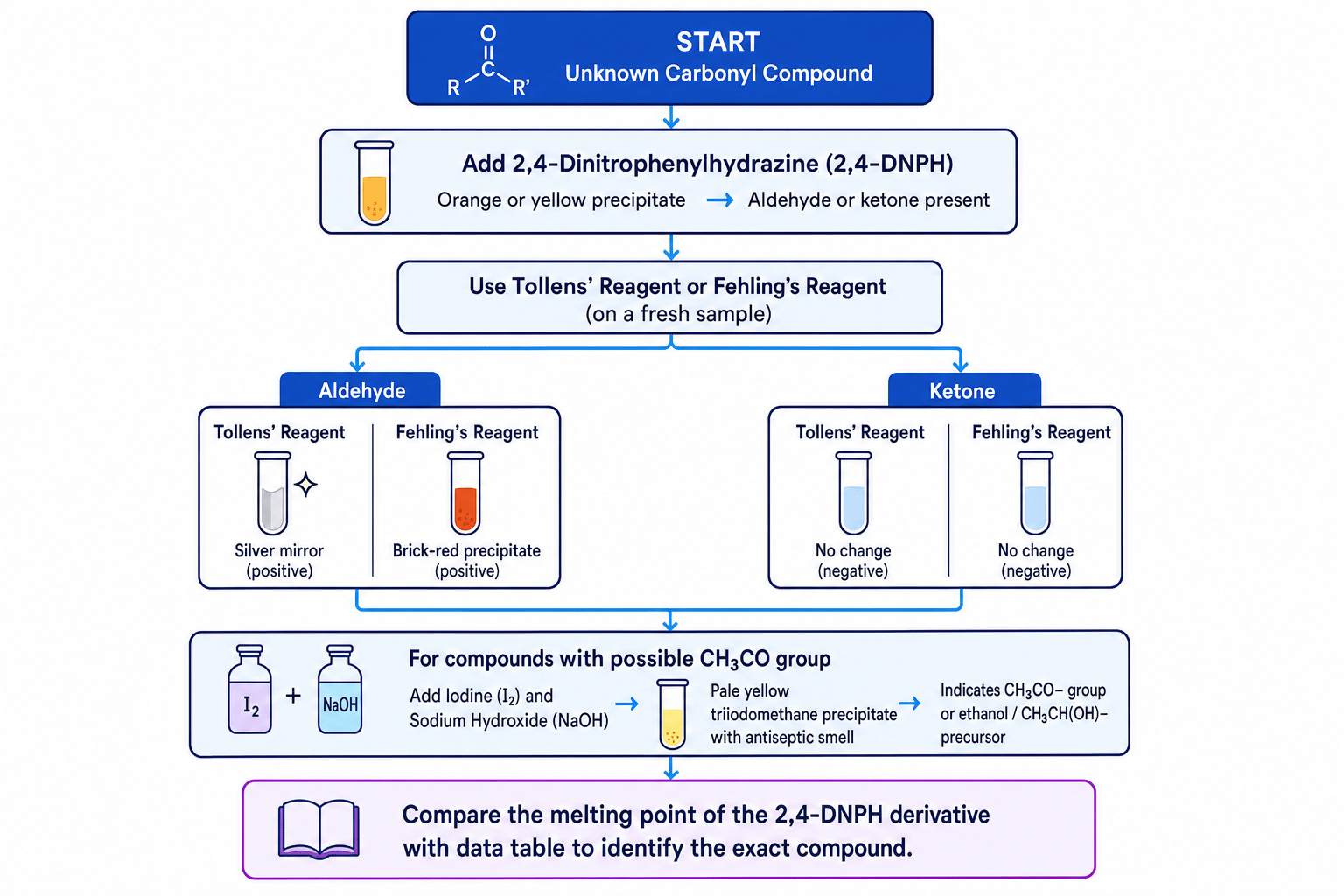
Tollens’ reagent is ammoniacal silver nitrate, containing the complex ion [Ag(NH3)2]+[\text{Ag}(\text{NH}_3)_2]^+[Ag(NH3)2]+. Warm gently with the sample.
- Aldehyde: silver mirror or grey/black silver precipitate.
- Ketone: no visible change.
Simplified ionic equation:
RCHO(aq)+2[Ag(NH3)2]+(aq)+3OH−(aq)→RCOO−(aq)+2Ag(s)+4NH3(aq)+2H2O(l)\text{RCHO(aq)} + 2[\text{Ag}(\text{NH}_3)_2]^+\text{(aq)} + 3\text{OH}^-\text{(aq)} \to \text{RCOO}^-\text{(aq)} + 2\text{Ag(s)} + 4\text{NH}_3\text{(aq)} + 2\text{H}_2\text{O(l)}RCHO(aq)+2[Ag(NH3)2]+(aq)+3OH−(aq)→RCOO−(aq)+2Ag(s)+4NH3(aq)+2H2O(l)Fehling’s reagent
Fehling’s reagent is an alkaline blue copper(II) solution. Heat with the sample.
- Aldehyde: brick-red precipitate of copper(I) oxide, Cu2O\text{Cu}_2\text{O}Cu2O.
- Ketone: no visible change.
Simplified ionic equation:
RCHO(aq)+2Cu2+(aq)+5OH−(aq)→RCOO−(aq)+Cu2O(s)+3H2O(l)\text{RCHO(aq)} + 2\text{Cu}^{2+}\text{(aq)} + 5\text{OH}^-\text{(aq)} \to \text{RCOO}^-\text{(aq)} + \text{Cu}_2\text{O(s)} + 3\text{H}_2\text{O(l)}RCHO(aq)+2Cu2+(aq)+5OH−(aq)→RCOO−(aq)+Cu2O(s)+3H2O(l)Tollens’ reagent safety
Tollens’ reagent should be freshly prepared and disposed of promptly, because explosive silver-containing residues can form if it is left to stand.
Interpreting oxidation test results
An unknown compound gives an orange precipitate with 2,4-DNPH, but no change with Tollens’ reagent.
- The orange precipitate with 2,4-DNPH shows the compound contains a carbonyl group, so it is likely to be an aldehyde or ketone.
- The negative Tollens’ test shows it is not easily oxidised, so it is not an aldehyde.
- Therefore the compound is a ketone.
Reduction using sodium borohydride
Aldehydes and ketones can be reduced using sodium borohydride, NaBH4\text{NaBH}_4NaBH4, usually in aqueous or ethanolic solution, followed by acidification.
Aldehydes reduce to primary alcohols:
RCHO+2[H]→RCH2OH\text{RCHO} + 2[\text{H}] \to \text{RCH}_2\text{OH}RCHO+2[H]→RCH2OHKetones reduce to secondary alcohols:
R2CO+2[H]→R2CHOH\text{R}_2\text{CO} + 2[\text{H}] \to \text{R}_2\text{CHOH}R2CO+2[H]→R2CHOHPredicting reduction products
Predict the product when propanal is reduced with NaBH4\text{NaBH}_4NaBH4.
- Propanal is an aldehyde because its carbonyl group is at the end of the chain.
- Aldehydes reduce to primary alcohols, so the C=O group becomes CHOH and the aldehydic carbon gains hydrogen.
- The product is propan-1-ol, CH3CH2CH2OH\text{CH}_3\text{CH}_2\text{CH}_2\text{OH}CH3CH2CH2OH.
Nucleophilic addition of hydrogen cyanide
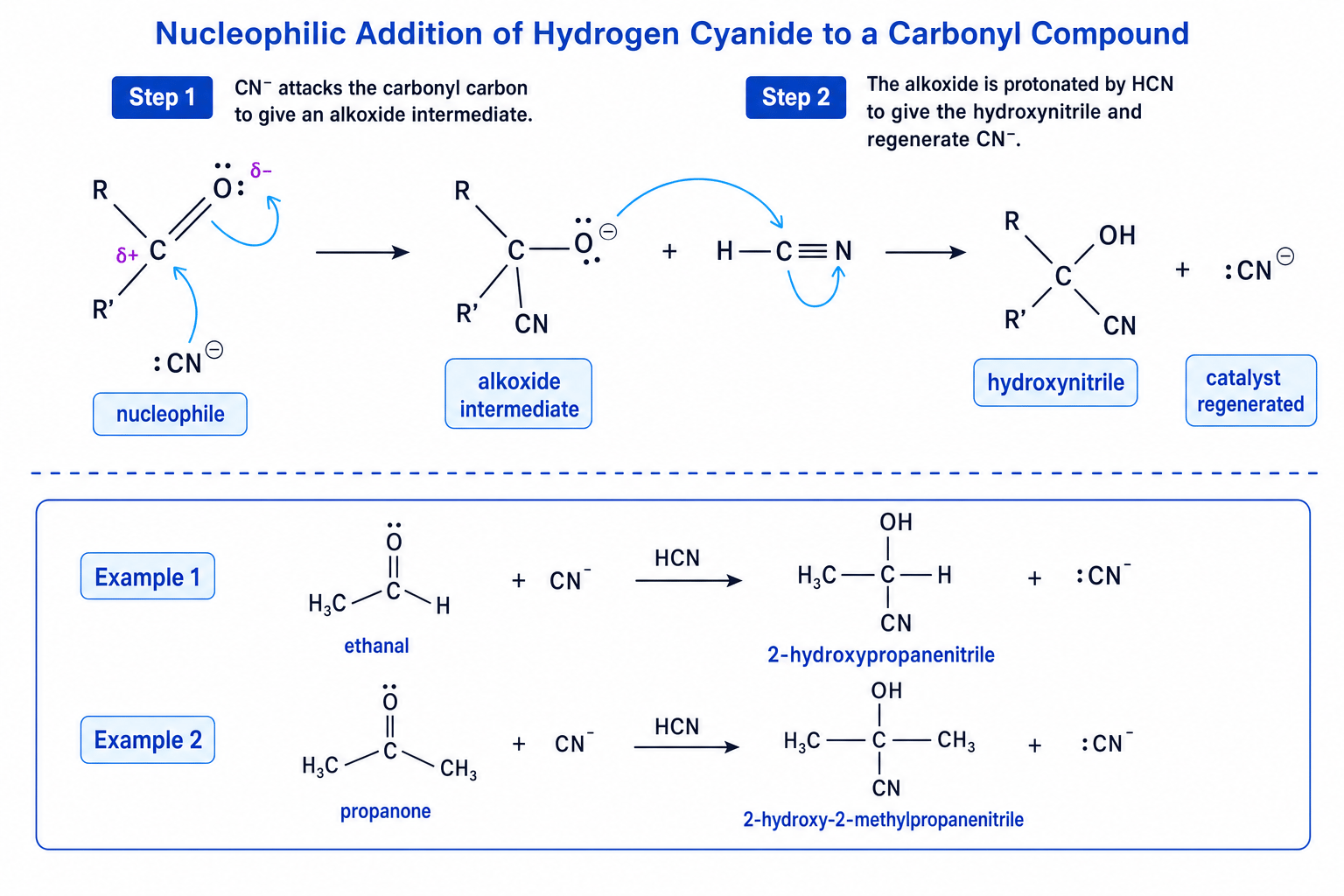
Aldehydes and ketones undergo nucleophilic addition. This means a nucleophile attacks the carbonyl carbon, and the C=O double bond opens up so one product molecule forms.
With hydrogen cyanide, HCN, the nucleophile is the cyanide ion, CN−\text{CN}^-CN−. In practice, HCN is very toxic, so reactions are carried out with strict controls; exam answers often state HCN with KCN or NaCN as a cyanide-ion source.
The product is a hydroxynitrile, containing both an OH group and a nitrile group, CN.
Mechanism in words:
- A curly arrow goes from the lone pair on the carbon of CN−\text{CN}^-CN− to the δ+\delta^+δ+ carbonyl carbon.
- A curly arrow goes from the C=O π bond to the oxygen atom, forming an alkoxide ion.
- The alkoxide ion is protonated by HCN, forming the hydroxynitrile and regenerating CN−\text{CN}^-CN−.
For ethanal:
CH3CHO+HCN→CH3CH(OH)CN\text{CH}_3\text{CHO} + \text{HCN} \to \text{CH}_3\text{CH(OH)CN}CH3CHO+HCN→CH3CH(OH)CNThe product is 2-hydroxypropanenitrile.
For propanone:
CH3COCH3+HCN→(CH3)2C(OH)CN\text{CH}_3\text{COCH}_3 + \text{HCN} \to \text{(CH}_3\text{)}_2\text{C(OH)CN}CH3COCH3+HCN→(CH3)2C(OH)CNThe product is 2-hydroxy-2-methylpropanenitrile.
Curly-arrow direction
Curly arrows show the movement of electron pairs. They must start at a lone pair or bond, not at a positive or partially positive atom.
Naming a hydroxynitrile product
Name the product formed when butanal reacts with HCN.
- Add CN and H across the C=O bond: butanal becomes CH3CH2CH2CH(OH)CN\text{CH}_3\text{CH}_2\text{CH}_2\text{CH(OH)CN}CH3CH2CH2CH(OH)CN.
- For nitriles, include the nitrile carbon in the main chain and number it as carbon 1.
- The longest chain has five carbons, with OH on carbon 2, so the product is 2-hydroxypentanenitrile.
2,4-DNPH test for a carbonyl group
2,4-dinitrophenylhydrazine, often called 2,4-DNPH or Brady’s reagent, reacts with aldehydes and ketones to form orange or yellow precipitates of 2,4-dinitrophenylhydrazones.
General equation, where Ar represents the 2,4-dinitrophenyl group:
R2C=O+H2NNHAr→R2C=NNHAr+H2O\text{R}_2\text{C=O} + \text{H}_2\text{NNHAr} \to \text{R}_2\text{C=NNHAr} + \text{H}_2\text{O}R2C=O+H2NNHAr→R2C=NNHAr+H2OWhat 2,4-DNPH proves
A positive 2,4-DNPH test shows a carbonyl group from an aldehyde or ketone. It does not distinguish aldehydes from ketones.
Specified practical: identifying aldehydes and ketones
A typical method is:
- Add a few drops of the unknown carbonyl compound to 2,4-DNPH reagent in a test tube.
- Observe whether an orange or yellow precipitate forms.
- Filter, wash and dry the solid derivative.
- Recrystallise if needed to improve purity.
- Measure the melting point and compare it with data-book values.
A pure derivative should have a sharp melting point. Impurities usually lower and broaden the melting range.
Using derivative melting points
A 2,4-DNPH derivative melts at 155–158 °C. Data values are: propanal derivative 156 °C, propanone derivative 126 °C, ethanal derivative 168 °C.
- Compare the observed melting range with the data values, not just the appearance of the precipitate.
- 155–158 °C is closest to 156 °C, so the unknown is most likely propanal.
- The range is slightly broad, suggesting the derivative may contain a small amount of impurity.
Triiodomethane test
The triiodomethane test, also called the iodoform test, uses iodine and sodium hydroxide. Warm gently.
A positive result is a pale yellow precipitate of triiodomethane, CHI3\text{CHI}_3CHI3, often with an antiseptic smell.
This identifies:
- compounds containing the CH3CO−\text{CH}_3\text{CO}-CH3CO− group, such as methyl ketones and ethanal
- precursors that can be oxidised to that group, such as ethanol and secondary alcohols containing CH3CH(OH)−\text{CH}_3\text{CH(OH)}-CH3CH(OH)−
For a methyl ketone:
RCOCH3(l)+3I2(aq)+4NaOH(aq)→RCOONa(aq)+CHI3(s)+3NaI(aq)+3H2O(l)\text{RCOCH}_3\text{(l)} + 3\text{I}_2\text{(aq)} + 4\text{NaOH(aq)} \to \text{RCOONa(aq)} + \text{CHI}_3\text{(s)} + 3\text{NaI(aq)} + 3\text{H}_2\text{O(l)}RCOCH3(l)+3I2(aq)+4NaOH(aq)→RCOONa(aq)+CHI3(s)+3NaI(aq)+3H2O(l)Using triiodomethane to identify an isomer
An unknown carbonyl compound has formula C4H8O\text{C}_4\text{H}_8\text{O}C4H8O. It gives 2,4-DNPH positive, Tollens’ negative, and triiodomethane positive.
- 2,4-DNPH positive shows it is an aldehyde or ketone.
- Tollens’ negative shows it is a ketone rather than an aldehyde.
- A positive triiodomethane test shows a CH3CO−\text{CH}_3\text{CO}-CH3CO− group; the ketone is therefore butanone.
In the exam
- Use the tests in order: 2,4-DNPH confirms a carbonyl, Tollens’ or Fehling’s separates aldehydes from ketones, and triiodomethane identifies CH3CO−\text{CH}_3\text{CO}-CH3CO− groups or suitable precursors.
- For mechanisms, draw the C=O dipole, start curly arrows at electron pairs, and show the alkoxide intermediate before protonation.
- Always state reagents and conditions: acidified dichromate(VI) for oxidation, NaBH4\text{NaBH}_4NaBH4 for reduction, HCN with cyanide ions for nucleophilic addition, and iodine/alkali for triiodomethane.
Check yourself
- Why must you distil when preparing an aldehyde from a primary alcohol?
- What observations would you expect for ethanal with Tollens’ reagent, Fehling’s reagent and 2,4-DNPH?
- What is the product when propanone reacts with HCN, and where does the new C–C bond form?