What you'll learn
- How to make primary and secondary alcohols from halogenoalkanes and carbonyl compounds.
- How alcohols react with hydrogen halides, ethanoyl chloride and carboxylic acids.
- Why phenol is acidic and unusually reactive towards bromine.
- How to use bromine water and FeCl₃(aq) to identify phenols.
Starting points: alcohols, phenols and functional groups
A functional group is the atom or group of atoms responsible for the characteristic reactions of an organic compound.
Alcohols and phenols
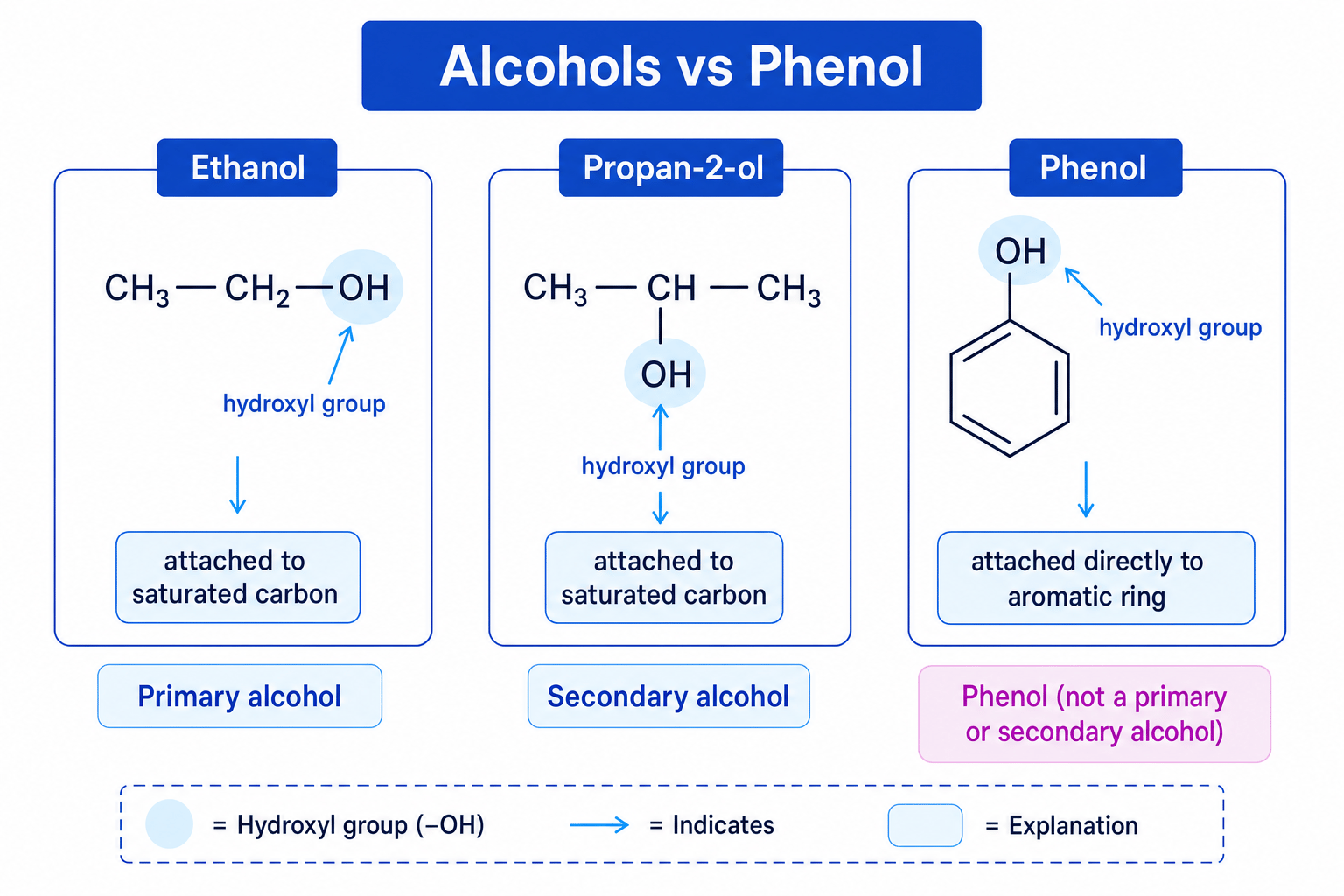
An alcohol contains the hydroxyl functional group, –OH, attached to a saturated carbon atom. A phenol contains an –OH group attached directly to a benzene ring, as in C₆H₅OH.
Alcohols are classified by the carbon atom bonded to –OH:
- Primary alcohol: the –OH carbon is bonded to one other carbon atom, e.g. ethanol, CH₃CH₂OH. Methanol is usually treated with this group.
- Secondary alcohol: the –OH carbon is bonded to two other carbon atoms, e.g. propan-2-ol, CH₃CH(OH)CH₃.
Phenol is not just an alcohol
Phenol has an –OH group, but it is not classified as a primary, secondary or tertiary alcohol because the –OH is attached directly to an aromatic ring, not to a saturated carbon atom.
Making primary and secondary alcohols
There are two key routes in this section:
- Hydrolysis of halogenoalkanes using aqueous hydroxide ions.
- Reduction of carbonyl compounds using a hydride reducing agent.
From halogenoalkanes: nucleophilic substitution
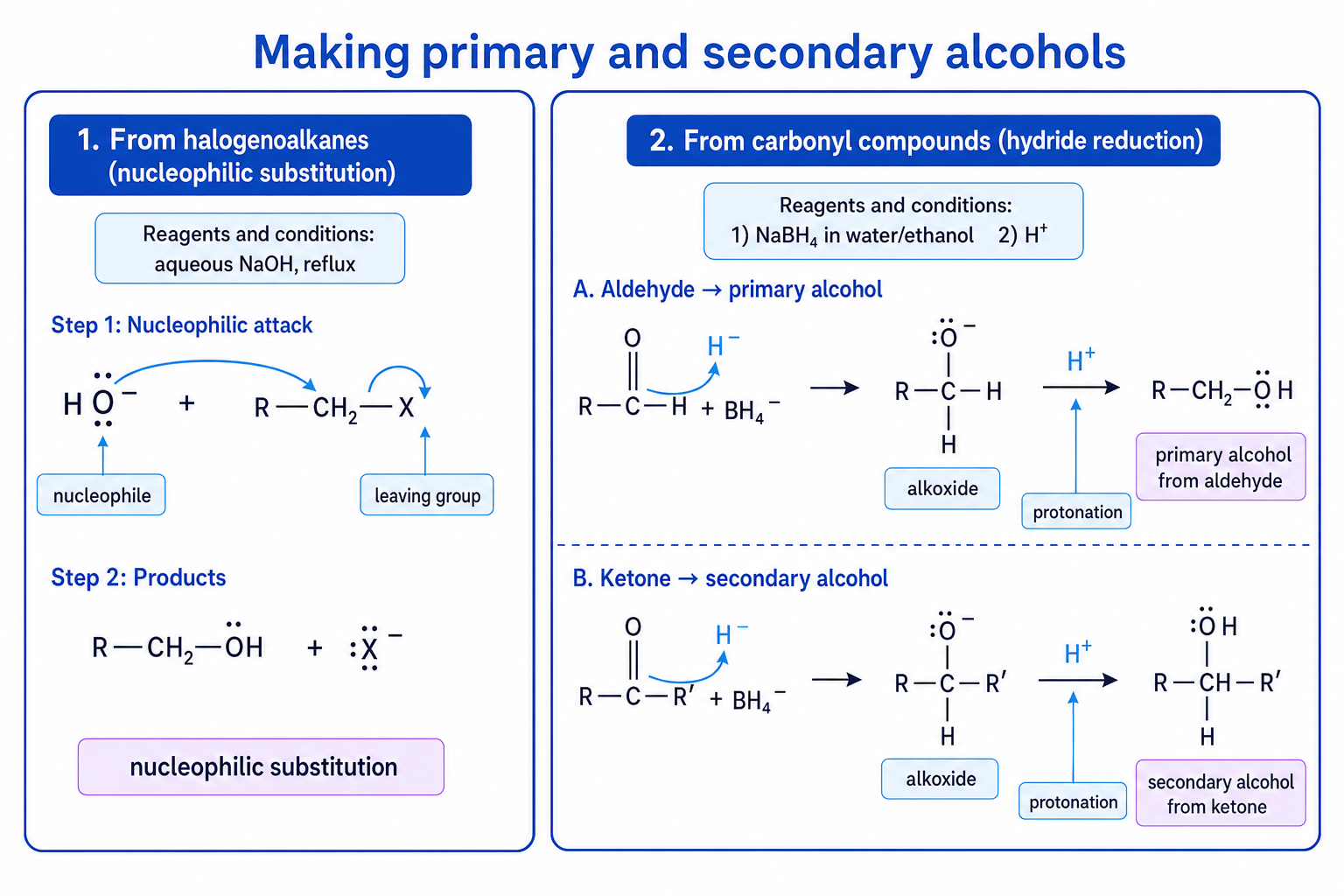
A halogenoalkane contains a carbon–halogen bond, such as C–Br or C–Cl. The halogen is more electronegative than carbon, so the carbon is δ⁺ and can be attacked by a nucleophile.
Nucleophile
A nucleophile is an electron-pair donor. It uses a lone pair to form a new covalent bond with an electron-deficient atom.
To make an alcohol, heat the halogenoalkane under reflux with aqueous sodium hydroxide or potassium hydroxide:
CH₃CH₂Br(l) + OH⁻(aq) → CH₃CH₂OH(aq) + Br⁻(aq)
The curly-arrow mechanism is nucleophilic substitution: OH⁻ attacks the δ⁺ carbon, while the C–Br bond breaks to Br⁻.
Aqueous versus ethanolic hydroxide
Use aqueous NaOH/KOH to form alcohols by substitution. Hot ethanolic hydroxide favours elimination, forming an alkene instead.
From carbonyl compounds: reduction
A carbonyl compound contains the C=O group. Aldehydes and ketones are reduced to alcohols.
- Aldehyde → primary alcohol
- Ketone → secondary alcohol
A common reducing agent is sodium tetrahydridoborate, NaBH₄, in water or ethanol, followed by protonation.
For example:
CH₃CHO + 2[H] → CH₃CH₂OH
CH₃COCH₃ + 2[H] → CH₃CH(OH)CH₃
In the mechanism, a hydride ion, H⁻, attacks the δ⁺ carbonyl carbon. The C=O π bond breaks onto oxygen, forming an alkoxide ion, which is then protonated to form the alcohol.
Choosing a route to butan-2-ol
You want to make butan-2-ol, CH₃CH(OH)CH₂CH₃.
- The product is a secondary alcohol because the carbon bonded to –OH is attached to two carbon atoms.
- From a halogenoalkane, choose 2-bromobutane or 2-chlorobutane; aqueous NaOH under reflux replaces the halogen by –OH.
- From a carbonyl compound, choose butanone; NaBH₄ reduces the ketone to the secondary alcohol.
Reactions of primary and secondary alcohols
Alcohols can be converted into halogenoalkanes and esters. The important idea is that the oxygen lone pair often starts the reaction, but the –OH group itself is a poor leaving group unless it is activated.
With hydrogen halides: forming halogenoalkanes
Alcohols react with hydrogen halides, HX, to form halogenoalkanes:
R–OH + HX → R–X + H₂O
For example:
CH₃CH₂OH(l) + HBr(aq) → CH₃CH₂Br(l) + H₂O(l)
Typical conditions include warming with HBr, or generating HBr in situ from KBr or NaBr and concentrated H₂SO₄. Chloroalkanes can be made using concentrated HCl, often with ZnCl₂.
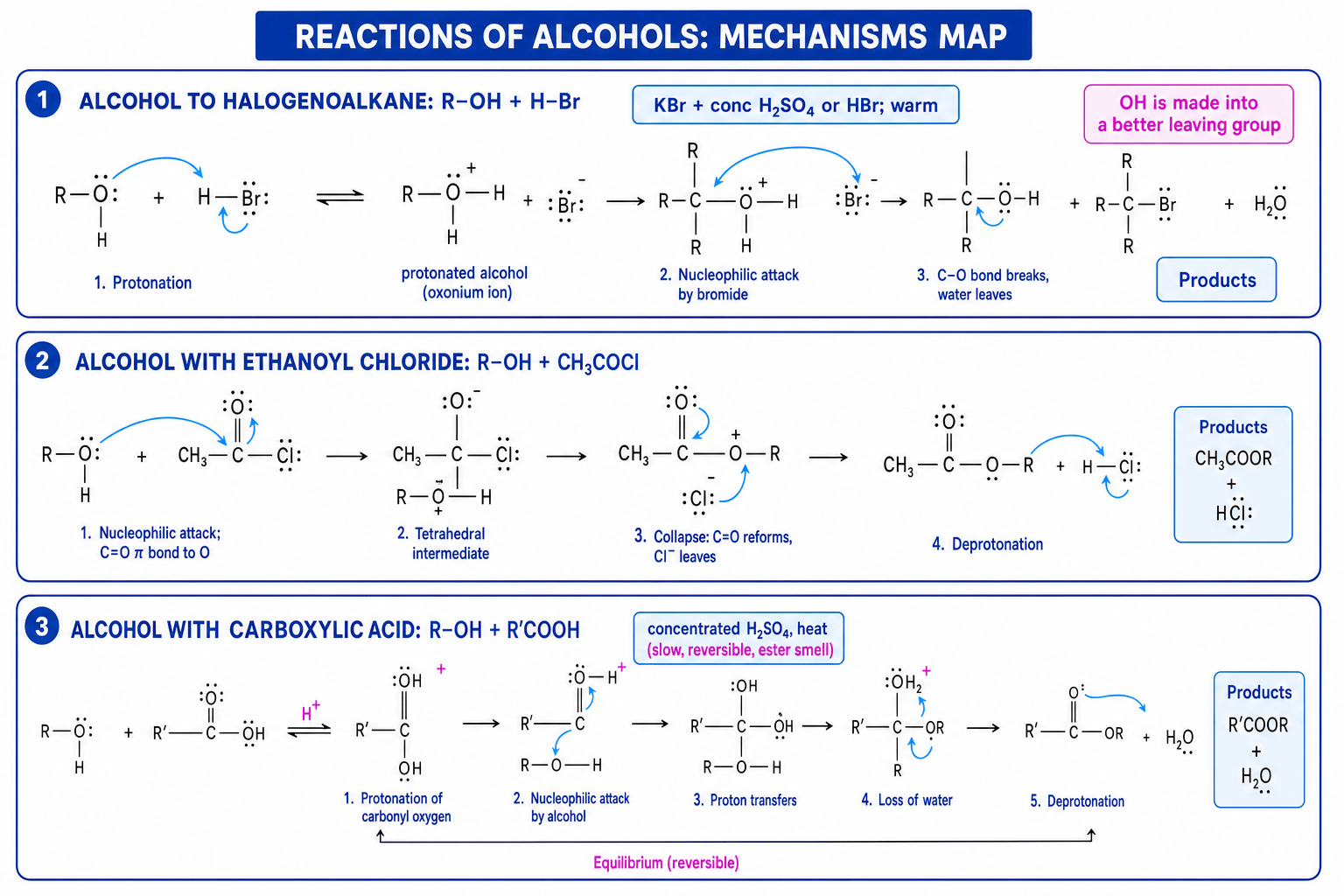
Mechanism summary:
- The alcohol oxygen is protonated, forming R–OH₂⁺.
- Water becomes the leaving group.
- The halide ion attacks the carbon, forming R–X.
Why protonation matters
The –OH group is a poor leaving group, but H₂O is a much better leaving group. Acid turns the alcohol into a species that can undergo substitution.
With ethanoyl chloride: forming esters
An ester has the functional group –COO–. Alcohols react rapidly with ethanoyl chloride, CH₃COCl, at room temperature:
R–OH + CH₃COCl → CH₃COOR + HCl
For example:
CH₃CH₂OH(l) + CH₃COCl(l) → CH₃COOCH₂CH₃(l) + HCl(g)
The product is ethyl ethanoate. You may observe steamy white fumes of HCl.
The mechanism is nucleophilic addition-elimination: the alcohol oxygen attacks the acyl carbon, a tetrahedral intermediate forms, Cl⁻ leaves, then deprotonation gives the ester.
Ethanoyl chloride safety
Ethanoyl chloride is reactive and produces HCl fumes. Practical work must be done in a fume cupboard with appropriate eye protection and gloves.
With carboxylic acids: acid-catalysed esterification
Alcohols react with carboxylic acids to form esters, but this reaction is slower and reversible:
R–OH + R′COOH ⇌ R′COOR + H₂O
Conditions:
- concentrated H₂SO₄ catalyst
- heat under reflux
- often use excess reactant or remove water to improve yield
For example:
CH₃CH₂OH(l) + CH₃COOH(l) ⇌ CH₃COOCH₂CH₃(l) + H₂O(l)
Naming the ester product
Predict the ester formed from propan-2-ol and ethanoic acid.
- The alcohol provides the alkyl part: propan-2-ol gives propan-2-yl.
- The carboxylic acid provides the carboxylate part: ethanoic acid gives ethanoate.
- Combine them to name the ester: propan-2-yl ethanoate.
Phenol: acidity and ring reactions
Phenol, C₆H₅OH, behaves differently from aliphatic alcohols because the oxygen lone pair interacts with the delocalised π system of the benzene ring.
Acidity of phenol
Phenol is a weak acid:
C₆H₅OH(aq) ⇌ C₆H₅O⁻(aq) + H⁺(aq)
It reacts with sodium hydroxide to form sodium phenoxide:
C₆H₅OH(aq) + NaOH(aq) → C₆H₅O⁻Na⁺(aq) + H₂O(l)
Phenol is more acidic than ethanol because the phenoxide ion is stabilised by delocalisation of the negative charge into the benzene ring. Ethoxide ions do not have this aromatic delocalisation.
However, phenol is much weaker than carboxylic acids, so it usually does not fizz with sodium carbonate.
Comparing phenol and ethanol as acids
Explain why phenol reacts with NaOH but ethanol does not to any useful extent.
- Removing H⁺ from phenol forms phenoxide, C₆H₅O⁻, where the negative charge can be delocalised into the aromatic ring.
- Removing H⁺ from ethanol forms ethoxide, CH₃CH₂O⁻, where the negative charge remains localised mainly on oxygen.
- The more stable conjugate base forms more readily, so phenol is the stronger acid and reacts with NaOH.
Reaction with bromine water
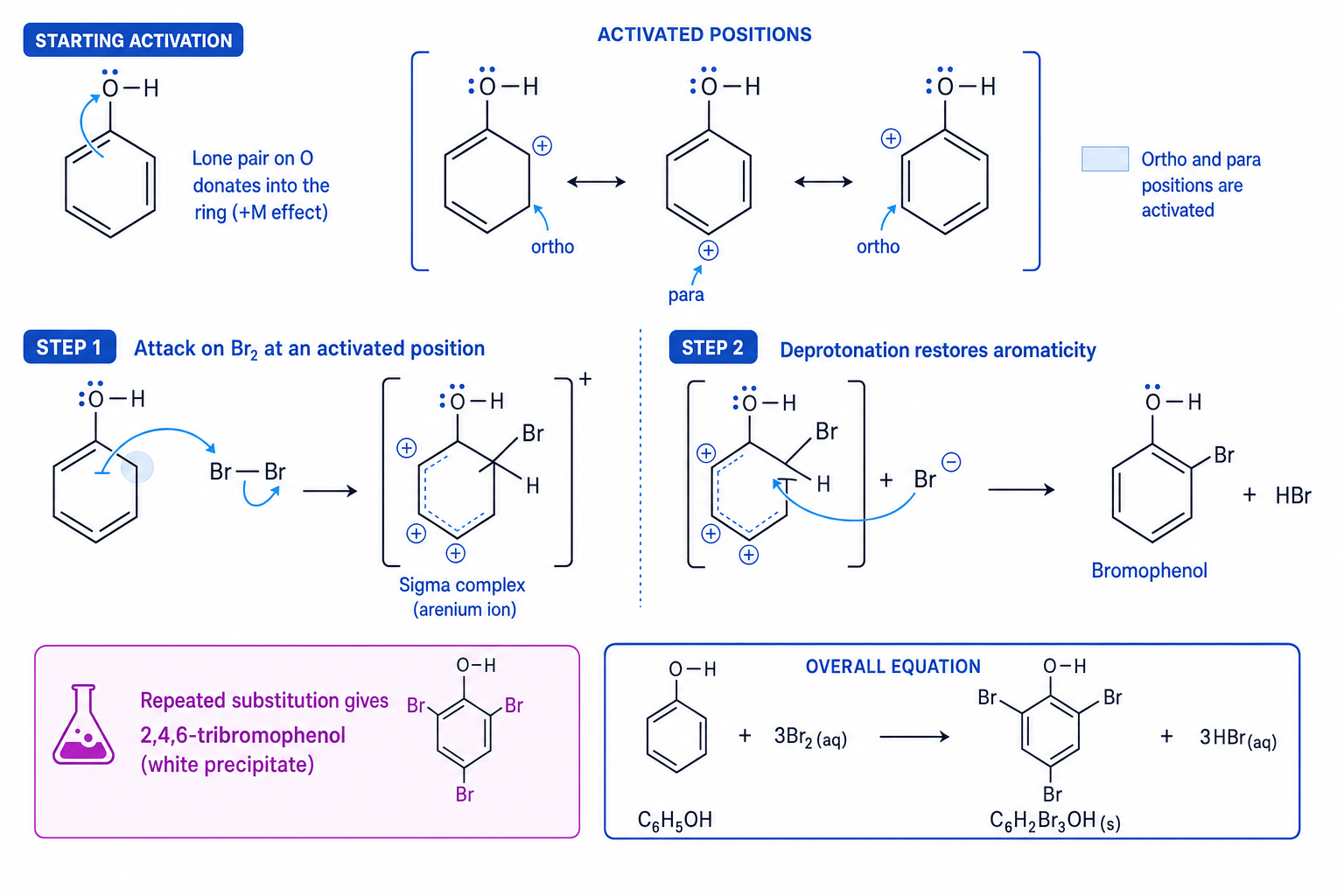
Phenol reacts readily with bromine water at room temperature. The orange/brown bromine water is decolourised and a white precipitate of 2,4,6-tribromophenol forms:
C₆H₅OH(aq) + 3Br₂(aq) → C₆H₂Br₃OH(s) + 3HBr(aq)
The –OH group donates electron density into the ring, activating the 2, 4 and 6 positions. Unlike benzene, phenol does not need a halogen carrier such as FeBr₃.
Bromine water evidence
Alkenes also decolourise bromine water, but phenol gives the extra evidence of a white precipitate of 2,4,6-tribromophenol.
Reaction with ethanoyl chloride
Phenol reacts with ethanoyl chloride to form phenyl ethanoate:
C₆H₅OH + CH₃COCl → CH₃COOC₆H₅ + HCl
The mechanism follows the same nucleophilic addition-elimination pattern as alcohols reacting with ethanoyl chloride: oxygen attacks the acyl carbon, chloride leaves, and deprotonation forms the ester.
FeCl₃(aq) test for phenols
Neutral iron(III) chloride solution is used to test for phenols. Add a few drops of FeCl₃(aq) to the sample, usually dissolved in water or ethanol.
A positive test gives a purple, violet, blue or green colour due to formation of an iron(III) complex with phenoxide ions.
Positive phenol test
A purple colour with neutral FeCl₃(aq) is strong evidence for a phenolic –OH group.
In the exam
- Always classify the compound first: halogenoalkane, aldehyde, ketone, alcohol or phenol. This usually tells you the reagent and product family.
- For mechanisms, draw curly arrows from an electron pair: a lone pair or a bond. Do not draw arrows from charges.
- Include conditions and observations where relevant: aqueous NaOH/reflux, NaBH₄ then H⁺, ethanoyl chloride with HCl fumes, bromine water with a white precipitate, and FeCl₃(aq) giving purple colour.
Check yourself
- Which carbonyl compound would you reduce to make pentan-2-ol?
- Why does phenol react with bromine water without a halogen carrier?
- What observation would you expect when FeCl₃(aq) is added to a phenol?