

What you'll learn
- How aqueous transition metal ions react with hydroxide ions, ammonia and chloride ions.
- How to write balanced ionic equations for precipitation, ligand substitution and redox reactions.
- Why transition metals and their compounds are effective catalysts.
- How to recognise common observations, especially for copper and iron ions.
The starting point: transition metal ions in water
Many transition metal ions in aqueous solution are not “bare” metal ions. They are surrounded by water molecules, forming complex ions.
Complex ion and ligand
A complex ion is a central metal ion surrounded by molecules or ions called ligands. A ligand donates a lone pair of electrons to the metal ion, forming a coordinate bond.
For example, copper(II) ions in water are usually written as the hexaaquacopper(II) ion:
[Cu(H2O)6]2+(aq)[\text{Cu(H}_2\text{O)}_6]^{2+}\text{(aq)}[Cu(H2O)6]2+(aq)The six water ligands arrange octahedrally around Cu2+. Reactions of transition metal ions often involve either:
- changing the ligands around the metal ion
- changing the oxidation state of the metal ion
Two big reaction types
For transition metal complexes, ask: has the metal changed oxidation state, or have the ligands changed? That usually tells you whether the reaction is redox, precipitation, or ligand substitution.
Finding an oxidation state in a complex
Find the oxidation state of iron in [Fe(H2O)5SCN]2+[\text{Fe(H}_2\text{O)}_5\text{SCN}]^{2+}[Fe(H2O)5SCN]2+.
-
Water ligands are neutral, so five H2O ligands contribute zero charge. The thiocyanate ligand, SCN−, contributes −1.
-
Let the oxidation state of iron be xxx. The total charge on the complex is +2, so:
x+(−1)=+2x + (-1) = +2x+(−1)=+2 -
Solve for xxx:
x=+3x = +3x=+3So iron is in the +3 oxidation state.
Reactions with hydroxide ions: precipitates
Adding sodium hydroxide solution provides hydroxide ions, OH−. These often form insoluble metal hydroxides, seen as precipitates.
Precipitate
A precipitate is an insoluble solid formed when two aqueous solutions react.
For copper(II):
[Cu(H2O)6]2+(aq)+2OH−(aq)→Cu(OH)2(s)+6H2O(l)[\text{Cu(H}_2\text{O)}_6]^{2+}\text{(aq)} + 2\text{OH}^-\text{(aq)} \to \text{Cu(OH)}_2\text{(s)} + 6\text{H}_2\text{O(l)}[Cu(H2O)6]2+(aq)+2OH−(aq)→Cu(OH)2(s)+6H2O(l)Observation: pale blue solution → pale blue precipitate.
For iron(II):
Fe2+(aq)+2OH−(aq)→Fe(OH)2(s)\text{Fe}^{2+}\text{(aq)} + 2\text{OH}^-\text{(aq)} \to \text{Fe(OH)}_2\text{(s)}Fe2+(aq)+2OH−(aq)→Fe(OH)2(s)Observation: pale green solution → green precipitate. The precipitate may slowly turn brown in air as Fe2+ is oxidised to Fe3+.
For iron(III):
Fe3+(aq)+3OH−(aq)→Fe(OH)3(s)\text{Fe}^{3+}\text{(aq)} + 3\text{OH}^-\text{(aq)} \to \text{Fe(OH)}_3\text{(s)}Fe3+(aq)+3OH−(aq)→Fe(OH)3(s)Observation: yellow/brown solution → brown precipitate.
Solution colour vs precipitate colour
Do not just write “blue” or “brown”. Examiners often want whether it is a solution or a precipitate, and what happens in excess reagent.
Ammonia: base first, ligand second
Aqueous ammonia, NH3(aq), behaves in two important ways:
- as a weak base, forming hydroxide precipitates
- as a ligand, replacing water ligands in some complexes
With Cu2+, a few drops of ammonia first give a pale blue precipitate of Cu(OH)2. In excess ammonia, this dissolves to form a deep blue solution containing the tetraammine complex:
[Cu(NH3)4(H2O)2]2+[\text{Cu(NH}_3)_4\text{(H}_2\text{O)}_2]^{2+}[Cu(NH3)4(H2O)2]2+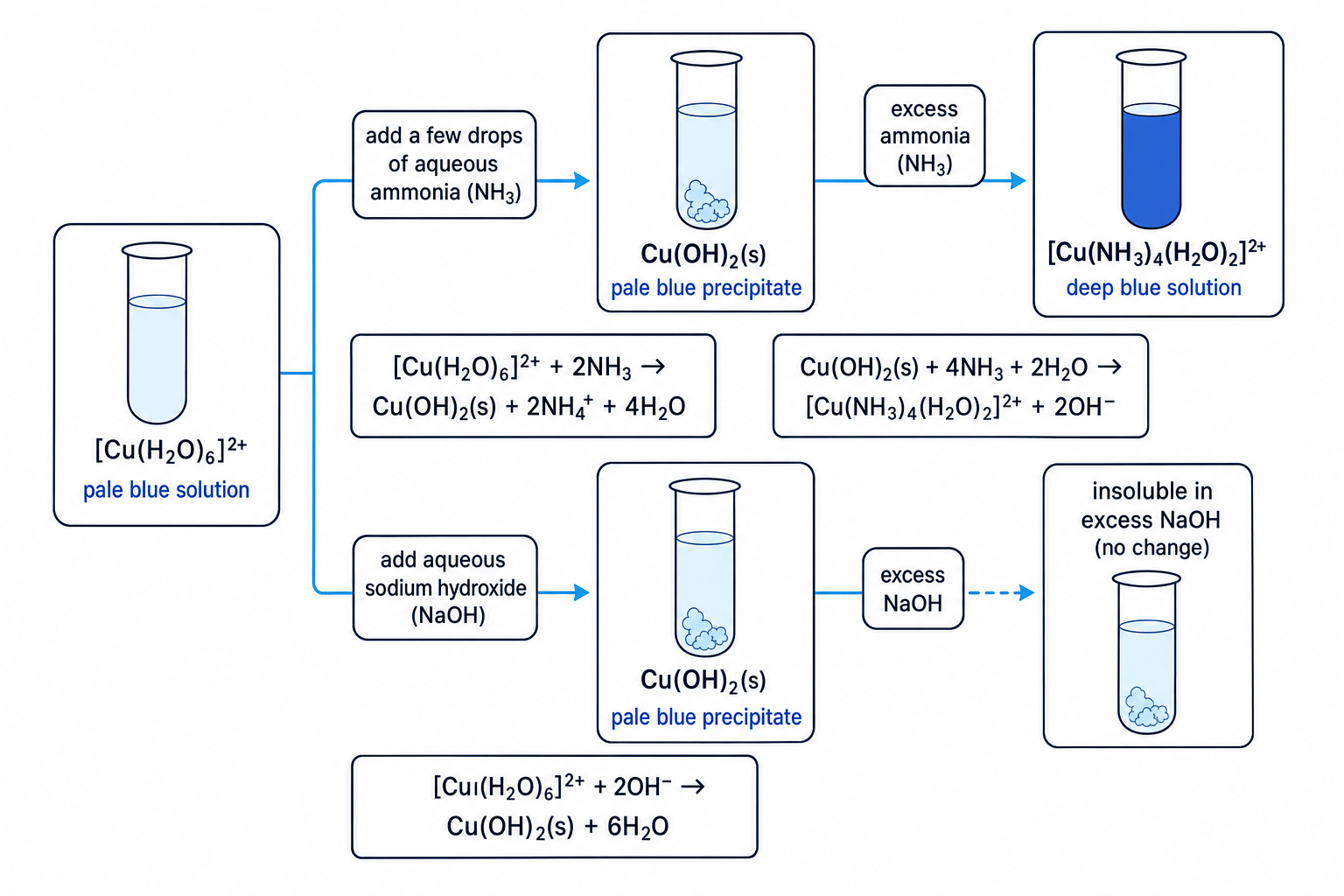
A useful overall ligand substitution equation is:
[Cu(H2O)6]2+(aq)+4NH3(aq)⇌[Cu(NH3)4(H2O)2]2+(aq)+4H2O(l)[\text{Cu(H}_2\text{O)}_6]^{2+}\text{(aq)} + 4\text{NH}_3\text{(aq)} \rightleftharpoons [\text{Cu(NH}_3)_4\text{(H}_2\text{O)}_2]^{2+}\text{(aq)} + 4\text{H}_2\text{O(l)}[Cu(H2O)6]2+(aq)+4NH3(aq)⇌[Cu(NH3)4(H2O)2]2+(aq)+4H2O(l)Interpreting copper(II) with ammonia and sodium hydroxide
An unknown aqueous transition metal ion gives a pale blue precipitate with NaOH(aq), insoluble in excess NaOH(aq). With NH3(aq), it gives a pale blue precipitate that dissolves in excess to form a deep blue solution. Identify the ion and the final complex.
-
A pale blue precipitate with hydroxide ions strongly suggests Cu2+, forming Cu(OH)2(s).
-
The precipitate being insoluble in excess NaOH(aq), but dissolving in excess NH3(aq), matches copper(II) complex formation rather than amphoteric hydroxide behaviour.
-
Excess ammonia replaces four water ligands to give the deep blue complex:
[Cu(NH3)4(H2O)2]2+[\text{Cu(NH}_3)_4\text{(H}_2\text{O)}_2]^{2+}[Cu(NH3)4(H2O)2]2+
Ligand substitution with chloride ions
A ligand substitution reaction happens when one ligand in a complex is replaced by another ligand.
Concentrated hydrochloric acid provides a high concentration of chloride ions, Cl−, which can replace water ligands.
For copper(II):
[Cu(H2O)6]2+(aq)+4Cl−(aq)⇌[CuCl4]2−(aq)+6H2O(l)[\text{Cu(H}_2\text{O)}_6]^{2+}\text{(aq)} + 4\text{Cl}^-\text{(aq)} \rightleftharpoons [\text{CuCl}_4]^{2-}\text{(aq)} + 6\text{H}_2\text{O(l)}[Cu(H2O)6]2+(aq)+4Cl−(aq)⇌[CuCl4]2−(aq)+6H2O(l)The colour changes from pale blue to yellow/green. The coordination number changes from 6 in the octahedral aqua complex to 4 in the tetrahedral chloride complex.
For cobalt(II), a common example is:
[Co(H2O)6]2+(aq)+4Cl−(aq)⇌[CoCl4]2−(aq)+6H2O(l)[\text{Co(H}_2\text{O)}_6]^{2+}\text{(aq)} + 4\text{Cl}^-\text{(aq)} \rightleftharpoons [\text{CoCl}_4]^{2-}\text{(aq)} + 6\text{H}_2\text{O(l)}[Co(H2O)6]2+(aq)+4Cl−(aq)⇌[CoCl4]2−(aq)+6H2O(l)Observation: pink solution ⇌ blue solution.
Using Le Chatelier’s principle
Adding concentrated HCl increases Cl−, so the equilibrium shifts towards the chloride complex. Adding water shifts it back towards the hexaaqua complex.
Redox reactions of transition metal ions
Transition metals often show variable oxidation states, so their ions can act as oxidising or reducing agents.
Redox reaction
A redox reaction involves electron transfer. Oxidation is loss of electrons; reduction is gain of electrons.
A classic example is acidified manganate(VII), MnO4−, oxidising Fe2+ to Fe3+.
Half-equations:
MnO4−(aq)+8H+(aq)+5e−→Mn2+(aq)+4H2O(l)\text{MnO}_4^-\text{(aq)} + 8\text{H}^+\text{(aq)} + 5e^- \to \text{Mn}^{2+}\text{(aq)} + 4\text{H}_2\text{O(l)}MnO4−(aq)+8H+(aq)+5e−→Mn2+(aq)+4H2O(l) Fe2+(aq)→Fe3+(aq)+e−\text{Fe}^{2+}\text{(aq)} \to \text{Fe}^{3+}\text{(aq)} + e^-Fe2+(aq)→Fe3+(aq)+e−Overall:
MnO4−(aq)+8H+(aq)+5Fe2+(aq)→Mn2+(aq)+4H2O(l)+5Fe3+(aq)\text{MnO}_4^-\text{(aq)} + 8\text{H}^+\text{(aq)} + 5\text{Fe}^{2+}\text{(aq)} \to \text{Mn}^{2+}\text{(aq)} + 4\text{H}_2\text{O(l)} + 5\text{Fe}^{3+}\text{(aq)}MnO4−(aq)+8H+(aq)+5Fe2+(aq)→Mn2+(aq)+4H2O(l)+5Fe3+(aq)This is used in redox titrations. Acidified potassium manganate(VII) is self-indicating: the endpoint is the first permanent pale pink colour.
Calculating iron(II) concentration from a manganate(VII) titration
25.0 cm3 of Fe2+(aq) required 20.40 cm3 of 0.0200 mol dm−3 KMnO4(aq) in acidic conditions. Calculate the concentration of Fe2+(aq).
-
Calculate the amount of MnO4− used:
n=cV=0.0200×20.401000=4.08×10⁻⁴ moln = cV = 0.0200 \times \frac{20.40}{1000} = 4.08 \times 10^{-4}\text{ mol}n=cV=0.0200×100020.40=4.08×10⁻⁴ mol -
Use the reacting ratio from the equation. One mole of MnO4− reacts with five moles of Fe2+:
n(Fe2+)=5×4.08×10−4=2.04×10⁻³ moln(\text{Fe}^{2+}) = 5 \times 4.08 \times 10^{-4} = 2.04 \times 10^{-3}\text{ mol}n(Fe2+)=5×4.08×10−4=2.04×10⁻³ mol -
Calculate the Fe2+ concentration in 25.0 cm3:
c=nV=2.04×10−325.0÷1000=0.0816 mol dm−3c = \frac{n}{V} = \frac{2.04 \times 10^{-3}}{25.0 \div 1000} = 0.0816\text{ mol dm}^{-3}c=Vn=25.0÷10002.04×10−3=0.0816 mol dm−3
Choosing the acid
Use dilute sulfuric acid for manganate(VII) titrations. Hydrochloric acid can be oxidised to chlorine, and nitric acid is itself an oxidising agent.
Transition metals as catalysts
Catalyst
A catalyst increases the rate of a reaction by providing an alternative route with a lower activation energy. It is regenerated by the end of the reaction.
Transition metals make good catalysts because they can:
- form temporary bonds with reactants
- provide surfaces for adsorption
- change oxidation state easily
- form intermediate complexes
There are two main types.
Heterogeneous catalysis
A heterogeneous catalyst is in a different physical phase from the reactants.
Examples include:
-
iron in the Haber process:
N2(g)+3H2(g)⇌2NH3(g)\text{N}_2\text{(g)} + 3\text{H}_2\text{(g)} \rightleftharpoons 2\text{NH}_3\text{(g)}N2(g)+3H2(g)⇌2NH3(g) -
nickel in hydrogenation of alkenes
-
vanadium(V) oxide, V2O5, in the Contact process
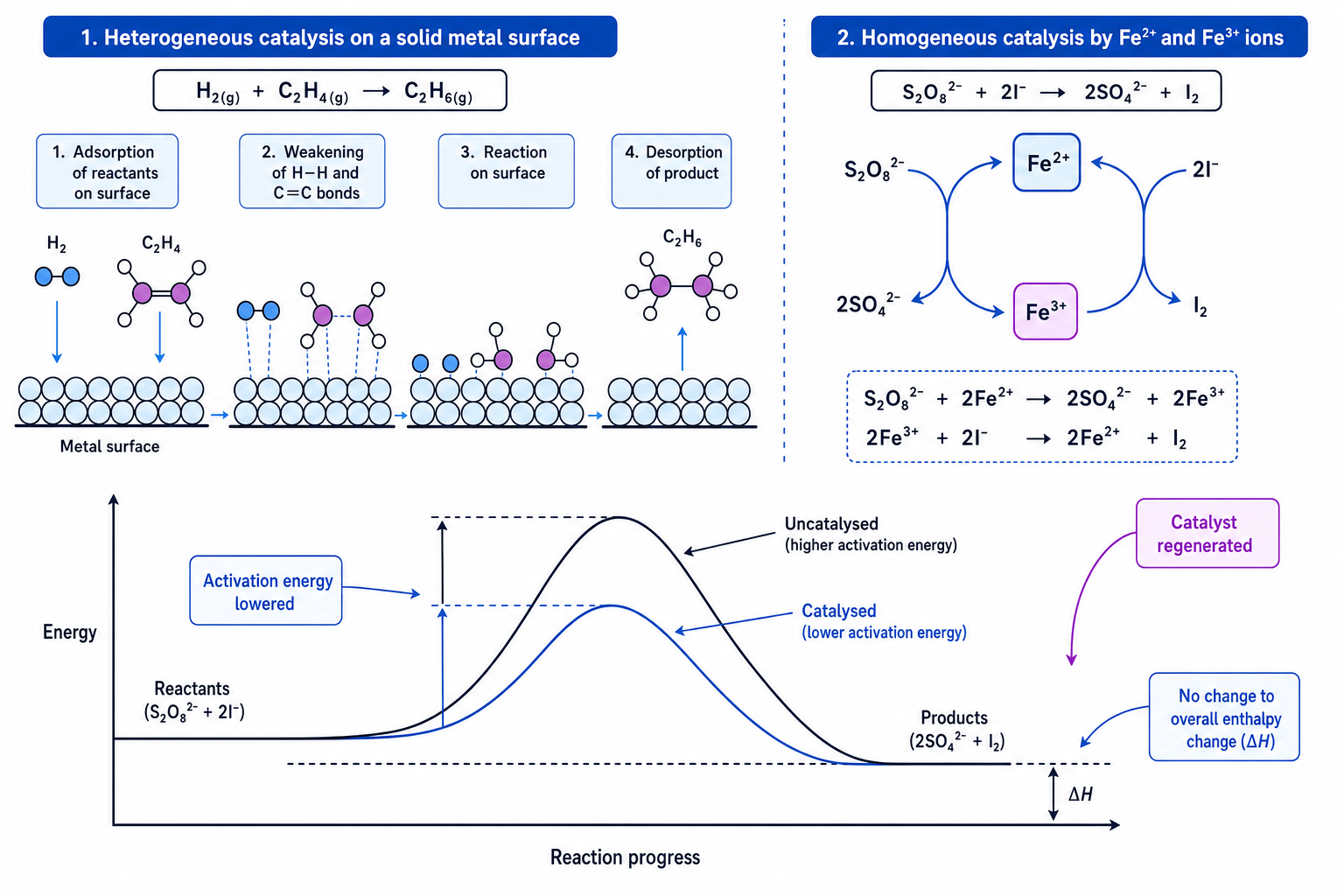
In heterogeneous catalysis, reactants are often adsorbed onto the catalyst surface. Adsorption means molecules attach to the surface. This weakens bonds and allows reaction to occur more easily. Products then desorb, meaning they leave the surface.
Homogeneous catalysis
A homogeneous catalyst is in the same physical phase as the reactants.
A common A-Level example is the reaction between peroxodisulfate ions and iodide ions:
S2O82−(aq)+2I−(aq)→2SO42−(aq)+I2(aq)\text{S}_2\text{O}_8^{2-}\text{(aq)} + 2\text{I}^-\text{(aq)} \to 2\text{SO}_4^{2-}\text{(aq)} + \text{I}_2\text{(aq)}S2O82−(aq)+2I−(aq)→2SO42−(aq)+I2(aq)This reaction is slow because both reactant ions are negatively charged, so they repel each other. Fe2+/Fe3+ ions catalyse it by providing two easier redox steps.
Showing that iron ions act as a catalyst
Use the two steps below to show the overall reaction and explain why iron ions are catalysts.
S2O82−+2Fe2+→2SO42−+2Fe3+\text{S}_2\text{O}_8^{2-} + 2\text{Fe}^{2+} \to 2\text{SO}_4^{2-} + 2\text{Fe}^{3+}S2O82−+2Fe2+→2SO42−+2Fe3+ 2Fe3++2I−→2Fe2++I22\text{Fe}^{3+} + 2\text{I}^- \to 2\text{Fe}^{2+} + \text{I}_22Fe3++2I−→2Fe2++I2-
Add the two equations together, keeping all species from both sides.
-
Cancel the species that appear unchanged on both sides. Here, 2Fe2+ and 2Fe3+ cancel because they are regenerated during the cycle.
-
The remaining overall equation is:
S2O82−+2I−→2SO42−+I2\text{S}_2\text{O}_8^{2-} + 2\text{I}^- \to 2\text{SO}_4^{2-} + \text{I}_2S2O82−+2I−→2SO42−+I2The iron ions are catalysts because they provide an alternative pathway and are regenerated.
Catalysts and equilibrium
A catalyst does not change ΔH\Delta HΔH, KcK_cKc, yield, or the position of equilibrium. It only helps equilibrium be reached faster by lowering the activation energy of both forward and reverse reactions.
In the exam
-
For test-tube reactions, always state the observation fully: colour, precipitate or solution, and whether it dissolves in excess reagent.
-
For equations involving complexes, check both charge balance and atom balance. Transition metal complex equations are easy to under-balance.
-
For catalysis questions, explain the actual role: adsorption for heterogeneous catalysts, or oxidation-state changes/intermediate complexes for homogeneous catalysts.
Check yourself
- What observations would you expect when excess NH3(aq) is added to Cu2+(aq)?
- Why can Fe2+/Fe3+ ions catalyse the reaction between S2O82− and I−?
- In a manganate(VII) titration, why is sulfuric acid used rather than hydrochloric acid?
