What you'll learn
- How a rate equation links reaction rate to reactant concentrations.
- How to find orders of reaction from experimental data.
- How to calculate the rate constant, including its units.
- How rate equations give evidence for possible reaction mechanisms.
Starting point: what “rate” means
The rate of reaction tells you how fast reactants are used up or products are formed. In A-Level Chemistry, rate is usually measured as a change in concentration per unit time, with units of mol dm⁻³ s⁻¹.
For a reactant, concentration decreases, so the gradient of a concentration-time graph is negative. We normally report rate as a positive value, so:
rate=−Δ[reactant]Δt\text{rate} = -\frac{\Delta[\text{reactant}]}{\Delta t}rate=−ΔtΔ[reactant]For a product, concentration increases, so the rate is the positive gradient.
Rate of reaction
The rate of reaction is the change in concentration of a reactant or product per unit time, usually measured in mol dm⁻³ s⁻¹.
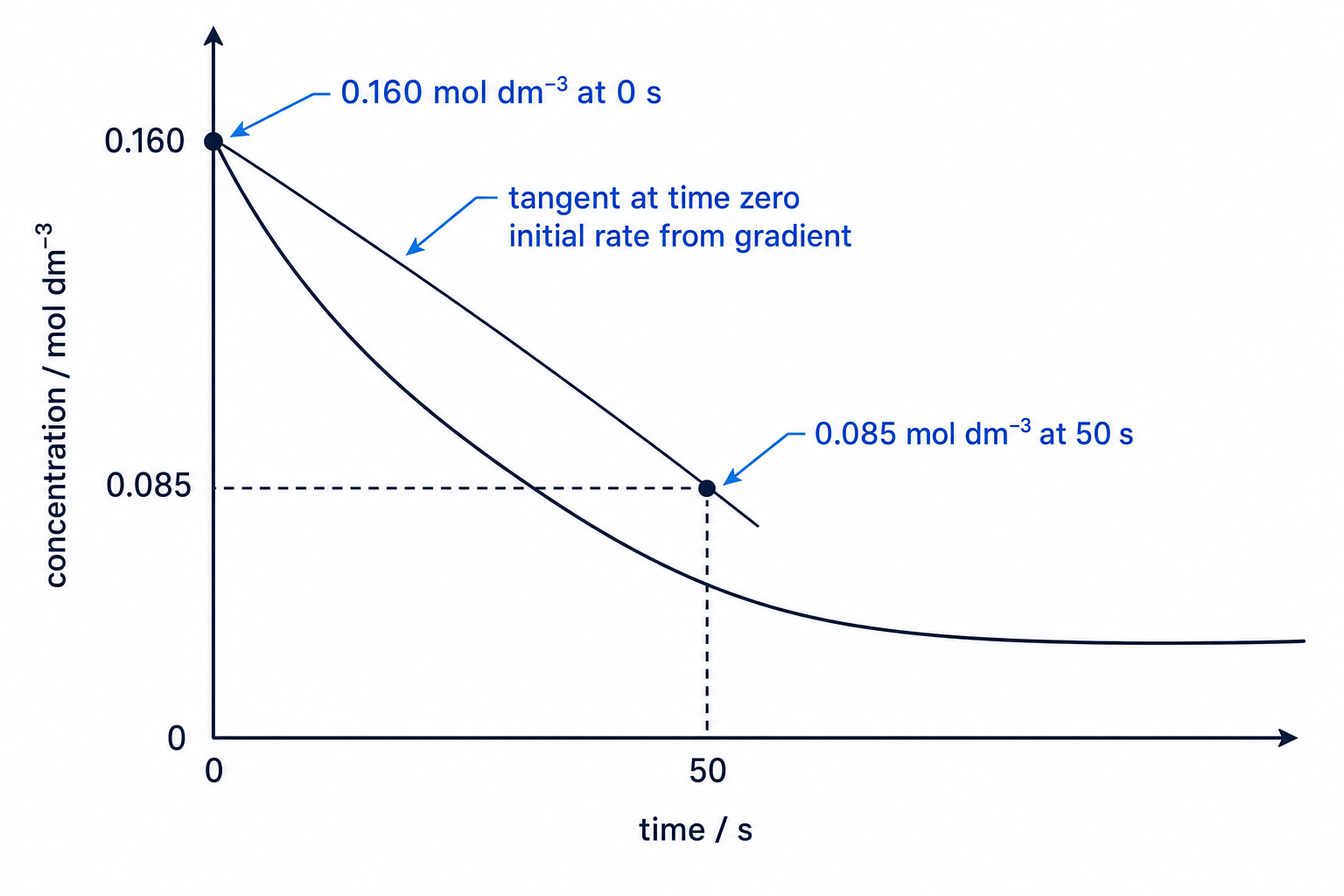
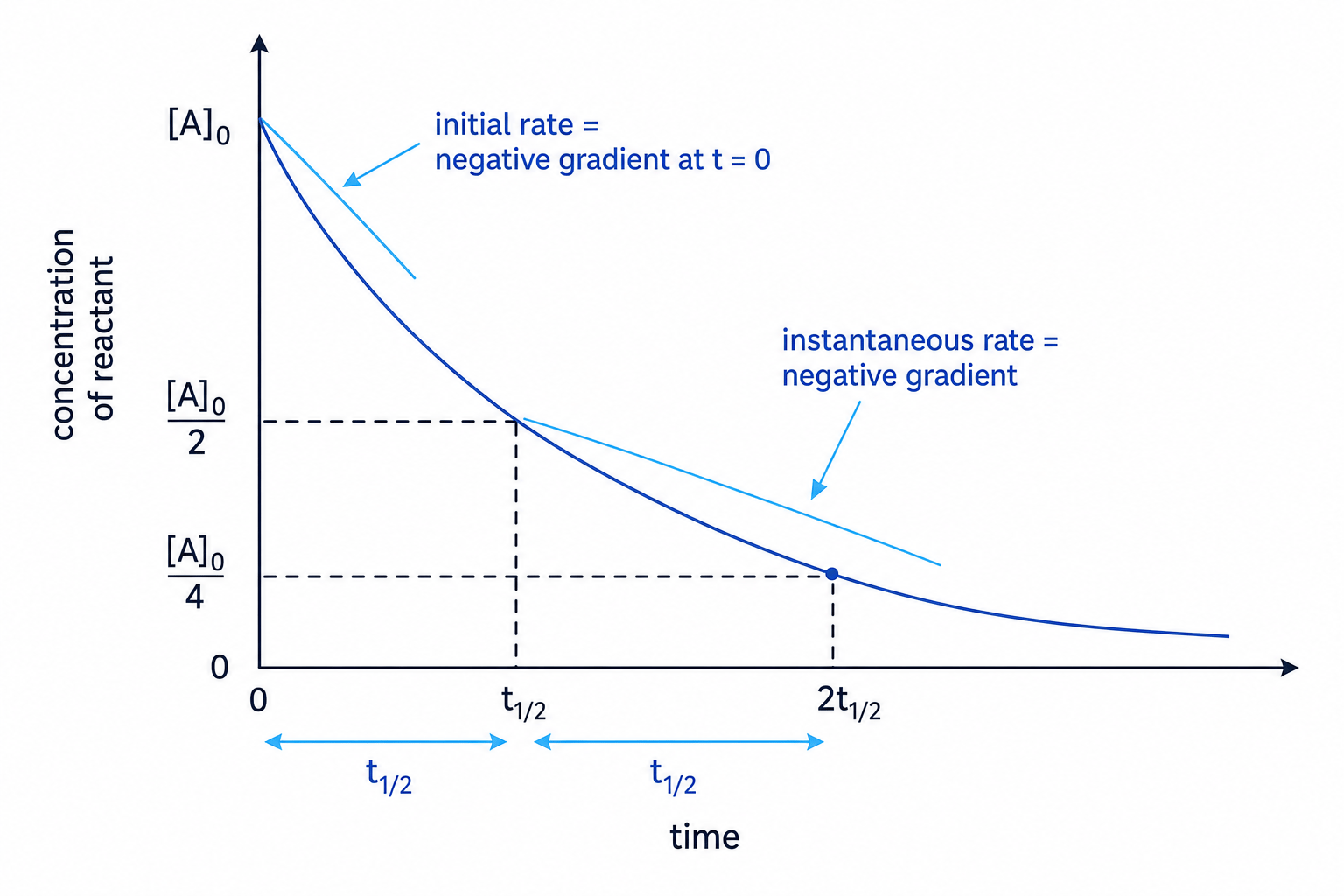
A concentration-time graph lets you estimate rate from the gradient. The initial rate is found from the tangent at time zero.
Calculating an initial rate from a tangent
A reactant concentration-time graph has a tangent at time zero passing through 0.160 mol dm⁻³ at 0 s and 0.085 mol dm⁻³ at 50 s.
-
Calculate the change in concentration along the tangent:
Δ[A]=0.085−0.160=−0.075\Delta[A] = 0.085 - 0.160 = -0.075Δ[A]=0.085−0.160=−0.075 mol dm⁻³. -
Divide by the time interval to find the gradient:
Δ[A]Δt=−0.07550=−1.50×10⁻³\frac{\Delta[A]}{\Delta t} = \frac{-0.075}{50} = -1.50 \times 10^{-3}ΔtΔ[A]=50−0.075=−1.50×10⁻³ mol dm⁻³ s⁻¹. -
Because this is a reactant, the rate is the negative of the gradient:
rate =1.50×10−3= 1.50 \times 10^{-3}=1.50×10⁻³ mol dm⁻³ s⁻¹.
The rate equation
For many reactions, the rate depends on the concentrations of reactants. A general rate equation looks like this:
rate=k[A]m[B]n\text{rate} = k[A]^m[B]^nrate=k[A]m[B]nHere:
- kkk is the rate constant.
- [A][A][A] and [B][B][B] are the concentrations of reactants A and B.
- mmm is the order with respect to A.
- nnn is the order with respect to B.
- m+nm + nm+n is the overall order of the reaction.
Rate equation
A rate equation is an experimentally determined equation showing how the rate of reaction depends on the concentrations of reactants.
Order of reaction
The order of reaction with respect to a reactant is the power to which that reactant’s concentration is raised in the rate equation.
Orders are experimental
You cannot usually work out the order of reaction from the balanced chemical equation. Orders must be found from experimental rate data.
What different orders mean
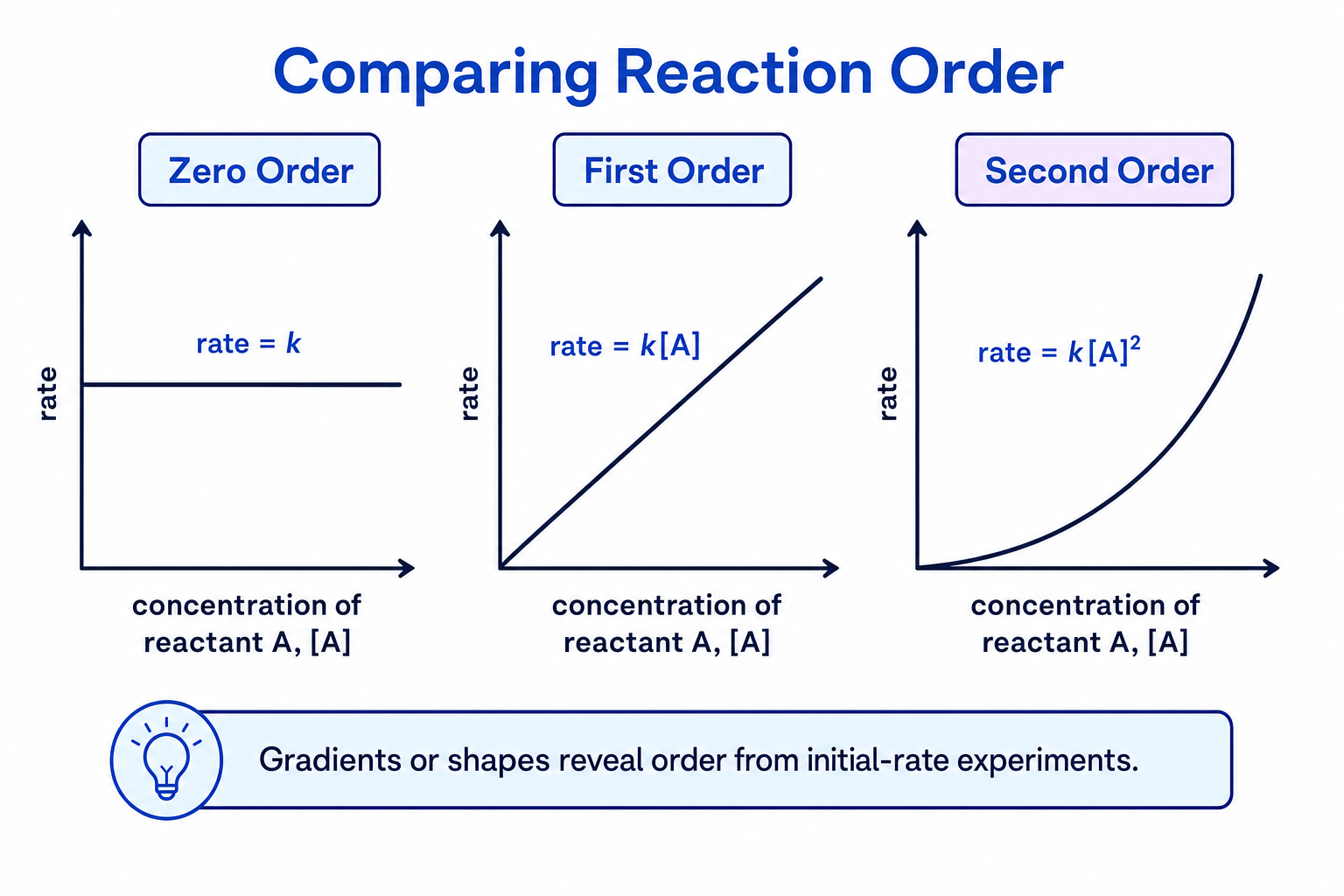
If a reaction is zero order with respect to A, changing [A][A][A] has no effect on the rate.
rate=k[A]0=k\text{rate} = k[A]^0 = krate=k[A]0=kIf a reaction is first order with respect to A, doubling [A][A][A] doubles the rate.
rate=k[A]\text{rate} = k[A]rate=k[A]If a reaction is second order with respect to A, doubling [A][A][A] makes the rate four times larger.
rate=k[A]2\text{rate} = k[A]^2rate=k[A]2These patterns also appear in rate-concentration graphs.
Quick order test
If only one reactant concentration changes: no rate change means zero order, rate changes by the same factor means first order, and rate changes by the square of the factor means second order.
Finding orders from initial rates
The initial rate method compares the rate at the very start of different experiments. This is useful because concentrations are known accurately at the start.
When only [A][A][A] changes, use:
rate2rate1=([A]2[A]1)m\frac{\text{rate}_2}{\text{rate}_1} = \left(\frac{[A]_2}{[A]_1}\right)^mrate1rate2=([A]1[A]2)mwhere mmm is the order with respect to A.
Deducing a rate equation from initial rates
A reaction between A and B gives this initial-rate data:
- Experiment 1: [A]=0.100[A] = 0.100[A]=0.100 mol dm⁻³, [B]=0.200[B] = 0.200[B]=0.200 mol dm⁻³, rate =2.40×10−4= 2.40 \times 10^{-4}=2.40×10⁻⁴ mol dm⁻³ s⁻¹
- Experiment 2: [A]=0.200[A] = 0.200[A]=0.200 mol dm⁻³, [B]=0.200[B] = 0.200[B]=0.200 mol dm⁻³, rate =9.60×10−4= 9.60 \times 10^{-4}=9.60×10⁻⁴ mol dm⁻³ s⁻¹
- Experiment 3: [A]=0.100[A] = 0.100[A]=0.100 mol dm⁻³, [B]=0.400[B] = 0.400[B]=0.400 mol dm⁻³, rate =4.80×10−4= 4.80 \times 10^{-4}=4.80×10⁻⁴ mol dm⁻³ s⁻¹
-
Compare experiments 1 and 2 because [B][B][B] is constant. [A][A][A] doubles, while the rate increases by a factor of 9.60×10−42.40×10−4=4\frac{9.60 \times 10^{-4}}{2.40 \times 10^{-4}} = 42.40×10−49.60×10−4=4, so 2m=42^m = 42m=4 and m=2m = 2m=2.
-
Compare experiments 1 and 3 because [A][A][A] is constant. [B][B][B] doubles, while the rate increases by a factor of 4.80×10−42.40×10−4=2\frac{4.80 \times 10^{-4}}{2.40 \times 10^{-4}} = 22.40×10−44.80×10−4=2, so 2n=22^n = 22n=2 and n=1n = 1n=1.
-
Write the rate equation using these orders:
rate=k[A]2[B]\text{rate} = k[A]^2[B]rate=k[A]2[B]. The overall order is 2+1=32 + 1 = 32+1=3. -
Substitute experiment 1 into the rate equation:
2.40×10−4=k(0.100)2(0.200)2.40 \times 10^{-4} = k(0.100)^2(0.200)2.40×10−4=k(0.100)2(0.200). -
Rearrange to find kkk:
k=2.40×10⁻⁴(0.100)2(0.200)=0.120k = \frac{2.40 \times 10^{-4}}{(0.100)^2(0.200)} = 0.120k=(0.100)2(0.200)2.40×10−4=0.120 dm⁶ mol⁻² s⁻¹.
Using equation coefficients as orders
Do not assume that a reaction such as A + 2B → C has rate equation rate=k[A][B]2\text{rate} = k[A][B]^2rate=k[A][B]2. The balanced equation tells you the stoichiometry, not the rate equation.
Units of the rate constant
The units of kkk depend on the overall order of the reaction.
Use this idea every time:
units of k=units of rateunits of concentrationoverall order\text{units of } k = \frac{\text{units of rate}}{\text{units of concentration}^{\text{overall order}}}units of k=units of concentrationoverall orderunits of rateSince rate has units mol dm⁻³ s⁻¹:
- Overall order zero: kkk has units mol dm⁻³ s⁻¹.
- Overall order one: kkk has units s⁻¹.
- Overall order two: kkk has units dm³ mol⁻¹ s⁻¹.
- Overall order three: kkk has units dm⁶ mol⁻² s⁻¹.
Sanity check for first order
If the reaction is first order overall, the rate constant has units s⁻¹. This is a very useful quick check.
Practical ways to collect rate data
Rate equations are found experimentally. Common methods include:
- Measuring gas volume produced against time.
- Measuring mass loss when a gas escapes.
- Using colorimetry if a coloured reactant or product changes concentration.
- Measuring pH or conductivity if ions are involved.
- Using a clock reaction, where a fixed visible change happens after a measured time.
In a clock reaction, the same small amount of product is formed by the endpoint each time. So, for early stages of the reaction:
initial rate∝1time\text{initial rate} \propto \frac{1}{\text{time}}initial rate∝time1Good practical technique matters. Keep temperature constant, use accurate pipettes or burettes, keep total volume constant when comparing mixtures, and repeat experiments to reduce random uncertainty.
Forgetting to control temperature
The rate constant kkk changes with temperature, so concentration comparisons are only valid if temperature is kept constant.
Half-life and first-order reactions
The half-life, written t1/2t_{1/2}t1/2, is the time taken for the concentration of a reactant to fall to half its original value.
For a first-order reaction, the half-life is constant. This means it takes the same time for:
- 0.080 mol dm⁻³ to fall to 0.040 mol dm⁻³
- 0.040 mol dm⁻³ to fall to 0.020 mol dm⁻³
- 0.020 mol dm⁻³ to fall to 0.010 mol dm⁻³
For a first-order reaction only:
t1/2=0.693kt_{1/2} = \frac{0.693}{k}t1/2=k0.693Using half-life to find a first-order rate constant
A reactant concentration falls from 0.080 mol dm⁻³ to 0.040 mol dm⁻³ in 120 s. It then falls from 0.040 mol dm⁻³ to 0.020 mol dm⁻³ in another 120 s.
-
Compare the two half-lives. Both are 120 s, so the reaction is consistent with first-order behaviour.
-
Use the first-order relationship:
t1/2=0.693kt_{1/2} = \frac{0.693}{k}t1/2=k0.693. -
Rearrange and substitute:
k=0.693120=5.78×10⁻³k = \frac{0.693}{120} = 5.78 \times 10^{-3}k=1200.693=5.78×10⁻³ s⁻¹.
Half-life formula limitation
Only use t1/2=0.693kt_{1/2} = \frac{0.693}{k}t1/2=k0.693 for first-order reactions. It is not valid for zero-order or second-order reactions.
Rate equations and mechanisms
A reaction mechanism is a sequence of smaller steps showing how reactants become products. The rate-determining step is the slowest step in the mechanism, and it controls the overall rate.
Rate-determining step
The rate-determining step is the slowest step in a reaction mechanism; it limits how fast the overall reaction can happen.
The rate equation gives evidence about which particles are involved in, or before, the rate-determining step. For example, if the rate equation contains [A]2[A]^2[A]2, the mechanism must explain why two particles of A affect the rate before or during the slow step.
Testing a proposed mechanism
The reaction below has the experimental rate equation rate=k[NO]2[H2]\text{rate} = k[\text{NO}]^2[\text{H}_2]rate=k[NO]2[H2].
Overall reaction:
2NO(g) + 2H₂(g) → N₂(g) + 2H₂O(g)
Proposed mechanism:
- Step 1: NO + NO ⇌ N₂O₂ fast
- Step 2: N₂O₂ + H₂ → N₂O + H₂O slow
- Step 3: N₂O + H₂ → N₂ + H₂O fast
-
Identify the slow step. Step 2 is slow, so it controls the rate.
-
The slow step involves N₂O₂ and H₂, so its rate depends on [N2O2][H2][\text{N}_2\text{O}_2][\text{H}_2][N2O2][H2].
-
Step 1 forms N₂O₂ from two NO molecules before the slow step, so [N2O2][\text{N}_2\text{O}_2][N2O2] depends on [NO]2[\text{NO}]^2[NO]2.
-
Substituting this into the slow-step rate gives rate proportional to [NO]2[H2][\text{NO}]^2[\text{H}_2][NO]2[H2], matching the experimental rate equation.
-
Therefore, the proposed mechanism is consistent with the evidence, although it is not absolutely proven.
In the exam
- Compare experiments where only one concentration changes; otherwise you cannot isolate that reactant’s order.
- Use rate ratios carefully: doubling concentration gives factors like 202^020, 212^121 or 222^222.
- Always give the full rate equation, the overall order, and the units of kkk when asked.
- Never deduce orders from the balanced equation unless the question explicitly states the reaction is a single elementary step.
- For mechanisms, say “consistent with the rate equation” rather than claiming the mechanism is definitely proven.
Check yourself
- If doubling [A][A][A] has no effect on rate, what is the order with respect to A?
- A reaction has rate equation rate=k[X][Y]2\text{rate} = k[X][Y]^2rate=k[X][Y]2. What is the overall order, and what are the units of kkk?
- Why must temperature be kept constant when collecting initial-rate data?