

What you'll learn
- How ligands form dative covalent bonds to transition-metal ions.
- How to work out charge, oxidation number, coordination number and shape in complex ions.
- How ligand substitution reactions happen, including key colour changes.
- Why multidentate ligands form especially stable complexes.
The starting point: lone pairs and metal ions
Transition-metal ions are often small, positively charged ions with available orbitals. They can accept lone pairs from other species. This is why they form complex ions so readily.
A lone pair is a pair of electrons on an atom that is not being used in a covalent bond. Species such as water, ammonia and chloride ions all have lone pairs that can be donated.
Ligand
A ligand is an ion or molecule that donates a lone pair of electrons to a central metal ion to form a dative covalent bond.
A dative covalent bond, also called a coordinate bond, is a covalent bond where both electrons in the shared pair come from the same atom. In complex ions, the ligand donates the electron pair and the metal ion accepts it.
Common ligands include:
- H₂O, called aqua in complex names, neutral.
- NH₃, called ammine, neutral.
- Cl⁻, called chloro, charge −1.
- OH⁻, often called hydroxo, charge −1.
- CN⁻, called cyano, charge −1.
Electron-pair donation
Ligands behave as Lewis bases because they donate electron pairs. The central metal ion behaves as a Lewis acid because it accepts electron pairs.
Complex ions and square brackets
A complex ion is a charged species made from a central metal ion surrounded by ligands. The whole complex is written inside square brackets, with the overall charge outside.
For example, the hexaaquacopper(II) ion is written as:
[Cu(H₂O)₆]²⁺
The six water ligands are inside the brackets because they are bonded to the copper ion. The overall charge is 2+ because water is neutral, so the charge comes from Cu²⁺.
Working out oxidation state and coordination number
Interpreting a complex ion formula
For the complex ion [Cr(H₂O)₄Cl₂]⁺:
-
Treat neutral ligands as charge zero and charged ligands normally. H₂O has charge zero, and each Cl⁻ has charge −1.
-
Let the oxidation number of chromium be xxx. The total charge is +1, so:
x+2(−1)=+1x + 2(-1) = +1x+2(−1)=+1
Therefore, x=+3x = +3x=+3.
-
Count the donor atoms bonded to the metal. There are four H₂O ligands and two Cl⁻ ligands, each donating one lone pair, so the coordination number is 6.
-
A coordination number of 6 usually gives an octahedral complex, so this complex would normally be described as octahedral.
Coordination number and shape
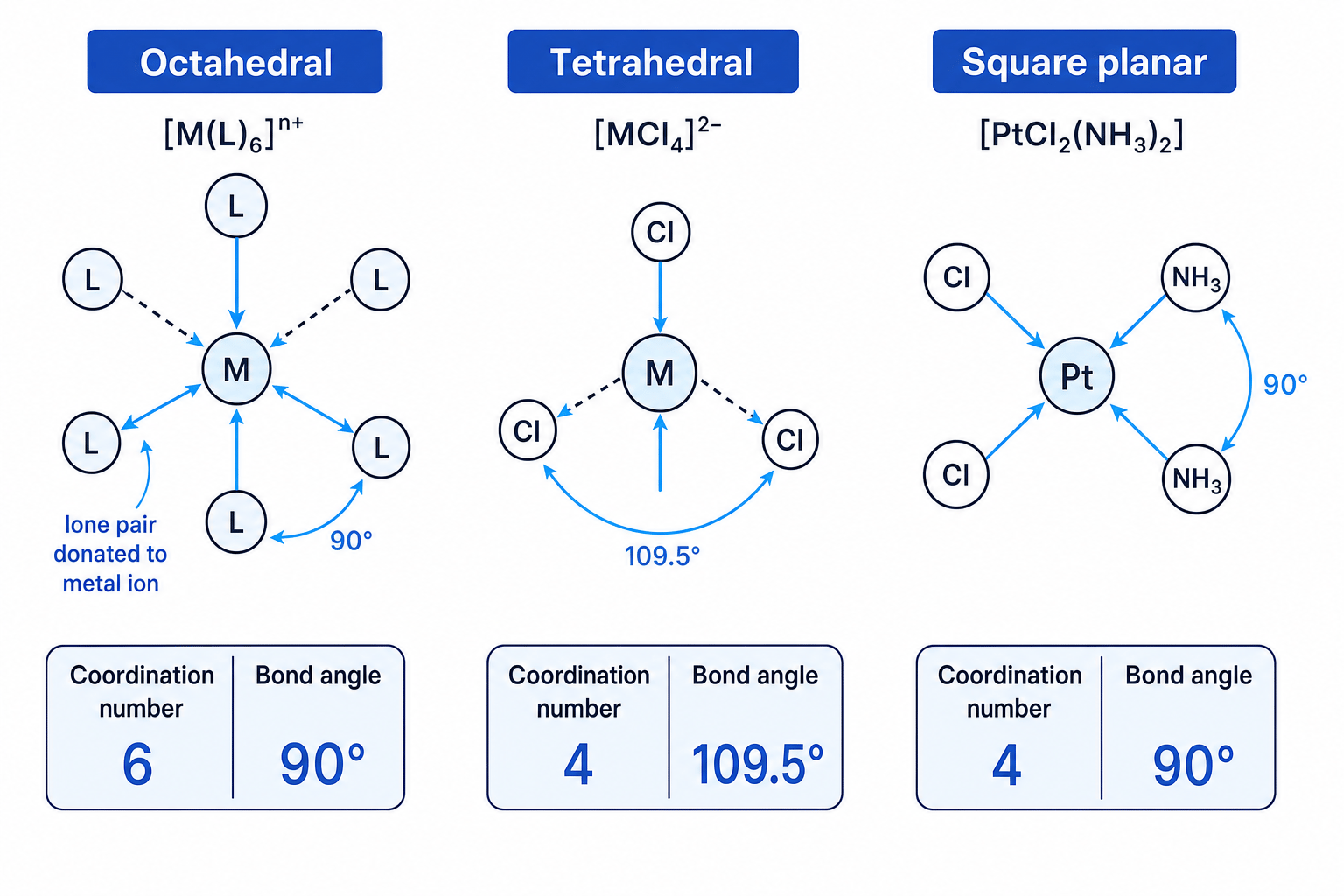
The coordination number is the number of coordinate bonds formed between the ligands and the central metal ion.
A ligand that donates one lone pair is monodentate. Water, ammonia and chloride ions are all monodentate ligands.
A ligand that donates two lone pairs from two different atoms is bidentate. A ligand that donates several lone pairs is multidentate.
Common shapes are:
- Coordination number 6: octahedral, with bond angles of 90°.
- Coordination number 4: often tetrahedral, with bond angles of 109.5°.
- Coordination number 4: sometimes square planar, especially for some Pt(II) and Ni(II) complexes, with bond angles of 90°.
- Coordination number 2: linear, with bond angle 180°.
Counting ligands instead of bonds
Coordination number is the number of coordinate bonds, not always the number of ligands. Three bidentate ligands can give a coordination number of 6.
Ligand substitution
Ligand substitution
Ligand substitution is a reaction where one ligand in a complex ion is replaced by another ligand.
Ligand substitution reactions are often equilibria. The position of equilibrium depends on:
- the concentration of each ligand;
- the relative stability of the complexes formed;
- the denticity of the ligands;
- sometimes the shape and coordination number of the product complex.
Substitution is often an equilibrium
Adding a high concentration of a new ligand can shift the equilibrium towards the substituted complex, even if the reaction is reversible.
Chloride ions replacing water ligands: cobalt(II)
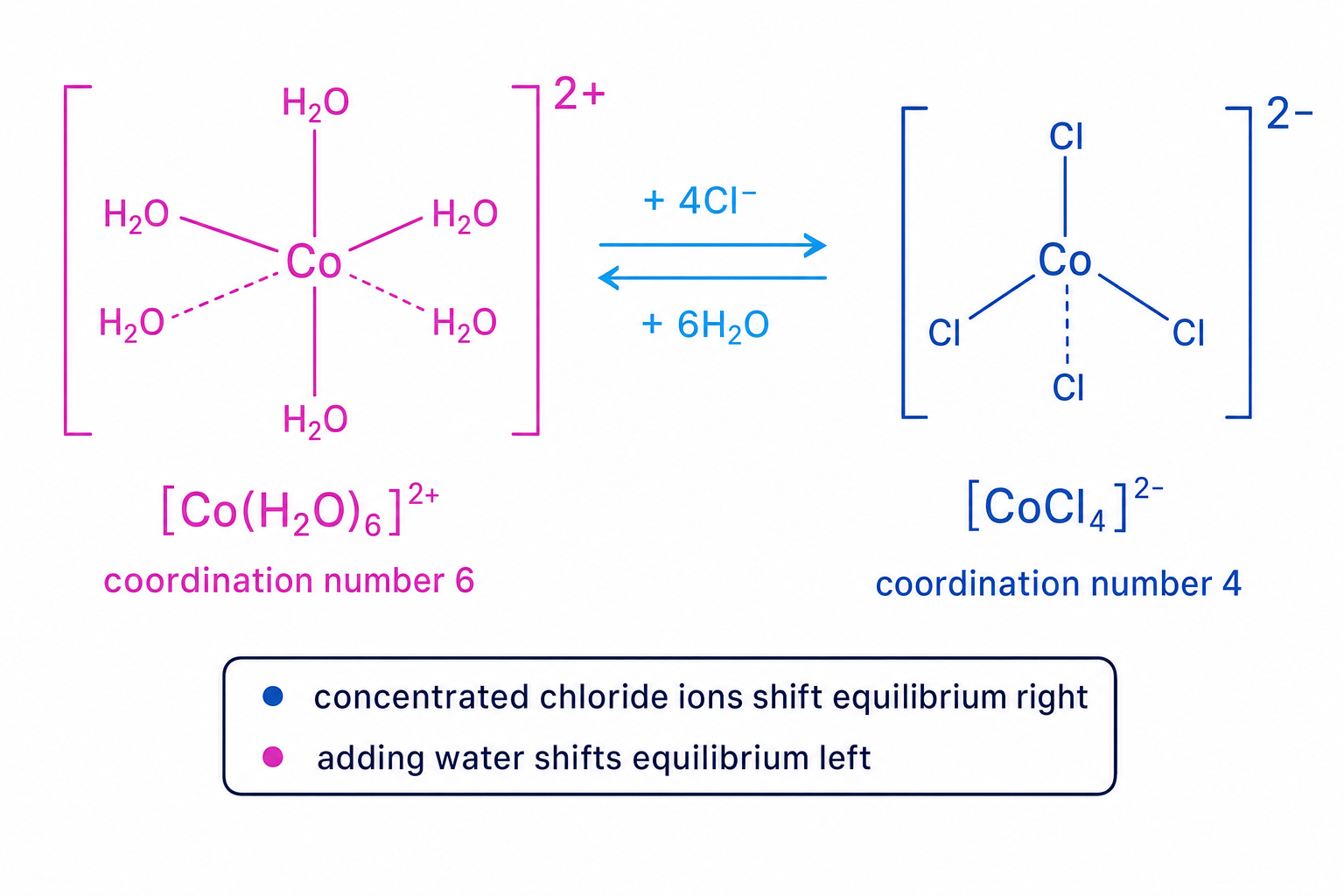
The hexaaquacobalt(II) ion is pink and octahedral. In concentrated chloride ions, such as concentrated hydrochloric acid, chloride ligands can replace water ligands:
[Co(H₂O)₆]²⁺(aq) + 4Cl⁻(aq) ⇌ [CoCl₄]²⁻(aq) + 6H₂O(l)
The product, [CoCl₄]²⁻, is blue and tetrahedral.
So this reaction involves:
- a colour change from pink to blue;
- coordination number changing from 6 to 4;
- shape changing from octahedral to tetrahedral.
Predicting the effect of adding water
A solution contains an equilibrium mixture of [Co(H₂O)₆]²⁺ and [CoCl₄]²⁻. Predict what happens when water is added.
-
Identify which side contains water as a product. In the equation, water appears on the right-hand side.
-
Adding water increases the concentration of a product, so Le Chatelier’s principle predicts that the equilibrium shifts left to reduce this change.
-
The left-hand complex is [Co(H₂O)₆]²⁺, which is pink, so the solution becomes more pink.
Ammonia replacing water ligands: copper(II)
The hexaaquacopper(II) ion is pale blue:
[Cu(H₂O)₆]²⁺
In excess ammonia, ammonia ligands replace four of the water ligands:
[Cu(H₂O)₆]²⁺(aq) + 4NH₃(aq) ⇌ [Cu(NH₃)₄(H₂O)₂]²⁺(aq) + 4H₂O(l)
The product is a deep blue complex ion.
In practice, when ammonia is added dropwise to a Cu²⁺ solution, you may first see a pale blue precipitate. This is because ammonia acts as a weak base and produces some OH⁻ ions in water. The OH⁻ ions deprotonate the aqua complex:
[Cu(H₂O)₆]²⁺(aq) + 2OH⁻(aq) → Cu(H₂O)₄(OH)₂ + 2H₂O(l)
In excess ammonia, the precipitate dissolves to form the deep blue ammine complex.
Ammonia is doing two jobs
Do not describe all ammonia reactions as simple ligand substitution. A small amount of NH₃ can act mainly as a base, producing OH⁻ and causing precipitation; excess NH₃ then acts as a ligand.
Chloride ions replacing water ligands: copper(II)
Copper(II) aqua complexes can also undergo ligand substitution with concentrated chloride ions:
[Cu(H₂O)₆]²⁺(aq) + 4Cl⁻(aq) ⇌ [CuCl₄]²⁻(aq) + 6H₂O(l)
[Cu(H₂O)₆]²⁺ is pale blue. [CuCl₄]²⁻ is yellow, but the observed solution is often green because it contains a mixture of blue and yellow species.
This is a useful reminder: the observed colour may come from an equilibrium mixture, not just one pure complex.
Chelation and multidentate ligands
A chelate is a complex containing a multidentate ligand bonded to the same metal ion through more than one donor atom. The ligand often forms a ring with the metal ion.
For example, ethane-1,2-diamine is a bidentate ligand. It is often abbreviated to en. Each molecule has two nitrogen atoms, and each nitrogen has a lone pair.
A typical substitution reaction is:
[M(H₂O)₆]²⁺(aq) + 3en(aq) ⇌ [M(en)₃]²⁺(aq) + 6H₂O(l)
This forms a more stable complex.
Explaining chelate stability using entropy
Explain why replacing water ligands with bidentate ethane-1,2-diamine can be favourable.
-
Count the particles on the left: one complex ion plus three en ligands gives 4 dissolved particles.
-
Count the particles on the right: one complex ion plus six water molecules gives 7 particles.
-
The reaction increases the number of particles in solution, so entropy increases.
-
A positive entropy change helps make the substituted complex more thermodynamically stable.
Multidentate ligands such as EDTA⁴⁻ are especially effective because they can wrap around a metal ion using several donor atoms. EDTA⁴⁻ is hexadentate, meaning it can form six coordinate bonds to one metal ion.
Chelate effect shortcut
If a reaction replaces several monodentate ligands with fewer multidentate ligands and releases more particles overall, explain the extra stability using increased entropy.
Stability constants
The stability constant, KstabK_\text{stab}Kstab, measures how far the equilibrium lies towards formation of a complex ion.
For a simplified complex formation equilibrium:
Mn++xL⇌MLxn+\text{M}^{n+} + x\text{L} \rightleftharpoons \text{ML}_x^{n+}Mn++xL⇌MLxn+the stability constant is:
Kstab=[MLxn+][Mn+][L]xK_\text{stab} = \frac{[\text{ML}_x^{n+}]}{[\text{M}^{n+}][\text{L}]^x}Kstab=[Mn+][L]x[MLxn+]A larger KstabK_\text{stab}Kstab means a more stable complex, with the equilibrium further to the right. The units depend on the number of ligands in the expression, so do not assume the units are always the same.
Comparing stability constants
Two ligands form complexes with the same metal ion. Complex A has Kstab=1.0×10⁵K_\text{stab} = 1.0 \times 10^5Kstab=1.0×10⁵ and complex B has Kstab=1.0×10¹¹K_\text{stab} = 1.0 \times 10^{11}Kstab=1.0×10¹¹.
-
Compare the values: 1.0×10111.0 \times 10^{11}1.0×10¹¹ is much larger than 1.0×1051.0 \times 10^51.0×10⁵.
-
The larger stability constant means the formation equilibrium for complex B lies further towards the complex.
-
If ligand B is added to a solution containing complex A, substitution is likely to favour formation of complex B, especially if ligand B is in excess.
Why ligand substitution changes colour
Transition-metal complex ions are often coloured because visible light can promote electrons between split d-orbitals. Different ligands split the d-orbitals by different amounts.
When ligand substitution happens, the energy gap changes. That changes which wavelengths of light are absorbed, so the observed colour changes.
You do not usually need to calculate the energy gap here, but you should link colour changes to formation of a different complex ion.
In the exam
-
Identify the central metal ion, the ligands, and the charge on each ligand before working out oxidation number or overall charge.
-
Count coordinate bonds to find coordination number; do not just count ligand molecules if bidentate or multidentate ligands are involved.
-
Write ligand substitution equations with square brackets, correct charges and state symbols; use ⇌ when the reaction is reversible.
-
Link observations to species: pink [Co(H₂O)₆]²⁺, blue [CoCl₄]²⁻, pale blue Cu²⁺ aqua complexes, and deep blue copper ammine complexes.
-
For chelate stability, explain the entropy increase from producing more particles, not just “stronger bonding”.
Check yourself
- Why is [Co(H₂O)₆]²⁺ octahedral but [CoCl₄]²⁻ tetrahedral?
- What colour change would you expect when concentrated chloride ions are added to a pink cobalt(II) aqua complex?
- Why can one EDTA⁴⁻ ligand replace several monodentate ligands?
