

What you'll learn
- What makes an element a transition element in A-Level Chemistry.
- How to write electron configurations for transition-metal atoms and ions.
- How transition metals form complex ions with different shapes.
- Why many transition-metal compounds are coloured and act as catalysts.
Starting point: d subshells and transition elements
You already know that electrons occupy shells and subshells. For the first-row transition metals, the key subshells are 4s and 3d, which are close in energy.
The d-block contains elements in which electrons are being added to d subshells. However, not every d-block element is a transition element by the A-Level definition.
Transition element
A transition element is a d-block element that forms at least one stable ion with a partially filled d subshell.
“Partially filled” means d¹ to d⁹. A d⁰ or d¹⁰ ion does not have a partially filled d subshell.
For the first-row d-block, the transition elements are usually taken as Ti to Cu. Scandium and zinc are the important exceptions.
Identifying transition elements
Decide whether Sc, Zn and Cu are transition elements.
-
Scandium has the atom configuration [Ar] 3d¹ 4s², but its common stable ion is Sc³⁺, which is [Ar]. It has no 3d electrons, so it is not a transition element.
-
Zinc has the atom configuration [Ar] 3d¹⁰ 4s², and Zn²⁺ is [Ar] 3d¹⁰. Its d subshell is full, not partially filled, so zinc is not a transition element.
-
Copper can form Cu²⁺, which is [Ar] 3d⁹. This is partially filled, so copper is a transition element.
Electron configurations: 4s and 3d
For neutral first-row d-block atoms, the 4s subshell fills before the 3d subshell. But when these atoms form ions, the 4s electrons are removed first.
This is a common source of mistakes because the order of filling is not the same as the order of removal.
4s electrons are lost first
For first-row transition-metal ions, write the neutral atom configuration, then remove electrons from 4s before 3d.
Two important atom configurations are unusual:
- Chromium: [Ar] 3d⁵ 4s¹, not [Ar] 3d⁴ 4s².
- Copper: [Ar] 3d¹⁰ 4s¹, not [Ar] 3d⁹ 4s².
These arrangements are relatively stable because chromium has a half-filled 3d subshell and copper has a full 3d subshell.
Writing iron ion configurations
Write the electron configurations of Fe²⁺ and Fe³⁺.
-
Iron has atomic number 26, so the neutral atom is [Ar] 3d⁶ 4s².
-
To form Fe²⁺, remove the two 4s electrons first. Fe²⁺ is therefore [Ar] 3d⁶.
-
To form Fe³⁺, remove one more electron from the 3d subshell. Fe³⁺ is therefore [Ar] 3d⁵.
Removing 3d before 4s
Do not remove 3d electrons first just because 3d is written before 4s in the configuration. For transition-metal ions, 4s electrons are lost first.
Variable oxidation states
Many transition metals form ions with different charges. This is because the 4s and 3d subshells are close in energy, so different numbers of electrons can be involved in bonding or removed during ion formation.
Oxidation state
The oxidation state of an atom is the charge it would have if all bonding were treated as fully ionic.
Common examples include:
- Fe²⁺ and Fe³⁺
- Cu⁺ and Cu²⁺
- Mn²⁺, MnO₂ and MnO₄⁻
- Cr³⁺ and Cr₂O₇²⁻
Higher oxidation states are often found in compounds containing oxygen, such as manganate(VII), MnO₄⁻, and dichromate(VI), Cr₂O₇²⁻.
Finding an oxidation state
Find the oxidation state of manganese in MnO₄⁻.
-
Oxygen usually has oxidation state -2, so four oxygen atoms contribute 4(−2)=−84(-2) = -84(−2)=−8.
-
Let the oxidation state of manganese be xxx. The overall ion charge is -1, so x−8=−1x - 8 = -1x−8=−1.
-
Solving gives x=+7x = +7x=+7, so manganese is in the +7 oxidation state.
Complex ions and ligands
Transition-metal ions are small and often highly charged, so they attract electron pairs from nearby ions or molecules. This leads to the formation of complexes.
Complexes and ligands
A complex contains a central metal ion surrounded by ligands. A ligand is an ion or molecule that donates a lone pair of electrons to the metal ion, forming a coordinate bond.
A coordinate bond is a covalent bond in which both electrons in the shared pair come from the same atom.
Common ligands include:
- H₂O, called aqua in complex names.
- NH₃, called ammine.
- Cl⁻, called chlorido.
- OH⁻, called hydroxido.
- CN⁻, called cyanido.
The coordination number is the number of coordinate bonds from ligands to the central metal ion. A monodentate ligand donates one lone pair and forms one coordinate bond. A bidentate ligand donates two lone pairs and forms two coordinate bonds.
Coordination number and shape
The shape of a complex depends mainly on its coordination number and the type of metal ion and ligands present.
The most important shapes at this stage are octahedral, tetrahedral, square planar and linear.
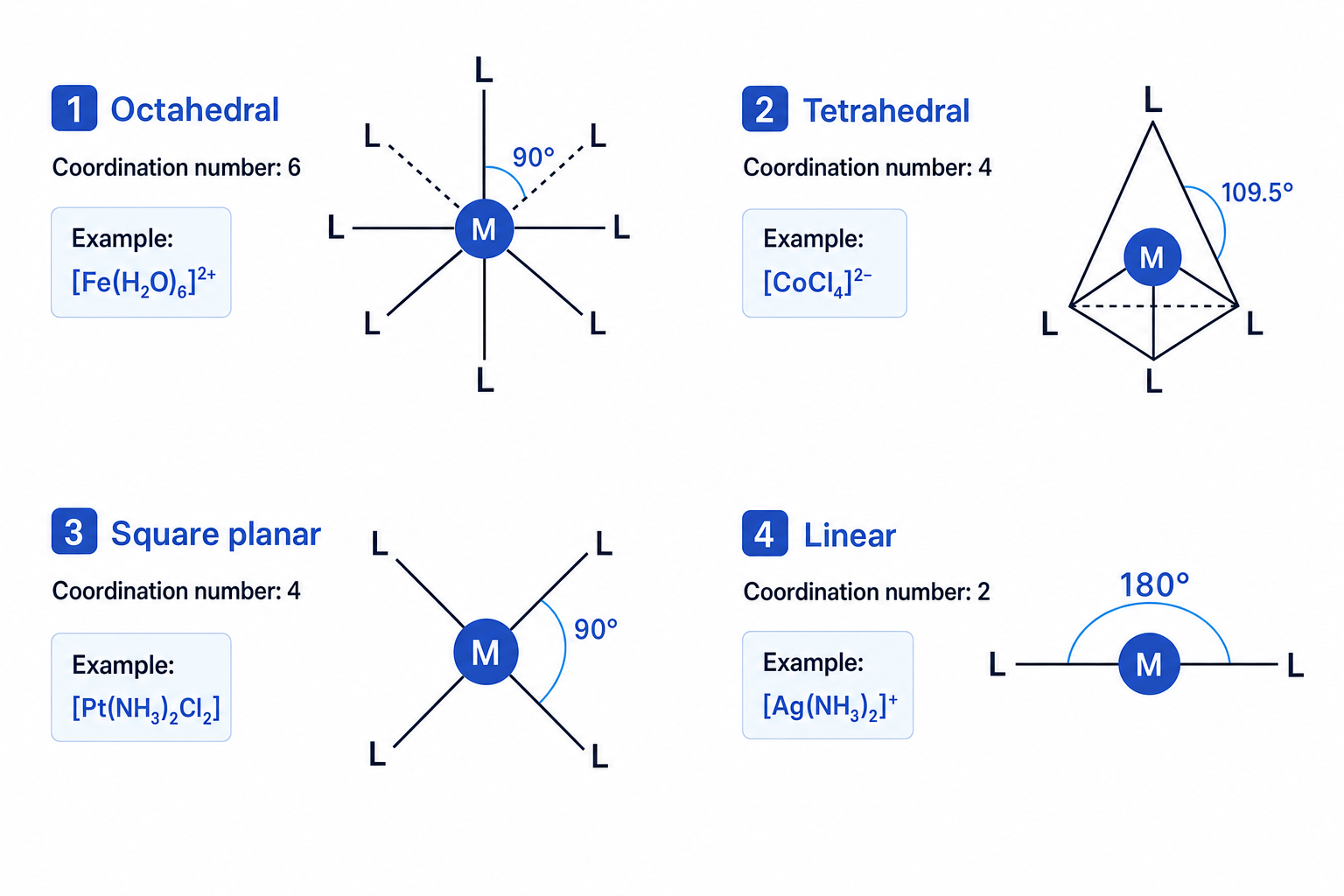
Most six-coordinate complexes, such as [Fe(H₂O)₆]²⁺, are octahedral. Four-coordinate complexes may be tetrahedral, such as [CoCl₄]²⁻, or square planar, especially for some Pt(II) and Ni(II) complexes.
Coordination number is not oxidation state
Coordination number counts coordinate bonds to the metal. Oxidation state is a formal charge assignment. They are different ideas, even if the numbers sometimes look similar.
Analysing a complex ion
Analyse [CoCl₄]²⁻.
-
Each chlorido ligand, Cl⁻, has charge -1. Four chlorido ligands contribute -4 in total.
-
Let the oxidation state of cobalt be xxx. The overall charge is -2, so x+4(−1)=−2x + 4(-1) = -2x+4(−1)=−2, giving x=+2x = +2x=+2.
-
There are four monodentate ligands, so the coordination number is 4. [CoCl₄]²⁻ is tetrahedral, with bond angles of about 109.5°.
Why transition-metal compounds are coloured
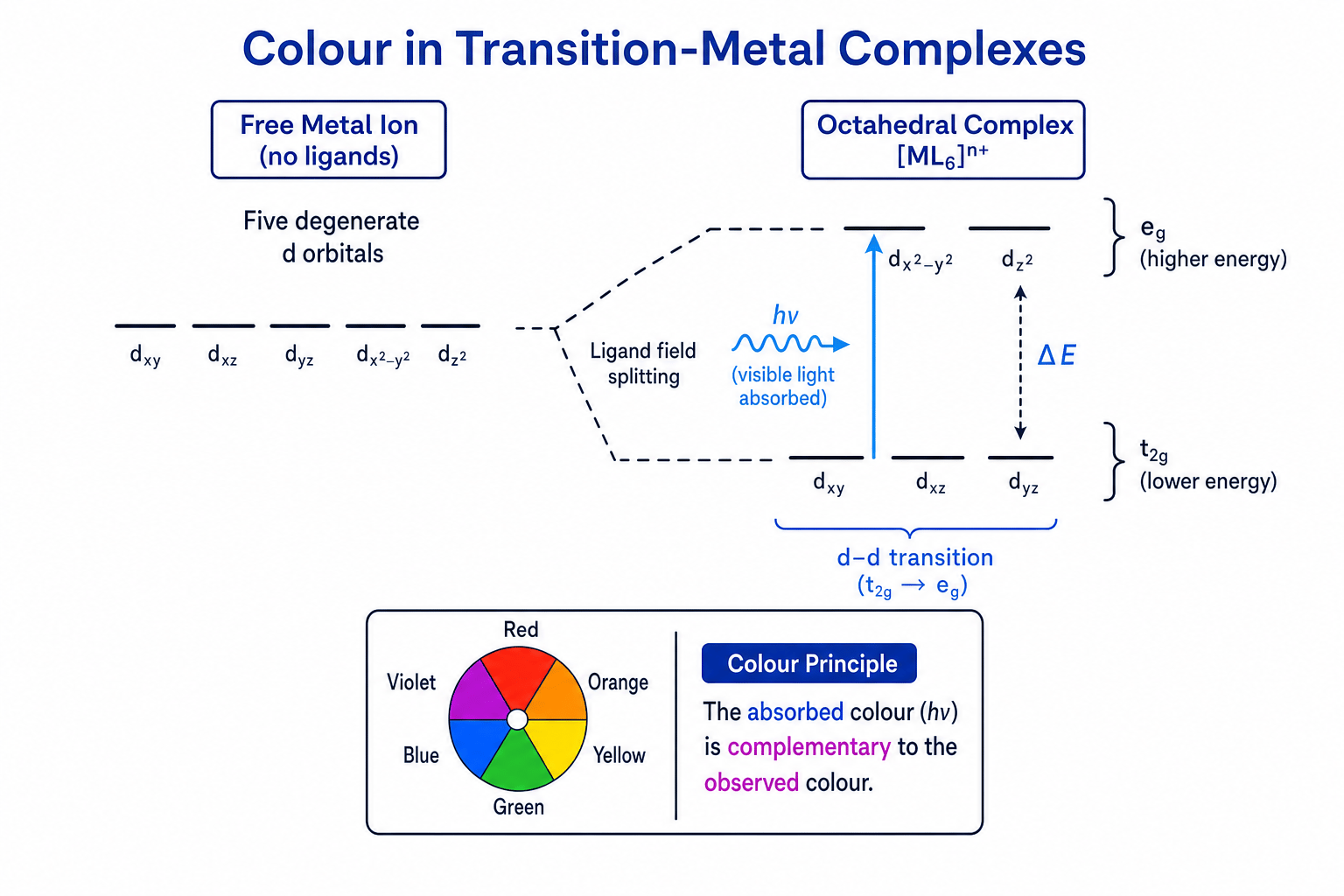
Many transition-metal compounds are coloured because their d orbitals are split into different energy levels when ligands bond to the metal ion.
In a free metal ion, the five d orbitals have the same energy. Orbitals with the same energy are called degenerate. When ligands approach, their electron pairs repel electrons in some d orbitals more than others, causing d-orbital splitting.
An electron can absorb visible light and move from a lower-energy d orbital to a higher-energy d orbital. This is called a d–d transition. The energy gap is often written as ΔE\Delta EΔE.
Colour comes from energy gaps
A transition-metal complex appears coloured when it absorbs some wavelengths of visible light for d–d transitions; the colour you see is the complementary colour of the light absorbed.
The size of ΔE\Delta EΔE depends on:
- the metal ion
- the oxidation state
- the ligand
- the coordination number and shape
This is why ligand substitution, where one ligand is replaced by another, often causes a colour change.
Absorbed colour is not observed colour
A complex appears the complementary colour to the main colour of light it absorbs. If orange light is absorbed strongly, the solution often looks blue.
Explaining colourless and coloured ions
Explain why Sc³⁺ compounds are usually colourless but Ti³⁺ compounds are often coloured.
-
Sc³⁺ has the electron configuration [Ar], so it has a d⁰ arrangement with no d electrons.
-
Ti³⁺ has the electron configuration [Ar] 3d¹, so it has one d electron that can be promoted between split d orbitals.
-
Ti³⁺ complexes can absorb visible light for a d–d transition, but Sc³⁺ cannot. Therefore Ti³⁺ compounds are often coloured, while Sc³⁺ compounds are usually colourless.
Catalytic action
A catalyst increases the rate of a reaction without being used up overall. Transition metals and their compounds are often good catalysts because they can change oxidation state and form temporary complexes.
There are two broad types:
- A homogeneous catalyst is in the same phase as the reactants.
- A heterogeneous catalyst is in a different phase from the reactants.
Examples include Fe in the Haber process, V₂O₅ in the Contact process, Ni in hydrogenation reactions, and Fe²⁺/Fe³⁺ ions in solution reactions.
Showing a catalytic cycle
Fe²⁺ ions catalyse the reaction between peroxodisulfate(VI) ions and iodide ions.
-
Peroxodisulfate(VI) ions oxidise Fe²⁺ to Fe³⁺:
S₂O₈²⁻(aq) + 2Fe²⁺(aq) → 2SO₄²⁻(aq) + 2Fe³⁺(aq)
-
Fe³⁺ ions then oxidise iodide ions to iodine, while Fe³⁺ is reduced back to Fe²⁺:
2Fe³⁺(aq) + 2I⁻(aq) → 2Fe²⁺(aq) + I₂(aq)
-
Adding the two equations cancels Fe²⁺ and Fe³⁺, giving the overall reaction:
S₂O₈²⁻(aq) + 2I⁻(aq) → 2SO₄²⁻(aq) + I₂(aq)
Because the iron ions are regenerated, they act as a catalyst.
In the exam
-
Use the exact definition: a transition element forms at least one stable ion with a partially filled d subshell.
-
For transition-metal ion configurations, remove 4s electrons before 3d electrons.
-
For complex ions, calculate oxidation state from ligand charges, then find coordination number by counting coordinate bonds.
-
When explaining colour, mention d-orbital splitting, absorption of visible light, and the complementary observed colour.
-
In catalyst questions, show that the catalyst is regenerated by cancelling species in the reaction cycle.
Check yourself
-
Why is copper a transition element, but zinc is not?
-
What are the oxidation state, coordination number and likely shape of [Fe(CN)₆]³⁻?
-
Why can changing the ligand in a complex ion change the colour of the solution?
